
LAWU-311 · Lesson 6 of 12 · 23 min
Exhibits and foundations
▶ Video coming soon A video version of this lesson is on the way.
Cadwallader arrives for the exhibits class with a cardboard box, a laptop and a sealed evidence bag. In the box are the exhibits for the week's exercise: a printout of a group chat, a delivery log, a photograph of a garage, a thumb drive with a doorbell video and a spreadsheet summarizing 4,000 warranty claims. "Every one of these can win or lose your case," he says, "and every one of them is worthless until it is admitted. The jury never sees an exhibit because it is important. It sees an exhibit because a lawyer laid the foundation." He then puts the class through what he calls the exhibit dance, twenty times, until the steps are automatic.
The steps for offering an exhibit
Courts vary in their procedures, and lawyers must learn the local practice, but the basic steps are similar everywhere. Exhibits are usually premarked before trial with numbers assigned by the court or agreed by the parties. At trial the lawyer refers to the exhibit by number, shows it to opposing counsel (or confirms that counsel has a copy), asks the court's permission to approach the witness if the local practice requires it, hands the exhibit to the witness, and asks the witness to identify it. The lawyer then lays the foundation, eliciting the facts that establish authenticity and any other requirement for admissibility, such as a hearsay exception. The lawyer offers the exhibit: "Your Honor, the plaintiff offers Exhibit 12." Opposing counsel may object, and may ask to question the witness briefly on the foundation, a procedure called voir dire of the witness. The court rules. If the exhibit is admitted, the lawyer asks permission to publish it to the jury, by displaying it on screens, passing it to jurors or having the witness read it.
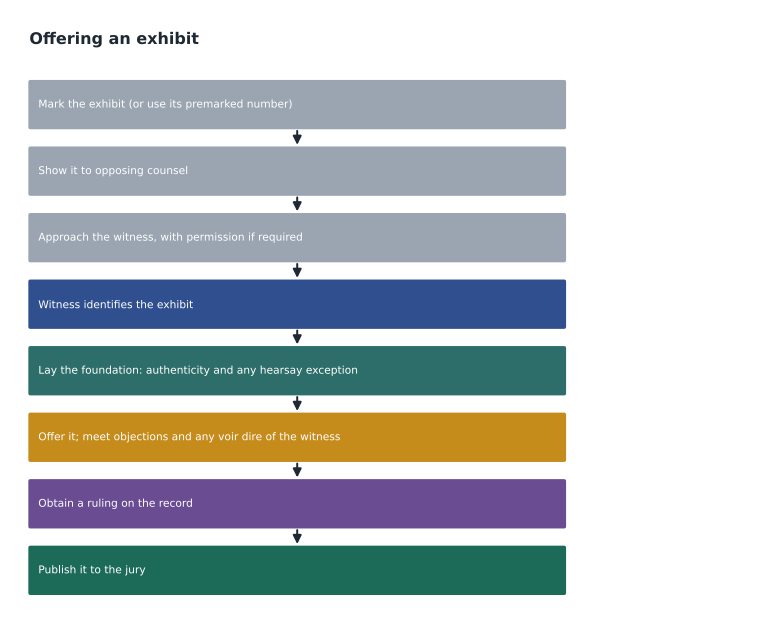
The steps exist so that the record is clear. An appellate court reading the transcript must be able to tell which exhibit was discussed, what foundation was laid, what objection was made and how the court ruled. Lawyers who say "this document" rather than "Exhibit 12" create a record no one can follow. A good trial lawyer also keeps an exhibit log in the trial notebook, recording each exhibit's status: identified, offered, admitted, excluded or admitted for a limited purpose. Before resting, the lawyer checks the log against the court's list to confirm that every exhibit the lawyer believes is in evidence actually is.
Authentication
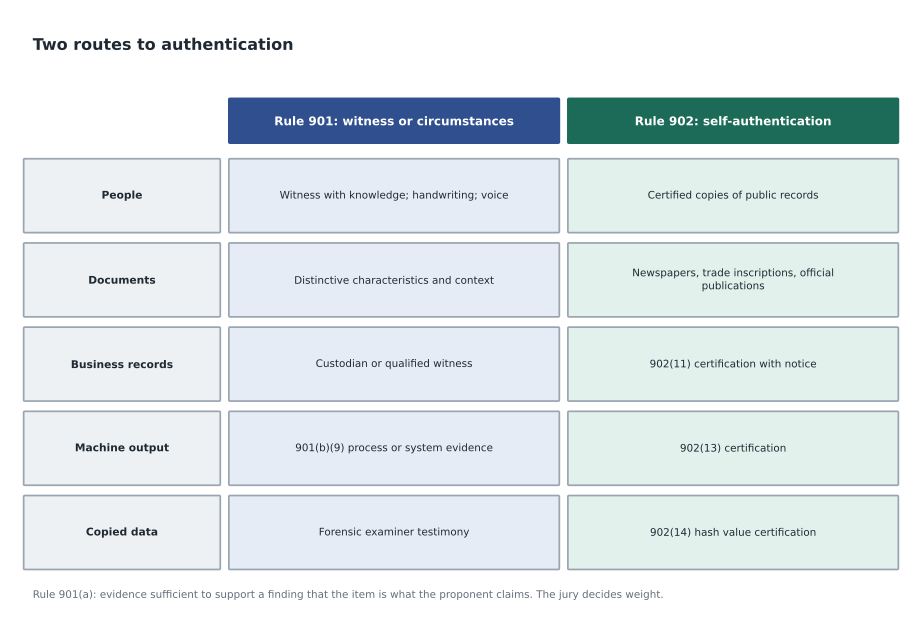
Rule 901(a) states the basic requirement: to authenticate an item, the proponent must produce evidence sufficient to support a finding that the item is what the proponent claims it is. The standard is low, and it is a question of conditional relevance under Rule 104(b): the judge asks whether a reasonable jury could find the item authentic, and the jury then decides whether it is. Disputes about weight, such as whether a photograph is entirely accurate, go to the jury.
Rule 901(b) lists illustrations of sufficient evidence, and lawyers should know the common ones by heart. A witness with knowledge can testify that an item is what it is claimed to be: the photograph fairly and accurately shows the garage as it looked after the fire; the knife is the one the officer found, recognized by the marks the officer scratched on it. A nonexpert who became familiar with handwriting other than for litigation can identify it. An expert or the jury can compare an item with an authenticated specimen. Distinctive characteristics, such as appearance, contents, substance and internal patterns, taken together with all the circumstances, can authenticate. A voice can be identified by anyone who has heard it under circumstances connecting it with the speaker. A telephone call can be authenticated by evidence that a call was made to the number assigned to a person and that the circumstances, such as self-identification, show the person answered. Public records can be authenticated by evidence that they were recorded or filed in a public office. And evidence describing a process or system, and showing that it produces an accurate result, can authenticate the output, which is the usual route for machine-generated data.
Some items are self-authenticating under Rule 902 and need no extrinsic evidence of authenticity. They include domestic public documents that are sealed and signed, certified copies of public records, official publications, newspapers and periodicals, trade inscriptions and labels, acknowledged documents, and commercial paper. Three provisions matter greatly in modern practice. Rule 902(11) allows a domestic record of a regularly conducted activity to be authenticated by a certification of a custodian or other qualified person that the record meets the requirements of Rule 803(6)(A) through (C), with advance written notice to the adverse party. Rule 902(13), added in 2017, allows a record generated by an electronic process or system to be authenticated by a similar certification. Rule 902(14), also added in 2017, allows data copied from an electronic device, storage medium or file to be authenticated by a certification of a qualified person that the copy was authenticated by a process of digital identification, usually by comparing hash values.
Real evidence and chain of custody
Real evidence, the physical object involved in the events, can be authenticated in two ways. If the object is distinctive or has been marked, a witness who recognizes it can identify it. If the object is fungible or could have been altered, such as drugs, blood samples or a battery cell removed from a fire scene, the proponent typically establishes a chain of custody: testimony accounting for the object's handling from the time it was collected to the time it is offered, sufficient to show that it is the same object and is in substantially the same condition. The chain need not be perfect. Gaps usually go to weight rather than admissibility, unless they suggest a reasonable probability of tampering or substitution. In Delgado, the plaintiff must account for the battery pack from the fire marshal's collection at the scene, through storage and the joint inspection protocol the parties agreed in discovery, to Dr. Achterberg's laboratory, because Kestrelwerk will argue that cell 23 was damaged after the fire.
Photographs, video and recordings
Photographs and videos are usually authenticated under one of two theories. Under the pictorial testimony theory, a witness who knows what the scene looked like testifies that the image fairly and accurately depicts it; the witness need not be the photographer. Under the silent witness theory, the image is authenticated by evidence of the reliability of the process that produced it, such as testimony about a security camera system, how it records, how the footage was retrieved and that it was not altered. The doorbell video in Delgado illustrates both: the neighbor can testify that the video fairly shows the view from his porch, and a witness familiar with the camera system can testify about how the device records and timestamps footage and how the clip was exported. Audio recordings follow similar principles, with additional attention to identification of the voices.
Concern about altered and synthetic media has grown. Fabricated images, audio and video produced with artificial intelligence tools can be difficult to detect, and lawyers on both sides should be prepared to question how an item was created and preserved. The federal Advisory Committee on Evidence Rules published a proposed Rule 707, which would apply the reliability standards of Rule 702 to machine-generated evidence offered without an expert witness. After the public comment period, the committee decided at its May 2026 meeting to revise and narrow the proposal rather than approve it, and planned further input from experts at its October 2026 meeting. As of November 2026 no such rule is in effect. Lawyers in the meantime rely on Rule 901, the process-or-system method of Rule 901(b)(9), Rule 403 and expert testimony where authenticity is genuinely disputed.
Electronic communications and social media
Emails, text messages and social media posts are authenticated like any other writing, usually by distinctive characteristics and circumstances. Courts look at evidence such as the account name and the phone number or email address associated with it, the content (including details only the purported author would likely know), the context of the conversation, replies from the purported author, and the author's later conduct consistent with the message. The mere fact that a post appears on an account bearing a person's name is often held insufficient by itself, because accounts can be created or accessed by others. In United States v. Vayner, 769 F.3d 125 (2d Cir. 2014), the court reversed a conviction where the government offered a printout of a social networking profile page with little evidence connecting the defendant to its creation. A widely cited trial court opinion, Lorraine v. Markel American Insurance Co., 241 F.R.D. 534 (D. Md. 2007), canvassed the evidence rules that apply to electronically stored information and emphasized that lawyers must address authentication, hearsay, the original writing rule and Rule 403 for each item.
Worked problem
Authenticating the DP_Fixes chat
In State v. Pike, the State offers printouts of a group chat in which an account named DP_Fixes wrote "watchman's old, takes his walk at 11, we go at 11:30" and sent the address of Fry's Metal Recovery. Defense counsel objects that the State cannot prove Pike wrote the messages. The State's witnesses include Detective Rachel Imbert, who extracted the chat from Kellan Shaw's phone, and Tara Quinn, who was a member of the group chat and has pleaded guilty. What foundation should the State lay?
Show solution
- Authenticity of the extraction. Detective Imbert testifies that she used forensic software to extract the chat from Shaw's phone, describes the process and confirms that the printout reflects the extraction report. Alternatively, the State may use a Rule 902(14) certification comparing hash values, with advance notice.
- Connection to Pike. Quinn testifies that the account was associated with Pike's phone number, displayed a photo of Pike's truck, and that the group members called the account "Devon" in replies. The State shows that the messages contained details consistent with Pike's visit to the yard four weeks earlier, when he posed as a customer and asked when the watchman came on.
- Conduct consistent with authorship. The camera shows three figures entering at 11:32 p.m., consistent with the message's plan, and the chat sent the scrapyard address where Shaw sold the copper.
- Hearsay. Once authenticated, Pike's own messages are statements of an opposing party under Rule 801(d)(2)(A) when offered against him. Other members' messages may be admissible as coconspirator statements under Rule 801(d)(2)(E), if the court finds by a preponderance that a conspiracy existed and the statements were made in furtherance of it, or for nonhearsay purposes such as context.
- Weight. Defense counsel may still argue to the jury that someone else used the account; that argument goes to weight once the foundation is sufficient.
Answer: The combination of the extraction process, the phone number, the truck photo, the name "Devon" in replies, the content and the matching conduct is sufficient for a reasonable jury to find that Pike wrote the messages, satisfying Rule 901(a). The defense's alternative-author argument goes to weight.
The original writing rule
When a party seeks to prove the content of a writing, recording or photograph, Rule 1002 requires the original, unless the rules or a statute provide otherwise. The rule applies only when content is at issue: when the writing itself is the thing being proved (a contract's terms, a defamatory letter), or when a witness's testimony is based on what the writing says. It does not apply when a witness testifies from personal knowledge of an event that also happens to have been recorded. A witness who watched the fire can describe it without producing the doorbell video; a witness who only watched the video and testifies about what it shows is proving its content.
Rule 1003 allows a duplicate to be admitted to the same extent as the original unless a genuine question is raised about the original's authenticity or circumstances make it unfair to admit the duplicate. Rule 1004 excuses the original when all originals are lost or destroyed (unless the proponent lost or destroyed them in bad faith), when an original cannot be obtained by judicial process, when the opponent had control of the original and was put on notice that it would be a subject of proof but does not produce it, or when the writing is not closely related to a controlling issue. For electronically stored information, an output readable by sight, such as a printout, that accurately reflects the information is an original under Rule 1001(d).
Summaries and illustrative aids
Rule 1006, amended effective December 1, 2024, allows a party to use a summary, chart or calculation to prove the content of voluminous writings, recordings or photographs that cannot be conveniently examined in court, whether or not they have been introduced into evidence. The amended rule makes clear that a summary meeting its requirements is itself evidence, and that the proponent must make the underlying materials available for examination or copying by other parties at a reasonable time and place. In Delgado, the paralegal's chart of 4,000 warranty claims is a classic Rule 1006 summary, provided the underlying claims are made available, the chart is accurate and nonargumentative, and the underlying records would themselves be admissible, typically as business records.
Rule 107, added at the same time, governs illustrative aids. The court may allow a party to present an illustrative aid to help the trier of fact understand the evidence or argument, if its utility is not substantially outweighed by the danger of unfair prejudice, confusing the issues, misleading the jury, undue delay or wasting time. An illustrative aid is not evidence and must not be provided to the jury during deliberations unless all parties consent or the court, for good cause, orders otherwise. When practicable, an illustrative aid used at trial must be entered into the record. The distinction matters in practice: a lawyer who wants a chart in the jury room must qualify it as a Rule 1006 summary or as substantive evidence, not merely as an aid.
Business records
Many exhibits are business records offered under Rule 803(6). The foundation requires that the record was made at or near the time by, or from information transmitted by, someone with knowledge; that it was kept in the course of a regularly conducted activity of a business or organization; that making the record was a regular practice of that activity; and that these conditions are shown by the testimony of the custodian or another qualified witness or by a certification under Rule 902(11) or (12). The opponent may still show that the source of information or the method or circumstances of preparation indicate a lack of trustworthiness. Lawyers in civil cases often avoid calling records custodians by using certifications and by stipulating to the authenticity of each side's routine business records, saving trial time for disputed matters.
Common mistakes
MistakeReferring to "this document" instead of the exhibit number.
InsteadUse exhibit numbers throughout so the record shows exactly what was identified, offered and admitted.
MistakeTreating authentication as a demanding standard the judge decides finally.
InsteadRule 901(a) requires only evidence sufficient to support a finding; the jury decides genuineness and weight.
MistakeAssuming a social media post is authenticated because it bears the defendant's name.
InsteadCourts look for distinctive characteristics, content, context and conduct linking the person to the account (Vayner).
MistakeThinking the original writing rule applies whenever a recording exists.
InsteadRule 1002 applies only when a party seeks to prove the content of the writing or recording.
MistakeSending an illustrative aid to the jury room as if it were evidence.
InsteadUnder Rule 107 illustrative aids are not evidence and do not go to the jury without consent or a court order; Rule 1006 summaries are evidence.
Summary and key terms
- Offering an exhibit follows set steps: mark, show, approach, identify, lay the foundation, offer, meet objections, obtain a ruling and publish.
- Rule 901(a) requires evidence sufficient to support a finding that the item is what the proponent claims; the jury decides weight.
- Rule 901(b) illustrations include witnesses with knowledge, distinctive characteristics, voice and telephone identification and process or system evidence.
- Rule 902 self-authentication includes certified business records (902(11)), machine-generated records (902(13)) and hash-verified copies of electronic data (902(14)).
- Fungible or alterable items require a chain of custody; gaps usually go to weight.
- Photographs and video are authenticated by pictorial testimony or by the silent witness theory; proposed Rule 707 on machine-generated evidence was being revised in 2026 and is not in effect.
- Rule 1002 requires the original to prove content, subject to duplicates (1003) and excuses (1004).
- Rule 1006 summaries are evidence (2024 amendment); Rule 107 illustrative aids are not.
- Foundation
- The facts that must be shown before an exhibit or testimony is admissible.
- Authentication
- Evidence sufficient to support a finding that an item is what its proponent claims.
- Self-authentication
- Authenticity established by the nature of the item or a certification under Rule 902, without a witness.
- Chain of custody
- Testimony accounting for an item's handling from collection to trial.
- Silent witness theory
- Authenticating a photograph or video by proof of the reliability of the system that produced it.
- Hash value
- A digital fingerprint used to verify that a copy of electronic data is identical to the original.
- Original writing rule
- Rule 1002's requirement of an original to prove the content of a writing, recording or photograph.
- Publishing an exhibit
- Showing an admitted exhibit to the jury.
Practice problems
Work each problem on paper first, then reveal the answer to check.
A plaintiff offers a photograph of the intersection taken a week after a crash. The photographer is unavailable. Can the plaintiff authenticate it?
Show answer
Yes, through any witness who knows how the intersection looked at the relevant time and testifies that the photograph fairly and accurately depicts it, noting any differences.
What does Rule 902(14) require to authenticate a copy of data from a phone?
Show answer
A certification by a qualified person that the copy was authenticated by a process of digital identification, such as a hash value comparison, plus advance written notice and an opportunity for the adverse party to inspect.
A witness testifies, "The contract said delivery by June 1." The contract is not offered. What objection applies?
Show answer
The original writing rule, Rule 1002: the testimony seeks to prove the contract's content, so the original (or an admissible duplicate) is required unless excused under Rule 1004.
Kestrelwerk objects that the plaintiff's warranty chart is argumentative because its headings say "Fires Kestrelwerk Ignored." What should the court do?
Show answer
Require the plaintiff to revise the chart. A Rule 1006 summary must accurately and fairly summarize the underlying records; argumentative headings belong in closing, not in evidence.
Lesson quiz · 5 questions
Score 60% or more to complete this lesson.
Create a free account to save your progress, take quizzes and earn a certificate.