
LAWU-311 · Lesson 10 of 12 · 24 min
Objections, preserving error and jury instructions
▶ Video coming soon A video version of this lesson is on the way.
Cadwallader runs the objections class as a drill. Students stand in pairs at the front of the moot courtroom; one asks questions from a script seeded with problems, and the other must object within two seconds, state a specific ground, and sit down. Hannah Lindqvist objects to the first leading question before it is finished; Jordan Kimura misses a hearsay answer entirely and then objects to the next, harmless question. "An objection is a tool for protecting your record and your client," Cadwallader says, "not a weapon for interrupting the other side. Object when it matters, object correctly, and object in time. A correct objection a minute late is no objection at all."
The rule: Rule 103
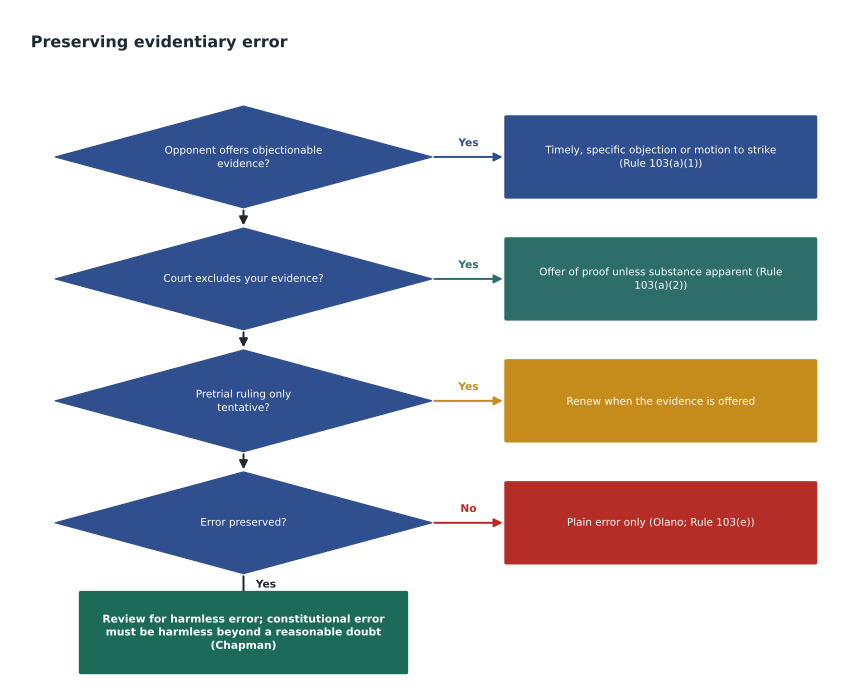
Rule 103(a) sets out what a party must do to preserve a claim of error in a ruling admitting or excluding evidence. When the ruling admits evidence, the party must, on the record, timely object or move to strike, and state the specific ground, unless it was apparent from the context. When the ruling excludes evidence, the party must inform the court of its substance by an offer of proof, unless the substance was apparent from the context. In either case the error must affect a substantial right of the party. Rule 103(b), discussed with motions in limine, provides that once the court rules definitively on the record, the party need not renew the objection or offer of proof. Rule 103(c) allows the court to make any statement about the character or form of the evidence, the objection and the ruling, and to direct an offer of proof in question-and-answer form. Rule 103(d) requires the court, to the extent practicable, to conduct a jury trial so that inadmissible evidence is not suggested to the jury by any means. And Rule 103(e) allows a court to take notice of a plain error affecting a substantial right, even if the claim of error was not properly preserved.
Each element matters. Timely means as soon as the ground becomes apparent: ordinarily after the question and before the answer, or immediately after an answer that was objectionable in a way the question did not reveal. Specific means stating the rule or principle that makes the evidence inadmissible. A general objection ("Objection") or a vague one ("Objection, improper") preserves little, and on appeal a party is generally limited to the ground stated at trial. If an objection is sustained, the opponent who wants to preserve the issue must make an offer of proof showing what the evidence would have been, outside the jury's hearing, so that an appellate court can assess whether excluding it mattered.
Harmless error and plain error
Even a preserved error leads to reversal only if it was not harmless. Under 28 U.S.C. section 2111, Federal Rule of Civil Procedure 61 and Federal Rule of Criminal Procedure 52(a), courts disregard errors that do not affect substantial rights. For constitutional errors in criminal cases, the government must show that the error was harmless beyond a reasonable doubt, under Chapman v. California, 386 U.S. 18 (1967). Unpreserved errors are reviewed, if at all, for plain error under Criminal Rule 52(b) and Evidence Rule 103(e). United States v. Olano, 507 U.S. 725 (1993), set out the standard: there must be an error that is plain (clear or obvious) and that affects substantial rights, and even then the appellate court has discretion to correct it only if it seriously affects the fairness, integrity or public reputation of judicial proceedings. Plain error review is a narrow safety net, which is why trial lawyers are taught to object rather than hope.
Common objections
Objections fall into two broad groups. Objections to the form of the question include leading (on direct), compound, vague or ambiguous, argumentative, assumes facts not in evidence, asked and answered, calls for a narrative, misstates the evidence, and speculation. Form objections are usually curable by rephrasing, and many judges expect them to be made only when the form actually matters. Objections to the substance of the evidence include relevance (Rules 401 and 402), unfair prejudice or confusion (Rule 403), improper character evidence (Rule 404), hearsay (Rule 802), lack of personal knowledge (Rule 602), improper lay opinion (Rule 701), improper expert opinion (Rule 702), lack of authentication (Rule 901), the original writing rule (Rule 1002), privilege (Rule 501), and the policy exclusions of Rules 407 to 411. Constitutional objections, such as the Confrontation Clause, must be stated as such; a hearsay objection does not necessarily preserve a confrontation claim.
The way an objection is made matters. Lawyers should stand, address the court and state the objection and ground in a few words: "Objection, hearsay." Many judges forbid speaking objections, in which the lawyer argues the point in front of the jury or suggests an answer to the witness, and will sanction lawyers who make them. If argument is needed, the lawyer asks to approach the bench or to be heard outside the jury's presence. When an objection is sustained after an answer has been given, the lawyer should move to strike the answer and ask the court to instruct the jury to disregard it. When evidence is admissible for one purpose but not another, Rule 105 requires the court, on timely request, to restrict the evidence to its proper scope and instruct the jury accordingly, so the lawyer must ask for a limiting instruction.
Running or continuing objections can avoid repeated interruptions. If the court has overruled an objection to a line of questioning, the lawyer may ask for a continuing objection to the entire line, and the court's grant should be stated on the record. Lawyers should be careful that the continuing objection's scope is clear, because an appellate court may hold that it did not reach testimony that differed from the line originally objected to.
When to object
Knowing what is objectionable is only half the skill; the other half is judgment about when to object. Jurors notice objections, and frequent objections can make a lawyer seem obstructive or afraid of the evidence. Lawyers commonly ask three questions before objecting. Is the evidence harmful, or merely improper? Will the objection likely be sustained? And will objecting highlight the evidence more than letting it pass? A leading question about an undisputed fact is objectionable but usually not worth an objection. A hearsay answer that goes to the heart of the case must be objected to, whatever the jury thinks. And some objections are made primarily to protect the record, such as a Confrontation Clause objection in a criminal case, even if the lawyer expects to lose.
Lawyers responding to objections should be ready to state the basis for admissibility in a sentence: "It's not offered for its truth, Your Honor; it's offered to show notice," or "Excited utterance." If the objection is sustained, they should consider whether a different foundation or a rephrased question will cure it, and whether an offer of proof is needed. They should not argue with the judge after a ruling.
Worked problem
Preserving the Abbott statement issue
In State v. Pike, the State calls Ray Dunleavy to repeat what Lou Abbott said when Dunleavy found him: "Three of them. The big one, Devon, shoved me. I'm not going to make it, am I? Tell my sister." Before trial, the court ruled tentatively that the statement would likely be admissible as an excited utterance and as a dying declaration but said it would decide after hearing the foundation. The defense believes the statement is unreliable because Abbott had been lying injured for about forty minutes and later told the ambulance crew he did not get a good look. How should defense counsel preserve the issue?
Show solution
- Recognize that the pretrial ruling was tentative, so Rule 103(b) does not apply. The objection must be made at trial.
- When the prosecutor asks Dunleavy what Abbott said, object before the answer, and ask to be heard outside the jury's presence: "Objection, hearsay, and request to voir dire the witness on the foundation outside the presence of the jury."
- At the hearing, challenge each exception's foundation. For an excited utterance under Rule 803(2), argue that forty minutes had passed and Abbott's statement was a reflective account rather than a spontaneous reaction. For a dying declaration under Rule 804(b)(2), which in criminal cases applies only in homicide prosecutions, argue that the State has not shown Abbott believed his death was imminent, despite "I'm not going to make it," because he later spoke to the ambulance crew about his condition.
- Raise the Confrontation Clause expressly, even though statements to a passerby seeking help are unlikely to be testimonial and dying declarations may fall within a historical exception the Supreme Court has acknowledged in dicta. A hearsay objection alone might not preserve the constitutional claim.
- If the court overrules the objection, ask for a ruling on the record, request a continuing objection to the statement's repetition by other witnesses, and ask for permission under Rule 806 to impeach Abbott with his statement to the ambulance crew.
- Later, propose a jury instruction on evaluating identification evidence and object on the record if the court refuses.
Answer: Because the in limine ruling was tentative, the defense must object at trial with specific grounds (hearsay under 803(2) and 804(b)(2), and the Confrontation Clause), seek a hearing outside the jury's presence, obtain a ruling, request a continuing objection, and use Rule 806 to impeach. Each step builds the record for appeal.
Motions for judgment as a matter of law
Trial lawyers must preserve challenges to the sufficiency of the evidence as well as evidentiary rulings. In federal civil cases, Rule 50(a) allows a party to move for judgment as a matter of law at any time before the case is submitted to the jury, after the opposing party has been fully heard on an issue, on the ground that a reasonable jury would not have a legally sufficient evidentiary basis to find for that party. The motion must specify the judgment sought and the law and facts that entitle the movant to it. If the court denies the motion, Rule 50(b) allows the movant to renew it no later than 28 days after entry of judgment, and the renewed motion may include an alternative request for a new trial under Rule 59.
The Supreme Court has strictly enforced these steps. In Unitherm Food Systems, Inc. v. Swift-Eckrich, Inc., 546 U.S. 394 (2006), it held that a party that fails to renew its motion under Rule 50(b) after the verdict cannot challenge the sufficiency of the evidence on appeal. In Dupree v. Younger, 598 U.S. 729 (2023), the Court distinguished purely legal issues: a party need not repeat in a post-trial motion a purely legal argument that the court rejected at summary judgment, because such rulings do not depend on the trial evidence. The lesson is practical: make a Rule 50(a) motion at the close of the opponent's case and again at the close of all the evidence, state the grounds specifically, and renew under Rule 50(b) after any adverse verdict. In criminal cases, Rule 29 allows a motion for a judgment of acquittal after the government closes its evidence, after the close of all the evidence, or within 14 days after a guilty verdict or the jury's discharge.
Jury instructions
The jury instructions are the law of the case for the jury, and many appeals turn on them. In federal civil cases, Rule 51 allows a party to file written requests for instructions at the close of the evidence or earlier as the court reasonably sets. The court must inform the parties of its proposed instructions and proposed action on the requests before instructing the jury and before final jury arguments, and must give them an opportunity to object on the record and out of the jury's hearing. A party who objects must do so on the record, stating distinctly the matter objected to and the grounds. An error in an instruction actually given is preserved by a proper objection; a failure to give a requested instruction is preserved if the party made a proper request and, unless the court rejected it definitively on the record, also objected. Rule 51(d)(2) allows a court to consider a plain error in the instructions that has not been preserved if it affects substantial rights. Criminal Rule 30 is similar, requiring objections before the jury retires to deliberate.
The charge conference is where these steps happen. The judge reviews the proposed instructions with counsel, usually in chambers or in the courtroom without the jury, and rules on objections and requests. Lawyers should come with their proposed instructions, supporting authority and alternative language ready, and should make sure every objection is on the record. Many courts use pattern instructions as a starting point. Lawyers often seek instructions tailored to their theory, such as an instruction on eyewitness identification, on the defendant's theory of defense, or on the inferences that may be drawn from a party's failure to produce evidence, and must be ready to show that each is supported by the evidence and the law.
The form of the verdict is also decided at this stage. Rule 49 provides for special verdicts, in which the jury returns written findings on each issue of fact, and general verdicts with answers to written questions. Special verdicts can make the basis of the decision clear and can reduce the need for retrial if an error affects only one issue; general verdicts give the jury more latitude. Lawyers think carefully about verdict forms in cases with multiple claims, multiple defendants or comparative fault, because the form determines how the jury allocates fault and damages.
Instructions during trial and deliberations
Instructions are not limited to the final charge. Courts give preliminary instructions at the start of trial, limiting instructions when evidence is admitted for a limited purpose, and curative instructions when something improper has occurred. Juries are presumed to follow instructions, a principle the Supreme Court has repeated many times, as in Weeks v. Angelone, 528 U.S. 225 (2000), where the jury asked a question during deliberations and the judge answered by referring it to an instruction already given. The presumption has limits: in Bruton v. United States, 391 U.S. 123 (1968), the Court held that a limiting instruction could not cure the admission of a nontestifying codefendant's confession incriminating the defendant at a joint trial.
During deliberations, juries often send notes asking questions or requesting testimony. The court must consult counsel before responding, and lawyers should make their positions on the response clear on the record. If a jury reports that it is deadlocked, the court may give a supplemental instruction encouraging further deliberation, often called an Allen charge after Allen v. United States, 164 U.S. 492 (1896). Such instructions must not be coercive, and courts evaluate them in context, as in Lowenfield v. Phelps, 484 U.S. 231 (1988). Lawyers should object if they believe a supplemental instruction is coercive, because the issue will otherwise be reviewed only for plain error.
Common mistakes
MistakeSaying only "Objection" without a ground.
InsteadRule 103(a) requires a specific ground unless apparent from context; state it in a word or two.
MistakeFailing to make an offer of proof after the court excludes evidence.
InsteadAn offer of proof shows the appellate court what was excluded and why it mattered.
MistakeMaking a speaking objection that argues the point in front of the jury.
InsteadState the objection briefly and ask to approach if argument is needed.
MistakeNot renewing a Rule 50 motion after an adverse verdict.
InsteadUnitherm bars sufficiency challenges on appeal without a Rule 50(b) motion; Dupree excepts only purely legal issues resolved at summary judgment.
MistakeAssuming that a proposed instruction preserves every objection to the charge.
InsteadUnder Civil Rule 51 and Criminal Rule 30, object on the record, stating the matter and grounds, before the jury is instructed or retires.
Summary and key terms
- Rule 103(a) requires a timely objection or motion to strike with a specific ground, or an offer of proof when evidence is excluded.
- Preserved errors are reviewed for harmlessness; constitutional errors in criminal cases must be harmless beyond a reasonable doubt (Chapman).
- Unpreserved errors receive only plain error review under the Olano standard.
- Form objections are usually curable; substance objections invoke specific rules; constitutional objections must be stated as such.
- Lawyers should object to harmful evidence, avoid speaking objections, request limiting instructions under Rule 105 and use continuing objections carefully.
- Civil Rule 50 requires a motion before submission and a renewed motion within 28 days after judgment (Unitherm; Dupree for purely legal issues); Criminal Rule 29 governs acquittal motions.
- Civil Rule 51 and Criminal Rule 30 require objections to instructions on the record before the jury is instructed or retires.
- Juries are presumed to follow instructions (Weeks), with exceptions such as Bruton; supplemental deadlock instructions must not be coercive (Allen; Lowenfield).
- Timely objection
- An objection made as soon as the ground becomes apparent, ordinarily before the answer.
- Specific objection
- An objection that states the rule or principle making the evidence inadmissible.
- Offer of proof
- A record of what excluded evidence would have shown, made outside the jury's hearing.
- Harmless error
- An error that does not affect substantial rights and does not require reversal.
- Plain error
- An obvious, unpreserved error affecting substantial rights that an appellate court may correct in its discretion (Olano).
- Speaking objection
- An objection that argues or suggests testimony in front of the jury.
- Judgment as a matter of law
- Judgment entered because no reasonable jury could find for the opposing party on the evidence (Rule 50).
- Charge conference
- The proceeding at which the court and counsel settle the jury instructions and verdict form.
- Allen charge
- A supplemental instruction encouraging a deadlocked jury to continue deliberating.
Practice problems
Work each problem on paper first, then reveal the answer to check.
Defense counsel objects "Objection, relevance" to testimony that is actually inadmissible hearsay. The court overrules. Can the defendant argue hearsay on appeal?
Show answer
Generally no. The objection preserved only the ground stated; hearsay was not raised, so review would be limited to plain error.
The court excludes a defense witness's testimony about an alibi. What must counsel do to preserve the issue?
Show answer
Make an offer of proof on the record, outside the jury's hearing, showing the substance of the excluded testimony, unless it was apparent from context.
Kestrelwerk moved for judgment as a matter of law at the close of the plaintiff's case and lost, then lost the verdict, and filed no further motion. Can it argue on appeal that the evidence was insufficient?
Show answer
No. Under Unitherm, a party must renew the motion under Rule 50(b) after the verdict to challenge sufficiency on appeal.
A judge tells a deadlocked jury that the case must be decided and that the minority should reconsider its views. What should counsel do?
Show answer
Object on the record that the supplemental instruction is coercive, citing Allen and Lowenfield and requesting a balanced instruction that tells all jurors not to surrender honest convictions.
Lesson quiz · 5 questions
Score 60% or more to complete this lesson.
Create a free account to save your progress, take quizzes and earn a certificate.