
LAWU-311 · Lesson 7 of 12 · 23 min
Cross-examination
▶ Video coming soon A video version of this lesson is on the way.
Cadwallader begins the cross-examination unit by quoting a line often attributed to John Henry Wigmore, the evidence scholar, that cross-examination is "beyond any doubt the greatest legal engine ever invented for the discovery of truth," and then adds his own: "It is also the fastest way to lose a jury that was on your side." Cross is where trials are most dramatic and where lawyers make the most mistakes. A lawyer who argues with a witness, asks open questions, or tries to win the whole case with one witness often hands the witness a chance to repeat and strengthen the direct. A lawyer who prepares a disciplined cross, built from short leading questions that each establish a single fact the lawyer can prove, can take a witness through the facts that support the lawyer's theory and sit down before the witness has a chance to explain. "The goal of cross is not to make the witness admit you are right," Cadwallader says. "The goal is to give the jury the facts they need to decide you are right."
The legal framework
Rule 611(b) limits the scope of cross-examination to the subject matter of the direct examination and matters affecting the witness's credibility, though the court may allow inquiry into additional matters as if on direct. Most federal courts and many states follow this restrictive or American rule; some states follow the wide-open or English rule, which permits cross on any relevant matter. When a cross-examiner goes beyond the scope of direct, the opponent may object, and if the court permits the questioning under its discretion, the examiner may have to use non-leading questions, as on direct. Lawyers must know which rule applies, because the scope rule determines whether a witness's damaging knowledge can be brought out on cross or must wait for the cross-examiner's own case, when the lawyer can call the witness as an adverse witness.
Rule 611(c) ordinarily permits leading questions on cross. The rationale is that the witness is presumed to be aligned with the party who called the witness, so the risk that the examiner will put words into a cooperative witness's mouth is low. When a witness on cross is plainly friendly to the cross-examiner, for example when a defendant's own employee is called adversely by the plaintiff and then cross-examined by the defense, the court may restrict leading.
In criminal cases, the Sixth Amendment's Confrontation Clause guarantees the accused the right to cross-examine the witnesses against him, and it applies to the states (Pointer v. Texas, 380 U.S. 400 (1965)). The right includes cross-examination to show bias. In Davis v. Alaska, 415 U.S. 308 (1974), the Court held that the defendant's right was violated when the trial court, applying a state policy protecting the confidentiality of juvenile records, barred him from showing that a key prosecution witness was on juvenile probation and therefore might have a motive to shade his testimony to please the police. In Delaware v. Van Arsdall, 475 U.S. 673 (1986), the Court held that trial judges retain wide latitude to impose reasonable limits on cross-examination based on concerns such as harassment, prejudice, confusion or marginal relevance, but that cutting off all inquiry into a witness's potential bias, there an agreement to drop charges in exchange for cooperation, violated the Confrontation Clause, subject to harmless error analysis.
Ethics rules also limit cross. A lawyer needs a good-faith basis for any factual assertion embedded in a question. Model Rule 3.4(e) forbids alluding to matters the lawyer does not reasonably believe are relevant or will be supported by admissible evidence, and courts require a good-faith basis before a lawyer asks a witness about specific instances of conduct under Rule 608(b). Asking "Isn't it true you were fired for stealing from your last employer?" without a basis is improper even if the witness denies it, because the question itself conveys the accusation. Rule 611(a) also directs the court to protect witnesses from harassment or undue embarrassment.
Constructive and destructive cross
Cross-examination has two broad purposes. Constructive cross brings out facts from the witness that support the cross-examiner's theory: favorable facts the witness knows and will concede. Destructive cross attacks the witness's testimony or credibility: perception, memory, bias, inconsistency, character for truthfulness. Most good crosses begin with constructive points, while the witness is still cooperative, and turn to destructive points later. A witness who has been attacked is unlikely to concede anything helpful afterward.
In Delgado, defense counsel cross-examining Rosa Delgado will not attack her credibility at all; she is a sympathetic, injured nurse, and an aggressive cross would cost the defense with the jury. Instead the cross is constructive: she does not know what is inside a battery cell; she did not see the moment the fire started; she charged the bike on a concrete floor near the garage door; she had owned the bike for eight months without a problem. Each concession supports the defense theory that the cause of this fire cannot be determined from her testimony, and none attacks her. By contrast, the cross of the plaintiff's expert will be largely destructive.
Technique: the rules of the road
Trial advocacy teachers have long taught a set of rules for cross-examination, often associated with the lawyer and teacher Irving Younger, whose lectures on the "ten commandments" of cross became famous. Cadwallader presents them as presumptions, not commandments, and explains the reason for each.
- Ask leading questions. A leading question lets the lawyer state the fact and the witness confirm it. "You were standing at the bus shelter." "You were looking at your phone." The jury hears the lawyer's version in the lawyer's words.
- Ask one fact per question. Short questions with one fact each are hard to evade. A compound question gives the witness room to agree with part and explain the rest, and it invites an objection.
- Know the answer, or not care what it is. Cross is not discovery. Questions whose answers the lawyer cannot prove from a deposition, a document or another witness are risky; if the witness answers badly, the lawyer has no way to impeach. The exception is a question where any answer helps.
- Do not ask why or how. Open questions invite the witness to explain, and an explanation from a hostile witness is the last thing the cross-examiner wants.
- Do not ask one question too many. The most famous mistake in cross is asking the witness to agree with the conclusion the facts support. The lawyer who has established that the witness was across the street, at night, looking at a phone, should not then ask, "So you couldn't really see the van, could you?" The witness will say, "I saw it clearly." Save the conclusion for closing.
- Listen to the answer. Witnesses sometimes give the cross-examiner a gift, or an opening the lawyer must close, and a lawyer reading the next question from a notepad will miss it.
- Do not argue with the witness. Arguing makes the lawyer look unfair and gives the witness the chance to restate the direct. If the witness will not concede a fact, the lawyer should prove it another way.
- Be brief and sit down. A cross that establishes three useful facts and ends is better than one that establishes the same three and then loses the jury's attention.
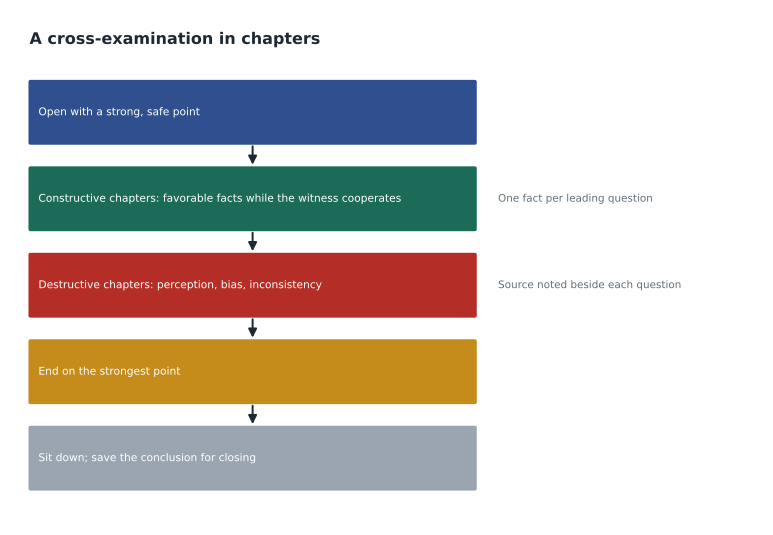
Organizing cross in chapters
Many trial lawyers organize cross in chapters: short sequences of questions, each with a single goal, such as establishing the witness's vantage point, showing a motive to favor the other side or proving a prior inconsistent statement. Each chapter can be written on a separate page with the source for each fact noted beside the question ("Dep. 42:7-15"), so the lawyer can impeach immediately if the witness strays. Chapters can be reordered at trial in response to the direct, and chapters that turn out to be unnecessary can be dropped. A headline at the start of each chapter ("Let's talk about where you were standing") helps the jury follow.
The order of chapters follows primacy and recency. Lawyers begin with a strong point that is safe, because the first exchange sets the tone and tells the jury whether the cross-examiner is in control. They end with the strongest point. If a cross is interrupted by a recess or an objection, the lawyer may need to restart a chapter so that the jury sees its logic.
Controlling the witness
Witnesses on cross often resist. They give long answers, volunteer harmful explanations, answer a different question, or argue. Cadwallader teaches a sequence of responses, from gentle to firm. First, ask tighter questions: a witness given only one fact to confirm has less room to wander. Second, repeat the question, exactly: "My question was whether you were standing at the bus shelter." Repeating the same question politely shows the jury that the witness is evading. Third, use the witness's own words: "You told the jury a moment ago that you saw it clearly. You were looking at your phone when the van turned." Fourth, if the witness persists, ask the court to instruct the witness to answer the question. Many judges will do so, and some will also allow a motion to strike nonresponsive portions of an answer. What the lawyer must not do is lose composure; the jury judges the lawyer's fairness as closely as the witness's.
Common objections on cross
Opposing counsel may object to cross-examination questions as argumentative (arguing with the witness rather than asking for facts), badgering or harassing (Rule 611(a)), compound, misleading or mischaracterizing the evidence, assuming facts not in evidence, asked and answered, beyond the scope of direct (Rule 611(b)), or calling for speculation. The cross-examiner should anticipate these and prepare questions that avoid them. A question that begins "So you expect this jury to believe" is argumentative; a question that misstates the witness's earlier testimony is misleading and will draw an objection that damages the examiner's credibility.
Cross of character witnesses
When a witness testifies to a person's character, through reputation or opinion under Rule 405(a), the cross-examiner may inquire into relevant specific instances of the person's conduct. The classic form is the "have you heard" question for reputation witnesses and "do you know" for opinion witnesses: "Have you heard that Mr. Pike was convicted of misdemeanor assault for shoving a bouncer?" The Supreme Court approved such questioning in Michelson v. United States, 335 U.S. 469 (1948), while emphasizing the trial court's duty to ensure a good-faith basis and to limit unfair prejudice. The question tests the witness's knowledge and the standards by which the witness formed the opinion; the specific act is not itself proved, and the examiner must accept the answer.
Worked problem
Cross-examining Tara Quinn
In State v. Pike, Tara Quinn, Pike's cousin and the getaway driver, testifies for the State under a plea agreement to burglary with a recommendation of probation. On direct she says that inside the car she heard someone shout "Devon, no!" and that Pike came back to the car breathing hard and saying "the old man went down." Defense counsel Priya Natarajan has Quinn's statement to police the night after the break-in, in which Quinn said she "was in the car" and "didn't see what happened inside," with no mention of a shout. Quinn is on parole for a 2023 felony theft, and she submitted a false rental application in 2024. Outline a cross.
Show solution
- Chapter 1, the deal (bias and interest). "You were charged with burglary." "You faced prison." "You are on parole for a 2023 felony." "A new felony could send you back to prison." "You signed an agreement with the State." "Under that agreement, the State will recommend probation." "That recommendation depends on your testimony here." Davis and Van Arsdall protect the defense's right to explore this.
- Chapter 2, where she was (perception). "You stayed in the car." "The car was parked on the street outside the fence." "The windows were closed." "It was dark." "You could not see inside the yard."
- Chapter 3, the statement to police (prior inconsistent statement). Commit: "You spoke to Detective Imbert the night after." "You wanted to tell the truth." Credit: "That was one day after the events." "Your memory was fresh." Confront: "You told the detective you were in the car." "You told her you didn't see what happened inside." "You did not tell her you heard anyone shout 'Devon, no.'" The lesson on impeachment covers the foundation and extrinsic proof.
- Chapter 4, dishonesty (Rule 609 and 608(b)). The 2023 felony theft may be admissible under Rule 609(a)(1)(A), subject to Rule 403; if the theft involved a dishonest act or false statement, it is admissible under 609(a)(2) without balancing. The false rental application may be inquired into under Rule 608(b) as a specific instance probative of untruthfulness, but the defense must accept her answer and cannot prove it with extrinsic evidence.
- End: return to the deal. "Ms. Quinn, the first time you said anything about a shout was after you signed the agreement." (Only if the defense can prove it.) Sit down.
Answer: The cross uses short leading questions in four chapters: the plea deal and parole exposure (bias), her limited vantage point (perception), her omission of the shout in her early statement (inconsistency), and her record (character for truthfulness). It ends on the timing of the new detail relative to the deal, if provable, and leaves the conclusion, that her account was shaped by her interest, for closing.
When not to cross
Sometimes the best cross-examination is none. If a witness has not hurt the case, or has hurt it in a way that cross cannot repair, a lawyer may stand and say, "No questions, Your Honor." That choice signals to the jury that the witness did not matter. The lawyer must weigh whether there is any constructive point the witness can supply, and whether the witness's testimony will be argued in closing in a way the lawyer must answer. A short, polite cross of a sympathetic witness, establishing one helpful fact, is often better than either silence or an attack.
Common mistakes
MistakeAsking the witness to agree with the ultimate conclusion.
InsteadEstablish the facts with short leading questions and save the conclusion for closing.
MistakeAsking open "why" questions of a hostile witness.
InsteadOpen questions invite explanations; use leading questions that each establish one fact.
MistakeAttacking every witness, including sympathetic ones.
InsteadUse constructive cross to gain concessions from sympathetic witnesses; reserve destructive cross for witnesses whose credibility matters.
MistakeAsking a question that assumes an accusation the lawyer cannot support.
InsteadEvery factual premise in a question requires a good-faith basis (Model Rule 3.4(e); Rule 608(b) practice).
MistakeArguing with a witness who refuses to concede a point.
InsteadRepeat the question, use the witness's own words, ask the court for an instruction or prove the fact another way.
Summary and key terms
- Rule 611(b) limits cross to the scope of direct and credibility, unless the court allows more; Rule 611(c) ordinarily allows leading questions.
- The Confrontation Clause guarantees criminal defendants the right to cross-examine, including on bias (Davis v. Alaska; Delaware v. Van Arsdall).
- Questions must have a good-faith factual basis, and the court protects witnesses from harassment under Rule 611(a).
- Constructive cross gains favorable facts; destructive cross attacks testimony or credibility; constructive points usually come first.
- Traditional rules: lead, one fact per question, know the answer, avoid why and how, do not ask one question too many, listen, do not argue, be brief.
- Organizing cross in chapters, with sources noted, allows flexibility and immediate impeachment.
- Control a runaway witness by tightening questions, repeating them, using the witness's words and, if needed, asking the court for help.
- Character witnesses may be asked about specific instances to test their knowledge, with a good-faith basis (Michelson).
- Cross-examination
- Questioning of a witness by a party other than the one who called the witness.
- Scope of direct rule
- Rule 611(b)'s limit of cross to the subject matter of direct and credibility.
- Constructive cross
- Cross that elicits facts supporting the examiner's theory.
- Destructive cross
- Cross that attacks the witness's testimony or credibility.
- Chapter method
- Organizing cross into short sequences of questions, each with a single goal.
- Good-faith basis
- A reasonable factual foundation for a question's premise.
- Nonresponsive answer
- An answer that does not respond to the question, which may be struck on motion.
- Have you heard question
- A question to a reputation witness about specific acts, testing the witness's knowledge (Michelson).
Practice problems
Work each problem on paper first, then reveal the answer to check.
On cross of an eyewitness, counsel asks, "Why were you looking at your phone?" What is the risk?
Show answer
An open question invites an explanation, such as "I'd just looked up and saw the van coming," that may hurt the examiner. A leading question ("You were looking at your phone") is safer.
The trial court bars all questions about a prosecution witness's pending charges in the same county. What constitutional issue arises?
Show answer
Under Van Arsdall and Davis, cutting off all inquiry into a potential source of bias may violate the Confrontation Clause, subject to harmless error review.
A plaintiff calls the defendant's foreman as an adverse witness and leads him. On the defense's cross, may defense counsel lead the foreman?
Show answer
The court may restrict leading, because the foreman is aligned with the defense; Rule 611(c) contemplates that leading on cross is ordinarily, not always, allowed.
When should a lawyer decide not to cross-examine at all?
Show answer
When the witness has not hurt the case and offers no helpful facts, or when cross cannot repair the harm and would only give the witness a chance to repeat it.
Lesson quiz · 5 questions
Score 60% or more to complete this lesson.
Create a free account to save your progress, take quizzes and earn a certificate.