
LAWU-311 · Lesson 2 of 12 · 25 min
Motions in limine and the trial plan
▶ Video coming soon A video version of this lesson is on the way.
Cadwallader opens the second week by holding up a single page. "This is the most valuable piece of paper in most trials, and juries never see it." It is the order on the parties' motions in limine in a products case he tried years ago, and it decided, before anyone was sworn, which three facts the jury would never hear. In his experience the trial is often won or lost in the pretrial conference room, where the judge decides what evidence will come in and on what terms. A lawyer who walks into trial without having asked for those rulings is improvising in front of a jury, and a lawyer who has asked for them but does not understand their effect can lose an issue on appeal by assuming that a pretrial ruling preserved it.
What a motion in limine does
A motion in limine (from the Latin for "at the threshold") asks the court to rule before trial, or before the evidence is offered, on whether particular evidence is admissible. The Federal Rules of Evidence do not mention the motion by name, but courts have long recognized the power to rule in advance as part of their authority to manage trials; the Supreme Court noted in Luce v. United States, 469 U.S. 38 (1984), that the practice developed from that inherent authority. Motions in limine serve several purposes. They keep prejudicial matter away from the jury, where an objection and a curative instruction may not undo the harm. They let both sides plan their openings and examinations around known rulings. They narrow the issues and save trial time. And they let the judge consider difficult questions with briefing rather than at the bench in the middle of testimony.
Motions in limine can be offensive or defensive. A defensive motion asks the court to exclude evidence the opponent will offer: a criminal defendant's prior convictions, other acts under Rule 404(b), a settlement offer under Rule 408, evidence of insurance under Rule 411, a subsequent remedial measure under Rule 407, or an expert's opinion under Rule 702. An offensive motion asks the court to rule in advance that the moving party's own evidence is admissible: a business record, a statement against interest, a summary chart under Rule 1006, or a demonstrative. Lawyers also use motions in limine to settle procedural matters such as the exclusion of witnesses, the use of deposition testimony, time limits, juror questions and the order of proof.
The rules that govern pretrial rulings
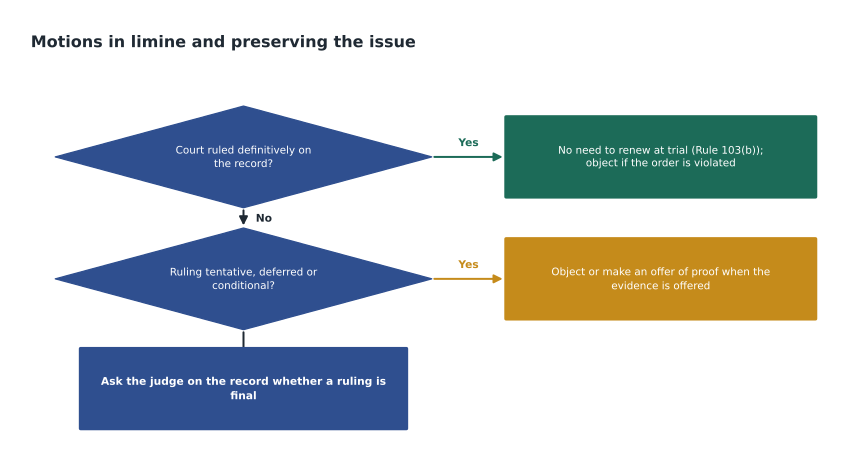
Rule 103 governs how evidence rulings are preserved, and its 2000 amendment made the effect of pretrial rulings much clearer. Under Rule 103(b), once the court rules definitively on the record, either before or at trial, a party need not renew an objection or offer of proof to preserve a claim of error for appeal. The word definitively matters. Many judges rule tentatively in limine, reserve ruling until they hear the evidence in context, or say that their ruling may change depending on how the trial unfolds. A tentative or conditional ruling does not preserve the issue, and the party must object, or make an offer of proof, when the evidence is actually offered. Cadwallader's practical rule: when in doubt, ask the judge on the record whether the ruling is final, and if the judge is unsure, renew the objection at trial outside the jury's hearing.
Rule 104 allocates preliminary questions. Under Rule 104(a), the court decides preliminary questions about whether a witness is qualified, whether a privilege exists or whether evidence is admissible, and in doing so is not bound by the evidence rules except those on privilege. Under Rule 104(b), when the relevance of evidence depends on whether a fact exists, the court admits it if there is proof sufficient to support a finding that the fact does exist, and the jury makes the final determination. The distinction matters in limine: the judge can decide a hearsay exception or an expert's reliability conclusively under Rule 104(a), but for a question of conditional relevance, such as whether a letter was actually written by the defendant, the judge decides only whether the jury could reasonably find the fact.
Two Supreme Court cases define the limits of in limine rulings for criminal defendants who must decide whether to testify. In Luce, the Court held that a defendant who does not testify cannot challenge on appeal an in limine ruling that his prior conviction would be admissible to impeach him under Rule 609, because without the testimony an appellate court cannot assess the ruling's effect or whether the government would actually have used the conviction. In Ohler v. United States, 529 U.S. 753 (2000), the Court held that a defendant who preemptively introduces her own prior conviction on direct examination, to draw the sting, cannot appeal the in limine ruling that it was admissible. The combination forces hard choices: to preserve the issue, the defendant must testify and let the prosecution impeach her with the conviction.
The common motions
Most trials produce a familiar set of motions in limine. In criminal cases, the defense commonly moves to exclude other crimes or acts under Rule 404(b), prior convictions under Rule 609, and statements obtained in violation of the Constitution, though constitutional suppression is usually raised by a separate pretrial motion under Federal Rule of Criminal Procedure 12. Rule 404(b)(3), as amended in 2020, requires the prosecutor in a criminal case to give reasonable notice in writing of any other-act evidence it intends to offer, to articulate the permitted purpose for which it is offered and the reasoning that supports that purpose, and to do so before trial unless the court excuses pretrial notice for good cause. The notice requirement gives the defense the material for its motion.
In civil cases the common motions concern subsequent remedial measures under Rule 407, settlement negotiations under Rule 408, offers to pay medical expenses under Rule 409, liability insurance under Rule 411, other accidents or complaints, collateral source payments, the plaintiff's financial condition, and expert testimony. Both sides commonly ask to exclude references to the size of the defendant or the wealth of either party, golden rule arguments, and any reference to the motions themselves. Many judges also grant standard motions excluding witnesses under Rule 615 at the start of trial.
Rule 615 was amended in 2023 in two respects that matter for trial planning. First, an order excluding witnesses from the courtroom now has a clearer reach outside it: under Rule 615(b) the court may also, by order, prohibit disclosing trial testimony to excluded witnesses and prohibit excluded witnesses from accessing that testimony. Without such an order, the rule's text reaches only exclusion from the courtroom, so a lawyer who wants to keep a witness from reading transcripts or watching a stream must ask for the additional order. Second, an entity party may designate only one officer or employee as its representative exempt from exclusion, though the court may allow additional people whose presence is shown to be essential and may allow the entity to substitute its representative. For Kestrelwerk, that means choosing whether its corporate representative at counsel table will be the engineer who may also testify, Dr. Anja Brenner, or someone else.
Rule 106, the rule of completeness, was also amended in 2023. It now applies to oral as well as written or recorded statements, and it provides that when a party introduces all or part of a statement, an adverse party may require the introduction of any other part that in fairness ought to be considered at the same time, over a hearsay objection. Lawyers planning to use excerpts of a party's interview, deposition or recorded statement should expect a completeness motion and should be ready to show why their excerpts are fair.
Stipulations and Old Chief
Some disputes are resolved by stipulation rather than ruling. A party may offer to stipulate to a fact in order to keep the opponent's more prejudicial proof of it from the jury. In Old Chief v. United States, 519 U.S. 172 (1997), the defendant was charged with possessing a firearm as a person previously convicted of a felony and offered to stipulate that he had a qualifying conviction. The Supreme Court held that the trial court abused its discretion under Rule 403 by refusing the stipulation and admitting the name and nature of the prior conviction, an assault causing serious bodily injury, because the stipulation established the element and the details added nothing but the risk of unfair prejudice. The Court emphasized that the holding is narrow: ordinarily the prosecution is entitled to prove its case by evidence of its own choice, because evidence has narrative richness and a stipulation may not satisfy a jury's expectations about what proof should look like. Old Chief applies where the point at issue is the defendant's legal status, which a stipulation fully captures.
| Motion | Rule | Typical argument |
|---|---|---|
| Exclude other acts | Rule 404(b); 403 | Offered only to show propensity; any permitted purpose is outweighed by unfair prejudice |
| Exclude prior conviction | Rule 609 | Probative value on truthfulness does not outweigh prejudice (for a criminal defendant, the stricter 609(a)(1)(B) balance) |
| Exclude subsequent repair | Rule 407 | Offered to prove negligence or a defect; no exception such as feasibility is genuinely contested |
| Exclude settlement talks | Rule 408 | Offered to prove the validity or amount of a disputed claim |
| Exclude offer to pay medical bills | Rule 409 | Offered to prove liability for the injury |
| Exclude insurance | Rule 411 | Offered to prove the insured acted negligently |
| Exclude or limit an expert | Rule 702; 104(a) | The proponent has not shown by a preponderance that the opinion is reliable and reliably applied |
| Exclude witnesses and testimony | Rule 615 | Exclude from the courtroom and order no disclosure of testimony under 615(b) |
Worked problem
Delgado motions in limine
In Delgado v. Kestrelwerk, the plaintiff plans to offer (1) Kestrelwerk's June 2026 firmware update, issued after the fire, which added a temperature-based limit on charging current; (2) a letter from Kestrelwerk's insurer offering to pay Rosa Delgado's medical bills; (3) the 2024 US recall of an earlier battery model; and (4) the 2025 email from a Kestrelwerk engineer stating that "we're pushing these cells harder than the datasheet allows." Kestrelwerk moves in limine to exclude all four. Analyze each.
Show solution
- Firmware update. Rule 407 excludes measures taken after an injury that would have made the injury less likely, when offered to prove negligence, culpable conduct, a defect in a product or its design, or a need for a warning. The update was taken after the fire, so it is a subsequent remedial measure. It may be admitted for another purpose, such as feasibility of precautionary measures, but only if feasibility is disputed. If Kestrelwerk concedes that a current limit was feasible, the exception falls away and the update should be excluded.
- Insurer's letter. Rule 409 excludes evidence of furnishing, offering or promising to pay medical, hospital or similar expenses resulting from an injury when offered to prove liability. The letter is excluded for that purpose. Any statements of fact in the letter are not protected by Rule 409 (unlike Rule 408), but a bare offer to pay medical bills contains nothing else to admit.
- Earlier recall. The 2024 recall predated the fire, so Rule 407 does not apply. The questions are relevance and Rule 403: whether the earlier model is substantially similar in the relevant respects, so that the recall shows notice or a pattern rather than inviting the jury to punish Kestrelwerk for a different product. Courts in products cases commonly require a showing of substantial similarity for other incidents offered to prove a defect, with a more relaxed showing when offered only for notice.
- Engineer's email. Statements by a party's employee on a matter within the scope of employment, made while the relationship existed, are not hearsay when offered against the party under Rule 801(d)(2)(D). The email is highly probative of the design choices at issue. Kestrelwerk's best argument is context, which it can supply through its own witness and, if the plaintiff offers an excerpt, through Rule 106.
- Ask for definitive rulings. For each ruling, plaintiff's counsel should confirm on the record whether it is final, and both sides should plan their openings around it.
Answer: The firmware update is likely excluded unless Kestrelwerk disputes feasibility; the insurer's offer to pay medical bills is excluded under Rule 409; the earlier recall turns on substantial similarity and Rule 403 and may come in for notice with a limiting instruction; and the engineer's email is admissible against Kestrelwerk as an opposing party's statement.
Bifurcation and the order of proof
Pretrial motions often address the structure of the trial itself. Under Federal Rule of Civil Procedure 42(b), the court may order separate trials of one or more issues for convenience, to avoid prejudice, or to expedite and economize. Courts frequently bifurcate the amount of punitive damages from liability, so that evidence of the defendant's wealth, relevant only to punitive damages, is not heard during the liability phase. Some courts bifurcate liability and damages in complex personal injury cases. A party seeking bifurcation must explain why separation will avoid prejudice or save time, and the opponent will often argue that the evidence overlaps and that separate trials will duplicate witnesses.
The trial plan also fixes the order of witnesses. The plaintiff or prosecution decides the order of its own case, subject to witnesses' availability and the court's schedule. Lawyers think about the order from the jury's point of view: who introduces the story, who supplies the technical proof, and who leaves the jury with the theme. Many plaintiffs' lawyers call an adverse party as an early witness, using Rule 611(c), which permits leading questions on direct examination of a hostile witness, an adverse party or a witness identified with an adverse party. In Delgado the plaintiff might call Kestrelwerk's product manager in the first morning, establish the 2025 production surge and the shortened thermal test cycles with leading questions, and end the day with Rosa Delgado herself.
Trial briefs, exhibits and technology
Many courts require or permit trial briefs that set out the parties' theories and the legal issues the court is likely to face. A good trial brief anticipates evidentiary disputes that were not resolved in limine and gives the judge the authority in a short form that can be read at the bench. Lawyers also prepare bench memos on specific evidence questions, ready to hand up when an objection is argued.
Exhibit planning is part of the same work. Each exhibit needs a number, a foundation witness, a plan for authentication and any hearsay issue, and a decision about how it will be displayed. Courts increasingly expect electronic presentation, and lawyers should test the courtroom technology before trial. Under Rule 107, added in 2024, a court may allow a party to present an illustrative aid, such as a drawing, animation or chart, to help the jury understand evidence or argument if its utility is not substantially outweighed by the danger of unfair prejudice, confusing the issues, misleading the jury, undue delay or wasting time. An illustrative aid is not evidence and may not go to the jury room unless all parties consent or the court orders otherwise. The distinction from a Rule 1006 summary, which is itself evidence and was amended the same year, is important for planning.
Living with the rulings
Rulings in limine bind the parties and their witnesses. A lawyer who violates an order excluding evidence, by asking a question or making an argument that refers to the excluded matter, risks a curative instruction, a mistrial and sanctions. The lawyer must also instruct the client's witnesses about the rulings, because a witness who blurts out excluded information can cause the same harm. Cadwallader recommends a short written list of excluded subjects for each witness, reviewed during preparation. When the opponent violates an order, the response is immediate: object, ask to approach, request that the answer be struck and the jury instructed, and, where the harm cannot be cured, move for a mistrial. A party that sits silently may be found to have waived the issue.
A ruling in limine can also open doors. If a party introduces evidence that makes excluded evidence newly relevant, for example by claiming on direct that the defendant has never been in trouble with the law, the court may find that the door has been opened and admit the previously excluded matter in response. Lawyers must prepare witnesses not to open doors unintentionally, and must listen for openings the opponent creates.
Common mistakes
MistakeAssuming that any pretrial ruling preserves the issue for appeal.
InsteadUnder Rule 103(b) only a definitive ruling on the record does; tentative or deferred rulings require an objection or offer of proof at trial.
MistakeThinking a criminal defendant can challenge an adverse Rule 609 ruling without testifying.
InsteadLuce requires the defendant to testify to preserve the issue, and Ohler holds that drawing the sting on direct waives it.
MistakeTreating the 2024 recall in Delgado as a subsequent remedial measure.
InsteadRule 407 covers only measures taken after the injury; earlier measures are analyzed for relevance, similarity and Rule 403.
MistakeRelying on a Rule 615 order to keep witnesses from reading transcripts.
InsteadSince 2023, Rule 615(b) lets the court order nondisclosure of testimony, but the party must ask for that additional order.
MistakeFailing to tell witnesses what the court excluded.
InsteadEach witness should be told which subjects are off limits, or a blurted answer can cause a mistrial.
Summary and key terms
- Motions in limine ask the court to rule on admissibility before evidence is offered, protecting the jury from prejudicial matter and letting both sides plan.
- Under Rule 103(b), a definitive ruling on the record preserves the issue without renewal; tentative rulings do not.
- Rule 104(a) preliminary questions are decided by the court; conditional relevance under Rule 104(b) requires only evidence sufficient to support a finding.
- Luce and Ohler limit appeals of Rule 609 rulings by defendants who do not testify or who draw the sting.
- Rule 404(b)(3) requires written pretrial notice and an articulated permitted purpose for the government's other-act evidence.
- The 2023 amendments to Rules 615 and 106 changed witness exclusion and completeness practice.
- Old Chief requires a court to accept a stipulation to a defendant's felon status when the name and nature of the conviction add only prejudice.
- Rule 107 allows illustrative aids, which are not evidence; Rule 1006 summaries are evidence.
- Motion in limine
- A motion asking the court to rule in advance on the admissibility of evidence.
- Definitive ruling
- A final ruling on the record that preserves an evidentiary issue without renewal under Rule 103(b).
- Offer of proof
- A statement or showing on the record of what excluded evidence would have been, needed to preserve its exclusion for appeal.
- Conditional relevance
- Relevance that depends on proof of a preliminary fact, admitted under Rule 104(b) if a jury could find the fact.
- Opening the door
- Introducing evidence or argument that makes previously excluded evidence admissible in response.
- Bifurcation
- Trying issues such as liability and punitive damages separately under Rule 42(b).
- Illustrative aid
- A chart, drawing or animation used to help the jury understand evidence or argument, governed by Rule 107 and not itself evidence.
- Drawing the sting
- Introducing damaging information about one's own witness on direct to blunt its impact on cross.
Practice problems
Work each problem on paper first, then reveal the answer to check.
The judge says of a ruling admitting a prior conviction: "For now it comes in, but I'll see how the testimony develops." Must defense counsel object again at trial?
Show answer
Yes. The ruling is tentative, so Rule 103(b) does not apply. Counsel should object when the conviction is offered, outside the jury's hearing if possible.
Why would a plaintiff move in limine for a ruling that its own summary chart is admissible?
Show answer
An offensive motion lets the plaintiff plan its opening and witness order around a known ruling and avoids a mid-trial dispute that could disrupt the presentation.
Kestrelwerk wants Dr. Anja Brenner to sit at counsel table as its representative and also to hear the plaintiff's expert. How does Rule 615 affect this?
Show answer
An entity party may designate one representative exempt from exclusion. If Brenner is designated, she may remain; if Kestrelwerk wants a second person, it must show that person's presence is essential.
A plaintiff's witness in a car crash case says on direct, "The defendant's insurance company never even called me." What should defense counsel do?
Show answer
Object, ask that the answer be struck and the jury instructed to disregard it, raise the violation of any order excluding insurance, and consider moving for a mistrial if the prejudice cannot be cured.
Lesson quiz · 5 questions
Score 60% or more to complete this lesson.
Create a free account to save your progress, take quizzes and earn a certificate.