
LAWU-311 · Lesson 1 of 12 · 26 min
Case theory, theme and trial preparation
▶ Video coming soon A video version of this lesson is on the way.
Professor Benedict Cadwallader begins the first Trial Advocacy class of the winter term by setting a kitchen timer on the lectern and starting it. He spent twenty years in courtrooms before he joined the Larkhaven faculty: eight as an assistant prosecutor in the Merrin County Attorney's Office, where he tried misdemeanors, then burglaries, then homicides, and twelve at a Brennan Falls trial firm that represented injured plaintiffs in some cases and businesses in others. He has tried more than ninety jury trials to verdict. "A jury trial is a performance with rules," he tells Section B, now in their third year. "Evidence taught you the rules. This course teaches the performance. And the first thing to know about the performance is that the jury's attention is the scarcest resource in the building. Juries forgive almost anything except being wasted." When the timer rings after two minutes he asks Daniel Reyes, who spent three years as a paralegal at a plaintiffs' firm, to tell the class in one sentence why Rosa Delgado should win her case against Kestrelwerk. Daniel tries, stops, and tries again. Cadwallader smiles. "That sentence is the hardest thing you will write all term. We start with it."
The course works from two files the class already knows. The civil file is Delgado v. Ridgeline Cycle Supply and Kestrelwerk, the e-bike battery fire that Section B followed through Civil Procedure and Evidence; Cadwallader assumes it is set for a jury trial in federal court. The criminal file is State v. Pike, the Riverside Salvage case from Criminal Law and Evidence, set for trial in Westmarch state court under evidence rules identical to the Federal Rules of Evidence. Students rotate through roles: every student will argue for each side at least once, examine at least one friendly and one hostile witness, and give an opening and a closing. Each Tuesday Cadwallader demonstrates a skill and explains the law that governs it; each Thursday students perform, on video, and review the recording in small groups. The final weeks are a full mock trial in a new file, presided over by Professor Lucinda Hartigan, who taught them Evidence after nine years as a state trial judge.
What a case theory is
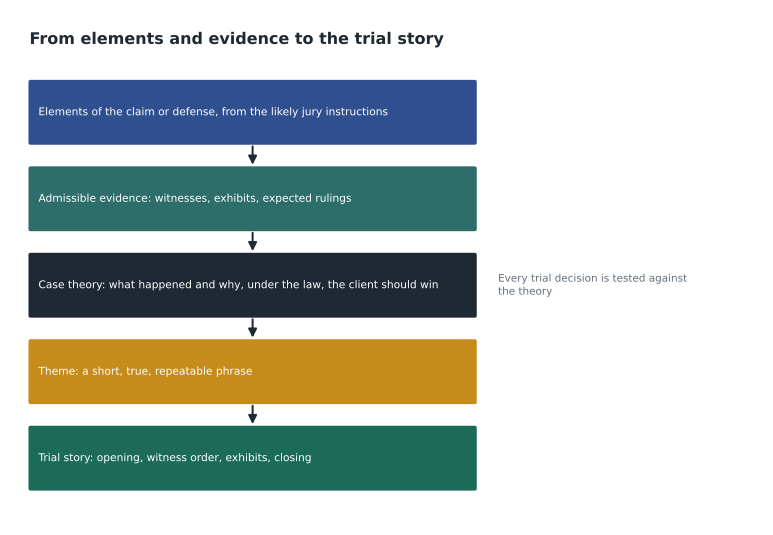
A case theory is the lawyer's account of what happened and why, under the law, the client should win. It has two halves that must fit together. The factual half is a story: a coherent, believable account of the events that explains all of the important evidence, including the evidence that hurts. The legal half is the set of elements the client must prove, or must defeat, under the jury instructions the judge will give. A theory that tells a good story but leaves an element unproved loses on a motion for judgment as a matter of law. A theory that checks every element but tells no believable story loses in the jury room. Cadwallader writes the test on the board: a good theory is consistent with the undisputed facts, explains the disputed facts better than the other side's theory, is supported by evidence the lawyer can actually get admitted, satisfies every element of the instructions, and appeals to the jury's sense of fairness.
The theory is not a slogan and it is not an argument. It is a working document that the lawyer writes early and revises constantly. In practice many trial lawyers write the theory as a short paragraph and keep it at the front of the trial notebook. Every decision in the case is then tested against it: which witnesses to call, which exhibits to offer, which motions in limine to file, which questions to ask on cross. A question that does not advance the theory, or protect it, is a question the lawyer should think hard about asking.
Hannah Lindqvist, the former history teacher, asks whether a lawyer can run two theories at once, for example arguing that the defendant was not there and, in the alternative, that the defendant acted in self-defense. Cadwallader answers that the pleadings rules allow alternative and even inconsistent claims and defenses, but juries are less forgiving than Rule 8. A defense lawyer who argues both alibi and self-defense invites the jury to conclude that the client has no true story. Sometimes alternative theories are unavoidable, especially on damages: a defendant may contest liability and still need to tell the jury what a fair award would be if it finds liability. The skill is to present the alternative in a way that does not undercut the main theory, often by having a different witness or a different part of the argument carry it.
Theme
A theme is the short phrase that captures the theory in words the jury will remember. Good themes are simple, moral and repeatable: "This case is about a company that knew and did not tell." "He was in the car, not in the warehouse." "Safety rules exist for the moment you are in a hurry." A theme often names a choice a person made, because jurors judge people by their choices. It should be true to the evidence, because an opposing lawyer who shows the jury that the theme is false will have turned it into a weapon. And it should be the lawyer's own: borrowed slogans sound borrowed.
The theme appears at predictable points. Many lawyers use it in the first minute of opening and the last minute of closing, and return to it at transitions. Some witnesses' testimony will illustrate it, and the lawyer may choose to end a direct examination on a fact that embodies it. But overuse is a real risk. A theme repeated twenty times becomes noise, and a theme that is plainly an advertising line can make the lawyer look manipulative. Cadwallader's rule of thumb is that the jury should be able to state the theme after opening, and should be able to state it in their own words after closing.
Marcus Webb, who worked at a battery-storage startup before law school, is assigned to Kestrelwerk for the first exercise and proposes a theme: "Batteries do not catch fire on their own." Cadwallader asks him what the evidence will be. Marcus admits that Kestrelwerk's own engineer wrote in 2025 that the company was pushing the cells harder than the datasheet allowed, and that the plaintiff's expert will testify about an internal short in cell 23. "Then your theme invites the plaintiff to say: this one did." They work toward something defensible: "Every one of these fires has a cause, and here the evidence does not show it was the battery's design." It is less catchy and more durable.
Building the theory from the instructions backward
Experienced trial lawyers often begin with the jury instructions, not the facts. The instructions are the law the jury will apply, stated in the words the jury will hear. In federal court the judge decides what instructions to give after an instruction conference, and parties submit proposed instructions under Federal Rule of Civil Procedure 51 or Federal Rule of Criminal Procedure 30. Most jurisdictions have pattern or model instructions; many federal circuits publish model civil and criminal instructions, and states publish their own. Lawyers who draft their proposed instructions at the start of trial preparation, rather than the night before the charge conference, know from the outset exactly what they must prove.
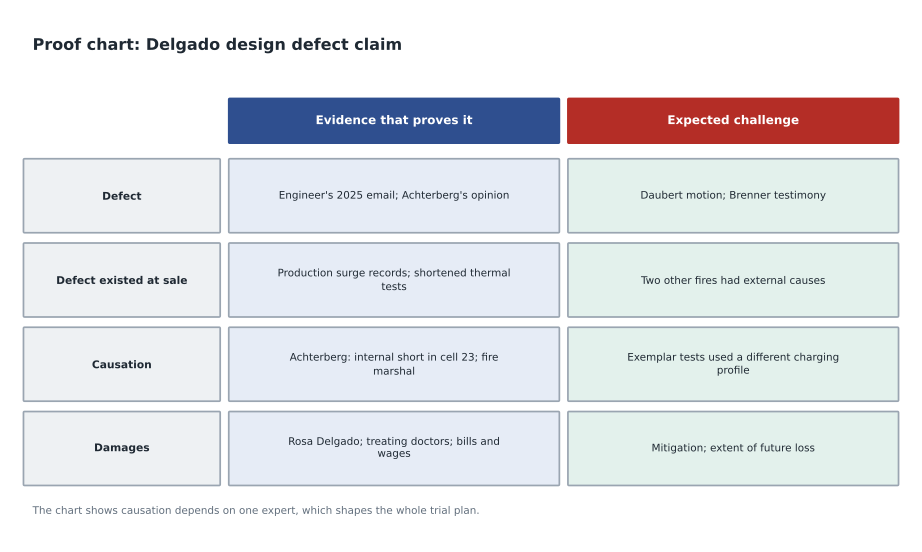
From the instructions, the lawyer builds a proof chart: a table with each element in the left column and, beside it, the witnesses and exhibits that will prove it, the expected objections, and the opponent's contrary evidence. The proof chart reveals gaps. In Delgado, the instructions on strict products liability for a design defect under Ohio law will require proof of a defect, that the defect existed when the product left the manufacturer's control, and proximate cause of the injury, along with the damages elements. The chart shows that causation depends almost entirely on the plaintiff's expert, Dr. Samuel Achterberg, which means the plaintiff's case lives or dies on the admissibility and credibility of his opinion under Rule 702. That realization shapes the whole trial plan: the expert's preparation, the motion practice over Kestrelwerk's challenge to his testing, and the order of witnesses.
Stories, primacy and recency
Jurors understand evidence by fitting it into stories. Research on juror decision making, often associated with the story model developed by Nancy Pennington and Reid Hastie, suggests that jurors construct a narrative from the evidence and then choose the verdict that best fits the story they have built. Trial lawyers draw practical lessons from that research. Give the jury a story early, so the evidence has a frame to attach to. Make the story about people and their choices, not about documents. Account for the bad facts inside the story rather than leaving them for the other side to explain. And remember primacy and recency: jurors tend to remember best what they hear first and last, in the trial as a whole, in each witness's testimony and in each segment of an argument.
The story is told in the lawyer's chosen order, which is often not chronological. A plaintiff's opening in Delgado might begin with the moment the battery caught fire in Rosa Delgado's garage at 9:47 p.m., captured by the neighbor's video doorbell, and then step back to the engineering decisions in Stuttgart that the plaintiff contends led to it. A defense opening in Pike might begin with the night watchman's own words to the truck driver who found him, because the defense's theory is that the State cannot prove who did what inside the yard. The order of witnesses follows the same logic. Lawyers often start strong, put weaker but necessary witnesses in the middle, and end with a witness who embodies the theme.
Preparing the trial notebook
Cadwallader requires every student to keep a trial notebook, paper or electronic, organized by stage of trial. The sections typically include: the theory and theme; the proof chart; the proposed jury instructions and verdict form; jury selection materials; motions in limine and rulings; opening; each witness's examination outline with exhibits and impeachment material; exhibit lists and a log of what has been offered and admitted; the evidence rules most likely to come up, with short notes on each; motions for judgment as a matter of law; and closing. A good notebook lets a lawyer find any document within seconds, which matters when a witness says something unexpected and the impeachment transcript must be in hand before the moment passes.
The notebook also holds the pretrial order. In federal civil cases Rule 16 conferences usually lead to a final pretrial order that lists witnesses, exhibits, stipulations and contested issues, and that order controls the course of trial unless modified to prevent manifest injustice. Many courts require parties to exchange exhibit lists and deposition designations in advance and to file objections to them, and failure to disclose a witness or exhibit can lead to exclusion under Rule 37(c)(1). A lawyer who discovers an important document in the week before trial must therefore act quickly: disclose it, seek leave, and be ready to explain why it was not listed earlier.
Worked problem
Writing the Pike defense theory
Priya Natarajan and Jordan Kimura are assigned to represent Devon Pike in State v. Pike. Pike is charged with felony murder and assault arising from the Riverside Salvage break-in; the State's evidence includes Lou Abbott's statements to the truck driver Ray Dunleavy ("The big one, Devon, shoved me"), the group chat under the account DP_Fixes, the yard camera showing three figures at 11:32 p.m., and Kellan Shaw's statement to his friend Mateo. Pike told police that Abbott swung his flashlight first. Write a one-paragraph defense theory and a theme, and identify the three biggest problems the theory must account for.
Show solution
- Start with the elements. Felony murder requires proof that Abbott's death was caused in the course of a listed felony; the burglary itself will be hard to contest given the chat and the camera. The assault charges require proof that Pike, not someone else, shoved Abbott, and the State must disprove self-defense beyond a reasonable doubt once the defense raises it.
- Choose where the theory will fight. Contesting presence is unrealistic: the chat, the truck photo and the camera put Pike at the yard. The more credible fights are identity of the person who shoved Abbott, causation of death (Abbott's heart disease and the forty-minute delay before anyone called for help), and the State's burden on self-defense.
- Write the story: three young men went to steal copper, a frightened watchman confronted them in the dark, and in the confusion someone pushed him. The State asks the jury to rely on the words of a badly injured man who told the ambulance crew he did not get a good look, and on the self-serving statement of a co-defendant who is trying to save himself.
- Account for the bad facts. The jury will hear that Pike planned the theft and that he told Shaw the next morning, "we never talk about last night." The theory concedes the theft, which earns credibility, and argues that shame about a theft is not a confession to a homicide.
- Choose a theme: "A theft, a frightened man in the dark, and a guess." Test it against the evidence the defense can get admitted, the instructions, and the likely rulings on Abbott's statements.
Answer: A workable defense theory concedes the burglary, contests who shoved Abbott and whether the shove caused his death, and puts the State to its burden on self-defense. Its three biggest problems are Abbott's naming of "Devon" to Dunleavy (likely admitted as an excited utterance or dying declaration), the DP_Fixes chat and Pike's own planning, and the next-morning text to Shaw. The theme must be one the jury will still believe after the State's case.
Ethics in preparation
Trial preparation runs into the rules of professional conduct at many points, and Cadwallader teaches them alongside the skills. Model Rule 3.3 forbids a lawyer to offer evidence the lawyer knows to be false and requires remedial measures, including disclosure to the tribunal if necessary, if the lawyer learns that material evidence the lawyer offered was false. Model Rule 3.4 forbids a lawyer to obstruct access to evidence, to falsify evidence or to counsel or assist a witness to testify falsely, and, in trial, to allude to matters the lawyer does not reasonably believe are relevant or will be supported by admissible evidence, or to state a personal opinion about the justness of a cause, the credibility of a witness or the guilt or innocence of an accused. Model Rule 3.5 limits communication with jurors, and Rule 3.6 limits extrajudicial statements that would have a substantial likelihood of materially prejudicing the proceeding.
Witness preparation is a particular focus. Lawyers may, and competent lawyers must, prepare witnesses to testify: explaining courtroom procedure, reviewing documents, discussing the likely questions, rehearsing, and suggesting that a witness speak clearly and answer only the question asked. What a lawyer may not do is script false testimony or encourage a witness to claim a lack of memory the witness does not have. The American Bar Association addressed the line in Formal Opinion 508 (2023), on the ethics of witness preparation, which treats preparation as a proper and often necessary part of representation while identifying conduct that crosses into improper influence, such as encouraging testimony the lawyer knows is false or coaching a witness during testimony in ways that obstruct the truth. Many courts also limit conferring with a witness during breaks in the witness's own testimony, especially during cross-examination, and lawyers must know the local practice.
The rhythm of a trial
Section B reviews the stages of a jury trial, which the rest of the course will take one at a time. Before trial come motions in limine and the final pretrial conference. Trial begins with jury selection, followed by preliminary instructions from the judge. The plaintiff or prosecution gives an opening statement, and the defense may open immediately or, in many courts, reserve its opening until the start of its case. The plaintiff or prosecution presents its case in chief through direct examination, cross, redirect and exhibits, and rests. The defense may move for judgment as a matter of law in a civil case under Rule 50(a) or for a judgment of acquittal in a criminal case under Federal Rule of Criminal Procedure 29. The defense presents its case, the plaintiff may offer rebuttal, motions are renewed, the court holds the charge conference, the parties give closing arguments, and the judge instructs the jury. The jury deliberates and returns a verdict, after which come post-trial motions.
Every stage has its own law, and the rules of evidence apply throughout. A lawyer who knows the law of each stage can turn a ruling to advantage; a lawyer who does not can waive a client's rights by silence. That is why the course pairs each skill with the rules that govern it, and why Cadwallader ends the first class with a warning: "There are two ways to lose a case you should have won. One is to bore the jury. The other is to forget to object. We will work on both."
Common mistakes
MistakeTreating the case theory as a slogan or a closing argument written in advance.
InsteadThe theory is a working account of the facts and law that is tested against every trial decision and revised as the evidence develops.
MistakeBuilding the theory from the facts alone and checking the instructions at the end.
InsteadStart from the elements in the likely instructions, build a proof chart, and identify gaps before choosing witnesses and exhibits.
MistakeIgnoring bad facts in the hope that the other side will not emphasize them.
InsteadA credible theory accounts for the bad facts inside the story; concessions on uncontested points often buy credibility for the contested ones.
MistakeChoosing a theme that the evidence can contradict.
InsteadA theme must be true to the admissible evidence, or the opponent will turn it against the client.
MistakeAssuming that preparing a witness is improper coaching.
InsteadPreparation is proper and often required; scripting false testimony, encouraging feigned memory loss or coaching during testimony is not (see ABA Formal Opinion 508).
Summary and key terms
- A case theory joins a believable factual story to the legal elements the client must prove or defeat.
- A good theory is consistent with the undisputed facts, explains the disputed facts, rests on admissible evidence, satisfies every element and appeals to fairness.
- A theme is a short, true, repeatable phrase that captures the theory, used at the start and end of the trial and at transitions.
- Draft proposed jury instructions early and build a proof chart linking each element to evidence and expected challenges.
- Jurors organize evidence into stories; primacy and recency shape the order of opening, witnesses and arguments.
- The trial notebook and the final pretrial order organize the trial; undisclosed witnesses and exhibits risk exclusion under Rule 37(c)(1).
- Model Rules 3.3 through 3.6 govern candor, fairness to the opposing party, juror contact and trial publicity.
- Witness preparation is proper; scripting false testimony or improper coaching is not.
- Case theory
- The lawyer's account of what happened and why, under the applicable law, the client should prevail.
- Theme
- A short phrase that captures the case theory in memorable, morally resonant terms.
- Proof chart
- A table linking each element of a claim or defense to the evidence that will prove or rebut it.
- Trial notebook
- An organized collection of all materials the lawyer needs at trial, arranged by stage.
- Final pretrial order
- The order entered after the final pretrial conference that lists witnesses, exhibits and issues and controls the trial.
- Primacy and recency
- The tendency of listeners to remember best what they hear first and last.
- Pattern jury instructions
- Model instructions published by courts or bar groups for common claims and defenses.
- Witness preparation
- A lawyer's lawful preparation of a witness to testify, including explaining procedure and reviewing likely questions.
Practice problems
Work each problem on paper first, then reveal the answer to check.
Why might a plaintiff's lawyer draft proposed jury instructions months before trial?
Show answer
The instructions define the elements the jury will apply. Drafting them early lets the lawyer build a proof chart, find gaps in the evidence and plan discovery, witnesses and motions around what must actually be proved.
A defense lawyer plans to argue both that the defendant was not at the scene and, alternatively, that he acted in self-defense. What is the risk?
Show answer
The theories contradict each other, and a jury may conclude the defendant has no true account. Alternative theories are permitted procedurally, but the lawyer must weigh whether presenting both undermines credibility.
May a lawyer rehearse a witness's direct examination and suggest clearer ways to describe events the witness remembers?
Show answer
Yes. Rehearsal and suggestions about clarity and demeanor are proper preparation. The lawyer may not suggest false testimony, encourage the witness to claim not to remember what the witness recalls, or otherwise counsel testimony the lawyer knows is untrue.
What does a proof chart reveal about the Delgado plaintiff's case?
Show answer
That causation depends largely on Dr. Achterberg's expert opinion, so his admissibility under Rule 702 and his credibility become central to the trial plan.
Lesson quiz · 5 questions
Score 60% or more to complete this lesson.
Create a free account to save your progress, take quizzes and earn a certificate.