
LAWU-311 · Lesson 8 of 12 · 23 min
Impeachment
▶ Video coming soon A video version of this lesson is on the way.
Impeachment is the part of cross-examination that juries remember, and Cadwallader treats it as a set of separate skills, each with its own law. "There are only a handful of reasons a jury should doubt a witness," he says, writing them on the board: the witness could not perceive, does not remember, has a reason to shade the truth, said something different before, is the kind of person who lies, or is contradicted by better evidence. "For each one, the rules tell you what you may ask, whether you may prove it with other evidence, and what the jury may do with it. Learn the three questions for each method and you will never be surprised by an objection."
Who may impeach
Under Rule 607, any party, including the party that called the witness, may attack the witness's credibility. The rule abolished the old voucher rule, under which a party was thought to vouch for its own witnesses and could not impeach them. Courts have recognized one important limit: a party may not call a witness primarily as a subterfuge to place before the jury an otherwise inadmissible prior statement in the guise of impeachment. If the prosecution knows that a witness will not repeat an earlier statement implicating the defendant, and calls the witness only so that it can introduce the earlier statement to impeach, many courts will find the impeachment improper, because the jury is likely to use the statement for its truth. That limit has become less important for prior inconsistent statements since the 2026 amendment discussed below, but it still matters for statements that do not qualify under that rule.
Bias and interest
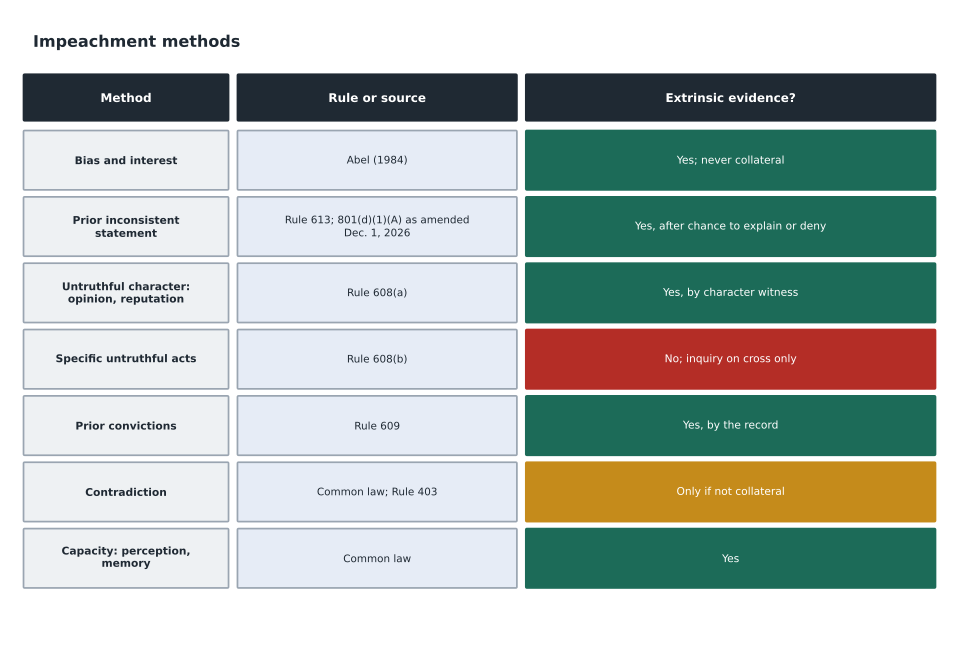
Evidence that a witness is biased, has an interest in the outcome or has a motive to testify falsely is always relevant to credibility. The Federal Rules of Evidence do not mention bias impeachment expressly, but in United States v. Abel, 469 U.S. 45 (1984), the Supreme Court held that it is permitted, and upheld cross-examination showing that a defense witness and the defendant were members of a secret prison organization whose members were sworn to lie for one another. Bias can be shown through family or romantic relationships, employment, financial interest, plea or immunity agreements, hostility toward a party, payment (including expert fees), and fear. Because bias is never a collateral matter, the examiner may generally prove it with extrinsic evidence if the witness denies it, though many courts require that the witness first be given a chance to admit or deny the facts. Rule 403 still limits the detail.
Prior inconsistent statements
A witness who said something different before can be impeached with the earlier statement. Rule 613(a) provides that when examining a witness about the witness's prior statement, a party need not show it or disclose its contents to the witness, but must, on request, show it or disclose its contents to an adverse party's attorney. Rule 613(b), as amended effective December 1, 2024, provides that extrinsic evidence of a witness's prior inconsistent statement is admissible only after the witness is given an opportunity to explain or deny the statement and an adverse party is given an opportunity to examine the witness about it, unless the court orders otherwise. The amendment changed the earlier rule, under which many courts allowed the foundation to be laid after the extrinsic evidence was introduced; the prior-foundation requirement is now the default. The rule does not apply to an opposing party's statement under Rule 801(d)(2), which may always be proved.
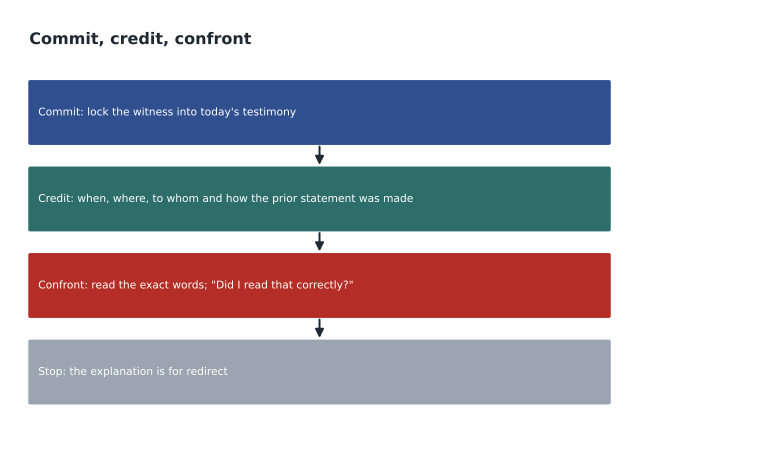
The procedure trial lawyers use is often summarized as commit, credit, confront. First, commit the witness to the testimony just given: "You told the jury this morning that the light was red for the van." Second, credit the prior statement, building up its reliability: when and where it was made, how close in time to the events, to whom, whether it was written or recorded, whether the witness signed it or was under oath. Third, confront the witness with the statement, by reading it exactly, or having the witness read it, and asking the witness to confirm that it was said: "You told Officer Haddix at the scene, 'the walking man was lit, she had the walk.' Did I read that correctly?" The examiner should not ask the witness to explain the discrepancy; that is for redirect, if the other side chooses.
Impeachment by omission is a variation. If a witness's earlier account left out an important fact that the witness now asserts, the omission can be inconsistent if it would have been natural to mention the fact. The examiner commits the witness to the current account, credits the earlier occasion (the witness was asked to tell everything important, the statement was detailed), and confronts the witness with the absence of the fact.
The 2026 amendment to Rule 801(d)(1)(A)
Until recently, a prior inconsistent statement was ordinarily admissible only to impeach, not for its truth, unless it fell within a hearsay exception or exclusion. Rule 801(d)(1)(A) excluded from hearsay a testifying witness's prior inconsistent statement only if it had been given under penalty of perjury at a trial, hearing, other proceeding or deposition. A statement to a police officer at the scene, or in an unsworn interview, could be used only to impeach, and juries were instructed (often to their confusion) that they could consider it only in deciding whether to believe the witness's trial testimony.
An amendment adopted by the Supreme Court on April 8, 2026, and effective December 1, 2026, removed the oath-and-proceeding requirement. As amended, Rule 801(d)(1)(A) excludes from the hearsay definition a prior statement of a declarant who testifies and is subject to cross-examination about the statement, if the statement is inconsistent with the declarant's testimony. The amendment applies to proceedings commenced after its effective date and, insofar as just and practicable, to proceedings then pending. The practical effect is large. A witness's inconsistent statement to an officer, an investigator, a friend or a social media audience may now be considered by the jury as evidence of the facts it asserts, not merely as a reason to doubt the witness, so long as the witness testifies and can be cross-examined about it. The amendment does not change Rule 613(b)'s foundation requirement for extrinsic evidence, and the court retains its Rule 403 authority. Many states have adopted similar rules for years, and lawyers must check whether their state follows the federal approach.
Character for truthfulness
Rule 608 governs impeachment with character for untruthfulness. Under Rule 608(a), a witness's credibility may be attacked by testimony about the witness's reputation for having a character for truthfulness or untruthfulness, or by testimony in the form of an opinion about that character. Evidence of truthful character is admissible only after the witness's character for truthfulness has been attacked. Under Rule 608(b), except for criminal convictions under Rule 609, extrinsic evidence is not admissible to prove specific instances of a witness's conduct in order to attack or support the witness's character for truthfulness. The court may, on cross-examination, allow specific instances to be inquired into if they are probative of the character for truthfulness or untruthfulness of the witness, or of another witness whose character the witness being cross-examined has testified about.
The limit on extrinsic evidence means the examiner must take the witness's answer. If a witness denies having lied on a loan application, the examiner may not call the loan officer to prove it. The examiner may, however, press the witness and may confront the witness with a document, in many courts, without offering the document into evidence. Lawyers must have a good-faith basis for the inquiry. Rule 610 forbids evidence of a witness's religious beliefs or opinions to attack or support credibility.
Prior convictions
Rule 609 governs impeachment with criminal convictions, and it draws distinctions that lawyers must know precisely. For crimes punishable by death or imprisonment for more than one year, Rule 609(a)(1) provides that the evidence must be admitted, subject to Rule 403, in a civil case or in a criminal case where the witness is not the defendant; and must be admitted in a criminal case where the witness is the defendant if the probative value of the evidence outweighs its prejudicial effect to that defendant. That second test is more protective than Rule 403, because the government bears the burden and the balance is not tilted toward admission. For any crime, regardless of punishment, Rule 609(a)(2) provides that the evidence must be admitted if the court can readily determine that establishing the elements of the crime required proving, or the witness admitting, a dishonest act or false statement. Courts have no discretion to exclude such convictions under Rule 403.
Rule 609(b) limits older convictions. If more than ten years have passed since the conviction or the witness's release from confinement for it, whichever is later, the evidence is admissible only if its probative value, supported by specific facts and circumstances, substantially outweighs its prejudicial effect, and the proponent gives reasonable written notice. Convictions that have been the subject of a pardon or similar procedure based on rehabilitation or innocence may be excluded under Rule 609(c). Juvenile adjudications are admissible only in a criminal case, only against a witness other than the defendant, and only in limited circumstances under Rule 609(d). A pending appeal does not make a conviction inadmissible, under Rule 609(e). In practice, impeachment with a conviction is usually limited to the name of the crime, the date and the sentence; the details are not explored unless the witness opens the door by minimizing it.
Contradiction and collateral matters
A witness may be impeached by showing that some part of the witness's testimony is wrong, through other evidence. The common law limited contradiction by the collateral matter rule: a party may not introduce extrinsic evidence to contradict a witness on a collateral matter, one relevant only because it contradicts the witness. The Federal Rules do not state the collateral matter rule expressly, but courts apply it through Rule 403. If an eyewitness testifies that she was wearing a blue coat and was in fact wearing a red one, the color of the coat is collateral; the examiner may ask about it but may not call another witness to prove it. If the eyewitness testifies that she was standing at the corner, and another witness can show she was a block away, the contradiction goes to her ability to perceive and is not collateral.
Capacity: perception and memory
A witness's capacity to perceive and remember is always open to attack. The examiner may show that the witness was far away, that the lighting was poor, that the witness was distracted, that the witness had been drinking, that the event was brief and stressful, or that much time has passed. Lawyers often prove capacity through the witness's own concessions, a diagram or photographs, and other witnesses. Expert testimony on the reliability of eyewitness identification is admitted in many jurisdictions, subject to Rule 702; the Supreme Court has noted the problems of eyewitness evidence while leaving most safeguards to the rules of evidence and the jury, as in Perry v. New Hampshire, 565 U.S. 228 (2012).
Impeaching a hearsay declarant
When a hearsay statement is admitted, the declarant's credibility is in issue even though the declarant does not testify. Rule 806 provides that the declarant's credibility may be attacked, and then supported, by any evidence that would be admissible if the declarant had testified as a witness. The court may admit evidence of the declarant's inconsistent statement or conduct, regardless of when it occurred or whether the declarant had an opportunity to explain or deny it. In State v. Pike, if the court admits Lou Abbott's statement to the truck driver, "The big one, Devon, shoved me," as an excited utterance or dying declaration, the defense may impeach Abbott with his inconsistent statement to the ambulance crew that he "didn't get a good look at them," even though Abbott, who died, could never be asked to explain it.
Worked problem
Impeaching Dr. Anja Brenner with her deposition
In Delgado, Kestrelwerk calls Dr. Anja Brenner, its thermal engineer, who testifies on direct that the Trail 750's cells were always operated within the manufacturer's specified charging limits. At her deposition in the case, taken under oath, she testified: "During the late-2025 production surge, we shortened the thermal test cycle, and some lots were charged at the upper end of the cell specification, at times slightly above it, during validation." Plaintiff's counsel Jordan Kimura wants to impeach her. How should he proceed, and how may the jury use the deposition answer?
Show solution
- Commit. "Dr. Brenner, you told the jury this morning that the cells were always operated within the specified charging limits." "Always." Get a clear yes.
- Credit. "You gave a deposition in this case." "In a conference room at your company's lawyers' office." "You took an oath to tell the truth." "A court reporter took down every word." "Your lawyers were present." "You had a chance to read the transcript and make corrections." "You made none to this answer."
- Confront. Hand the witness the transcript (with a copy to opposing counsel): "Please follow along on page 118, line 4. Question: ... Answer: 'During the late-2025 production surge, we shortened the thermal test cycle, and some lots were charged at the upper end of the cell specification, at times slightly above it, during validation.' Did I read that correctly?"
- Stop. Do not ask her to reconcile the statements. If she volunteers an explanation, the jury will weigh it; redirect is defense counsel's job.
- Use. The deposition answer, given under oath at a deposition, was substantive evidence even before the 2026 amendment. It is also admissible against Kestrelwerk as an opposing party's statement under Rule 801(d)(2)(D), because she is Kestrelwerk's employee speaking on a matter within the scope of her employment. Under Civil Rule 32(a)(3), an adverse party may use for any purpose the deposition of a party's officer, director, managing agent or designee, and under Rule 32(a)(2) any party may use a deposition to contradict or impeach a testifying deponent.
Answer: Commit, credit and confront, reading the deposition exactly and stopping without asking for an explanation. The answer is substantive evidence on several grounds: Rule 801(d)(1)(A) in either version, Rule 801(d)(2)(D) against Kestrelwerk, and the deposition-use rules of Civil Rule 32. The plaintiff may argue it for its truth in closing.
Common mistakes
MistakeAsking the witness to explain why the prior statement differs.
InsteadAfter confronting, stop; let the opposing party decide whether to seek an explanation on redirect.
MistakeCalling a witness to prove a specific instance of lying after the witness denies it on cross.
InsteadRule 608(b) bars extrinsic evidence of specific instances; the examiner must take the answer.
MistakeTreating all felony convictions the same for every witness.
InsteadRule 609(a)(1) applies a stricter balance when the witness is a criminal defendant; 609(a)(2) crimen falsi convictions come in without balancing.
MistakeAssuming an unsworn statement to police can only impeach.
InsteadSince December 1, 2026, Rule 801(d)(1)(A) makes a testifying witness's prior inconsistent statement substantive evidence, sworn or not.
MistakeIntroducing extrinsic evidence of a prior inconsistent statement before giving the witness a chance to explain or deny it.
InsteadSince the 2024 amendment, Rule 613(b) requires the opportunity first unless the court orders otherwise.
Summary and key terms
- Rule 607 lets any party impeach any witness, but impeachment may not be a subterfuge for placing inadmissible statements before the jury.
- Bias and interest impeachment is permitted (Abel), is never collateral and may be proved extrinsically.
- Rule 613(b), amended in 2024, requires that the witness be given a chance to explain or deny before extrinsic proof of a prior inconsistent statement, unless the court orders otherwise.
- Since December 1, 2026, Rule 801(d)(1)(A) treats a testifying witness's prior inconsistent statement as substantive evidence without the former oath-and-proceeding requirement.
- Rule 608(a) allows opinion and reputation evidence of untruthful character; Rule 608(b) allows inquiry into specific instances on cross but bars extrinsic proof.
- Rule 609 distinguishes felonies (with a stricter balance for criminal defendants), crimen falsi convictions (admitted without balancing) and convictions older than ten years.
- Extrinsic evidence to contradict a witness is barred on collateral matters; capacity to perceive and remember is always open to attack.
- Rule 806 allows impeachment of a hearsay declarant as if the declarant had testified.
- Impeachment
- Evidence or questioning that attacks a witness's credibility.
- Extrinsic evidence
- Evidence other than the witness's own answers on cross, such as documents or other witnesses.
- Prior inconsistent statement
- A witness's earlier statement that conflicts with the witness's trial testimony.
- Commit, credit, confront
- The three-step method for impeaching with a prior inconsistent statement.
- Impeachment by omission
- Showing that a witness's earlier account left out a fact the witness would naturally have mentioned.
- Crimen falsi
- A crime whose elements require proof of a dishonest act or false statement, admissible under Rule 609(a)(2).
- Collateral matter
- A fact relevant only to contradict a witness, which may not be proved by extrinsic evidence.
- Voucher rule
- The abolished common law rule that a party could not impeach its own witness.
Practice problems
Work each problem on paper first, then reveal the answer to check.
A defendant on trial for robbery testifies. He has a seven-year-old felony conviction for drug possession. What standard governs its admission to impeach him?
Show answer
Rule 609(a)(1)(B): it is admitted only if its probative value outweighs its prejudicial effect to the defendant. Drug possession has limited bearing on truthfulness, so exclusion is likely.
A civil witness has a misdemeanor conviction for filing a false insurance claim. Can the court exclude it under Rule 403?
Show answer
No. Under Rule 609(a)(2), a conviction requiring proof of a dishonest act or false statement must be admitted, regardless of punishment, if within the time limits.
At a February 2027 trial, an eyewitness testifies that the van had a green light. She told an officer at the scene that the light was red for the van. May the jury use the earlier statement as proof that the light was red?
Show answer
Yes, under Rule 801(d)(1)(A) as amended effective December 1, 2026, because she testifies and is subject to cross-examination about the inconsistent statement.
Defense counsel wants to prove through a second witness that a prosecution witness was wearing glasses, which the witness denied. Is that collateral?
Show answer
Probably not, if the glasses bear on the witness's ability to see the events; capacity is not collateral. If the glasses were irrelevant to perception, extrinsic proof would be barred.
Lesson quiz · 5 questions
Score 60% or more to complete this lesson.
Create a free account to save your progress, take quizzes and earn a certificate.