
LAWU-311 · Lesson 11 of 12 · 22 min
Closing arguments
▶ Video coming soon A video version of this lesson is on the way.
Closing argument is the only time in a trial when a lawyer may tell the jury what the evidence means. Everything before it has been restrained: opening could preview but not argue, direct belonged to the witness, cross had to be asked as questions. In closing the lawyer may argue inferences, attack and defend credibility, explain how the evidence fits the instructions, and ask for a verdict. Cadwallader warns Section B that the freedom is easy to misuse. "By closing, the jury has heard everything. They do not need you to repeat it. They need you to organize it, to show them why it leads where you say, and to give them the words they will use in the jury room to persuade one another. The best closing is the one a juror can repeat."
Order and timing
The order of closing arguments depends on the court and the type of case. In federal criminal trials, Federal Rule of Criminal Procedure 29.1 provides that the government argues first, the defense argues next, and the government may then argue in rebuttal. In civil trials, the party with the burden of proof usually argues first and last, with the defense in between, though practice varies among courts and states. Rebuttal is limited to responding to the opponent's argument; a party that saves new material for rebuttal, where the opponent cannot answer, invites an objection. Courts commonly set time limits for closing, and lawyers should plan the argument to the minute, leaving time for rebuttal if they have it.
The timing of closing relative to the instructions varies. Federal Rule of Civil Procedure 51(b)(3) allows the court to instruct the jury at any time before the jury is discharged, and many federal judges now instruct before closing arguments, so that the lawyers can refer to the instructions the jury has just heard. Others instruct after closing. Either way, the court will have settled the instructions at the charge conference, and lawyers should build their closings around the actual language the judge will use.
What closing may do
In closing, a lawyer may summarize the evidence, argue the reasonable inferences from it, comment on witnesses' credibility based on the evidence, explain the law as the court has given or will give it, apply the law to the facts, and ask the jury to return a particular verdict. Lawyers may use analogies, rhetorical questions and stories, and may appeal to the jury's common sense and sense of justice. They may use admitted exhibits and, with permission, illustrative aids under Rule 107. And they may respond to arguments the other side has made or is expected to make.
The limits are equally important. A lawyer may not argue facts not in evidence, misstate the evidence or the law, refer to evidence the court excluded, state a personal opinion about the justness of the cause, the credibility of a witness or the guilt or innocence of the accused (Model Rule 3.4(e)), appeal to prejudice or passion untethered from the evidence, or ask jurors to put themselves in a party's position in deciding damages (the golden rule argument, which courts widely condemn). In criminal cases additional limits apply. The prosecutor may not comment on the defendant's failure to testify, under Griffin v. California, 380 U.S. 609 (1965), or use the defendant's silence after Miranda warnings to impeach, under Doyle v. Ohio, 426 U.S. 610 (1976). The prosecutor may not vouch for witnesses by suggesting personal knowledge or the government's prestige behind their credibility, or shift the burden of proof by suggesting that the defendant must prove innocence.
| Permitted in closing | Improper in closing |
|---|---|
| "The evidence shows she never charged the bike overnight." | "I believe Rosa Delgado; I've known honest people, and she is one." |
| "Why would Ms. Quinn add a shout she never mentioned before she signed her deal?" | "The government wouldn't have charged him if he weren't guilty." |
| Arguing reasonable inferences from admitted evidence | Arguing facts that were never admitted or were excluded |
| Explaining the instructions as the court gave them | Misstating the burden of proof or the law |
| Responding to the opponent's arguments | Commenting on a criminal defendant's decision not to testify (Griffin) |
| Asking for a specific verdict and amount supported by the evidence | Asking jurors to award what they would want if they were the plaintiff |
The Supreme Court's standards for improper argument
The Supreme Court's classic statement of the prosecutor's duty comes from Berger v. United States, 295 U.S. 78 (1935): the prosecutor may strike hard blows, but is not at liberty to strike foul ones, because the government's interest in a criminal prosecution is not that it shall win a case but that justice shall be done. The Court has also made clear that not every improper remark requires reversal. In United States v. Young, 470 U.S. 1 (1985), defense counsel accused the prosecution of acting unfairly, and the prosecutor responded with his personal opinion that the defendant was guilty. The Court held that the prosecutor's remarks were improper, but that under the invited response doctrine a reviewing court should consider whether they were a reply to defense counsel's improper argument, and that the remarks, not objected to at trial, did not amount to plain error. In Darden v. Wainwright, 477 U.S. 168 (1986), the Court held that the relevant question on federal habeas review is whether the prosecutor's comments so infected the trial with unfairness as to make the resulting conviction a denial of due process; offensive and improper remarks, there including the prosecutor's description of the defendant as an animal, did not meet that standard on the record as a whole.
The practical lesson for prosecutors is that the most effective closings are also the safest: arguments built on the evidence and the instructions, made with restraint. The lesson for defense lawyers is that improper argument must be met with a timely objection, a request for a curative instruction and, where the harm is serious, a motion for a mistrial. Without an objection, review on appeal will be for plain error, and appellate courts are reluctant to reverse on the basis of argument.
Structure
There are many ways to organize a closing, and the right one depends on the case. Cadwallader teaches a common structure. Begin with the theme, connecting back to opening so that the jury sees the promises kept. Identify the questions the jury must answer, usually the disputed elements and issues. For each question, marshal the evidence that answers it, organized by issue rather than by witness. Address credibility, explaining why the jury should believe the lawyer's witnesses and doubt the other side's, with reasons the jury can repeat. Deal with the opponent's best points directly. Explain the burden of proof and the instructions. Walk through the verdict form. And end with the theme and a clear request.
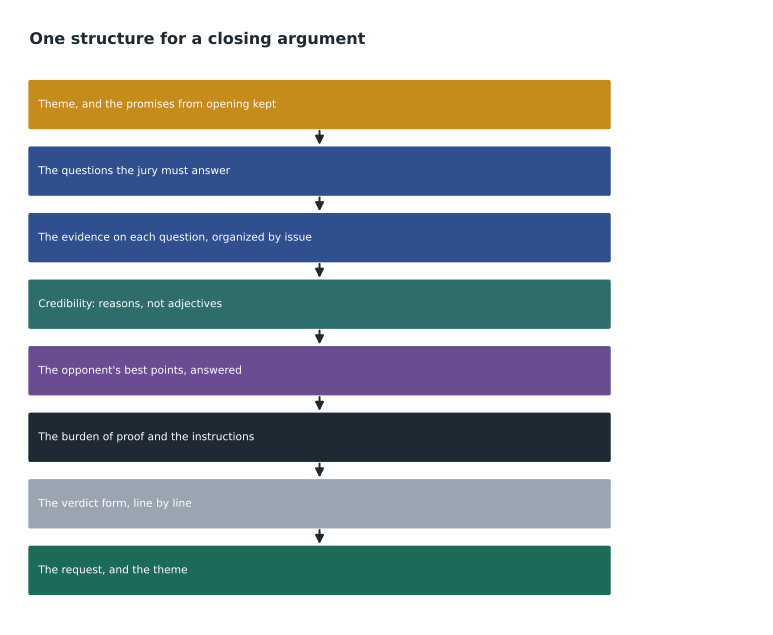
Organizing by issue rather than witness is one of the most important choices. A closing that recounts each witness in turn repeats the trial; a closing that takes the disputed questions one at a time and gathers the evidence on each shows the jury how to decide. For each issue the lawyer can use a simple pattern: the question, the answer, the evidence, and the reason the other side's answer does not work. Credibility arguments should rest on reasons, such as interest, opportunity to observe, consistency with documents and other witnesses, and common sense, rather than on adjectives.
Closing is also the time to draw the conclusions the lawyer was careful not to ask witnesses to accept on cross. The cross of Dr. Achterberg established that his tests used a higher charging current than the Trail 750's charger delivers; the closing argues what that means: his tests show what happens when a cell is pushed harder than Rosa Delgado's ever was, and so they do not show what happened in her garage. The cross of Tara Quinn established her deal and her earlier statement; the closing asks why the shout appeared only after the deal.
Arguing the burden of proof
In criminal cases, the defense closing usually centers on reasonable doubt. The Due Process Clause requires proof beyond a reasonable doubt of every element of the charged crime, under In re Winship, 397 U.S. 358 (1970). Courts differ on whether and how reasonable doubt should be defined for the jury, and the Supreme Court has held that the Constitution neither requires nor prohibits a definition, so long as the instructions taken as a whole correctly convey the concept (Victor v. Nebraska, 511 U.S. 1 (1994)). Lawyers must argue reasonable doubt using the court's instruction and must avoid quantifying it or trivializing it, both of which courts have criticized. Prosecutors may argue that the evidence meets the standard and may explain that it does not require proof beyond all possible doubt, but may not dilute it.
In civil cases the burden is usually a preponderance of the evidence, and plaintiffs' lawyers often use the image of a scale. Defense lawyers emphasize that the burden is on the plaintiff and that a tie goes to the defendant. Where a heightened standard applies, such as clear and convincing evidence for punitive damages in many jurisdictions, both sides should explain what it means in the court's words.
Arguing damages
In civil cases, the plaintiff's closing must give the jury a way to calculate damages. Economic damages, such as medical expenses and lost earnings, can be presented from the evidence with specific numbers. Noneconomic damages, such as pain and suffering, are harder, and jurisdictions differ on how lawyers may argue them. Some allow per diem arguments, which suggest a daily or hourly figure multiplied over the period of suffering; others prohibit or restrict them as speculative. Some allow lawyers to suggest a specific total for noneconomic damages; others forbid it. Lawyers must know the rule where they try cases. Defense lawyers face a choice: arguing only liability risks leaving the jury with only the plaintiff's numbers, but arguing damages can seem to concede liability. Many defense lawyers make a short, separate damages argument framed conditionally, often after the liability argument and with a transition that preserves the main theory.
Punitive damages arguments raise their own issues. Arguments about the defendant's wealth are usually limited to a bifurcated punitive phase. Due process limits on punitive awards, from BMW of North America v. Gore (1996) and State Farm Mutual Automobile Insurance Co. v. Campbell (2003), shape what a lawyer may ask for. And courts often forbid arguments urging the jury to send a message to the defendant or to society during the compensatory phase, because compensatory damages are meant to compensate, not to punish.
Worked problem
Two closings in State v. Pike
At the end of the mock trial in State v. Pike, Daniel Reyes closes for the State and Priya Natarajan for the defense. In his rebuttal, Daniel says: "Defense counsel wants you to believe Lou Abbott didn't know who shoved him. But Devon Pike sat there for this whole trial and never told you any different." He also says: "I've prosecuted a lot of cases, and I know a guilty man when I see one." What should Priya do, and what remedies are available?
Show solution
- Identify the problems. The first statement comments on the defendant's failure to testify, a Griffin violation, by pointing to his silence at trial as evidence. The second states the prosecutor's personal opinion of guilt and implies knowledge beyond the evidence, which is improper vouching and violates Model Rule 3.4(e).
- Object immediately, even though objecting during closing is uncomfortable: "Objection, Your Honor. May we approach?" At sidebar, state both grounds: comment on the defendant's silence in violation of the Fifth Amendment and Griffin, and personal opinion and vouching.
- Request a curative instruction: the jury must not consider the defendant's decision not to testify for any purpose, and the lawyer's personal opinions are not evidence. Ask that the instruction be given immediately, not only in the final charge.
- Move for a mistrial. A direct comment on the defendant's silence in rebuttal, where the defense has no chance to respond, is serious, and the defense should make the motion to preserve the issue even if the court is likely to deny it.
- On appeal, the preserved Griffin error would be reviewed for harmlessness beyond a reasonable doubt under Chapman; the vouching would be assessed in context under Young and, on habeas review, Darden.
Answer: Priya must object at once on both grounds, ask for an immediate curative instruction and move for a mistrial. The Griffin comment is constitutional error that the State must show was harmless beyond a reasonable doubt; the personal opinion of guilt is improper vouching. Silence would reduce both to plain error review.
Delivery and the last word
Closing is delivered, not read. Lawyers should know the argument well enough to speak from a short outline, maintain eye contact with jurors, and use exhibits and admitted testimony at the moments they matter. Reading a key sentence from the transcript or showing a key frame of video can be more persuasive than any characterization of it. Visuals should be prepared in advance and shown to the opponent and the court if local practice requires. Many lawyers practice the first and last two minutes word for word and allow the middle to flow from the outline.
The last words of a closing are the last words the jury hears from the lawyer, and they should be memorable and specific. Lawyers often end by returning to the theme, telling the jury exactly what the lawyer is asking for on the verdict form, and thanking the jury briefly. Cadwallader tells his students to sit down while the jury is still listening. "If you have to say 'in conclusion' twice, you have already lost them."
Common mistakes
MistakeRecounting the testimony witness by witness.
InsteadOrganize the closing by the questions the jury must decide and gather the evidence on each.
MistakeStating personal belief in the client's cause or a witness's honesty.
InsteadArgue credibility from reasons in the evidence; Model Rule 3.4(e) forbids personal opinions.
MistakeSaving new arguments for rebuttal.
InsteadRebuttal is limited to responding to the opponent's argument.
MistakeLetting an improper argument pass without objection.
InsteadObject, request a curative instruction and move for a mistrial if needed; otherwise review is for plain error.
MistakeAsking jurors to award what they would want if they were the plaintiff.
InsteadGolden rule arguments are improper; give the jury a principled basis for the amount.
Summary and key terms
- Closing argument is the time to argue inferences, credibility and the application of the law to the facts.
- Criminal Rule 29.1 sets the order: government, defense, government rebuttal; rebuttal is limited to responding.
- Courts may instruct before or after closings (Civil Rule 51(b)(3)); closings should track the court's instructions.
- Improper arguments include facts outside the evidence, personal opinions, golden rule appeals, comments on a defendant's silence (Griffin; Doyle) and burden shifting.
- Berger, Young and Darden define the prosecutor's duty and the standards for reviewing improper argument.
- A strong structure moves from theme to the questions, the evidence on each, credibility, the opponent's points, the burden, the verdict form and the request.
- Reasonable doubt must be argued using the court's instruction (Winship; Victor); civil burdens and damages arguments vary by jurisdiction.
- Improper argument must be met with an immediate objection, a curative instruction and, if necessary, a mistrial motion.
- Closing argument
- Counsel's argument after the evidence, explaining what it shows and asking for a verdict.
- Rebuttal argument
- The final argument by the party with the burden, limited to responding to the opponent.
- Vouching
- Improperly supporting a witness's credibility with personal assurances or the government's prestige.
- Golden rule argument
- An improper request that jurors decide as they would want if they were a party.
- Invited response
- The doctrine that an improper remark may be evaluated in light of the opponent's provocation (Young).
- Per diem argument
- A damages argument suggesting a daily or hourly amount for pain and suffering, permitted in some jurisdictions.
- Griffin error
- Prosecutorial comment on a criminal defendant's decision not to testify.
- Curative instruction
- An instruction directing the jury to disregard improper argument or evidence.
Practice problems
Work each problem on paper first, then reveal the answer to check.
In closing, a plaintiff's lawyer says, "Ask yourselves what you would want if this had happened to your daughter." What is the objection?
Show answer
Golden rule argument. It asks jurors to put themselves in the plaintiff's position instead of deciding on the evidence.
A prosecutor argues in rebuttal a new theory of the defendant's motive that she did not raise in her first closing or in response to the defense. What can the defense do?
Show answer
Object that the argument exceeds the scope of rebuttal and, if allowed, request an opportunity to respond or a limiting instruction.
Defense counsel argues that the prosecution's case is a "frame-up" and the prosecutor replies, "I wouldn't be here if I didn't believe he was guilty." How would Young evaluate this?
Show answer
The prosecutor's personal opinion is improper, but a reviewing court considers whether it was an invited response to defense counsel's improper argument and, if unobjected to, whether it was plain error.
Why do many lawyers organize closing by issue rather than by witness?
Show answer
Because it shows the jury how the evidence answers each question they must decide, rather than repeating the trial, and gives jurors arguments they can use in deliberation.
Lesson quiz · 5 questions
Score 60% or more to complete this lesson.
Create a free account to save your progress, take quizzes and earn a certificate.