
LAWU-304 · Lesson 9 of 12 · 24 min
Specific performance
▶ Video coming soon A video version of this lesson is on the way.
Calderwood adds three new documents to the Juniper Hill file, all invented for the course. The first is a signed contract, dated June 2, 2026, under which Berenice Corbin agreed to sell Juniper Hill the thirty-acre pasture that adjoins the creamery's land for 210,000 dollars, closing October 15. In September a developer offered her 290,000 dollars, and she told Lena Marsh she would not close. The second is a bill of sale, signed but not yet performed, for a 1960s copper cheese vat that Winifred Lachance, a retiring cheesemaker two counties away, agreed to sell for 38,000 dollars; she has since received a higher offer from a collector and says she will return the deposit. The third is an employment agreement with Mattias Hjelm, Juniper Hill's head cheesemaker, who has announced he is leaving in December to join Wolf Hollow Creamery, a competitor thirty miles away. His agreement has a two-year term and a promise not to work for a competing creamery within fifty miles during the term. "In each case," Calderwood says, "the client wants the thing, not the money. Equity can sometimes give it to her."
The nature of specific performance
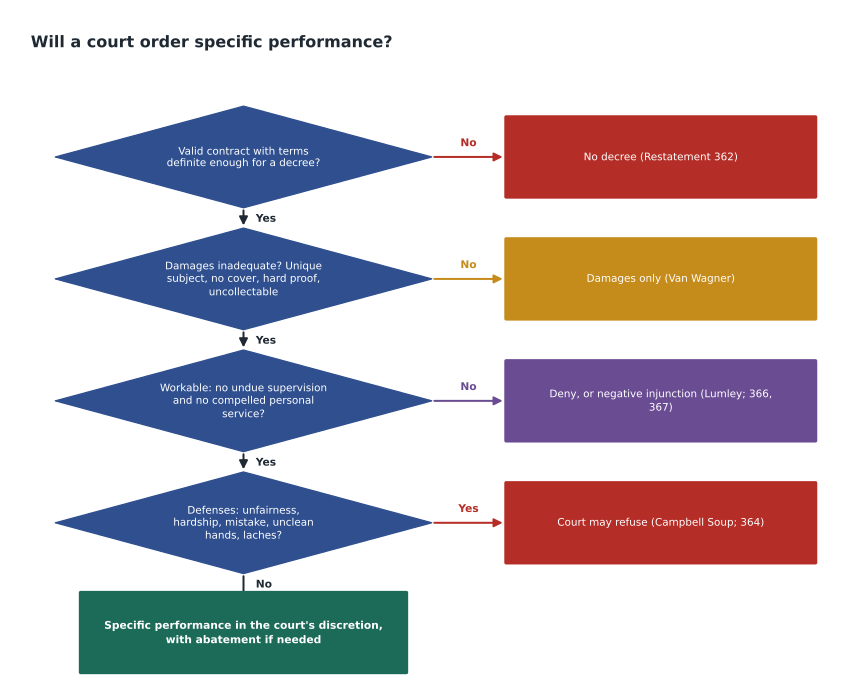
Specific performance is a decree ordering a party to perform its contract. It is the contract equivalent of an injunction, and it is subject to the same equitable conditions: the remedy at law must be inadequate, the decree must be workable, and the court has discretion to refuse relief when it would be unfair. Restatement (Second) of Contracts section 359(1) states the adequacy principle: specific performance or an injunction will not be ordered if damages would be adequate to protect the expectation interest of the injured party. Section 360 lists the factors that bear on adequacy: the difficulty of proving damages with reasonable certainty, the difficulty of procuring a suitable substitute performance by means of the money awarded as damages, and the likelihood that an award of damages could not be collected.
In theory, specific performance is the best measure of expectation, because the plaintiff gets exactly what it bargained for. In practice, Anglo-American law has treated damages as the normal remedy for breach of contract and specific performance as exceptional, unlike civil law systems, in which specific performance is at least formally the primary remedy. The traditional preference for damages has been defended on economic grounds, as permitting efficient breach, and criticized on the ground that damages often undercompensate because of the limits studied in Lesson 3. Modern courts have expanded specific performance, especially for goods, but the requirement of inadequacy remains.
Land
Courts have long treated every parcel of land as unique, and contracts for the sale of land are the classic case for specific performance. A buyer of land need not prove that the particular parcel has special characteristics; the remedy is available almost as a matter of course. The Corbin pasture is a clear example. It adjoins Juniper Hill's land, it is the only parcel that could expand the creamery's grazing without moving the herd, and it cannot be replaced with money. Lena can sue for specific performance, and a court will very likely order Berenice Corbin to convey the pasture for 210,000 dollars. The developer's higher offer does not excuse Corbin's breach; if anything, it shows why damages would be inadequate, since Juniper Hill could not buy the parcel at any price once it is sold to someone else. Lena should promptly record a notice of pending action, often called a lis pendens, so that the developer cannot take the land free of Juniper Hill's claim.
Most courts also allow the seller of land to obtain specific performance against a defaulting buyer, ordering the buyer to pay the price and take the deed. The seller's damages, the difference between the contract price and the market value, may seem adequate, so the remedy has been explained by mutuality of remedy: since the buyer could get specific performance, the seller should too. The mutuality doctrine has been widely criticized and is largely abandoned as a general requirement, and some courts deny vendors specific performance when the property can readily be resold. Under the doctrine of equitable conversion, a buyer under a specifically enforceable contract is treated as the equitable owner of the land from the time of signing, which matters for risk of loss and for inheritance if a party dies before closing.
When the seller cannot convey everything promised, the buyer may obtain specific performance with abatement of the price. If Berenice Corbin turned out to own only twenty-eight of the thirty acres, Lena could take the twenty-eight acres at a proportionally reduced price, unless the shortfall defeated the purpose of the purchase. The buyer cannot be forced to accept a materially different performance, but may choose to.
Goods
For contracts for the sale of goods, UCC section 2-716(1) provides that specific performance may be decreed where the goods are unique or in other proper circumstances. The Official Comment states that the section seeks to further a more liberal attitude than some courts have shown, and that uniqueness is to be determined by the total situation, which characterizes the contract. Output and requirements contracts involving a particular or peculiarly available source or market present the typical commercial specific performance situation, and inability to cover is strong evidence of other proper circumstances. Section 2-716(3) gives the buyer a right of replevin for goods identified to the contract if, after reasonable effort, it is unable to cover.
Several cases illustrate the expansion. In Laclede Gas Co. v. Amoco Oil Co. (8th Cir. 1975), a gas utility had a long-term contract for Amoco to supply propane to new subdivisions until natural gas lines reached them. When propane prices rose during the energy crisis, Amoco tried to cancel. The court ordered specific performance, because a long-term supply contract in a volatile market could not be replaced and damages over the remaining term would be speculative. In Sedmak v. Charlie's Chevrolet, Inc. (Mo. Ct. App. 1981), a dealer agreed to sell a buyer a limited-edition Corvette Indianapolis 500 pace car at the sticker price, then demanded a higher price because of demand. The court ordered specific performance, finding the car unique under the circumstances because of its scarcity and the buyer's inability to obtain one elsewhere without considerable expense and delay.
The Lachance vat is a strong case. Copper vats of that era are rare, Juniper Hill wants it for a traditional cheddar process, and no comparable vat is available on the market. A court could find it unique under section 2-716(1), or find other proper circumstances in Juniper Hill's inability to cover. Lena should also consider replevin under section 2-716(3), which lets a buyer recover goods identified to the contract.
Not every scarcity justifies the remedy. Campbell Soup Co. v. Wentz (3d Cir. 1948) shows that a court may refuse specific performance even when the goods are effectively unique. Campbell Soup contracted with farmers for their entire crop of Chantenay red cored carrots, a variety Campbell used for its uniform color and shape. When market prices tripled, the farmers sold some of the carrots to a neighbor, who resold them to Campbell. The Third Circuit agreed that the carrots were unique enough for specific performance because they were virtually unobtainable on the open market, but refused relief because the contract was too one-sided: among other things, it excused Campbell from accepting carrots in some circumstances while forbidding the farmers to sell them elsewhere. A party who drives that hard a bargain, the court said, should not come to equity for help in enforcing it.
Inadequacy beyond uniqueness
Van Wagner Advertising Corp. v. S and M Enterprises (N.Y. 1986) is the leading modern discussion of what uniqueness means. Van Wagner leased space on the side of a Manhattan building for an advertising sign visible to heavy traffic on a busy Manhattan approach road. A new owner bought the building and canceled the lease. New York's highest court agreed that the space was unique in a physical sense, but explained that uniqueness is not a matter of physical difference alone; the question is whether damages can be calculated. Here they could, because Van Wagner resold the space to advertisers and its lost revenue could be measured. The court therefore held that damages were adequate and that the trial court had properly declined to order specific performance.
Courts also consider the plaintiff's ability to collect. If a defendant is insolvent, a damages judgment may be worthless, while specific performance of a promise to convey a specific asset gives the plaintiff the asset ahead of other creditors. Restatement section 360(c) lists the likelihood that damages could not be collected as a factor. Bankruptcy law limits the advantage, because a trustee may reject executory contracts, but specific performance can still matter outside bankruptcy.
Definiteness and supervision
A court can order performance only of terms that are certain enough to frame a decree. Restatement section 362 provides that specific performance will not be granted unless the terms of the contract are sufficiently certain to provide a basis for an appropriate order. A contract may be definite enough to support damages, which require only a reasonable basis for computing loss, but too indefinite for specific performance, which requires the court to say exactly what the defendant must do.
Courts also hesitate to order performance that would require extensive supervision. In Northern Delaware Industrial Development Corp. v. E.W. Bliss Co. (Del. Ch. 1968), the owner of a steel mill that was being expanded sued the contractor, seeking an order requiring the contractor to add a night shift and put more workers on the job. The Delaware Court of Chancery refused, explaining that it could not effectively supervise a large construction project with hundreds of workers, and that the owner's remedy was damages. Restatement section 366 provides that a promise will not be specifically enforced if the character and magnitude of the performance would impose on the court burdens in enforcement or supervision that are disproportionate to the advantages to be gained. Modern courts sometimes appoint a monitor or receiver, as they do in structural cases, but the reluctance remains.
Personal service contracts
Courts will not order a person to perform a contract for personal services. Restatement section 367(1) states that a promise to render personal service will not be specifically enforced. The reasons are practical and moral: a court cannot supervise the quality of an unwilling performer's work, and compelling a person to work for another resembles involuntary servitude, which the Thirteenth Amendment forbids. Mattias Hjelm cannot be ordered to keep making cheese for Juniper Hill.
Equity has an alternative: a negative injunction forbidding the employee from working for a competitor during the term. In Lumley v. Wagner (Ch. 1852), the opera singer Johanna Wagner contracted to sing exclusively at Benjamin Lumley's theater for a season and not to sing elsewhere, then agreed to sing for a rival. The court would not order her to sing for Lumley, but it enjoined her from singing for the rival during the term. Restatement section 367(2) adopts a limited version: a promise to refrain from rendering services will not be enforced by injunction if the probable result would be to compel a performance involving personal relations the enforced continuance of which is undesirable, or would be to leave the employee without other reasonable means of making a living. Courts typically limit negative injunctions to employees whose services are unique or extraordinary, such as performers, athletes and key executives. In American Broadcasting Cos. v. Wolf (N.Y. 1981), the court refused to bar a sportscaster from working for a rival network after his ABC contract had expired, even though he had breached a good-faith negotiation clause, because there was no express covenant not to compete after the term and the policy against restraining a person's livelihood was strong.
Covenants not to compete that extend beyond the term of employment are governed by state contract law. Most states enforce them if they are reasonable in duration, geography and scope and protect a legitimate interest such as trade secrets or customer relationships. California refuses to enforce most employee noncompetes by statute. Hjelm's covenant applies only during his two-year term and within fifty miles, and Wolf Hollow is thirty miles away. If Hjelm's skills as a head cheesemaker are distinctive, if he knows Juniper Hill's recipes and aging methods, and if losing him to a nearby competitor would cause harm that is hard to measure, a court could enjoin him from working for Wolf Hollow until the term ends. It could not order him to return to Juniper Hill, and it would consider whether the injunction would leave him without other reasonable means of making a living. He could make cheese more than fifty miles away, or do other work.
Defenses to specific performance
Because specific performance is equitable, the defendant may raise defenses that would not bar damages. Restatement section 364 provides that specific performance will be refused if the contract was induced by mistake or by unfair practices, if relief would cause unreasonable hardship or loss to the party in breach or to third persons, or if the exchange is grossly inadequate or the terms are otherwise unfair. Campbell Soup is an unfairness case. A defendant may also invoke unclean hands, laches and the other equitable defenses discussed in Lesson 11. These defenses leave the plaintiff its damages remedy; they only withhold the extraordinary remedy.
Worked problem
Lena's three demands
Lena asks what Juniper Hill can obtain in each matter: (1) the Corbin pasture, (2) the Lachance vat, and (3) Mattias Hjelm's services. Berenice Corbin argues that 210,000 dollars is now well below market. Winifred Lachance argues that the vat is just equipment and Juniper Hill can buy a modern stainless vat. Hjelm argues that he cannot be forced to work.
Show solution
- Corbin pasture: land is presumed unique. A higher outside offer is not a defense; the price was fair when made, and a rise in value is the buyer's benefit of the bargain. Juniper Hill should tender the price, record a lis pendens and sue for specific performance. A decree is very likely.
- Lachance vat: a 1960s copper vat for a traditional process is unique or presents other proper circumstances under section 2-716(1); a modern stainless vat is not a substitute for Juniper Hill's purpose. Replevin under section 2-716(3) is also available once Juniper Hill shows that it cannot cover after reasonable effort. The collector's higher offer does not excuse Lachance's breach.
- Hjelm: no court will order him to work for Juniper Hill (Restatement section 367(1)). A negative injunction forbidding him from working for Wolf Hollow during the term is possible if his services are distinctive and the covenant is reasonable, and if the injunction would not leave him without means of a living. Juniper Hill may also recover damages for the cost of replacing him.
- Practical point: specific performance for land and the vat gives Juniper Hill exactly what it wants. For Hjelm, the realistic goal is to protect Juniper Hill's recipes and customers and to negotiate a transition.
Answer: Specific performance for the pasture and the vat; a possible negative injunction, not specific performance, against Hjelm.
Common mistakes
MistakeRequiring a buyer of land to prove that the parcel is physically special.
InsteadLand is presumed unique, and buyers obtain specific performance almost as a matter of course.
MistakeLimiting specific performance of goods to antiques and works of art.
InsteadUCC section 2-716(1) permits it for unique goods or in other proper circumstances, including long-term supply contracts and inability to cover (Laclede Gas; Sedmak).
MistakeTreating physical uniqueness as decisive.
InsteadVan Wagner holds that the question is whether damages are adequate; unique property whose value can be measured may support only damages.
MistakeAsking a court to order an employee to keep working.
InsteadCourts will not order personal services; a negative injunction during the term may be available for unique employees (Lumley; Restatement section 367(2)).
MistakeAssuming a plaintiff who meets the adequacy test is entitled to specific performance.
InsteadThe remedy is discretionary, and unfairness, hardship, mistake, unclean hands and laches can defeat it (Campbell Soup; Restatement section 364).
Summary and key terms
- Specific performance orders a party to perform its contract; it requires inadequate damages, a definite and workable decree and the absence of equitable defenses.
- Restatement sections 359 and 360 make adequacy turn on difficulty of proof, difficulty of obtaining a substitute and collectability.
- Land is presumed unique; sellers may also obtain specific performance in most states; equitable conversion and abatement follow.
- UCC section 2-716 permits specific performance of unique goods or in other proper circumstances, including long-term supply contracts (Laclede Gas; Sedmak) and inability to cover; replevin is available for identified goods.
- Van Wagner focuses on whether damages can be measured, not physical uniqueness; Campbell Soup refused relief for an unfair contract.
- Courts refuse decrees that are too indefinite or require disproportionate supervision (Restatement sections 362 and 366; Northern Delaware).
- Personal services are never specifically enforced; negative injunctions may bar unique employees from working for competitors during the term (Lumley v. Wagner; ABC v. Wolf; Restatement section 367).
- Restatement section 364 lists defenses: mistake, unfair practices, unreasonable hardship, inadequate exchange and unfair terms.
- Specific performance
- A decree ordering a party to perform its contract.
- Mutuality of remedy
- The largely abandoned doctrine that specific performance is available to one party only if it is available to the other.
- Equitable conversion
- The doctrine treating the buyer under a specifically enforceable land contract as the equitable owner from signing.
- Abatement
- A reduction in the price when the seller can convey only part of what was promised.
- Lis pendens
- A recorded notice that a lawsuit affects title to land, binding later purchasers to the outcome.
- Replevin
- A remedy for recovering specific goods; available to buyers of identified goods under UCC section 2-716(3).
- Negative injunction
- An order forbidding a party from performing for others, used to enforce exclusive service contracts without compelling service.
- Covenant not to compete
- A promise not to work for or become a competitor, enforceable in most states if reasonable in time, place and scope.
Practice problems
Work each problem on paper first, then reveal the answer to check.
A buyer contracts to buy a new, mass-produced sedan from a dealer. The dealer refuses to deliver because prices have risen. Can the buyer get specific performance?
Show answer
Probably not. The car is not unique and the buyer can cover by buying a similar car elsewhere, recovering the price difference under section 2-712. If the model is scarce and cover is impossible, as in Sedmak, the result could differ.
A city contracts with a developer to build and operate a downtown hotel. The developer abandons the project. The city seeks an order requiring construction. What obstacles does it face?
Show answer
Supervision and definiteness: a decree requiring construction and long-term operation would impose disproportionate burdens on the court (Northern Delaware; Restatement section 366), and the terms may not be definite enough. Damages are the likely remedy.
A professional athlete with three years left on his contract signs with a rival team. What can his current team obtain?
Show answer
Not an order to play for it. If his services are unique and the contract contains an exclusivity promise, the team may obtain a negative injunction barring him from playing for the rival during the contract term (Lumley v. Wagner).
A seller agrees to sell land worth 400,000 dollars for 100,000 dollars after the buyer conceals a planned highway that will make the land more valuable. Is specific performance likely?
Show answer
No. Restatement section 364 permits refusal when the contract was induced by unfair practices or the exchange is grossly inadequate. The seller may also have a rescission or fraud claim.
Lesson quiz · 5 questions
Score 60% or more to complete this lesson.
Create a free account to save your progress, take quizzes and earn a certificate.