
LAWU-304 · Lesson 1 of 12 · 29 min
The remedial map: rights, remedies and the rightful position
▶ Video coming soon A video version of this lesson is on the way.
Professor Severin Calderwood begins the first Remedies class of the fall by carrying in a banker's box and setting it on the lectern. Before he joined the Larkhaven faculty he spent ten years as a commercial trial lawyer, about half of it for plaintiffs and half for defendants, and then seven years as a federal magistrate judge, where much of his docket was settlement conferences, preliminary injunction hearings and damages inquests after default. "For two years," he tells Section B, now in their third year, "your professors have taught you how to decide who wins. This course is about what the winner gets. A right without a remedy is a lecture." The box, he explains, is the remedies docket: a set of files the class already knows from earlier courses, reopened at the point where the question stops being liability and becomes relief. Juniper Hill Creamery's claims against Calloway Refrigeration Systems and Northgate Grocers are in it. So are the injuries from the Haldane County Fair. He has added a few new files of his own, including a dispute between a quarry and a horse farm, and for the purposes of the course he places every file in the fictional State of Westmarch.
Calderwood writes three questions on the board and tells the class they will answer them for every file in the box. What is the rightful position? Which remedy, or combination of remedies, gets the plaintiff there? What stops us from getting there? The first question identifies the goal. The second chooses the tool. The third catalogs the limits: doctrines like foreseeability, certainty and avoidable consequences, the equitable prerequisites, the defenses, the constitutional limits on punishment and the practical limits of enforcement. Daniel Reyes, who spent three years as a paralegal at a plaintiffs' personal-injury firm before law school, says that in his experience the third question was the only one anyone asked. Calderwood agrees that it is where cases are won and lost, but says nobody can answer it well without the first two.
Rights and remedies
Lawyers often talk as if a right and a remedy were the same thing, but they are not. A substantive right says what one person owes another: not to injure carelessly, to perform a promise, not to take property. A remedy is what a court will do when the right is violated, or is about to be. The distinction matters because the same right can support very different remedies, and because the law sometimes recognizes a right while limiting or denying the remedy. The old maxim "where there is a right, there is a remedy" expresses an aspiration, and Chief Justice Marshall invoked it in Marbury v. Madison (1803), but modern law is full of rights whose enforcement is limited: immunities shield governments and officials, statutes cap damages, and courts decline to imply private rights of action from statutes that create duties without saying who can sue. Alexander v. Sandoval (2001) is the leading modern statement that private rights of action to enforce federal law must be created by Congress, and in Landor v. Louisiana Department of Corrections (2026) the Supreme Court held that the Religious Land Use and Institutionalized Persons Act does not authorize damages suits against prison officials in their personal capacities, even though the statute plainly protects the religious exercise of prisoners.
A remedies course therefore studies the space between right and relief. Most of the doctrine is common to many fields. The rules for measuring damages, the standards for injunctions and the law of restitution apply across contracts, torts, property, intellectual property and constitutional litigation. A lawyer who knows them can move from a breach of contract to a nuisance to a civil rights case and ask the same questions in each.
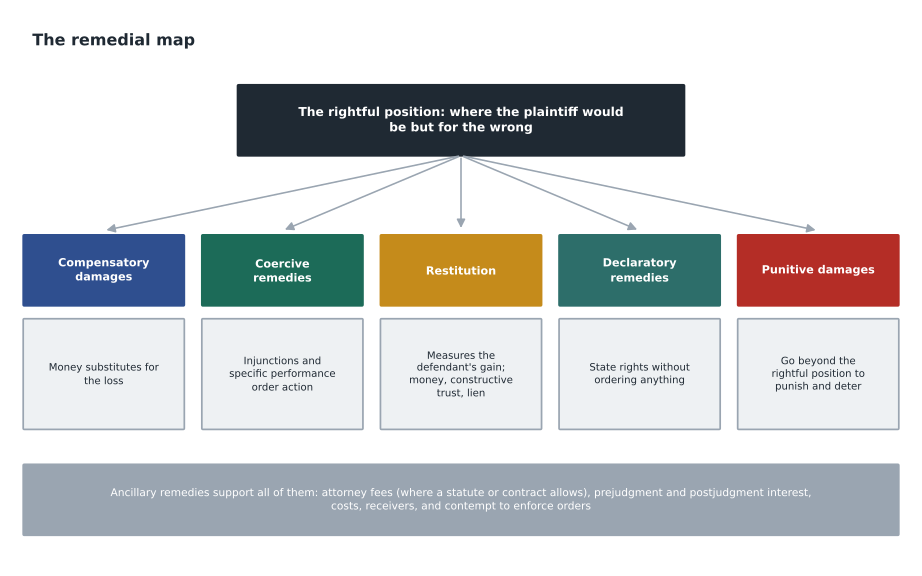
A classification of remedies
Remedies can be sorted several ways, and Calderwood uses two. The first sorting asks what the remedy does. Substitutionary remedies give the plaintiff money in place of the thing lost. Compensatory damages are the central example: the plaintiff whose cheese spoiled gets the value of the cheese, not new cheese. Specific remedies try to give the plaintiff the very thing it was entitled to, or to prevent the harm from happening at all. An injunction that orders a quarry to stop blasting before seven in the morning, a decree of specific performance that orders a seller to convey land, and an order to return a stolen painting are specific remedies. Specific relief is usually coercive: it is an order addressed to the defendant personally, enforceable by contempt.
The second sorting asks what the remedy measures. Compensatory remedies measure the plaintiff's loss. Restitutionary remedies measure the defendant's gain. Punitive remedies are measured by what it takes to punish and deter. Declaratory remedies measure nothing; they state rights. Most remedies fall clearly into one category, but some do not. Restitution can be money (a judgment for the value of a benefit) or specific (a constructive trust that gives the plaintiff the very asset). Specific performance is sometimes described as the most complete form of expectation recovery. And ancillary remedies, such as attorney fees, interest, costs and contempt, exist to make the others work.
- Compensatory damages: money that puts the plaintiff in the rightful position, as nearly as money can.
- Restitution and disgorgement: recovery measured by the defendant's unjust gain, as money or through a constructive trust, equitable lien or accounting for profits.
- Coercive remedies: injunctions and specific performance, which order the defendant to act or to refrain from acting.
- Declaratory remedies: declaratory judgments, quiet title and similar actions that state the parties' rights and leave them to act accordingly.
- Punitive damages: money beyond compensation, awarded to punish especially culpable conduct and to deter it.
- Ancillary remedies: attorney fees in the cases where they are available, prejudgment and postjudgment interest, costs, receivers and contempt.
The rightful position
The organizing idea of the course is the rightful position, a phrase Calderwood credits to the remedies scholar Douglas Laycock: the position the plaintiff would have occupied if the wrong had never occurred. Compensatory damages aim to restore the plaintiff to that position. So do most injunctions. The principle is easy to state and hard to apply, because it requires a counterfactual. To compute it the court must imagine a world in which the defendant behaved lawfully and ask what the plaintiff would have had in that world.
The counterfactual differs by field. In contract, the lawful world is the world in which the promise was performed, so the rightful position is the position the plaintiff would have reached through performance. That is the expectation interest, the subject of Lesson 2. In tort, the lawful world is usually the world before the injury, so the rightful position is the plaintiff's position before the accident, adjusted for what would have happened anyway. In a case of continuing wrong, the rightful position is a world in which the wrong stops. The principle also has a ceiling: in general the plaintiff should not end up better off than the rightful position, which is why damages are reduced by benefits the wrong conferred and by losses the plaintiff could reasonably have avoided. Punitive damages and disgorgement of profits are deliberate exceptions to that ceiling, and much of the law of those remedies is about when the exception is justified.
Priya Natarajan, who wants to do appellate work and likes to test principles at the edges, asks how the rightful position applies to a plaintiff who cannot be restored. Nadia Okoro, the dental hygienist burned by debris from a low-bursting firework shell at the Haldane County Fair, will carry scars on her face and neck no matter what any court does. Calderwood says the law's answer is that money stands in for what cannot be restored, and that the hardest questions in the law of damages, those about pain, disfigurement and lost enjoyment of life, arise precisely because no market sets the price. That is Lesson 4.
Law and equity
Every remedy in this course has a lineage, and the lineage still matters. For centuries English courts were divided. The common law courts gave damages and, in a few actions such as replevin and ejectment, recovery of specific property. The Court of Chancery, which grew from petitions to the king's chancellor, gave remedies the common law courts did not: injunctions, specific performance, accountings, constructive trusts, rescission and reformation. Chancery acted on the person of the defendant. Its decrees were orders, and a defendant who disobeyed could be jailed for contempt. Because equity offered extraordinary relief, it insisted on conditions: the plaintiff had to show that the legal remedy was inadequate, and the chancellor exercised discretion, guided by maxims such as "he who seeks equity must do equity" and "equity aids the vigilant, not those who slumber on their rights."
American federal courts merged law and equity procedurally when the Federal Rules of Civil Procedure took effect in 1938; Rule 2 provides that there is one form of action, the civil action, and nearly every state has done the same. But merger of procedure did not merge the remedies. Four consequences of the old division survive. First, the Seventh Amendment preserves the right to a jury in suits at common law, which the Supreme Court has read to mean claims that would have been tried at law in 1791 and claims analogous to them. Equitable claims are tried to the judge. When a case mixes both, Beacon Theaters v. Westover (1959) and Dairy Queen v. Wood (1962) require that legal issues common to both be tried to the jury first, so that the judge's equitable findings do not preempt the jury. SEC v. Jarkesy (2024) applied the same historical test to hold that the SEC's claims for civil penalties for securities fraud are legal in nature and carry a jury right. Second, equitable remedies remain discretionary in a way damages are not: a plaintiff who proves a tort is entitled to damages, but a plaintiff who proves a nuisance must still persuade the court that an injunction is appropriate. Third, equitable remedies are enforceable by contempt, while a money judgment is enforced by execution against the defendant's property. Fourth, equitable defenses, such as laches and unclean hands, traditionally apply only to equitable claims.
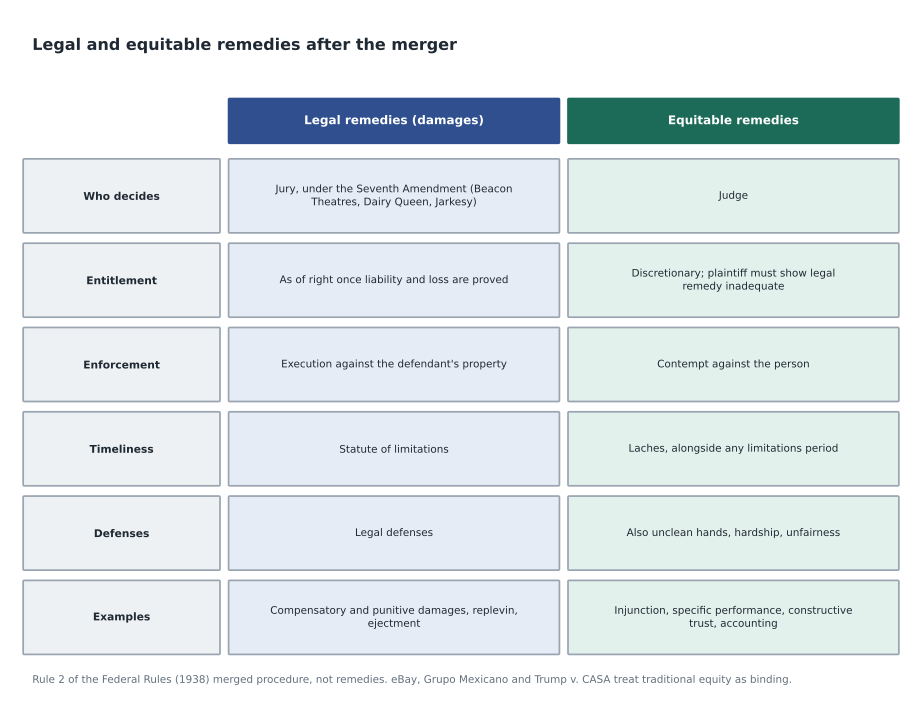
Hannah Lindqvist, a former history teacher, asks whether the inadequacy requirement still means anything when the courts are merged. Calderwood calls it the most debated question in the field. Laycock argued in an influential 1991 book that the irreparable injury rule is mostly dead in practice: courts grant specific relief whenever damages would not fully restore the plaintiff, which is almost always, and they deny it for other reasons that they then describe as adequacy. The Supreme Court, however, continues to repeat the traditional requirement. In eBay Inc. v. MercExchange (2006) it said that a plaintiff seeking a permanent injunction must show irreparable injury, inadequate remedies at law, a balance of hardships favoring relief and that the public interest would not be disserved. In Grupo Mexicano de Desarrollo v. Alliance Bond Fund (1999) it held that federal courts' equitable powers are limited to the relief traditionally available in equity, which did not include a preliminary injunction freezing a defendant's assets before a money judgment. And in Trump v. CASA (2025), studied in Lesson 8, the Court relied on the same historical approach to hold that universal injunctions likely exceed the equitable authority Congress conferred in the Judiciary Act of 1789. History, Calderwood says, is not just background in this course. It is doctrine.
Choosing among remedies
Most plaintiffs have more than one remedy available, and the choice is strategic. A buyer whose seller refuses to deliver a unique copper cheese vat could sue for damages measured by the difference between the contract price and the market price, or seek specific performance, or rescind and recover the deposit. A landowner whose neighbor's quarry throws dust across her pastures could seek damages for past harm, an injunction against future harm, or both. A company whose bookkeeper embezzled could sue for damages or seek a constructive trust over the lake cabin the bookkeeper bought with the money.
The rule against double recovery limits combinations. A plaintiff may plead inconsistent remedies in the alternative under Rule 8(d), but cannot ultimately recover both the value of the contract and restitution of the price, or both damages for permanent loss of a property's value and an injunction that restores the value. The older doctrine of election of remedies, which forced a plaintiff to choose early and held it to the choice, has largely given way to a rule that a plaintiff need only choose before judgment, and is bound earlier only if the defendant has relied on the choice. In the Uniform Commercial Code the point is explicit: section 1-305 directs that remedies be liberally administered to put the aggrieved party in as good a position as if the other party had fully performed, but not to award consequential or penal damages except as specifically provided.
Calderwood adds the client's perspective. A remedy is worth only what it delivers. A judgment against an insolvent defendant is a piece of paper, which is why secured creditors, sureties and insurers matter so much in practice. An injunction against a defendant who will comply only grudgingly may require years of supervision. A constructive trust over a specific asset can beat a money judgment when the defendant is insolvent, because the asset is treated as the plaintiff's and not the defendant's. The best remedy is the one the client can actually collect or enforce, at a cost that makes sense.
Remedies and procedure
Remedies enter a case at the beginning. Rule 8(a)(3) requires a complaint to contain a demand for the relief sought, which may include relief in the alternative or of different types. The demand matters most when a defendant defaults: under Rule 54(c), a default judgment must not differ in kind from, or exceed in amount, what is demanded in the pleadings. In contested cases, Rule 54(c) directs that every other final judgment grant the relief to which the party is entitled, even if the party has not demanded that relief in its pleadings. The demand also drives the jury right, the amount in controversy for diversity jurisdiction, the scope of discovery into damages and the shape of settlement negotiations.
Statutes add their own remedies. Many statutes specify remedies in detail: the Clayton Act's treble damages and attorney fees for antitrust plaintiffs, the Copyright Act's choice between actual damages and profits or statutory damages, civil rights statutes that authorize fee awards, and consumer statutes with minimum damages. When a statute provides a remedy, courts generally hold that it displaces remedies the statute does not mention, unless the text or structure indicates otherwise. When a statute is silent, the question whether courts may supply remedies is one of the most contested in public law, as the sharp limits the Supreme Court has placed on Bivens actions against federal officers show. Egbert v. Boule (2022) said that a court should almost never recognize a new Bivens context, because creating a damages remedy is a legislative judgment.
Remedies against governments
Remedies against governments follow special rules, which Federal Courts covers in depth. The federal government is immune from suit except where Congress waives immunity, as in the Federal Tort Claims Act and the Tucker Act. States are immune from damages suits in federal court under the Eleventh Amendment and in their own courts under Alden v. Maine (1999), but Ex parte Young (1908) permits suits against state officers for prospective injunctive relief to stop ongoing violations of federal law. Section 1983 provides damages against state and local officials, subject to qualified immunity, and against municipalities when a policy or custom caused the violation under Monell v. Department of Social Services (1978). In Olivier v. City of Brandon (2026) the Supreme Court unanimously held that Heck v. Humphrey does not bar a section 1983 suit seeking only prospective declaratory and injunctive relief, even by a plaintiff who was previously convicted under the challenged law. The structure of these rules shows the remedial map at work: the law often permits forward-looking specific relief against government while restricting backward-looking money relief.
Worked problem
Mapping the remedies docket
Calderwood asks Section B to take three files from the box and, for each, identify the rightful position, the candidate remedies and the obvious limits. (1) Juniper Hill Creamery v. Calloway Refrigeration Systems: Calloway installed the aging room and cold storage seven weeks late and with undersized coils; about 2,600 pounds of young cheese spoiled in a July heat wave. (2) Nadia Okoro v. Brightfall Pyrotechnics: a low-bursting shell burned Nadia's face and neck; Brightfall had two low-burst incidents with the same supplier's shells in 2025. (3) Albescu Stables v. Brackenridge Stone Co.: a quarry expanded next to a horse boarding farm and began early-morning blasting that frightens the horses and coats the paddocks in dust.
Show solution
- Juniper Hill: the rightful position is the position Juniper Hill would have been in had Calloway performed on time and with conforming equipment. Candidate remedies are damages under the UCC buyer's remedies, including incidental and consequential damages for the spoiled cheese and the rented trailer. The limits are foreseeability, certainty of lost profits, mitigation and any contractual limitation of remedy that is part of the contract.
- Okoro: the rightful position is Nadia's position before the injury. Compensatory damages cover medical expenses, lost earnings, future losses, pain and suffering and disfigurement. Punitive damages are a candidate because Brightfall continued using shells it knew had burst low. The limits include proof of future losses, any state cap and the due process limits on punitive awards.
- Albescu: the rightful position is a world in which the quarry operates without unreasonably interfering with the farm. Candidate remedies are damages for past harm and an injunction limiting future blasting. The limits are the eBay factors, the balance of hardships, the public interest in the quarry's jobs and stone, and the possibility that a court awards permanent damages instead, as in Boomer v. Atlantic Cement.
- Across all three: a lawyer should ask what the client most needs. Juniper Hill needs money and working equipment. Nadia needs full compensation and, if the facts support it, an award that deters. The Albescus need the blasting changed more than they need a check.
Answer: Each file has a different rightful position and a different best remedy. The course will return to each: Juniper Hill in Lessons 2, 3 and 5, Okoro in Lessons 4 and 6, and Albescu in Lessons 7, 8 and 11.
A vocabulary for the course
Calderwood closes by giving the class a vocabulary that they will use all semester. A legal remedy is one historically available in the common law courts, chiefly damages. An equitable remedy is one historically available in Chancery. Specific relief gives the plaintiff the thing itself rather than its value. Substitutionary relief gives value instead. Preventive relief, such as a preliminary or permanent injunction, acts before harm occurs, while reparative relief repairs harm that has occurred. Structural relief, such as a decree reorganizing a prison or a school district, reshapes an institution so that it stops violating the law. Each of these labels maps onto rules that the course will develop. A good remedies lawyer, Calderwood says, can describe any requested relief using all of them, because the labels determine who decides, what must be shown and how the order will be enforced.
Common mistakes
MistakeTreating the right and the remedy as the same question, so that proving liability is assumed to settle what the plaintiff gets.
InsteadLiability establishes that some remedy may be available; the measure, the type and the limits of relief are separate questions with their own doctrine.
MistakeAssuming the merger of law and equity made the distinction irrelevant.
InsteadThe distinction still determines the jury right, whether relief is discretionary, how it is enforced and which defenses apply.
MistakeMeasuring every plaintiff's recovery by the position before the wrong.
InsteadThe rightful position in contract is the position after performance (expectation); in tort it is usually the position before the injury, adjusted for what would have happened anyway.
MistakeAsking for every remedy and expecting to collect all of them.
InsteadPlaintiffs may plead in the alternative, but the rule against double recovery means they must eventually choose remedies that do not compensate the same loss twice.
MistakeIgnoring collectability and enforcement when choosing a remedy.
InsteadA remedy is worth what it delivers; insolvency, immunity and the cost of supervising compliance often decide which remedy to pursue.
Summary and key terms
- A right defines what is owed; a remedy is what a court will do when the right is violated, and the two can diverge.
- Remedies can be sorted by function (substitutionary or specific) and by measure (the plaintiff's loss, the defendant's gain, punishment or a declaration of rights).
- The rightful position, the position the plaintiff would have occupied but for the wrong, is the organizing principle for compensatory damages and most injunctions.
- Law and equity are procedurally merged, but the distinction still controls jury rights (Beacon Theaters, Dairy Queen, Jarkesy), discretion, enforcement by contempt and defenses.
- eBay, Grupo Mexicano and Trump v. CASA show that the Supreme Court treats the historical limits of equity as binding doctrine.
- Plaintiffs may plead remedies in the alternative but may not recover twice for the same loss; UCC section 1-305 states the expectation principle for commercial cases.
- Statutes often specify remedies, and courts are reluctant to imply remedies that statutes omit (Sandoval, Egbert, Landor).
- Remedies against governments favor prospective specific relief (Ex parte Young; Olivier v. City of Brandon) over damages, which are limited by immunity.
- Remedy
- What a court does to enforce a right or redress its violation: damages, specific relief, restitution, a declaration or an ancillary order.
- Rightful position
- The position the plaintiff would have occupied if the wrong had not occurred; the measure for compensatory damages and most injunctions.
- Substitutionary remedy
- A remedy that gives the plaintiff money in place of the thing lost, such as compensatory damages.
- Specific remedy
- A remedy that gives the plaintiff the very thing to which it is entitled or prevents the harm, such as an injunction or specific performance.
- Equitable remedy
- A remedy historically available in the Court of Chancery, such as an injunction, specific performance, a constructive trust or an accounting.
- Irreparable injury rule
- The traditional requirement that a plaintiff seeking equitable relief show that legal remedies are inadequate.
- Election of remedies
- The doctrine requiring a plaintiff to choose between inconsistent remedies; today the choice usually need be made only before judgment.
- Ancillary remedy
- A remedy that supports others, such as attorney fees, interest, costs, receivership or contempt.
- Structural injunction
- An injunction that reorganizes an institution so that it stops violating the law, such as a school desegregation or prison decree.
Practice problems
Work each problem on paper first, then reveal the answer to check.
A tenant sues a landlord who refuses to make promised repairs. The tenant asks for damages for the reduced value of the apartment and an order requiring the repairs. Which remedies are substitutionary and which are specific?
Show answer
The damages for reduced value are substitutionary: money in place of the repaired apartment. The order requiring repairs is specific and coercive, and as an equitable remedy it is discretionary and enforceable by contempt.
A plaintiff sues for breach of contract and asks only for specific performance. Is the defendant entitled to a jury?
Show answer
Generally no. Specific performance is an equitable remedy decided by the judge. If the plaintiff also sought damages, legal issues common to both claims would have to be tried to the jury first under Beacon Theaters and Dairy Queen.
Why did the Court in Grupo Mexicano refuse to permit a preliminary injunction freezing the defendant's assets in a suit for money?
Show answer
Because federal equitable power is limited to relief traditionally available in the English Court of Chancery, and a creditor without a judgment or a lien could not obtain such an asset freeze in equity.
Under Olivier v. City of Brandon (2026), may a person convicted under a city ordinance bring a section 1983 suit seeking only an injunction against future enforcement?
Show answer
Yes. The Court held unanimously that Heck v. Humphrey does not bar suits seeking purely prospective declaratory and injunctive relief, even by someone previously convicted under the challenged law.
Lesson quiz · 5 questions
Score 60% or more to complete this lesson.
Create a free account to save your progress, take quizzes and earn a certificate.