
LAWU-304 · Lesson 8 of 12 · 26 min
Preliminary relief, structural injunctions and the scope of relief
▶ Video coming soon A video version of this lesson is on the way.
Calderwood rewinds the Albescu file. Suppose, he says, that it is early April. Winter has paused Brackenridge's blasting, and the quarry has just sent its neighbors a notice that early-morning blasting will resume on April 15, with larger charges to make up for lost time. Trial cannot happen until next year. Three boarders have told the Albescus they will leave if the blasting resumes, and the farm's spring riding camp, which brings in a third of its annual revenue, starts in May. "A final judgment next year," Calderwood says, "may come too late to matter. Interim relief exists for that problem. It is also where courts make some of their most consequential decisions with the least information." The second half of the lesson turns to the other end of the remedial spectrum: injunctions that reorganize institutions, and the question of how far any injunction may reach beyond the parties.
Temporary restraining orders
Federal Rule of Civil Procedure 65 provides two forms of interim injunctive relief. A temporary restraining order is the fastest. Under Rule 65(b), a court may issue a TRO without written or oral notice to the adverse party only if specific facts in an affidavit or verified complaint clearly show that immediate and irreparable injury will result before the adverse party can be heard in opposition, and the movant's attorney certifies in writing any efforts made to give notice and the reasons why it should not be required. A TRO issued without notice expires at the time the court sets, not to exceed fourteen days, unless the court extends it for good cause for a like period or the adverse party consents. The opposing party may move to dissolve it on two days' notice. TROs issued after notice are often treated as preliminary injunctions. Courts reserve true ex parte relief for emergencies in which notice would be impossible or would itself cause the harm, for example where the defendant would destroy evidence or move assets.
Preliminary injunctions: the Winter test
A preliminary injunction, under Rule 65(a), may issue only on notice to the adverse party, usually after a hearing. In Winter v. Natural Resources Defense Council, Inc. (2008), environmental groups sought to enjoin the Navy from using mid-frequency sonar in training exercises off California because of its effects on marine mammals. The Ninth Circuit had upheld an injunction on a showing of a "possibility" of irreparable harm. The Supreme Court reversed. A plaintiff seeking a preliminary injunction, it held, must establish that it is likely to succeed on the merits, that it is likely to suffer irreparable harm in the absence of preliminary relief, that the balance of equities tips in its favor, and that an injunction is in the public interest. A mere possibility of irreparable harm is not enough. The Court described a preliminary injunction as an extraordinary remedy never awarded as of right, and found that the Navy's interest in realistic training to protect national security outweighed the plaintiffs' interests.
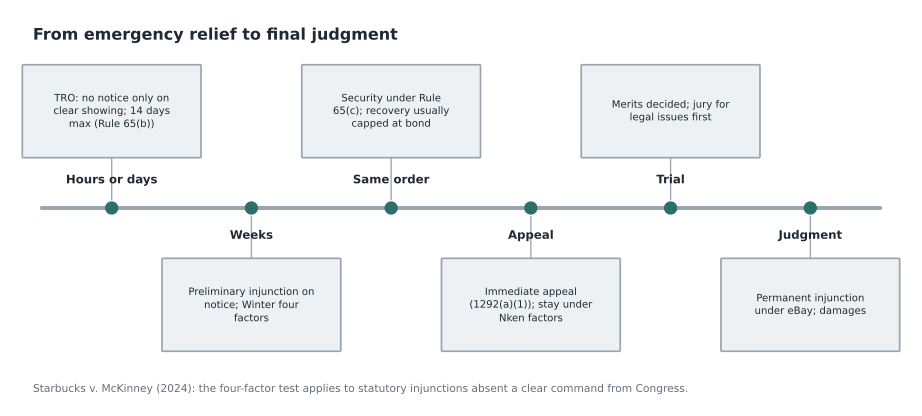
The four factors are now the default standard across federal law. In Starbucks Corp. v. McKinney (2024), the National Labor Relations Board sought a preliminary injunction under section 10(j) of the National Labor Relations Act requiring Starbucks to reinstate employees fired during a union campaign. The Sixth Circuit had applied a more lenient two-part test. The Supreme Court held that, absent a clear command from Congress, courts must apply the traditional four-factor test from Winter, and that section 10(j)'s authorization of "just and proper" relief did not displace it.
Courts disagree about how the factors interact. Before Winter, many circuits used a sliding scale under which a strong showing on irreparable harm could offset a weaker showing on the merits, and vice versa. After Winter, some circuits abandoned the sliding scale. Others retained versions of it. The Ninth Circuit held in Alliance for the Wild Rockies v. Cottrell (9th Cir. 2011) that a plaintiff who shows serious questions going to the merits and a balance of hardships that tips sharply in its favor may obtain an injunction, provided it also shows a likelihood of irreparable harm and that the injunction is in the public interest. The Supreme Court has not resolved the question, though its opinions repeatedly describe the factors as requirements.
Status quo, mandatory relief and the bond
Preliminary injunctions traditionally preserve the status quo pending trial. Courts define the status quo as the last uncontested status that preceded the controversy, not whatever the defendant has managed to accomplish just before the suit. A preliminary injunction that requires the defendant to take affirmative action, such as rehiring an employee or rebuilding something it removed, is a mandatory preliminary injunction, and many circuits require a heightened showing for it, such as a clear or substantial likelihood of success. The Supreme Court has said that a preliminary injunction should not be granted unless the movant, by a clear showing, carries the burden of persuasion (Mazurek v. Armstrong, 1997).
Rule 65(c) provides that the court may issue a preliminary injunction or TRO only if the movant gives security in an amount that the court considers proper to pay the costs and damages sustained by any party found to have been wrongfully enjoined or restrained. The bond protects the defendant, because a preliminary injunction is issued on incomplete information and may turn out to have been wrong. Most courts hold that a wrongfully enjoined defendant's recovery is limited to the amount of the bond, absent bad faith or a statute providing otherwise, which makes the amount important. Courts have discretion to set a nominal bond, particularly in public interest litigation or where the plaintiff is indigent and the risk of harm to the defendant is small, though the circuits differ on whether the bond requirement can be waived entirely.
Worked problem
The Albescus' motion for a preliminary injunction
On April 3, the Albescus move for a TRO and preliminary injunction barring Brackenridge from blasting before 9:00 a.m. or with charges larger than those used in 2025, pending trial. They submit affidavits from three boarders, the riding camp's enrollment figures, a veterinarian's report on two injured horses and an expert affidavit on blasting vibration. Brackenridge responds that delaying blasting until 9:00 a.m. will cost it about 4,000 dollars a day in idle crews and late road-stone deliveries, and that the Albescus' business losses are compensable in money.
Show solution
- TRO: blasting is set to resume April 15, so there is time for notice and a hearing. The court should hold a prompt hearing rather than issue an ex parte order; a TRO after notice may hold the status quo until the hearing.
- Likelihood of success: the Albescus have a strong nuisance claim. Early-morning blasting near an established stable, over their objections, is likely an unreasonable interference.
- Irreparable harm: loss of boarders, the riding camp and the horses' safety are likely, not merely possible, if blasting resumes. Lost goodwill of an established small business and injury to animals are hard to compensate fully in money.
- Balance of equities and public interest: the order sought is narrow. It does not stop the quarry, only shifts blasting hours and limits charge size. Brackenridge's 4,000 dollars a day in costs is real but modest compared with the harm to the farm. The public interest in road stone is served if the quarry continues operating.
- Bond: the court should set security under Rule 65(c) based on Brackenridge's projected costs, perhaps 4,000 dollars a day for the expected months until trial, discounted for the likelihood that schedules can be adjusted. A bond that large may be beyond the Albescus' means, and the court has discretion to set a lower amount if it finds the risk of wrongful injunction small.
Answer: A narrow preliminary injunction limiting blasting hours and charge sizes is likely, conditioned on a bond tied to Brackenridge's provable costs. The breadth of the order matters: a request to stop all blasting would face a much harder balance of equities.
Stays pending appeal
A party that loses a preliminary injunction motion may appeal immediately under 28 U.S.C. section 1292(a)(1), and may seek a stay of the order pending appeal. In Nken v. Holder (2009), the Supreme Court identified four factors for a stay: whether the applicant has made a strong showing that it is likely to succeed on the merits, whether it will be irreparably injured absent a stay, whether a stay will substantially injure the other parties, and where the public interest lies. The first two factors are the most critical. The Supreme Court applies similar factors on its own emergency docket, where interim decisions about the effect of major federal policies have become a prominent part of its work. In Trump v. Cook (2026), for example, the Court declined to stay a preliminary injunction that kept a governor of the Federal Reserve Board in office, concluding that the President had not provided the process required before removal.
Structural injunctions
At the other extreme from a narrow order about blasting hours is the structural injunction, a decree that reorganizes a public institution so that it stops violating the law. The modern structural injunction began with school desegregation. In Brown v. Board of Education (1954), the Court held segregated public schools unconstitutional; in Brown II (1955), it remanded to the district courts to fashion decrees requiring desegregation "with all deliberate speed," guided by equitable principles. After years of resistance, Swann v. Charlotte-Mecklenburg Board of Education (1971) upheld broad remedial powers, including busing, mathematical ratios as starting points and redrawn attendance zones, stating that the scope of a remedy is determined by the nature and extent of the constitutional violation.
That principle also limits structural relief. In Milliken v. Bradley (1974), the Court rejected an interdistrict remedy that would have combined Detroit's schools with suburban districts, because there was no finding that the suburban districts had committed violations causing interdistrict segregation. In Missouri v. Jenkins (1995), it held that a district court exceeded its authority by ordering salary increases and expensive programs designed to attract white students from the suburbs to Kansas City's schools, because the remedy went beyond restoring the victims of discrimination to the position they would have occupied absent the violation. Structural decrees have also reshaped prisons, mental hospitals, police departments and child welfare systems. Courts often appoint special masters or monitors under Rule 53 to oversee implementation.
Prison litigation shows both the power and the limits of structural relief. In Brown v. Plata (2011), the Court, by a five to four vote, affirmed a three-judge court's order requiring California to reduce its prison population to 137.5 percent of design capacity within two years, because overcrowding was the primary cause of constitutionally inadequate medical and mental health care. The order was issued under the Prison Litigation Reform Act, 18 U.S.C. section 3626, which requires that prospective relief in prison conditions cases extend no further than necessary to correct the violation of the federal right of particular plaintiffs, be narrowly drawn and be the least intrusive means necessary to correct the violation, and that prisoner release orders be entered only by a three-judge court. The PLRA also provides for termination of prospective relief after two years on motion unless the court finds an ongoing violation.
Courts must also allow structural decrees to end. In Rufo v. Inmates of Suffolk County Jail (1992), discussed in Lesson 7, the Court adopted a flexible standard for modifying institutional reform consent decrees. In Horne v. Flores (2009), it held that a district court must ask whether ongoing enforcement of a decree is supported by an ongoing violation of federal law, emphasizing that institutional reform injunctions often raise federalism concerns and that responsibility for state institutions should return to state officials when the violation has been remedied.
The scope of relief: universal injunctions
Every injunction raises a question of scope: whom does it protect? An injunction in a private dispute protects the plaintiff. An injunction against enforcement of a statute or regulation could protect only the plaintiffs, or everyone the statute affects. In the early 2020s, district courts increasingly issued universal injunctions, sometimes called nationwide injunctions, barring the federal government from enforcing a policy against anyone, not only the plaintiffs. Supporters argued that such injunctions prevented irreparable harm to many people and avoided the inefficiency of duplicative suits. Critics argued that they let a single district judge set national policy, encouraged forum shopping, and lacked any basis in traditional equity.
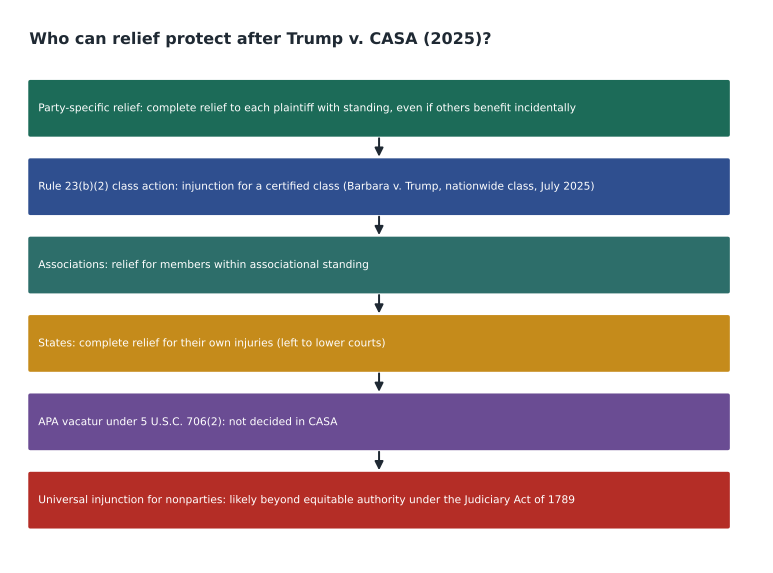
In Trump v. CASA, Inc. (2025), the Supreme Court addressed universal injunctions in litigation over Executive Order 14160, which would have denied birthright citizenship to children of certain noncitizen parents. Three district courts had issued universal injunctions barring enforcement of the order against anyone. The government asked the Court to narrow the injunctions without reaching the merits. In an opinion by Justice Barrett, for six justices, the Court held that universal injunctions likely exceed the equitable authority that Congress has granted to federal courts. The Judiciary Act of 1789 conferred jurisdiction over suits in equity, and the Court held that this authority encompasses only remedies sufficiently analogous to those traditionally accorded by courts of equity at the founding, following the approach of Grupo Mexicano (Lesson 1). Because founding-era equity did not provide relief to nonparties, a universal injunction is not a remedy federal courts may award. The Court acknowledged the complete-relief principle, under which a court may grant the relief needed to fully protect the plaintiffs even if it incidentally benefits others, but held that the principle justifies only relief that the plaintiffs themselves need. It granted partial stays to the extent the injunctions were broader than necessary to provide complete relief to each plaintiff with standing, and left it to the lower courts to determine whether the state plaintiffs needed broader relief to be fully protected.
Justice Thomas, concurring, emphasized that complete relief is a ceiling, not a means of reviving universal injunctions. Justice Alito, concurring, urged lower courts to enforce the rules for third-party standing by states and the requirements of Rule 23 rigorously. Justice Kavanaugh, concurring, observed that the Supreme Court would often have to provide a nationwide interim answer on major federal policies through its emergency docket. Justice Sotomayor, joined by Justices Kagan and Jackson, dissented, arguing that universal injunctions were consistent with traditional equity and that the order was plainly unconstitutional; Justice Jackson also dissented separately, arguing that allowing the executive to continue unlawful conduct against those who had not sued threatened the rule of law.
CASA left several routes open. First, class actions: a court may certify a class under Rule 23(b)(2), which applies when the party opposing the class has acted or refused to act on grounds that apply generally to the class, so that final injunctive relief is appropriate respecting the class as a whole. Within two weeks of the decision, on July 10, 2025, the district court in Barbara v. Trump in New Hampshire certified a nationwide class of children affected by the order and issued a class-wide preliminary injunction. The Supreme Court later granted review of the merits in that case, and on June 30, 2026, in Trump v. Barbara, it held that the executive order was unconstitutional, in an opinion by Chief Justice Roberts. Second, associations may seek relief for their members, within the limits of associational standing. Third, states may argue that they need broad relief to obtain complete relief for their own injuries. Fourth, the Court expressly did not decide whether the Administrative Procedure Act's direction that a reviewing court "set aside" unlawful agency action, 5 U.S.C. section 706(2), authorizes vacatur of a rule as to everyone. The APA does not apply to presidential actions such as the order at issue in CASA, but it governs most agency rules, so the vacatur question remains significant.
Calderwood connects CASA back to the rightful position. A remedy aims to restore the plaintiff to the position she would have occupied but for the wrong. Relief for nonparties does not serve that aim, which is why CASA treats complete relief to the plaintiffs as the outer limit. The disagreement among the justices is partly about history and partly about whether, in modern government, protecting a plaintiff from a policy can be separated from stopping the policy. For a plaintiff's lawyer, the practical lesson is that a challenge meant to protect many people should be framed from the start as a class action, an association's suit or, where available, an APA challenge.
Common mistakes
MistakeSeeking a preliminary injunction on a showing that irreparable harm is possible.
InsteadWinter requires that irreparable harm be likely absent preliminary relief, along with likely success, a favorable balance of equities and the public interest.
MistakeAssuming specialized statutes carry their own lenient preliminary injunction standards.
InsteadStarbucks v. McKinney requires the traditional four-factor test absent a clear congressional command.
MistakeForgetting the bond.
InsteadRule 65(c) requires security, and a wrongfully enjoined defendant's recovery is usually limited to the bond, so its amount matters to both sides.
MistakeAsking a federal court to enjoin enforcement of a policy against everyone after CASA.
InsteadUniversal injunctions likely exceed federal equitable authority; relief must give complete relief to the plaintiffs, and broader protection comes through class actions, associations, states or APA vacatur.
MistakeDesigning structural remedies to achieve the best policy outcome.
InsteadThe scope of a remedy is determined by the nature and extent of the violation (Swann; Milliken; Missouri v. Jenkins), and the PLRA imposes need, narrowness and least-intrusiveness requirements in prison cases.
Summary and key terms
- TROs under Rule 65(b) may issue without notice only on a clear showing of immediate irreparable injury and last no more than fourteen days unless extended.
- Winter requires likely success, likely irreparable harm, a favorable balance of equities and the public interest; a possibility of harm is not enough.
- Starbucks v. McKinney applies the four-factor test to statutory injunctions absent a clear congressional command; circuits differ on sliding scales.
- Preliminary injunctions preserve the last uncontested status quo; mandatory preliminary relief often requires a heightened showing; Rule 65(c) requires security.
- Stays pending appeal follow the four Nken factors.
- Structural injunctions are limited by the nature and extent of the violation (Swann; Milliken; Missouri v. Jenkins) and, in prisons, by the PLRA (Brown v. Plata); decrees must end when violations are remedied (Horne v. Flores).
- Trump v. CASA (2025) held that universal injunctions likely exceed equitable authority under the Judiciary Act of 1789; relief is limited to complete relief for the plaintiffs.
- Class actions under Rule 23(b)(2), associations, state plaintiffs and APA vacatur remain routes to broader relief; Barbara v. Trump certified a nationwide class in July 2025, and Trump v. Barbara (2026) held the order unconstitutional.
- Temporary restraining order
- A short-term injunction, which may issue without notice in emergencies, under Rule 65(b).
- Preliminary injunction
- An injunction issued on notice before trial to prevent irreparable harm pending a decision on the merits.
- Winter test
- Likely success, likely irreparable harm, balance of equities and public interest.
- Sliding scale
- An approach allowing a stronger showing on one preliminary injunction factor to offset a weaker showing on another.
- Status quo ante litem
- The last uncontested status that preceded the controversy, which a preliminary injunction usually preserves.
- Injunction bond
- Security required by Rule 65(c) to pay the costs and damages of a party wrongfully enjoined.
- Structural injunction
- A decree that reorganizes an institution to end ongoing violations of law.
- Universal injunction
- An injunction barring enforcement of a law or policy against anyone, including nonparties.
- Complete relief principle
- The principle that a court may grant relief necessary to fully protect the plaintiffs, even if others incidentally benefit.
- Vacatur
- An order setting aside agency action, as under APA section 706(2).
Practice problems
Work each problem on paper first, then reveal the answer to check.
An employee seeks a preliminary injunction ordering her former employer to reinstate her pending trial on a discrimination claim. What standard applies, and what makes the request harder?
Show answer
The Winter factors apply. Because reinstatement is a mandatory injunction that changes the status quo, many circuits require a heightened showing, and lost wages are usually compensable in money, so irreparable harm is hard to show.
A district court enjoins a federal agency from enforcing a new rule against anyone in the country, though only three businesses sued. What arguments does the agency have after CASA, and what arguments do the plaintiffs have?
Show answer
The agency argues that a universal injunction exceeds equitable authority and that relief must be limited to the three plaintiffs. The plaintiffs argue for APA vacatur under section 706(2), which CASA did not address, or for class certification under Rule 23(b)(2), or that complete relief to them requires broader relief.
Why does a defendant care about the amount of a Rule 65(c) bond?
Show answer
Because a wrongfully enjoined defendant's recovery is generally limited to the bond. A low bond means uncompensated losses if the injunction turns out to have been wrong.
What limits did Milliken v. Bradley place on school desegregation remedies?
Show answer
A remedy reaching suburban districts was improper absent findings that those districts committed violations causing interdistrict segregation; the scope of the remedy must match the violation.
Lesson quiz · 5 questions
Score 60% or more to complete this lesson.
Create a free account to save your progress, take quizzes and earn a certificate.