
LAWU-304 · Lesson 3 of 12 · 25 min
Limits on damages: causation, foreseeability, certainty and avoidable consequences
▶ Video coming soon A video version of this lesson is on the way.
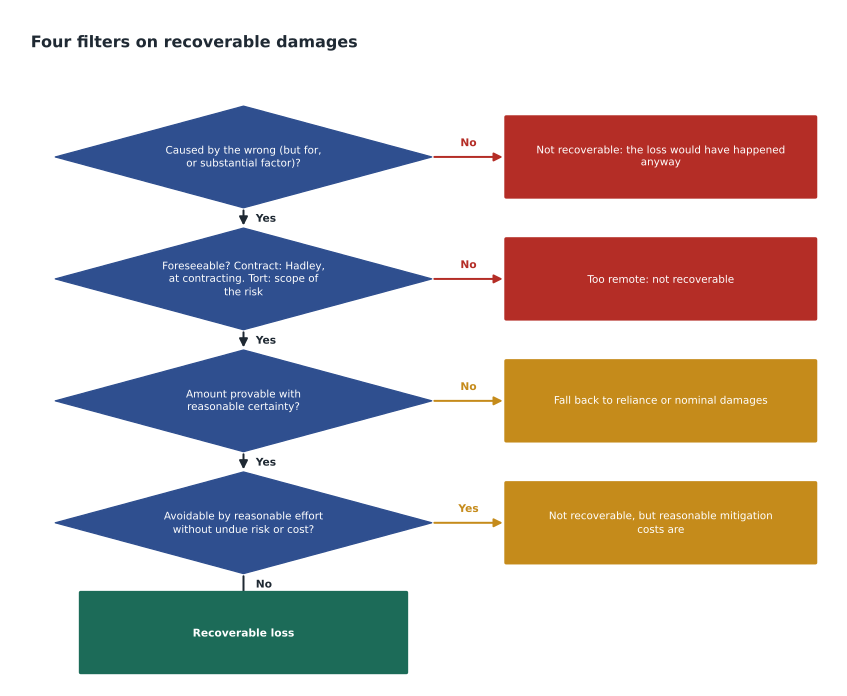
"The formulas tell you what the plaintiff lost," Calderwood says. "This lesson tells you how much of that loss the law will make the defendant pay." He draws a funnel on the board. At the top goes every loss the plaintiff can trace to the defendant's conduct. Four filters narrow it. The loss must have been caused by the wrong. It must have been foreseeable to the defendant in the sense the law requires. It must be proved with reasonable certainty. And it must not be a loss the plaintiff could reasonably have avoided. Whatever comes out the bottom is recoverable. The filters apply in both contract and tort, though the details differ, and they explain most of the gap between what plaintiffs ask for and what they get.
Causation
The first filter is causation in fact. A loss is recoverable only if it would not have occurred but for the breach or tort, or, in cases with multiple sufficient causes, if the wrong was a substantial factor in bringing it about. Causation sounds like a liability question, and in torts it is, but it also does remedial work. Each item of damages must be traced to the wrong. Juniper Hill's electrical upgrade, discussed in Lesson 2, fails the test: the creamery would have needed three-phase power for any modern refrigeration system, so the cost was not caused by Calloway's breach.
Causation also screens out losses the plaintiff would have suffered anyway. If a breach delays a shipment, but the buyer's plant was closed for an unrelated fire during the delay, the buyer cannot recover profits it could not have made. In personal injury cases, a defendant whose negligence aggravates a preexisting condition is liable only for the aggravation, but the eggshell plaintiff rule makes the defendant liable for the full extent of injuries that are worse than expected because of the plaintiff's vulnerability. Harold Lindgren, the seventy-one-year-old man with osteoporosis whom a panicked show steer knocked down at the Haldane County Fair, illustrates both rules. If his bones were fragile, the defendant whose negligence set the steer loose takes him as it finds him and pays for the broken hip, even though a younger man might have walked away. But the defendant does not pay for the osteoporosis itself, or for the decline that the condition would have caused regardless of the fall.
Foreseeability in contract: Hadley v. Baxendale
In Hadley v. Baxendale (Exch. 1854), a mill's crankshaft broke, and the millers sent it by a carrier to an engineer in Greenwich to serve as a model for a new one. The carrier delayed delivery, and the mill stayed idle for several extra days. The millers sued for lost profits. The Court of Exchequer held that the jury should have been instructed that damages for breach of contract are recoverable only if they arise naturally, according to the usual course of things, from the breach, or are such as may reasonably be supposed to have been in the contemplation of both parties at the time they made the contract, as the probable result of the breach. The carrier had not been told that the mill could not run without the shaft, and in the usual course of things a mill might have had a spare. The lost profits were too remote.
The two branches of Hadley survive as general damages, those that flow naturally from a breach of that kind, and special or consequential damages, those that arise from the plaintiff's particular circumstances and are recoverable only if the defendant had reason to know of those circumstances when the contract was made. Restatement section 351 states the rule in modern terms: damages are not recoverable for loss that the party in breach did not have reason to foresee as a probable result of the breach when the contract was made. The UCC version, section 2-715(2)(a), allows consequential damages for loss resulting from general or particular requirements and needs of which the seller at the time of contracting had reason to know and which could not reasonably be prevented by cover. Section 351(3) adds a safety valve: a court may limit damages for foreseeable loss by excluding lost profits or by allowing only reliance damages if it concludes that justice so requires in order to avoid disproportionate compensation.
Three features of the test matter in practice. First, foreseeability is judged at the time of contracting, not the time of breach, because the rule is meant to let parties price their risks. A carrier that knows a shipment is critical can charge more, buy insurance or decline. Second, the defendant need only have reason to foresee the loss as a probable result; it need not have actually foreseen it or agreed to bear it. Most American courts rejected the narrower "tacit agreement" test, associated with Justice Holmes in Globe Refining Co. v. Landa Cotton Oil Co. (1903), under which the defendant had to have tacitly agreed to assume the risk. The UCC comments expressly reject it. Third, the amount of the loss need not have been foreseeable, only its kind.
Evra Corp. v. Swiss Bank Corp. (7th Cir. 1982) shows the rule applied to modern commerce. A bank failed to execute a wire transfer that Evra needed to make on time to keep a lucrative ship charter, and Evra lost the charter. Judge Posner held that the bank was not liable for the lost charter. The bank had no reason to know the consequences of a missed transfer, and Evra was in a better position to prevent the loss, because it could have arranged the payment earlier or confirmed it. The opinion emphasizes the economic logic of Hadley: the rule places the risk of unusual losses on the party who knows about them and can avoid them more cheaply.
Calderwood applies the test to Juniper Hill. The creamery's March 3 purchase order specified a June 1 completion date, made time of the essence and included a warranty of fitness for the purpose of aging cheese. Calloway installs cold storage for food producers. It had reason to know that a creamery needs working refrigeration to keep cheese, and that a delayed system during a summer heat wave risks spoilage. The spoiled cheese is a classic foreseeable consequential loss. The lost profits from three weeks of reduced production while the coils were replaced are also foreseeable in kind. A harder item would be a claim that Juniper Hill lost its relationship with Northgate because of the shortfall, since Calloway may have had no reason to know of that contract or its terms.
Foreseeability in tort: scope of the risk
Tort law's version of the limit is proximate cause. Under the scope of the risk test now favored by the Restatement (Third) of Torts, a defendant is liable only for harms that result from the risks that made its conduct tortious. The foreseeability of the type of harm, not its extent or the precise manner of its occurrence, generally controls, and the eggshell plaintiff rule means the extent of harm need not be foreseeable. Torts students learned these rules through Palsgraf and the Wagon Mound cases. In Remedies they reappear as limits on which items of damages can be recovered. Brightfall Pyrotechnics, whose low-bursting shell burned Nadia Okoro and set fire to hay bales near the livestock barn, may be liable for burn injuries and for the fire's spread across the fields, since those are within the risk of firing shells too close to spectators and dry grass. The broken hip of Harold Lindgren, knocked down by a steer that escaped through a gate a volunteer left open, raises a harder question of scope and of the volunteer's intervening negligence.
Certainty
The third filter requires that the amount of a loss be proved with reasonable certainty. Restatement section 352 states that damages are not recoverable for loss beyond an amount that the evidence permits to be established with reasonable certainty. The requirement does not demand mathematical precision. Once the fact of damage is established, courts allow juries considerable latitude about amount, especially when the defendant's wrong is what makes precise measurement difficult. The rule bites hardest on claims for lost profits, which depend on predictions about markets, customers and costs.
The traditional new business rule barred lost profits for a business with no track record. Most courts have abandoned the per se rule in favor of an evidentiary approach: a new business may recover lost profits if it can prove them with reasonable certainty, using market studies, comparable businesses (the yardstick method), the later performance of the same business, or expert models. But the burden remains heavy. In Kenford Co. v. County of Erie (N.Y. 1986), developers sued after the county abandoned plans to build a domed stadium near Buffalo. They sought twenty years of lost profits from a stadium that had never been built, supported by detailed projections. New York's highest court held the profits too speculative: the projections rested on assumptions about attendance and events for a facility that had no history, and the parties had not contemplated liability for such profits. Chicago Coliseum Club v. Dempsey (Ill. App. 1932), in which a boxing promoter could not recover the profits of a fight the heavyweight champion refused to fight, is the older example.
When expectation fails for lack of certainty, the plaintiff is not left with nothing. It may recover reliance damages, as in Security Stove, or nominal damages that vindicate the right. Lesson 5 shows that parties who expect proof problems can agree in advance on liquidated damages.
Lena Marsh's claim for three weeks of reduced production is a reasonably certain claim. Juniper Hill has years of production and sales records, a steady customer base and a precise period of reduced capacity. An expert can compare the three weeks to the same weeks in prior years, adjust for the herd's milk output and estimate the lost sales. Calderwood warns that the claim is only as good as the records. A family business that does not keep books invites a defense expert to call any estimate speculation.
Avoidable consequences
The fourth filter is the doctrine of avoidable consequences, often called the duty to mitigate. The phrase "duty" is misleading. The plaintiff does not owe the defendant anything, but it cannot recover for losses it could have avoided by reasonable effort without undue risk, burden or humiliation (Restatement section 350). Conversely, the plaintiff may recover the reasonable costs of efforts to avoid loss, even if the efforts failed. The defendant bears the burden of proving that the plaintiff failed to mitigate and that mitigation would have reduced the loss.
Rockingham County v. Luten Bridge Co. (4th Cir. 1929) is the standard illustration. A county contracted for a bridge, then, after a change in the county commission, voted to cancel the contract and told the builder to stop. The bridge would have led to no road. The builder kept building anyway and sued for the full price. The court held that after notice of repudiation the builder could not pile up damages by continuing to perform; it could recover only the profit it would have made plus the costs it had already incurred, not the costs of work done after the county told it to stop. The rule encourages efficient responses to breach. A party who learns that performance is unwanted should stop spending money on it.
Mitigation in employment cases asks whether a wrongfully discharged employee unreasonably refused comparable work. In Parker v. Twentieth Century-Fox Film Corp. (Cal. 1970), the studio canceled a musical in which Shirley MacLaine had been cast and offered her instead a western to be filmed in Australia. The California Supreme Court held that she did not have to accept the substitute, because it was different and inferior employment, and awarded her the full guaranteed compensation. A dissent argued that whether the substitute was inferior was a question of fact. The case stands for the rule that the employee must accept only substantially similar employment, and that the employer bears the burden of proving that such employment was available.
In tort, the same principle requires injured plaintiffs to obtain reasonable medical care and to return to work when they reasonably can. A plaintiff who refuses a safe and routine treatment that would have cured the injury may not recover for the consequences of refusing. Courts take account of religious objections and of the risks of the treatment. The seat belt defense, which reduces damages for failure to wear a seat belt, is a variant of avoidable consequences. States are divided: some admit the evidence to reduce damages, some treat it under comparative fault, and many exclude it by statute.
Juniper Hill's trailer rental shows mitigation from the plaintiff's side. When Calloway's June 22 email warned that the system would not be ready until late July, Lena rented a refrigerated trailer to hold as much cheese as possible. The trailer was too small to hold everything, and the July 8 heat wave spoiled what it could not hold. Calloway will argue that Juniper Hill should have rented a second trailer, moved cheese to a commercial cold storage facility or slowed production. Juniper Hill will answer that it acted reasonably on the information it had, that a second trailer was not available in its county on short notice, and that the cost of mitigation is recoverable either way. Calderwood says the jury will likely give the creamery the benefit of the doubt, because the law asks only for reasonable efforts and judges them as of the time, not in hindsight.
Worked problem
Running Juniper Hill through the funnel
Juniper Hill seeks 18,980 dollars for the spoiled cheese, 2,100 dollars for the trailer, 6,400 dollars in lost profits for the coil replacement period, and 40,000 dollars in profits it says it would have earned on a new line of cave-aged cheese it planned to launch in fall 2026 but postponed until spring 2027. Calloway knew from the purchase order that the system was for aging cheese and that time was of the essence. It did not know of the cave-aged line.
Show solution
- Causation: each item is traced to the delay or the undersized coils. The cave-aged line was postponed because the aging room was not reliable until mid-August; causation is plausible but contested, since Juniper Hill might have postponed for other reasons such as staff or financing.
- Foreseeability: spoilage, the trailer and lost production are foreseeable to an installer of food storage who knew of the deadline. The profits of a particular new product line that Calloway was not told about are a closer question; a court may treat them as special damages requiring notice of the plan.
- Certainty: the cheese and the trailer are documented. The coil-period profits can be proved from records. The new line has no sales history, so its profits face a Kenford-type challenge even under the modern evidentiary approach.
- Avoidable consequences: the trailer rental was a reasonable mitigation effort and is recoverable. Calloway must prove that further steps were reasonably available and would have reduced the spoilage.
Answer: Likely recoverable: about 27,480 dollars (cheese, trailer and coil-period profits). The 40,000 dollars for the postponed line is vulnerable on both foreseeability and certainty; Juniper Hill may recover its wasted preparation costs as reliance damages if it cannot prove the profits.
Emotional distress and other excluded items
Some categories of loss are excluded by rule rather than by the four filters. Damages for emotional disturbance are generally not recoverable for breach of contract unless the breach also caused bodily harm or the contract or breach is of a kind that makes serious emotional disturbance a particularly likely result (Restatement section 353). The exception covers contracts such as those for funeral services, the delivery of a death message, or the care of a family member's remains, and some courts extend it to contracts for the construction of a home. Attorney fees are generally not recoverable as damages under the American rule (Lesson 11), even though litigation is a foreseeable cost of breach. And damages for breach of contract do not include punitive damages, however willful the breach, unless the conduct also constitutes an independent tort for which punitive damages are available (Restatement section 355).
Common mistakes
MistakeJudging contract foreseeability at the time of breach.
InsteadHadley and Restatement section 351 ask what the defendant had reason to foresee as a probable result of breach when the contract was made.
MistakeRequiring that the defendant foresee the exact amount of the loss.
InsteadOnly the kind of loss must be foreseeable; the amount need not be.
MistakeTreating the new business rule as an absolute bar.
InsteadMost courts now allow a new business to recover lost profits if proved with reasonable certainty, though projections for untested ventures, as in Kenford, often fail.
MistakeSaying the plaintiff has a duty to mitigate that the defendant can sue to enforce.
InsteadAvoidable consequences only limits recovery; the defendant bears the burden of proving that reasonable mitigation was available, and the plaintiff recovers reasonable mitigation costs.
MistakeRequiring a discharged employee to take any available job.
InsteadUnder Parker v. Twentieth Century-Fox, the employee need accept only substantially similar employment.
Summary and key terms
- Recoverable damages must pass four filters: causation, foreseeability, certainty and avoidable consequences.
- Causation excludes losses that would have occurred anyway; the eggshell plaintiff rule makes the defendant liable for the full extent of harm to a vulnerable plaintiff.
- Hadley v. Baxendale and Restatement section 351 limit contract damages to losses the defendant had reason to foresee as probable when the contract was made; UCC section 2-715(2)(a) applies the same idea to goods.
- Tort damages are limited by proximate cause, under which harms must fall within the scope of the risk that made the conduct tortious.
- Damages must be proved with reasonable certainty (section 352); lost profits of new ventures are the hardest case (Kenford).
- A plaintiff cannot recover losses it could reasonably have avoided (section 350; Rockingham County v. Luten Bridge), but recovers reasonable costs of mitigation.
- A discharged employee need accept only substantially similar employment (Parker v. Twentieth Century-Fox).
- Emotional distress, attorney fees and punitive damages are generally excluded in contract cases by separate rules.
- General damages
- Damages that flow naturally from a breach of the kind in question; the first branch of Hadley.
- Special or consequential damages
- Damages arising from the plaintiff's particular circumstances, recoverable only if the defendant had reason to know of them when contracting.
- Tacit agreement test
- A narrower foreseeability test, associated with Globe Refining (1903), requiring that the defendant tacitly agree to bear the loss; rejected by the UCC and most courts.
- Reasonable certainty
- The standard of proof for the amount of damages; precision is not required once the fact of damage is shown.
- New business rule
- The traditional bar to lost profits for businesses without a track record; now mostly an evidentiary hurdle.
- Yardstick method
- Proof of lost profits by comparison with similar businesses.
- Avoidable consequences
- The doctrine denying recovery for losses the plaintiff could reasonably have avoided; often called the duty to mitigate.
- Eggshell plaintiff rule
- The rule that a tortfeasor is liable for the full extent of injury even if the plaintiff's preexisting vulnerability made it unusually severe.
Practice problems
Work each problem on paper first, then reveal the answer to check.
A trucking company agrees to deliver a wedding cake by noon. It arrives at five o'clock, after the reception. The bakery that hired the carrier sues for the profit it lost when the couple refused to pay and for future business the couple's friends will not give it. Which losses are recoverable?
Show answer
If the carrier knew it was carrying a wedding cake for a noon reception, the price the couple refused to pay is a foreseeable loss. Lost future business from the couple's friends is likely too speculative and may also be unforeseeable.
An employer wrongfully fires a high school principal and offers her a position as a substitute teacher at the same school at lower pay. Must she accept it to preserve her damages?
Show answer
No. A substitute teaching job is different and inferior employment. Under Parker, she need accept only substantially similar work.
After a buyer repudiates a contract for custom machinery, the seller finishes building it and sues for the full price. What limits the seller's recovery?
Show answer
Avoidable consequences: after repudiation the seller should have stopped work unless finishing was the commercially reasonable way to reduce loss. UCC section 2-704(2) lets a seller complete manufacture only in the exercise of reasonable commercial judgment for the purpose of avoiding loss.
A defendant negligently causes a minor car accident. The plaintiff, who has a rare bone condition, suffers multiple fractures. Is the defendant liable for the fractures?
Show answer
Yes, under the eggshell plaintiff rule. The defendant is not liable for the bone condition itself or for losses the condition would have caused anyway.
Lesson quiz · 5 questions
Score 60% or more to complete this lesson.
Create a free account to save your progress, take quizzes and earn a certificate.