
LAWU-304 · Lesson 12 of 12 · 24 min
Capstone: building a remedies plan
▶ Video coming soon A video version of this lesson is on the way.
For the last class Calderwood puts the banker's box away and hands out a new file, labeled only "Saltmarsh." It is entirely fictional. Saltmarsh Outfitters, Inc., a Westmarch corporation, sells outdoor clothing and gear from a single large store in Brennan Falls and online. Its founder and president, Noreen Dravecky, has come to the firm with three problems, all of which surfaced in the fall of 2026. The class's task, Calderwood says, is the one that practicing lawyers face every week: not to decide who is right, which they will do in passing, but to build a remedies plan that tells the client what she can get, how fast, at what cost and with what risk. "Use the three questions," he says. "What is the rightful position? Which remedies get her there? What stops us?"
The file
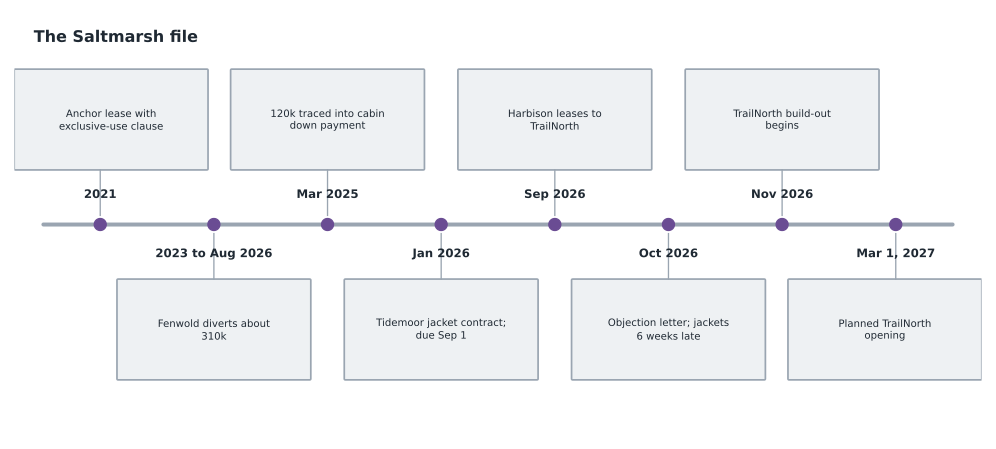
Problem one is the lease. Since 2021 Saltmarsh has leased the anchor space at Harbison Commons, a shopping center owned by Harbison Commons LLC, under a ten-year lease. Section 9 of the lease provides that the landlord will not lease or permit the use of any other space in the center for a business whose primary business is the retail sale of outdoor apparel, footwear or camping equipment. The lease also provides that the prevailing party in any action to enforce it recovers reasonable attorney fees. In September 2026, Harbison signed a lease with TrailNorth Gear, a regional chain of outdoor stores, for the vacant space next to Saltmarsh, with an opening planned for March 1, 2027. Harbison's leasing agent told TrailNorth about Saltmarsh's exclusive and said Harbison believed it was unenforceable. Noreen learned of the deal in early October from a sign in the window and sent Harbison and TrailNorth a letter objecting. TrailNorth began its build-out in November anyway and has spent about 180,000 dollars so far.
Problem two is theft. From 2023 until August 2026, Saltmarsh's bookkeeper, Cyprian Fenwold, paid about 310,000 dollars of false invoices to Northpine Supply LLC, a company he secretly controlled, and moved the money into his personal bank account. In March 2025, he used 120,000 dollars from that account, which a forensic accountant can trace entirely to Saltmarsh's payments, as the down payment on a cabin at Lake Callowhill, financing the rest of the 400,000-dollar price with a mortgage. The cabin is now worth about 460,000 dollars, and about 272,000 dollars remains on the mortgage. Fenwold spent most of the rest of the money on travel and on a pickup truck now worth about 30,000 dollars, bought with 45,000 dollars from the same account after it had been replenished with his own wages. He has about 4,000 dollars left in the account, credit card debts of about 60,000 dollars, and a criminal case pending in which prosecutors will seek restitution.
Problem three is a supplier. In January 2026, Saltmarsh contracted with Tidemoor Textile Mills to buy 2,400 insulated jackets at 68 dollars each, a total price of 163,200 dollars, for delivery by September 1, 2026, in time for the fall season. The contract, which both parties negotiated with counsel, provides that if delivery is late, Tidemoor will pay one dollar per jacket for each week of delay, up to a maximum of 15 percent of the price, "as Buyer's sole and exclusive remedy for late delivery," and that neither party will be liable for lost profits. Tidemoor delivered the jackets on October 13, 2026, six weeks late. Saltmarsh accepted them. Noreen estimates that the delay cost Saltmarsh about 60,000 dollars in lost early-season sales and markdowns.
A method for remedies problems
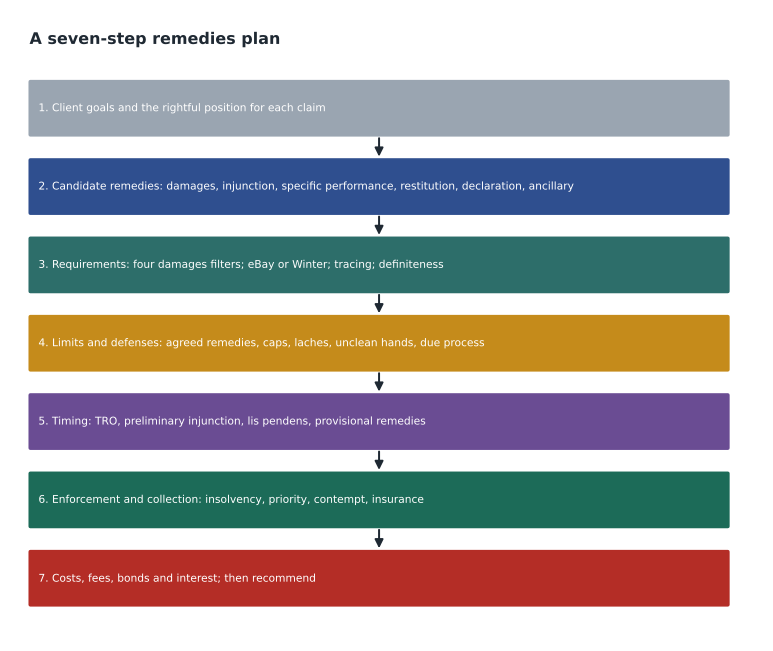
Calderwood gives the class the checklist he used as a magistrate judge when reviewing proposed orders and damages submissions, and which he expects them to use on the examination.
Problem one: the exclusive
The rightful position is a Harbison Commons without a competing outdoor retailer for the rest of Saltmarsh's lease, which runs to 2031. Saltmarsh wants TrailNorth not to open, not merely money for the effects of its opening.
The candidate remedies are an injunction against Harbison, prohibiting it from permitting TrailNorth to operate in violation of Section 9; an injunction against TrailNorth itself; damages for lost profits; a declaratory judgment that Section 9 is enforceable; and attorney fees under the lease. Because the opening is set for March 1, the timing points to a preliminary injunction motion filed soon, with the declaratory claim and a permanent injunction to follow.
On the merits, exclusive-use clauses in shopping center leases are generally enforceable if reasonable, as Walgreen Co. v. Sara Creek Property Co. illustrates. Harbison's belief that the clause is unenforceable is a legal position, not a defense, and nothing in the file suggests a basis for it beyond the agent's statement. Saltmarsh can seek a declaratory judgment to resolve that question. The likelihood of success factor favors Saltmarsh.
Irreparable harm and the adequacy of damages are the heart of the motion. Walgreen is directly on point: Judge Posner affirmed an injunction because damages from a competitor's entry would require predicting the effect on sales over years, a task full of uncertainty, while an injunction would leave the parties to bargain to their own solution. Saltmarsh's losses would be the same kind of speculative, long-term loss of customers and market position. A court applying Winter must find irreparable harm likely, not merely possible, and Saltmarsh should support the motion with evidence: an economist's projection of diverted sales, examples of customers who shop both stores, and the importance of the exclusive in the original lease negotiations.
The balance of hardships is where TrailNorth will fight. It has spent about 180,000 dollars on the build-out and will lose more if it cannot open. But TrailNorth knew of the exclusive before it signed, was told only that Harbison thought it unenforceable, received Noreen's objection letter in October and started construction in November anyway. A defendant that proceeds in the face of a known claim takes the risk; courts give little weight to hardships that a defendant brought on itself, much as they do when a builder deliberately encroaches on a neighbor's land. The public interest is modest on either side: consumers benefit from competition, but the public also has an interest in the enforcement of commercial contracts.
Who can be enjoined? Harbison is a party to the lease and can be ordered not to permit the competing use. TrailNorth is not a party to Saltmarsh's lease, but it can be named as a defendant. A restrictive covenant in a lease generally binds later takers of the restricted property who have notice of it, and TrailNorth had actual notice. Even if TrailNorth were not a defendant, Rule 65(d) and its Westmarch counterpart would bind it as a person in active concert with Harbison once it received actual notice of the order. Naming TrailNorth avoids any argument and lets the court consider its interests directly.
The court will require a bond under Rule 65(c), sized to TrailNorth's and Harbison's likely losses if the injunction turns out to have been wrongful, such as delay costs and lost rent. Noreen should be prepared to post a substantial bond. If Saltmarsh prevails, the lease's fee clause entitles it to reasonable attorney fees from Harbison. Lackey v. Stinnie concerned a federal fee statute, but a careful lawyer will note that the prevailing party language in a contract is interpreted under state contract law and should make sure the case proceeds to a final judgment or a consent decree rather than ending with a preliminary injunction alone.
Recommendation on problem one: file now for a declaratory judgment, a preliminary injunction and a permanent injunction against both Harbison and TrailNorth, with an alternative claim for damages. Expect a negotiation: TrailNorth may pay for a release, Harbison may relocate TrailNorth to a different center, or the parties may agree to limits on what TrailNorth sells. The injunction, as Calabresi and Melamed's analysis predicts, gives Saltmarsh the bargaining position of a property rule.
Problem two: Fenwold
The rightful position is the return of the 310,000 dollars, with interest, and Saltmarsh's claim for the defendant's gain is equally strong because Fenwold is a conscious wrongdoer and a faithless employee. Saltmarsh has claims for conversion, fraud and breach of the duty of loyalty, and a claim in restitution for unjust enrichment. A money judgment for 310,000 dollars plus prejudgment interest is easy to win and hard to collect: Fenwold's unsecured creditors will compete for his few assets.
Restitution through tracing gives Saltmarsh priority. The forensic accountant can trace 120,000 dollars of Saltmarsh's money into the cabin's down payment. Saltmarsh may claim an equitable lien on the cabin for 120,000 dollars, or a constructive trust over a proportionate share of the cabin. The proportion is 120,000 dollars out of a 400,000-dollar purchase price, or 30 percent. Because the cabin has risen in value to 460,000 dollars, a 30 percent share would be worth 138,000 dollars of the cabin's value. The mortgage lender gave value without notice of Saltmarsh's claim and holds a prior lien that Saltmarsh cannot disturb. Saltmarsh's claim reaches only Fenwold's interest, which is the cabin's value minus the 272,000 dollars still owed, or about 188,000 dollars. Saltmarsh should argue that its claim to the appreciation follows the Third Restatement's rule that a conscious wrongdoer may not keep the profits of the wrong, while Fenwold will argue that his own mortgage payments since 2025 entitle him to a share of the gain. The court can sort out the competing contributions, but either way Saltmarsh's claim to the cabin equity has priority over Fenwold's credit card companies.
The truck and the bank account require tracing through a commingled account. Fenwold replenished the account with wages before buying the truck. Under the lowest intermediate balance rule, if the account fell to a low point after the cabin purchase and before the wages were deposited, Saltmarsh's traceable share is capped at that low point, and later wage deposits do not restore it unless Fenwold intended them to. The forensic accountant must reconstruct the balances. Any of Saltmarsh's money that survived the low point and went into the truck can support a lien on the truck; the 4,000 dollars left in the account may also be traceable. The rest of the 310,000 dollars, spent on travel, is dissipated and supports only an unsecured claim. Montanile shows the cost of waiting: once traceable funds are spent on nontraceable items, equitable remedies are lost. Saltmarsh should therefore seek a preliminary injunction or other provisional remedy freezing the cabin and the truck. Grupo Mexicano bars a pre-judgment asset freeze for a simple money claim in federal court, but it does not bar preliminary relief to protect specific property in which the plaintiff asserts an equitable interest, such as the cabin and the truck here. Saltmarsh should also record a lis pendens against the cabin.
Fraud and conversion are torts that can support punitive damages if the state permits them on clear and convincing evidence of malice or fraud. Fenwold's scheme of false invoices over three years clearly qualifies in culpability. But punitive damages add little against a defendant who cannot pay compensatory damages, and an award many times the compensatory damages would face the due process limits of Lesson 6. Saltmarsh should check whether Westmarch has a civil theft statute providing multiple damages and attorney fees, which many states do. Otherwise, under the American rule, Saltmarsh will bear its own fees in this matter. Saltmarsh should also coordinate with the prosecutor, because a restitution order in the criminal case can be enforced like a civil judgment, though criminal restitution serves different purposes, as Ellingburg v. United States noted, and Saltmarsh must avoid double recovery. Saltmarsh's insurer may have an employee dishonesty policy that pays part of the loss and then is subrogated to Saltmarsh's claims.
Problem three: Tidemoor
The rightful position is jackets delivered on September 1. Saltmarsh's losses from the six-week delay, about 60,000 dollars in lost sales and markdowns, would be consequential damages under UCC section 2-715(2), foreseeable to a supplier that knew the jackets were for the fall season and probably provable with reasonable certainty from Saltmarsh's sales history. But the parties agreed on the remedy.
The clause provides one dollar per jacket per week of delay, capped at 15 percent of the price. Six weeks of delay on 2,400 jackets is 14,400 dollars, well under the cap of 24,480 dollars. The clause makes the liquidated amount the sole and exclusive remedy for late delivery and excludes lost profits. The penalty doctrine of Restatement section 356 and UCC section 2-718(1) polices clauses that fix unreasonably large damages. This clause fixes a small amount, and courts generally treat clauses that underliquidate as limitations of remedy, enforceable under section 2-719 unless unconscionable or unless the limited remedy fails of its essential purpose. Here the parties were merchants, both negotiated with counsel and the clause reflects a deliberate allocation of the risk of delay. Section 2-719(3) states that a limitation of damages where the loss is commercial is not prima facie unconscionable. And the remedy has not failed of its essential purpose: it was designed for exactly this situation, late delivery, and it works as written.
Saltmarsh's best arguments would be that the delay was caused by Tidemoor's bad faith, such as diverting the jackets to a higher-paying customer, which might take the claim outside the clause, or that the clause is unconscionable. Nothing in the file supports either argument. Recommendation on problem three: collect the 14,400 dollars, which Tidemoor should pay without litigation, and use the experience to negotiate a stronger clause next season. Calderwood notes that this is the hardest advice in the file to give, because the client's real loss is much larger, and the most important to give honestly.
Worked problem
The remedies memo
Write the bottom line of the memo to Noreen Dravecky, ranking her three matters by expected value and urgency.
Show solution
- Most urgent: the exclusive. File for a declaratory judgment and preliminary injunction before TrailNorth's March 1, 2027 opening. Strong merits; strong irreparable harm argument under Walgreen; TrailNorth's hardships are self-inflicted. Budget for a bond. Fees are recoverable from Harbison if Saltmarsh prevails to a final judgment or consent decree.
- Largest dollars: Fenwold. Seek provisional relief and record a lis pendens against the cabin now. Pursue a constructive trust or equitable lien on the cabin equity (at least 120,000 dollars, possibly a 30 percent share worth more) and tracing into the truck and account. The remaining loss is an unsecured claim of limited value; check for a civil theft statute and employee dishonesty insurance; coordinate with criminal restitution.
- Smallest: Tidemoor. The agreed remedy of 14,400 dollars is likely enforceable as a limitation of remedy between merchants; recover it and renegotiate the clause for next season.
- Throughout: claim prejudgment interest where available, avoid double recovery among the civil, criminal and insurance routes, and move quickly, since delay can support laches against equitable relief and lets traceable assets disappear.
Answer: Act immediately on the exclusive and on freezing Fenwold's traceable assets; accept the agreed remedy against Tidemoor. Expected recovery is driven by the injunction's bargaining value and the cabin equity, not by the size of the losses on paper.
Closing the box
Calderwood ends the course where he began. A remedy, he says, is a promise the legal system makes good on, and every limit studied this semester, from Hadley to Winter to CASA, is a judgment about how far that promise should reach and who should bear the cost when it falls short. Priya Natarajan asks which remedy he would choose if he could keep only one. He says the injunction, because it is the only one that lets a court stop a wrong before it happens, and then adds that his old colleagues on the bench would say damages, because they are the only one every court can award in every case. Jordan Kimura puts the remedies docket back in the box. Hannah Lindqvist writes the three questions on the inside of the lid.
Common mistakes
MistakeAnalyzing liability at length and treating the remedy as an afterthought.
InsteadIn a remedies plan, liability is a step; the plan must state the rightful position, the available remedies, their requirements, limits, timing and collectability.
MistakeSeeking only a money judgment against an insolvent wrongdoer.
InsteadTrace the plaintiff's property and seek a constructive trust or equitable lien, which gives priority over general creditors, and move before assets are dissipated (Montanile).
MistakeTreating every contract clause that limits recovery as a penalty.
InsteadThe penalty doctrine polices unreasonably large amounts; clauses that underliquidate are limitations of remedy, enforceable between merchants unless unconscionable or failing of their essential purpose.
MistakeIgnoring a defendant's notice of the plaintiff's claim when weighing hardships.
InsteadHardships a defendant incurs after learning of the claim, like TrailNorth's build-out, receive little weight in the balance.
MistakeForgetting fees, bonds and interest.
InsteadA lease fee clause, a Rule 65(c) bond and prejudgment interest can change the economics of a case as much as the main remedy.
Summary and key terms
- A remedies plan answers three questions for each claim: what is the rightful position, which remedies get the client there, and what stops them.
- The seven-step method covers goals, candidate remedies, requirements, limits and defenses, timing, enforcement and collection, and costs, fees and interest.
- Saltmarsh's exclusive-use clause supports a declaratory judgment and a preliminary injunction against the landlord and the competitor with notice, under Winter and Walgreen, subject to a bond.
- TrailNorth's build-out after notice is a self-inflicted hardship that carries little weight.
- Against Fenwold, tracing into the cabin, the truck and the account supports equitable liens or a constructive trust with priority over unsecured creditors; the mortgage lender's prior lien is unaffected.
- Provisional relief to protect specific property is available despite Grupo Mexicano, and prompt action avoids the loss of traceable funds.
- Tidemoor's clause is an enforceable limitation of remedy between merchants; Saltmarsh recovers 14,400 dollars.
- Fees, bonds, interest, insurance and criminal restitution shape the economics of each matter.
- Remedies plan
- An analysis of each claim's rightful position, available remedies, requirements, limits, timing, enforceability and costs.
- Exclusive-use clause
- A lease term in which a landlord agrees not to lease other space for a competing use.
- Underliquidated damages clause
- A clause fixing damages below the likely actual loss, treated as a limitation of remedy.
- Provisional remedy
- Relief before judgment, such as a preliminary injunction, attachment or lis pendens, to protect the plaintiff's eventual recovery.
- Proportionate share
- A constructive trust over the fraction of an asset purchased with the plaintiff's money, carrying any appreciation.
- Employee dishonesty coverage
- Insurance covering an employer's losses from employee theft, after which the insurer is subrogated to the employer's claims.
Practice problems
Work each problem on paper first, then reveal the answer to check.
If TrailNorth had signed its lease without any notice of Saltmarsh's exclusive and had completed its build-out before Saltmarsh objected, how would the analysis change?
Show answer
TrailNorth's hardship would weigh much more heavily, it might not be bound by the covenant without notice, and a court might deny an injunction against TrailNorth and leave Saltmarsh to damages against Harbison.
Suppose the cabin had fallen in value to 340,000 dollars. Which equitable remedy should Saltmarsh choose?
Show answer
An equitable lien securing 120,000 dollars against Fenwold's equity, rather than a 30 percent share of a depreciated asset.
Saltmarsh's employee dishonesty insurer pays it 150,000 dollars. What happens to Saltmarsh's claims against Fenwold?
Show answer
The insurer is subrogated to Saltmarsh's claims to the extent of its payment. Saltmarsh may pursue the remaining loss, but it cannot recover the insured portion twice.
Tidemoor's clause capped late-delivery damages at 15 percent of the price. If delivery had been twenty weeks late, causing Saltmarsh to miss the whole season, what argument might Saltmarsh make?
Show answer
That the limited remedy failed of its essential purpose under section 2-719(2), or that delay of that length amounted to a different breach, such as a failure to deliver, permitting rejection and cover. The argument would be difficult between negotiating merchants.
Lesson quiz · 5 questions
Score 60% or more to complete this lesson.
Create a free account to save your progress, take quizzes and earn a certificate.