
LAWU-304 · Lesson 11 of 12 · 26 min
Declaratory judgments, contempt, attorney fees and equitable defenses
▶ Video coming soon A video version of this lesson is on the way.
Calderwood calls this lesson "the machinery." Four sets of rules sit around the main remedies and decide whether they work in practice. Declaratory judgments let parties learn their rights before anyone acts. Contempt is how courts enforce injunctions and decrees. Attorney fees decide whether a case is worth bringing at all. And equitable defenses let a defendant defeat equitable relief even when the plaintiff has a good claim. He returns to two files to illustrate. In November 2026, Northgate Grocers, which owes Juniper Hill money on past cheese deliveries, wrote to say that it considers itself an intended beneficiary of Juniper Hill's contract with Calloway, because Calloway knew the cold storage was meant to supply Northgate, and that it may sue Calloway for its own losses. And in the Albescu file, Calderwood imagines that a year after the decree in Lesson 7, Brackenridge has started blasting at 7:00 a.m. again.
Declaratory judgments
The federal Declaratory Judgment Act, enacted in 1934 and codified at 28 U.S.C. sections 2201 and 2202, provides that in a case of actual controversy within its jurisdiction, any court of the United States may declare the rights and other legal relations of any interested party seeking such declaration, whether or not further relief is or could be sought. A declaration has the force and effect of a final judgment. Section 2202 allows further necessary or proper relief based on a declaratory judgment, after reasonable notice and hearing, against any adverse party whose rights have been determined by the judgment. Nearly every state has a similar statute, many based on the Uniform Declaratory Judgments Act.
The declaratory judgment is a remedy that orders nothing. Its value lies in letting parties resolve uncertainty before they act, rather than acting at their peril and litigating afterward. A business unsure whether a contract permits it to terminate a supplier, an insurer unsure whether a policy covers a claim, a licensee unsure whether a patent is valid, and a person unsure whether a statute forbids her intended conduct can all seek declarations. The remedy is mild: because it does not order anyone to do anything, it raises fewer concerns than an injunction, and in Steffel v. Thompson (1974) the Supreme Court held that a person threatened with prosecution under a state law may seek a federal declaratory judgment that the law is unconstitutional without showing the bad faith or irreparable harm that would be needed for an injunction against a pending prosecution.
The Act does not expand jurisdiction. The dispute must be an Article III case or controversy. In Aetna Life Insurance Co. v. Haworth (1937), the Court upheld the Act and explained that the controversy must be definite and concrete, touching the legal relations of parties having adverse legal interests, and admitting of specific relief through a decree of a conclusive character, as distinguished from an opinion advising what the law would be upon a hypothetical state of facts. In MedImmune, Inc. v. Genentech, Inc. (2007), the Court held that a patent licensee need not breach its license by stopping royalty payments before seeking a declaration that the patent is invalid; the threat of liability was enough to create a controversy. The Act also does not create federal question jurisdiction where none would otherwise exist (Skelly Oil Co. v. Phillips Petroleum Co., 1950).
Courts have discretion whether to entertain declaratory actions. In Wilton v. Seven Falls Co. (1995), the Supreme Court held that district courts have broad discretion to stay or dismiss a declaratory judgment action in favor of a parallel state court proceeding, reaffirming the approach of Brillhart v. Excess Insurance Co. (1942). Courts weigh whether a declaration will clarify the parties' relations and settle the controversy, whether the action is being used for procedural fencing or a race to the courthouse, and whether it would interfere with other litigation.
Northgate's letter presents a classic occasion for declaratory relief. Juniper Hill and Calloway have a dispute about damages. If Northgate is an intended beneficiary, it might sue Calloway separately, and Calloway might argue that any recovery by Northgate reduces what it owes Juniper Hill, or that Juniper Hill's settlement with Calloway does not bind Northgate. Calloway or Juniper Hill could seek a declaration that Northgate is only an incidental beneficiary under Restatement (Second) of Contracts section 302, because the contract shows no intent to give Northgate the benefit of Calloway's performance. Settling that question early lets the parties negotiate knowing who has claims. Calderwood notes that a declaration is also often joined with other relief: a quiet title action, which declares ownership of land, is a form of declaratory relief that the Albescus or the Corbins might use in a boundary dispute.
Contempt
Injunctions and decrees for specific performance are enforced by contempt. Courts have inherent power to punish contempt, and federal courts have statutory power under 18 U.S.C. section 401 to punish disobedience or resistance to their lawful orders. The law distinguishes civil from criminal contempt, and the distinction determines the procedures required.
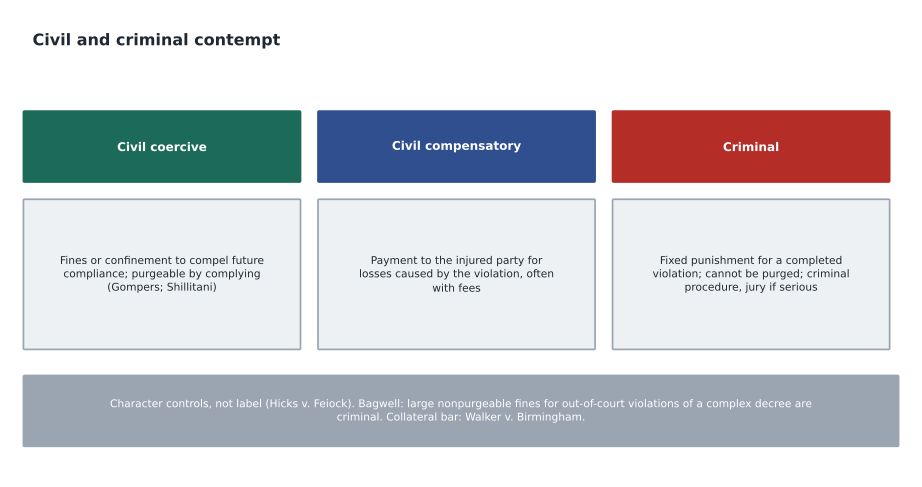
Civil contempt is remedial. Coercive civil contempt uses fines or confinement to compel the contemnor to comply in the future. The classic formulation, from Gompers v. Bucks Stove and Range Co. (1911), is that a civil contemnor carries the keys of his prison in his own pocket: he can end the sanction by complying. In Shillitani v. United States (1966), witnesses jailed for refusing to testify before a grand jury were in civil contempt because they could secure release by agreeing to testify. Compensatory civil contempt orders the contemnor to pay the injured party for losses caused by the violation. Criminal contempt is punitive: it imposes a fixed fine or sentence for a completed violation that the contemnor cannot purge by later compliance. Criminal contempt requires criminal procedural protections, including notice, proof beyond a reasonable doubt, the privilege against self-incrimination and, for serious penalties, a jury trial.
The line between civil and criminal is often blurred, and the Supreme Court has looked to the character of the sanction rather than the label. In Hicks v. Feiock (1988), it held that the question turns on whether the sanction is remedial and purgeable. In International Union, United Mine Workers of America v. Bagwell (1994), a Virginia court had enjoined a union from violent strike activity and then, after hearings without a jury, imposed more than 52 million dollars in fines for violations, most payable to the state and counties. The Supreme Court held the fines criminal. They were not compensatory, they could not be purged once the violations occurred, and they were imposed for widespread out-of-court violations of a complex injunction, which required the kind of factfinding that calls for criminal procedural protections. A per diem fine announced in advance and suspended as long as the contemnor complies, by contrast, is coercive civil contempt.
Civil contempt requires proof by clear and convincing evidence that the defendant violated a clear and specific order. Good faith is generally not a defense to civil contempt, but in Taggart v. Lorenzen (2019) the Court held that a bankruptcy court may hold a creditor in civil contempt for violating a discharge order only if there is no fair ground of doubt as to whether the order barred the creditor's conduct, that is, no objectively reasonable basis for concluding that the conduct might be lawful. The decision drew on traditional contempt principles and emphasized that contempt is a severe remedy. Inability to comply is a defense, though the contemnor bears the burden of proving it. In Turner v. Rogers (2011), the Court held that an indigent parent facing incarceration for civil contempt for failure to pay child support is not automatically entitled to counsel, but that the state must provide alternative safeguards, such as notice that ability to pay is the critical issue and a finding on ability to pay.
The collateral bar rule limits a defendant's ability to challenge an injunction by disobeying it. In Walker v. City of Birmingham (1967), civil rights leaders, including Martin Luther King Jr., marched in Birmingham in violation of a state court injunction that they believed, with good reason, to be unconstitutional. The Supreme Court upheld their contempt convictions, holding that they were required to challenge the injunction in court before violating it, unless it was transparently invalid or there was no opportunity for prompt review. The rule protects the authority of courts but places a heavy burden on those subject to invalid orders. Many state courts follow it; some have relaxed it.
Worked problem
Brackenridge blasts early
A year after the decree in Albescu v. Brackenridge, which limited blasting to 9:00 a.m. to 4:00 p.m. on weekdays, Brackenridge blasts at 7:00 a.m. on six days over two weeks, saying it needed to meet a deadline for the county's road project. Two horses are injured, at a cost of 6,500 dollars in veterinary care, and the Albescus lose a boarder paying 900 dollars a month. The Albescus move for contempt. What sanctions are available?
Show solution
- Violation: the decree's hours are clear and specific, and the six early blasts are documented. Clear and convincing evidence of a violation is easy to show. A business deadline is not inability to comply.
- Compensatory civil contempt: the court can order Brackenridge to pay the Albescus' provable losses from the violations, the 6,500 dollars in veterinary care and the boarding revenue lost because of the violations, plus their attorney fees for the contempt motion, which courts commonly award in civil contempt.
- Coercive civil contempt: the court can announce a prospective fine, for example 10,000 dollars for each future blast outside the permitted hours, payable to the court and suspended as long as Brackenridge complies. Because Brackenridge can avoid it by obeying, it is civil under Hicks and Bagwell.
- Criminal contempt: a fixed fine to punish the six completed violations would be criminal, requiring notice, proof beyond a reasonable doubt and, if serious, a jury. The court could refer the matter for prosecution, but the civil sanctions likely suffice.
- Modification: Brackenridge may move to modify the decree if circumstances have changed, but it may not modify it on its own by disobeying.
Answer: Compensatory damages of about 8,000 dollars or more plus fees for the motion, and a prospective, purgeable per-blast fine. A fixed punitive fine for past violations would require criminal procedures.
Attorney fees and the American rule
Under the American rule, each party pays its own attorney fees, win or lose, unless a statute or contract provides otherwise. In Alyeska Pipeline Service Co. v. Wilderness Society (1975), the Supreme Court held that federal courts lack general equitable power to award fees to a prevailing party on the theory that it acted as a private attorney general, and that the decision to shift fees belongs to Congress. The rule contrasts with the English rule, under which the loser generally pays the winner's costs, including lawyers' fees. Defenders of the American rule say it keeps the courts open to plaintiffs of modest means who would otherwise fear paying a large corporation's fees. Critics say it lets defendants with weak defenses wear down plaintiffs with strong claims, and that it means compensatory damages never fully compensate, since part of the award goes to the plaintiff's lawyer.
The exceptions are many. Hundreds of federal statutes shift fees, most notably 42 U.S.C. section 1988, which allows a court, in its discretion, to award a reasonable attorney fee to the prevailing party in civil rights actions. Prevailing plaintiffs ordinarily recover fees unless special circumstances would make an award unjust, while prevailing defendants recover only if the plaintiff's action was frivolous, unreasonable or without foundation (Christiansburg Garment Co. v. EEOC, 1978). Fees are computed by the lodestar method: the number of hours reasonably expended multiplied by a reasonable hourly rate (Hensley v. Eckerhart, 1983), with enhancements only in rare and exceptional circumstances (Perdue v. Kenny A., 2010). Other statutes have different standards. Under the Copyright Act, courts award fees to prevailing plaintiffs and defendants on the same terms (Fogerty v. Fantasy, Inc., 1994); under the Patent Act, fees are available in exceptional cases, which Octane Fitness, LLC v. ICON Health and Fitness, Inc. (2014) defined as cases that stand out from others.
Who is a prevailing party? In Buckhannon Board and Care Home, Inc. v. West Virginia Department of Health and Human Resources (2001), the Court rejected the catalyst theory, under which a plaintiff prevailed if its lawsuit caused the defendant to change its conduct voluntarily. A prevailing party must obtain a judicially sanctioned change in the legal relationship of the parties, such as a judgment on the merits or a court-ordered consent decree. In Lackey v. Stinnie (2025), the Court held that plaintiffs who obtained a preliminary injunction against Virginia's practice of suspending driver's licenses for unpaid court fines, but whose case became moot when the legislature repealed the law before final judgment, were not prevailing parties. A preliminary injunction, the Court reasoned, is based on a prediction of likely success rather than a conclusive determination of the merits, so it does not make a plaintiff a prevailing party under section 1988. Calderwood tells the class that Lackey makes the timing of a final judgment important for civil rights plaintiffs who depend on fee awards.
Fees may also be shifted by contract. Commercial agreements commonly provide that the prevailing party in any dispute recovers its fees, and courts enforce such clauses. Some states, by statute, make one-way fee clauses reciprocal, so that a consumer who wins can recover fees under a clause that by its terms protects only the business; California Civil Code section 1717 is a well-known example. Other exceptions include the common fund doctrine, under which a plaintiff whose litigation creates a fund for the benefit of a class may be paid fees from the fund (Boeing Co. v. Van Gemert, 1980); the inherent power to sanction bad-faith litigation conduct with fee awards (Chambers v. NASCO, Inc., 1991), limited to fees caused by the misconduct (Goodyear Tire and Rubber Co. v. Haeger, 2017); Rule 11 sanctions; and 28 U.S.C. section 1927, which allows courts to require an attorney who multiplies proceedings unreasonably and vexatiously to pay the excess costs. Fees for a successful contempt motion, as in the Brackenridge example, rest on the court's power to make the injured party whole.
Equitable defenses
Because equitable relief is discretionary, equity developed defenses that may defeat it even when the plaintiff proves its claim. The most important are laches and unclean hands.
Laches bars equitable relief when the plaintiff has unreasonably delayed in asserting its rights and the delay has prejudiced the defendant. Prejudice may be evidentiary, such as lost witnesses or documents, or economic, such as investments the defendant made in reliance on the plaintiff's inaction. A landowner who watches a neighbor build an expensive structure over a disputed line for two years before suing may be denied an injunction requiring its removal. Laches is traditionally unavailable against claims for damages, which are governed by statutes of limitations. In Petrella v. Metro-Goldwyn-Mayer, Inc. (2014), the Supreme Court held that laches cannot bar a claim for copyright damages brought within the Copyright Act's three-year limitations period, though delay may be considered in fashioning equitable relief. SCA Hygiene Products Aktiebolag v. First Quality Baby Products, LLC (2017) applied the same rule to patent damages. When a statute of limitations governs, Congress has made the judgment about timeliness, and courts may not override it with laches for legal relief.
Unclean hands bars a plaintiff who has acted inequitably in the matter for which it seeks relief. The misconduct must relate directly to the transaction in suit; general bad character is not enough. In Keystone Driller Co. v. General Excavator Co. (1933), the Court refused to enforce patents whose owner had suppressed evidence of prior use in earlier litigation. In Precision Instrument Manufacturing Co. v. Automotive Maintenance Machinery Co. (1945), it refused relief to a patent holder who had concealed knowledge of perjury in the patent office proceedings. Unclean hands is a defense to equitable relief; whether it bars legal claims is disputed, though some courts apply analogous doctrines such as in pari delicto, which bars a plaintiff equally at fault from recovering from a co-wrongdoer.
Other equitable defenses include estoppel, which prevents a party from asserting a right inconsistent with its prior conduct on which the other party reasonably relied; acquiescence, which overlaps with laches; and unconscionability and hardship, discussed in Lesson 9. Because these defenses are discretionary, they reward careful factual development. A plaintiff's lawyer seeking an injunction should move quickly, document the client's objections and avoid any conduct that could be called inequitable. A defendant's lawyer should look for delay, reliance and misconduct.
Calderwood applies the defenses to the Albescus. Brackenridge might argue laches because the Albescus did not sue until months after the new pit opened. The Albescus will answer that they complained in writing within weeks, that blasting intensified only in spring 2026, and that Brackenridge's investment in the new pit came before any delay on their part, so it was not caused by their inaction. Brackenridge might also argue unclean hands if, for example, the Albescus had misrepresented their losses. Neither defense appears strong on the facts in the file.
Common mistakes
MistakeThinking a declaratory judgment requires a completed violation.
InsteadA declaration requires only an actual controversy; MedImmune permits a licensee to sue without breaching, and Steffel permits a challenge to a threatened prosecution.
MistakeLabeling any fine civil contempt because the court calls it civil.
InsteadThe character of the sanction controls: fixed, nonpurgeable, noncompensatory fines for completed violations are criminal (Hicks; Bagwell).
MistakeAdvising a client to disobey an injunction it believes is unconstitutional.
InsteadUnder Walker v. City of Birmingham, the client must usually seek review first; violation risks contempt even if the order is later held invalid.
MistakeAssuming a plaintiff who wins a preliminary injunction is a prevailing party for fee purposes.
InsteadLackey v. Stinnie holds that a preliminary injunction does not confer prevailing party status under section 1988 if the case becomes moot before final judgment.
MistakeRaising laches against a damages claim filed within the statute of limitations.
InsteadPetrella and SCA Hygiene hold that laches cannot bar legal relief within a federal limitations period; it remains available against equitable relief.
Summary and key terms
- The Declaratory Judgment Act lets courts declare rights in an actual controversy, with further relief available under section 2202; Aetna v. Haworth and MedImmune define the controversy requirement.
- Declaratory relief is discretionary (Brillhart; Wilton) and does not expand jurisdiction (Skelly Oil); Steffel allows it against threatened prosecutions without a showing of bad faith.
- Civil contempt coerces compliance or compensates; criminal contempt punishes and requires criminal procedures (Gompers; Hicks; Bagwell).
- Contempt requires clear and convincing proof of a violation of a clear order; Taggart applies a no fair ground of doubt standard to discharge orders; Turner v. Rogers requires safeguards for indigent contemnors.
- The collateral bar rule generally forbids challenging an injunction by disobeying it (Walker v. City of Birmingham).
- Under the American rule each side pays its own fees (Alyeska), except under statutes such as section 1988, contracts, common fund and bad-faith doctrines.
- Prevailing party status requires a judicially sanctioned change in legal relations (Buckhannon); a preliminary injunction does not suffice (Lackey v. Stinnie, 2025).
- Laches and unclean hands bar equitable relief; laches cannot bar legal relief within a federal limitations period (Petrella; SCA Hygiene).
- Declaratory judgment
- A judgment declaring the parties' rights without ordering any action.
- Civil coercive contempt
- A sanction to compel future compliance, which the contemnor can purge by complying.
- Civil compensatory contempt
- An order to pay the injured party for losses caused by a violation.
- Criminal contempt
- A fixed punishment for a completed violation, requiring criminal procedural protections.
- Collateral bar rule
- The rule that a party may not defend against contempt by arguing that the violated order was invalid.
- American rule
- The rule that each party pays its own attorney fees unless a statute or contract provides otherwise.
- Lodestar
- Hours reasonably expended multiplied by a reasonable hourly rate; the standard method for computing statutory fees.
- Prevailing party
- A party that obtains a judicially sanctioned change in the legal relationship of the parties.
- Laches
- An equitable defense based on unreasonable delay that prejudices the defendant.
- Unclean hands
- An equitable defense barring a plaintiff whose own inequitable conduct relates directly to the matter in suit.
Practice problems
Work each problem on paper first, then reveal the answer to check.
An insurer believes a policy does not cover a pending lawsuit against its insured. What remedy can it seek, and what discretion does the court have?
Show answer
A declaratory judgment that the policy does not cover the claim. The court may decline or stay the action under Brillhart and Wilton if a parallel state proceeding will resolve the issue.
A court orders a company to produce documents and fines it 5,000 dollars a day until it complies. Is this civil or criminal contempt?
Show answer
Civil coercive contempt. The fine is prospective and the company can end it by complying.
Civil rights plaintiffs win a preliminary injunction; the state then repeals the challenged law and the case is dismissed as moot. Can the plaintiffs recover fees under section 1988?
Show answer
No. Under Lackey v. Stinnie, a preliminary injunction does not make them prevailing parties when no final judgment on the merits follows.
A copyright owner sues eighteen years after infringement began, seeking damages for the past three years and an injunction. Can the defendant invoke laches?
Show answer
Not against damages within the three-year limitations period (Petrella). Delay may be considered in deciding whether to grant an injunction and in shaping equitable relief.
Lesson quiz · 5 questions
Score 60% or more to complete this lesson.
Create a free account to save your progress, take quizzes and earn a certificate.