
LAWU-304 · Lesson 2 of 12 · 26 min
Compensatory damages
▶ Video coming soon A video version of this lesson is on the way.
Calderwood opens the Juniper Hill file to a single page: a handwritten list Lena Marsh made in August 2026, after the Calloway system finally worked, of everything the late and defective installation had cost the creamery. It includes the cheese that spoiled in the July heat wave, the refrigerated trailer the creamery rented in late June, the extra electrical work, the two payments Calloway extracted for "cost increases," the weeks of reduced production while the undersized coils were replaced, and a line that just says "stress." He asks Marcus Webb, the engineer in Section B, to sort the list into what the law of compensatory damages will pay for, what it might pay for, and what it will not. "Before you can sort it," Calderwood says, "you need the measures. Damages law is mostly a set of formulas for building the counterfactual."
Three interests
In 1936 Lon Fuller and William Perdue published an article that still organizes the subject. They identified three interests a contract plaintiff may seek to protect. The expectation interest is the plaintiff's interest in having the benefit of the bargain, measured by putting the plaintiff in the position it would have occupied had the contract been performed. The reliance interest is the plaintiff's interest in being reimbursed for loss caused by relying on the contract, measured by putting the plaintiff in the position it would have occupied had the contract never been made. The restitution interest is the plaintiff's interest in recovering any benefit it conferred on the other party. The Restatement (Second) of Contracts adopts the same three interests in section 344.
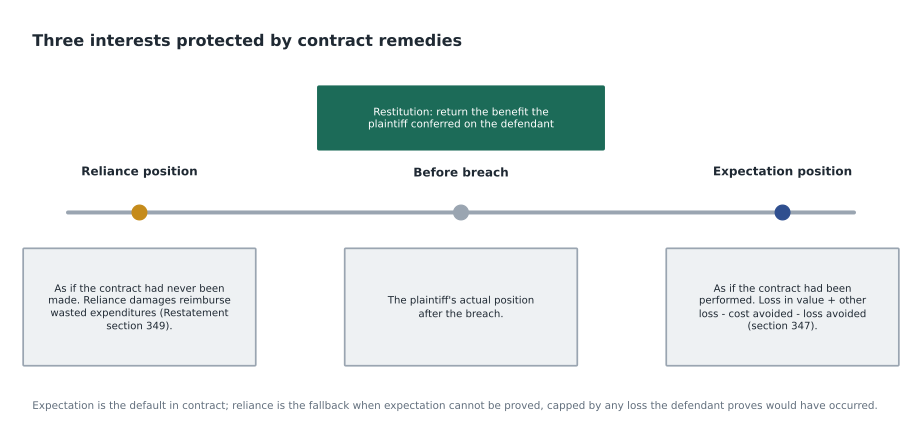
Expectation is the default in contract. It follows from the rightful position principle: the lawful world is one in which the defendant performed. Reliance is a fallback when expectation cannot be proved with reasonable certainty, and it is the usual measure for promissory estoppel, though Restatement section 90 says that the remedy granted for breach may be limited as justice requires. Restitution is the subject of Lesson 10. In tort, by contrast, there is no bargain, and compensatory damages aim to restore the plaintiff to the position before the tort. The tort measure therefore resembles reliance more than expectation, although lost future earnings and similar items look forward in time.
The expectation formula
Restatement section 347 states the expectation measure as a formula. The injured party may recover the loss in the value to it of the other party's performance caused by the failure or deficiency, plus any other loss, including incidental or consequential loss, caused by the breach, less any cost or other loss that it has avoided by not having to perform. Each term does work. Loss in value is the difference between what the plaintiff was promised and what it received. Other loss captures incidental expenses, such as the cost of finding a substitute, and consequential losses, such as lost profits or damage to other property. Cost avoided subtracts what the plaintiff saved because it did not have to finish its own performance. Loss avoided subtracts value the plaintiff salvaged, such as the resale value of materials it no longer needs.
The classic illustration is Hawkins v. McGee (N.H. 1929), the "hairy hand" case. A doctor promised to make a boy's scarred hand "a hundred percent perfect" by grafting skin from his chest. The graft left the hand covered in hair and worse than before. The New Hampshire Supreme Court held that the measure was the difference between the value of a perfect hand, as promised, and the value of the hand as it turned out, not the difference between the hand before and after the operation. Pain from the operation itself was not recoverable, because the boy would have endured it even if the doctor had performed. The case shows the counterfactual at work: the plaintiff gets the promised result, measured in money, and does not get compensation for burdens that performance itself would have imposed.
Cost of completion or diminution in value
When a contractor fails to build what it promised, there are two ways to measure the owner's loss in value: the cost of completing or correcting the work, or the difference in the market value of the property with and without the promised work. Usually they are close. When they diverge sharply, the choice is hard. In Jacob and Youngs v. Kent (N.Y. 1921), a builder used Cohoes pipe instead of the Reading pipe the contract specified, though the two were of the same quality. Replacing it would have required tearing out finished walls. Judge Cardozo held that the measure was the difference in value, which was nominal or nothing, because cost of replacement would be grossly and unfairly out of proportion to the good attained. In Groves v. John Wunder Co. (Minn. 1939), a company that leased land to remove sand and gravel promised to leave it at a uniform grade, then deliberately did not. The court awarded the cost of regrading, about sixty thousand dollars, even though the land would have been worth only about twelve thousand dollars after regrading.
Peevyhouse v. Garland Coal and Mining Co. (Okla. 1962) went the other way. The Peevyhouses leased their farm for strip mining, insisting on a promise that the mining company would restore the land when it finished. It did not. Restoration would have cost about twenty-nine thousand dollars, but would have increased the farm's value by only about three hundred dollars. A jury awarded five thousand dollars; the Oklahoma Supreme Court reduced the award to three hundred, holding that where the provision breached was incidental to the main purpose of the contract and the economic benefit of performance was grossly disproportionate to its cost, damages were limited to diminution in value. The case has been criticized ever since. Later research showed that the Peevyhouses had bargained hard for the restoration clause, and many scholars argue the result let the company keep the benefit of a promise it never intended to keep. Restatement section 348(2) takes a middle position: the plaintiff may recover diminution in market value, or the reasonable cost of completing performance or remedying defects if that cost is not clearly disproportionate to the probable loss in value to the plaintiff.
Jordan Kimura, the Army logistics officer who leads Section B's study group, points out that the Restatement test asks about loss in value to the plaintiff, not loss in market value. A homeowner who wants a particular garden, or a farmer who wants land restored for his family, may value performance far above what the market would pay. Calderwood agrees that this is the key: the cost of completion is the better measure when the plaintiff actually wants the work done and will use the money for it, and the worse measure when it would give the plaintiff a windfall.
Reliance damages
When the plaintiff cannot prove what performance would have been worth, it may recover reliance damages instead. In Security Stove and Manufacturing Co. v. American Railways Express Co. (Mo. Ct. App. 1932), a stove maker shipped a furnace to a trade show, and the carrier lost a crucial part. The maker could not prove the profits it would have made from showing the furnace, but it recovered its expenses of travel, booth space and shipping, because those were wasted in reliance on the carrier's promise. Sullivan v. O'Connor (Mass. 1973) awarded a patient whose nose surgery went badly her out-of-pocket expenses, the pain and suffering of the extra operations and the worsening of her condition, but not the difference between the promised nose and the result. The court reasoned that doctors' promises about results should be enforced cautiously, and a reliance measure did that.
Reliance recovery has a ceiling. A plaintiff cannot use reliance to escape a losing contract. Restatement section 349 allows reliance damages, including expenditures in preparation and performance, less any loss that the defendant can prove with reasonable certainty the plaintiff would have suffered had the contract been performed. Judge Learned Hand applied that rule in L. Albert and Son v. Armstrong Rubber Co. (2d Cir. 1949). The burden is on the breaching party to prove the plaintiff would have lost money; if it cannot, the plaintiff recovers its reliance.
Damages under the Uniform Commercial Code
Article 2 of the UCC translates the expectation principle into specific formulas for sales of goods. Section 1-305 states the goal. The individual sections then give the aggrieved party menus. A buyer who does not receive conforming goods, or who rightfully rejects or revokes acceptance, may cover by buying substitute goods in good faith and without unreasonable delay, and recover the difference between the cost of cover and the contract price (section 2-712), or may recover the difference between the market price at the time the buyer learned of the breach and the contract price (section 2-713). A buyer who accepts goods and keeps them despite a breach recovers the difference between the value of the goods accepted and the value they would have had if they had been as warranted (section 2-714). In each case the buyer may add incidental damages, such as expenses of inspecting, transporting and caring for rejected goods and of effecting cover, and consequential damages, including losses from general or particular requirements the seller had reason to know of that could not reasonably be prevented by cover, and injury to person or property proximately resulting from a breach of warranty (section 2-715).
A seller whose buyer refuses to take goods has a parallel menu. It may resell in a commercially reasonable manner and recover the difference between the contract price and the resale price (section 2-706), or recover the difference between the contract price and the market price at the time and place for tender (section 2-708(1)), or, if the market measure would not put it in as good a position as performance, recover the profit it would have made (section 2-708(2)). Section 2-709 permits an action for the price only in narrower cases: when the buyer has accepted the goods, when conforming goods were lost after risk of loss passed to the buyer, and when the goods were identified to the contract and the seller cannot resell them at a reasonable price.
Section 2-708(2) is the home of the lost volume seller. In Neri v. Retail Marine Corp. (N.Y. 1972), a buyer backed out of buying a boat, and the dealer resold it to someone else at the same price. The dealer recovered its lost profit anyway, because it could have sold a boat to the second buyer even if the first buyer had performed: it had an essentially unlimited supply from the manufacturer. The breach cost the dealer one sale. A seller with limited capacity cannot make that argument.
Northgate's repudiation
Calderwood turns to the Northgate deal. In late March 2026, Northgate Grocers' buyer Carla Brandt agreed orally to buy 400 pounds of aged cheddar a month from Juniper Hill for twelve months beginning in October 2026, and confirmed the deal by email. In September 2026, new Northgate management repudiated. Assume for this lesson that the contract is enforceable, a question Section B argued in Contracts, and that the contract price was 8.40 dollars a pound. By the time of repudiation the market price for comparable aged cheddar had fallen by about a quarter, to about 6.30 dollars a pound.
If Juniper Hill uses section 2-708(1), its damages are roughly the contract price minus the market price, times the quantity: 2.10 dollars a pound times 4,800 pounds, or about 10,080 dollars, plus incidental damages and minus expenses saved in consequence of the breach. Because this is an anticipatory repudiation of a contract with future deliveries, section 2-723 supplies the time for measuring the market price: the price prevailing at the time the aggrieved party learned of the repudiation. If instead Juniper Hill resells the cheese to other buyers in a commercially reasonable way, it can recover the difference between the contract price and the resale prices under section 2-706. Juniper Hill cannot claim lost volume status. Its output is limited by the milk its herd produces, so every pound it sells elsewhere is a pound it could not have sold to Northgate.
Worked problem
Sorting Lena's list
Use the expectation measure and the UCC buyer's remedies to sort the items on Lena's list against Calloway. Assume, as one view in Contracts concluded, that Calloway's limitation of remedy and exclusion of consequential damages did not become part of the contract under section 2-207, and that the court will apply section 2-715. Lena's list: (a) 2,600 pounds of young cheese spoiled in the July 8 heat wave; Calderwood's assumed figures are an aged wholesale value of 8.40 dollars a pound and remaining aging costs of 1.10 dollars a pound; (b) refrigerated trailer rental of 2,100 dollars in late June and July; (c) the creamery's 18,000-dollar electrical upgrade after the barn was found to have single-phase power; (d) Calloway's two demands for 9,000 and 15,000 dollars, the second paid under protest; (e) about three weeks of reduced production while undersized coils were replaced, with lost profit estimated at 6,400 dollars; (f) "stress."
Show solution
- Spoiled cheese: a consequential loss under section 2-715(2)(a) if Calloway had reason to know that a creamery needed working cold storage by June 1 and the loss could not reasonably have been prevented by cover. Value it net: 8.40 minus 1.10 equals 7.30 dollars a pound, times 2,600 pounds, or 18,980 dollars. Lesson 3 tests foreseeability and mitigation.
- Trailer rental: a reasonable expense incurred to avoid further loss is recoverable as incidental or consequential damages, even though it is also evidence that Juniper Hill tried to mitigate. Recoverable: 2,100 dollars.
- Electrical upgrade: not caused by Calloway's breach. The barn needed three-phase power for any modern system, and Juniper Hill would have paid for the upgrade if Calloway had performed perfectly. Under the expectation formula, it is a cost of performance, not a loss from breach.
- The 9,000 and 15,000 dollar payments: these are not damages for late or defective performance. Whether Juniper Hill can recover them depends on whether the modifications were enforceable or obtained by economic duress. If the second was extracted by duress, Juniper Hill can recover it as restitution (Lesson 10).
- Reduced production: lost profits are consequential damages if proved with reasonable certainty; a creamery with a history of sales has a good chance of proving them (Lesson 3).
- Stress: emotional distress damages are generally not recoverable for breach of a commercial contract (Restatement section 353), and a partnership cannot suffer emotional distress in any event.
Answer: Strong items: about 18,980 dollars for the cheese, 2,100 dollars for the trailer and the 6,400-dollar profit claim if proved. The electrical upgrade is not a breach loss; the payments to Calloway are a restitution question; stress is not recoverable.
Compensatory damages in tort
Tort damages restore the plaintiff to the position before the tort. For property, the basic measure is the diminution in market value, or in many jurisdictions the reasonable cost of repair if it does not exceed the property's value, plus loss of use during repair. For a destroyed chattel, the measure is its market value at the time of destruction. For personal injury, the plaintiff recovers economic losses (medical expenses and lost earnings, past and future) and noneconomic losses (pain, suffering, emotional distress, disfigurement, loss of enjoyment of life). The tort measure looks to what the plaintiff lost, not what the defendant gained, and it ignores what the defendant expected. Lesson 4 develops these rules, and Lesson 3 explains the limits that apply to both tort and contract damages.
Tort and contract measures can be compared directly when the same facts support both claims. A plaintiff who was induced to buy a business by a fraudulent misrepresentation may recover in tort under the out-of-pocket rule (the difference between what it paid and what it received), or in many states under the benefit-of-the-bargain rule (the difference between what it was promised and what it received). The choice of rule can change the outcome dramatically, and states disagree about which applies. When the plaintiff has both a contract and a tort claim, the economic loss rule may confine it to contract (Lesson 4).
Interest and the time value of money
A judgment entered years after the loss does not restore the rightful position unless it accounts for the time value of money. Prejudgment interest compensates for that delay. The traditional rule allowed prejudgment interest on liquidated claims, those whose amount was fixed or readily ascertainable, and left unliquidated claims to the discretion of the factfinder. Many states now provide by statute for prejudgment interest on most contract and property claims, and some extend it to personal injury damages. In federal courts, postjudgment interest runs under 28 U.S.C. section 1961 at a rate tied to Treasury yields. Calderwood tells the class that in large commercial cases interest can be worth more than any single item of damages, and that a good damages expert always computes it.
Common mistakes
MistakeMeasuring a breach of contract plaintiff's damages by its position before the contract.
InsteadThe default measure is expectation; reliance is a fallback when expectation cannot be proved and is capped by any loss the defendant proves the plaintiff would have suffered.
MistakeAwarding cost of completion in every construction case.
InsteadRestatement section 348(2) permits cost of completion unless it is clearly disproportionate to the probable loss in value to the plaintiff; Jacob and Youngs and Peevyhouse limited recovery to diminution in value.
MistakeIncluding costs that the plaintiff would have incurred even if the defendant had performed.
InsteadSuch costs, like Juniper Hill's electrical upgrade, are part of the plaintiff's own performance, not losses caused by breach.
MistakeLetting a seller who resold the goods at the same price recover nothing in every case.
InsteadA lost volume seller with capacity to make both sales recovers lost profit under section 2-708(2), as in Neri v. Retail Marine.
MistakeForgetting interest.
InsteadPrejudgment interest compensates for delay and is often available by statute; postjudgment interest runs in federal court under 28 U.S.C. section 1961.
Summary and key terms
- Contract damages protect the expectation, reliance and restitution interests (Fuller and Perdue; Restatement section 344); expectation is the default.
- Restatement section 347: loss in value, plus other loss, minus cost avoided and loss avoided.
- Hawkins v. McGee measures the loss as the difference between the promised result and the actual result.
- Cost of completion is the measure unless it is clearly disproportionate to the loss in value to the plaintiff (section 348(2)); compare Jacob and Youngs, Groves and Peevyhouse.
- Reliance damages reimburse wasted expenditures (Security Stove; Sullivan v. O'Connor), less losses the defendant proves the plaintiff would have suffered (L. Albert and Son).
- UCC buyers use cover, market or accepted-goods measures plus incidental and consequential damages (sections 2-712 to 2-715); sellers use resale, market, lost profit or price (sections 2-706, 2-708, 2-709).
- Tort damages restore the pre-tort position; property damages usually measure diminution in value or cost of repair plus loss of use.
- Prejudgment interest and postjudgment interest are part of restoring the rightful position.
- Expectation interest
- The interest in receiving the benefit of the bargain, measured by the position the plaintiff would have occupied had the contract been performed.
- Reliance interest
- The interest in being reimbursed for loss caused by reliance on the contract, measured by the position had the contract not been made.
- Restitution interest
- The interest in recovering a benefit conferred on the other party.
- Cost of completion
- The cost to finish or correct defective performance; the alternative to diminution in value in construction cases.
- Diminution in value
- The difference in market value of property with and without the promised performance or before and after an injury.
- Cover
- A buyer's good-faith purchase of substitute goods after the seller's breach (UCC section 2-712).
- Incidental damages
- Reasonable expenses caused by the breach, such as the cost of inspecting, storing or replacing goods (UCC sections 2-710 and 2-715(1)).
- Consequential damages
- Losses resulting from the plaintiff's particular needs or circumstances, such as lost profits, recoverable if foreseeable and not reasonably avoidable (UCC section 2-715(2)).
- Lost volume seller
- A seller with capacity to make additional sales, who loses a profit when a buyer breaches even though it resells the goods (UCC section 2-708(2)).
- Prejudgment interest
- Interest on a damages award from the time of loss to judgment, compensating for delay.
Practice problems
Work each problem on paper first, then reveal the answer to check.
A buyer contracted to buy 1,000 bushels of corn at 4.50 dollars a bushel. The seller repudiated, and the buyer bought substitute corn at 5.10 dollars. What are the buyer's damages?
Show answer
Under section 2-712, cover price minus contract price: 0.60 dollars times 1,000 bushels, or 600 dollars, plus incidental and consequential damages, minus expenses saved.
A homeowner contracts for a pool. The builder makes it two feet shallower than specified. Fixing it would cost 90,000 dollars; it reduces the house's market value by 4,000 dollars. What arguments determine the measure?
Show answer
Under section 348(2), the homeowner gets the cost of correction unless it is clearly disproportionate to the probable loss in value to the homeowner. The builder will cite Jacob and Youngs and Peevyhouse; the homeowner will argue personal value, as in Groves, especially if she will actually fix the pool.
A manufacturer spent 40,000 dollars preparing to perform a contract that the buyer then repudiated. The buyer proves that the manufacturer would have lost 15,000 dollars on the contract. What may the manufacturer recover?
Show answer
Reliance damages of 40,000 dollars less the 15,000-dollar loss the buyer proved: 25,000 dollars (Restatement section 349; L. Albert and Son).
A boat dealer's customer backs out; the dealer resells the boat at the same price a week later. The dealer can order as many boats as it can sell. Can it recover damages?
Show answer
Yes. As a lost volume seller, it recovers the profit it would have made on the first sale under section 2-708(2), as in Neri v. Retail Marine.
Lesson quiz · 5 questions
Score 60% or more to complete this lesson.
Create a free account to save your progress, take quizzes and earn a certificate.