
LAWU-304 · Lesson 4 of 12 · 25 min
Damages for personal injury, property loss and economic loss
▶ Video coming soon A video version of this lesson is on the way.
Calderwood takes the Okoro file out of the box. On the night of August 22, 2026, a six-inch shell fired by Brightfall Pyrotechnics at the Haldane County Fair burst low, and burning debris struck Nadia Okoro on the front lawn about three hundred feet from the mortars. She was twenty-nine, a dental hygienist, and she suffered burns to her face and neck. Her mother, Grace Okoro, was beside her when a fragment landed at her feet, and has since been diagnosed with post-traumatic stress disorder. The same night, embers from the fireworks set hay bales alight near the livestock barn, and a fire spread across the fields to the Pedersen farm, where it destroyed a barn. Liability, Calderwood says, was Torts. "Today we price the injuries. Juries do it every day, and lawyers who cannot help them do it well lose cases they should win."
The components of a personal injury award
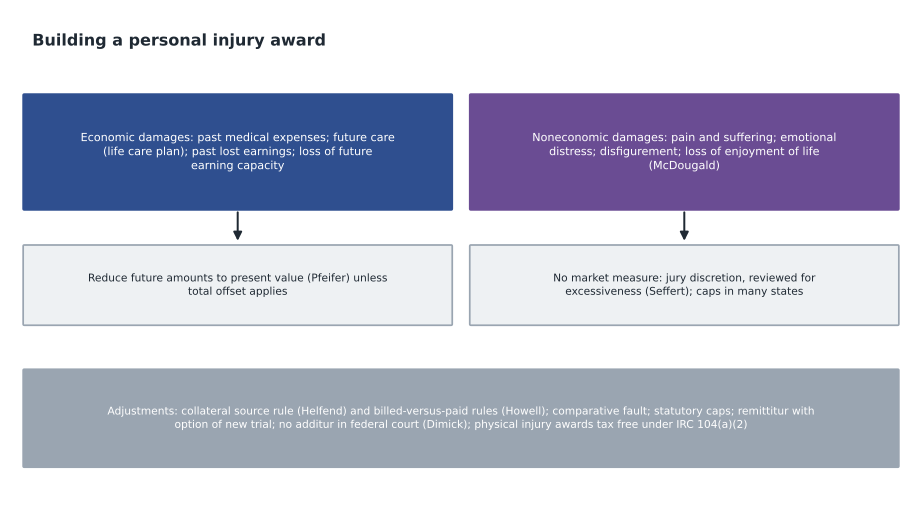
Personal injury damages fall into two groups. Economic damages, sometimes called special damages, compensate losses that have a market measure: past and future medical expenses, past lost earnings, loss of future earning capacity, and other out-of-pocket costs such as household help and travel to treatment. Noneconomic damages, sometimes called general damages, compensate losses without a market measure: physical pain, mental suffering, emotional distress, disfigurement, physical impairment and loss of enjoyment of life. A personal injury judgment is a lump sum, awarded once, that must cover both past losses and the plaintiff's projected future, which is why the law of damages for future losses depends so heavily on expert testimony and on rules for converting future dollars into present ones.
Medical expenses
Past medical expenses are proved by bills and testimony that the treatment was reasonable and necessary. Future medical expenses are usually proved through a life care plan, prepared by a nurse or physician who projects the treatments, surgeries, therapy and equipment the plaintiff will need, and an economist who prices them and reduces them to present value. For Nadia, a burn specialist expects at least three more reconstructive procedures over the next three years, plus laser treatment for scarring and years of follow-up care.
A recurring dispute concerns what counts as the amount of a past medical expense. Hospitals bill at list prices, but insurers and government programs pay much less, and the provider writes off the rest. Is the plaintiff's loss the billed amount or the amount actually paid? In Howell v. Hamilton Meats and Provisions, Inc. (Cal. 2011), the California Supreme Court held that an injured plaintiff whose medical expenses were paid by a private insurer could recover no more than the amounts paid, because the plaintiff never incurred liability for the written-off amounts. Other states allow recovery of the reasonable value of services, which may be proved by the billed amounts, and some have legislated on the issue. The question interacts with the collateral source rule.
The collateral source rule
Under the collateral source rule, payments to the plaintiff from sources independent of the defendant, such as health insurance, disability insurance, employee sick pay and gifts, do not reduce the defendant's liability. Restatement (Second) of Torts section 920A states the rule. The California Supreme Court explained its rationale in Helfend v. Southern California Rapid Transit District (Cal. 1970): a tortfeasor should not benefit from the plaintiff's foresight in buying insurance, and the plaintiff's insurer will often be entitled to reimbursement through subrogation or a lien on the recovery, so there is no double recovery in fact. Critics respond that subrogation is often not pursued and that the rule inflates awards. Many states have modified the rule by statute, most often for medical malpractice, by allowing evidence of collateral payments or by reducing awards by collateral benefits that are not subject to subrogation.
Lost earnings and earning capacity
Past lost earnings are the wages and benefits the plaintiff did not earn between the injury and trial. Nadia missed five months of work while her burns healed and has since returned to work part time; her past lost earnings are a matter of payroll records. Future losses are harder. The plaintiff recovers for loss of earning capacity: the difference between what she would have earned over her working life without the injury and what she can earn with it. The measure is capacity, not actual earnings, so even a plaintiff who was not working, such as a student or a parent at home, can recover for impaired capacity. Proof usually requires a vocational expert, who testifies to the plaintiff's work prospects, and an economist, who projects earnings and benefits, applies growth rates and discounts the stream to present value. A dental hygienist who cannot tolerate long hours in a mask and face shield over healing grafts, or whose disfigurement leads patients to choose other providers, may have a substantial capacity claim.
Present value
Because a lump sum awarded today can be invested, future losses must be discounted to present value. Otherwise the plaintiff would be overcompensated. In Jones and Laughlin Steel Corp. v. Pfeifer (1983), a case under the Longshore and Harbor Workers' Compensation Act, the Supreme Court explained the problem in detail. Future earnings would have grown with inflation and with the worker's productivity, and the lump sum will earn interest, which also reflects inflation. A court may handle the problem by projecting nominal earnings growth and discounting at a nominal interest rate, or by ignoring inflation on both sides and discounting at a real, after-inflation rate. The Court declined to choose one method for all cases but held that the discount rate should be based on the rate of interest that would be earned on the best and safest investments, and that the factfinder may not simply ignore inflation. Some states, following Beaulieu v. Elliott (Alaska 1967), use a total offset method that treats inflation and interest as canceling out, so future losses are not discounted at all.
Worked problem
Discounting Nadia's future surgery costs
The life care planner projects that Nadia will need reconstructive surgery and related care costing 40,000 dollars in each of the next three years, in today's dollars. The plaintiff's economist uses a net discount rate of 2 percent a year, reflecting the difference between the expected return on safe investments and the expected growth of medical costs. What is the present value of the projected costs?
Show solution
- Year one: 40,000 divided by 1.02 equals about 39,216 dollars.
- Year two: 40,000 divided by 1.02 squared equals about 38,447 dollars.
- Year three: 40,000 divided by 1.02 cubed equals about 37,693 dollars.
- Total: about 115,355 dollars, compared with 120,000 dollars undiscounted.
- Defense response: Brightfall's economist may argue for a higher net discount rate, which lowers the present value, or challenge whether the third surgery is reasonably certain. Medical costs have historically risen faster than general inflation, which is why plaintiffs argue for low net rates on medical items.
Answer: About 115,355 dollars. The choice of net discount rate, more than the arithmetic, is where the parties' experts will disagree.
Taxes
Damages received on account of personal physical injuries or physical sickness are excluded from the recipient's gross income under section 104(a)(2) of the Internal Revenue Code. Lost earnings awards therefore replace taxable wages with tax-free dollars. In Norfolk and Western Railway Co. v. Liepelt (1980), a wrongful death case under the Federal Employers' Liability Act, the Supreme Court held that the jury should be told that the award would not be taxed, and that evidence of the decedent's income taxes was admissible to compute lost after-tax earnings. State courts are divided on whether to follow Liepelt in ordinary tort cases. Punitive damages and most damages for emotional distress not arising from physical injury are taxable.
Noneconomic damages
Pain and suffering has no market. A jury is asked to translate the experience of a burn victim, the months of dressing changes, the grafts, the fear of mirrors, into dollars. The law gives it little guidance beyond the instruction to award fair and reasonable compensation. Seffert v. Los Angeles Transit Lines (Cal. 1961) is the classic case on review. A bus door closed on a woman's foot and dragged her; she suffered severe and permanent injuries and endured repeated surgeries. The jury awarded 134,000 dollars, most of it for pain and suffering, which was a large sum at the time. The California Supreme Court affirmed, holding that an appellate court may interfere only when the award is so large that it shocks the conscience and suggests passion or prejudice. Justice Traynor's dissent argued that pain and suffering awards should be compared with awards in similar cases and that unguided awards are arbitrary.
Courts disagree about how lawyers may help juries. Some states permit per diem arguments, in which counsel suggests a dollar figure per day or per hour of pain and multiplies it by the plaintiff's life expectancy. Others forbid them as creating an illusion of precision. Many states allow counsel to suggest a total figure, and some require a limiting instruction. Calderwood tells the class that this is a jurisdiction-specific trial skill they will practice in Trial Advocacy.
Loss of enjoyment of life, sometimes called hedonic damages, compensates for the plaintiff's inability to engage in activities she once enjoyed. Courts disagree whether it is a separate category. In McDougald v. Garber (N.Y. 1989), a woman left in a permanent coma after surgery sought damages for loss of enjoyment of life. New York's highest court held that some level of cognitive awareness is a prerequisite to recovery for loss of enjoyment, because damages that the plaintiff cannot experience serve no compensatory purpose, and that loss of enjoyment should not be a separate category from pain and suffering, to avoid duplicative awards. Other courts allow separate awards.
Emotional distress claims by family members require separate liability rules, which Torts covered. Grace Okoro's claim as a bystander who witnessed her daughter's injury depends on the state's approach. California's Thing v. La Chusa (Cal. 1989) limits bystander recovery to close relatives who are present at the scene, are aware that the injury is occurring, and suffer serious emotional distress. Grace was beside Nadia, so she likely satisfies that test, and she may also have a claim in her own right as someone in the zone of danger, since a fragment landed at her feet. Once liability is established, damages for her post-traumatic stress disorder are measured like other emotional distress damages, with proof of treatment and its cost.
Caps and other statutory limits
Many states cap noneconomic damages, at least in medical malpractice cases and sometimes in all personal injury cases. Caps take different forms: a flat dollar limit, a limit that rises with inflation, or a higher limit for catastrophic injuries. Their constitutionality depends on state constitutional provisions, and state courts have reached different results. Some have struck caps down as violating the right to a jury trial, separation of powers or equal protection under their state constitutions, while others have upheld them as permissible legislative choices. A remedies lawyer must check both the statute and the state's case law. Wrongful death and survival statutes create their own measures. A survival action continues the decedent's own claim for losses before death, such as medical expenses and conscious pain and suffering. A wrongful death action compensates the survivors for their losses, such as loss of financial support and, in many states, loss of companionship. Some states limit wrongful death damages to pecuniary losses.
Remittitur and additur
When a judge finds a jury's award excessive, the usual remedy is remittitur: the judge orders a new trial unless the plaintiff accepts a reduced award. The plaintiff's choice preserves the jury right. Additur, the mirror-image practice of denying a new trial if the defendant agrees to pay more, is unconstitutional in federal court under Dimick v. Schiedt (1935), because it would substitute a judge's finding for a jury verdict, but some state courts permit it. In Gasperini v. Center for Humanities, Inc. (1996), the Supreme Court held that a federal court sitting in diversity should apply New York's statutory standard, under which an award is excessive if it deviates materially from what would be reasonable compensation, with the trial judge applying the standard and the court of appeals reviewing for abuse of discretion.
Damages for harm to property
Property damages follow the rightful position principle with market tools. For personal property that is destroyed, the plaintiff recovers its market value at the time of destruction, plus interest. For damaged personal property, the plaintiff recovers the difference in value before and after the harm, or the reasonable cost of repair, plus compensation for loss of use. Items without a market value, such as family photographs and heirlooms, are valued by their value to the owner, but courts generally exclude purely sentimental value. Most courts still treat pets as property, though a growing number permit recovery beyond market value for the loss of a companion animal.
For real property, the choice is between diminution in market value and cost of restoration, as in contract. Most courts award the cost of restoration unless it is disproportionate to the diminution in value, and many recognize an exception when the owner has personal reasons for restoration, such as a family home or a stand of trees with special significance. The Pedersen barn is the test case. Rebuilding a barn of comparable size and quality would cost about 180,000 dollars; the farm's market value fell by about 95,000 dollars, because buyers of farmland pay less for barns than they cost to build. The Pedersens use the barn to house equipment and hay, and they will rebuild. Calderwood says most courts would award the reasonable cost of rebuilding, perhaps adjusted for the age of the old barn, plus the value of the equipment and hay lost and the loss of use while they rebuild. A court focused strictly on market value would award less.
The fire also produced two smaller property claims with lessons of their own. Volunteer firefighters tore down two hundred feet of the Pedersens' fence and cut a firebreak across a field. Under the doctrine of public necessity, the firefighters are not liable, but the Pedersens can include the fence and the firebreak in their claim against the party whose negligence caused the fire, since the firefighting was a foreseeable response. A fleeing family drove a pickup across the Pedersens' soybeans to escape the fire. Under the doctrine of private necessity illustrated by Vincent v. Lake Erie Transportation Co. (Minn. 1910), they had a privilege to enter, but they remain liable for the actual damage they caused.
The economic loss rule
A plaintiff whose only loss is economic, without injury to person or property, often cannot recover in negligence. The rule has two branches. The first concerns strangers. In Robins Dry Dock and Repair Co. v. Flint (1927), a dry dock negligently damaged a ship's propeller, and the charterers of the ship, who lost its use, sued. Justice Holmes held that they could not recover, because their loss arose only from their contract with the owner. In 532 Madison Avenue Gourmet Foods, Inc. v. Finlandia Center, Inc. (N.Y. 2001), businesses closed for weeks after a building wall collapsed near them in Manhattan could not recover lost profits in negligence, because the defendant owed no duty to the indefinite class of businesses that suffered purely economic harm. Courts sometimes make exceptions for commercial fishermen whose livelihood depends on a polluted resource, as in Union Oil Co. v. Oppen (9th Cir. 1974).
The second branch concerns parties in a contractual chain. In East River Steamship Corp. v. Transamerica Delaval, Inc. (1986), the Supreme Court held in admiralty that a manufacturer has no duty in tort to prevent a product from injuring itself; a purchaser whose turbines failed had only warranty claims. Most states apply the same rule to products: when a product damages only itself, the buyer's remedies lie in contract and warranty, where the parties could allocate risk. When the product damages other property or a person, tort remedies are available. Calderwood applies the rule to Juniper Hill: the undersized coils that harmed only the refrigeration system itself are a warranty matter, but the cheese that spoiled is other property. Whether a court treats spoiled cheese stored in a defective cold room as damage to other property or as a disappointed expectation of the bargain is a question on which courts have split.
Common mistakes
MistakeAwarding future losses at their undiscounted total.
InsteadFuture economic losses must be reduced to present value, using a discount rate based on safe investments, unless the jurisdiction uses the total offset method (Pfeifer; Beaulieu).
MistakeReducing a tort award by the plaintiff's health insurance payments.
InsteadThe collateral source rule ordinarily excludes such payments, though many states have modified it by statute and courts disagree about billed versus paid medical expenses (Howell).
MistakeMeasuring lost earning capacity by the plaintiff's actual earnings at the time of injury.
InsteadThe measure is impaired capacity over the plaintiff's working life, which an unemployed plaintiff can also prove.
MistakeAssuming a judge can raise an inadequate federal jury award.
InsteadAdditur violates the Seventh Amendment in federal court (Dimick v. Schiedt); remittitur is permitted if the plaintiff can choose a new trial instead.
MistakeLetting a buyer sue in negligence when a defective product destroys only itself.
InsteadEast River and the economic loss rule confine the buyer to contract and warranty remedies unless other property or persons are harmed.
Summary and key terms
- Personal injury damages combine economic losses (medical expenses, lost earnings, lost earning capacity) and noneconomic losses (pain, distress, disfigurement, loss of enjoyment).
- Future losses are proved through life care plans and expert projections and reduced to present value (Jones and Laughlin Steel v. Pfeifer), except where total offset applies.
- The collateral source rule excludes independent payments such as insurance (Helfend; Restatement section 920A); states differ on billed versus paid medical expenses (Howell).
- Physical injury damages are tax free under IRC section 104(a)(2); Liepelt permits telling the jury so in FELA cases.
- Noneconomic awards are reviewed deferentially (Seffert); McDougald requires awareness for loss of enjoyment and treats it as part of pain and suffering in New York.
- Many states cap noneconomic damages; constitutionality varies by state.
- Remittitur is allowed with the option of a new trial; additur is barred in federal court (Dimick); Gasperini applies the state excessiveness standard in diversity cases.
- Property damages measure market value, diminution or reasonable cost of repair plus loss of use; the economic loss rule limits recovery of purely economic loss in negligence (Robins Dry Dock; East River; 532 Madison).
- Economic damages
- Damages for losses with a market measure, such as medical expenses and lost earnings.
- Noneconomic damages
- Damages for losses without a market measure, such as pain and suffering, emotional distress and loss of enjoyment of life.
- Life care plan
- An expert projection of the medical care and support an injured plaintiff will need over her lifetime.
- Loss of earning capacity
- The reduction in the plaintiff's ability to earn over her working life, measured by capacity rather than actual earnings.
- Present value
- The amount that, invested today at an appropriate rate, will produce a future sum.
- Total offset method
- An approach that treats inflation and interest as canceling out, so future losses are not discounted.
- Collateral source rule
- The rule that benefits from sources independent of the defendant do not reduce the defendant's liability.
- Remittitur
- An order granting a new trial unless the plaintiff accepts a reduced award.
- Additur
- An order denying a new trial if the defendant agrees to an increased award; unconstitutional in federal court.
- Economic loss rule
- The doctrine limiting recovery in negligence for purely economic loss unaccompanied by injury to person or other property.
Practice problems
Work each problem on paper first, then reveal the answer to check.
A plaintiff's health insurer paid 30,000 dollars on hospital bills of 90,000 dollars, and the hospital accepted the payment in full. In a state following Howell, how much may the plaintiff recover for past medical expenses?
Show answer
The 30,000 dollars actually paid, because she never incurred liability for the written-off amount. In a reasonable value state, she might prove a higher figure.
A federal jury awards 5,000 dollars for a broken leg with documented medical bills of 40,000 dollars. May the judge increase the award to 60,000 dollars?
Show answer
No. Additur violates the Seventh Amendment under Dimick v. Schiedt. The judge may grant a new trial on damages.
A defective furnace explodes and destroys itself and the buyer's garage. Can the buyer sue the manufacturer in negligence?
Show answer
Yes for the garage, which is other property; the furnace itself is ordinarily a warranty claim under East River and the economic loss rule.
A seventeen-year-old who planned to become a nurse is permanently disabled. She had no earnings yet. Can she recover lost earnings?
Show answer
She can recover for loss of earning capacity, proved by evidence of her prospects and expert testimony, even though she had no earnings at the time of injury.
Lesson quiz · 5 questions
Score 60% or more to complete this lesson.
Create a free account to save your progress, take quizzes and earn a certificate.