
LAWU-304 · Lesson 5 of 12 · 23 min
Agreed remedies: liquidated damages and limitation clauses
▶ Video coming soon A video version of this lesson is on the way.
Calderwood hands out two documents. The first is the back of Calloway Refrigeration's March 6, 2026 acknowledgment form, the page Section B argued over in Contracts: Calloway's "exclusive remedy" of repair or replacement, its disclaimer of implied warranties, and its exclusion of "incidental, consequential or special damages of any kind." The second is new to the class. It is a draft construction contract between Juniper Hill Creamery and Quarrington Earthworks, a local excavation firm, for a cheese cave to be dug into the hillside behind the barn. Clause 14 provides that if the cave is not substantially complete by May 1, 2027, Quarrington will pay "as liquidated damages and not as a penalty" 600 dollars for each day of delay. Lena Marsh has asked whether the clause is enforceable and whether she should ask for more. "Parties can write their own remedies," Calderwood says, "but only within limits that courts police. This lesson is about those limits."
Why parties agree on remedies
Parties agree on remedies for good reasons. The default rules of damages, studied in Lessons 2 and 3, are expensive to apply. Proving lost profits requires experts, and certainty and foreseeability rules may defeat real losses. A liquidated damages clause lets the parties fix the amount in advance, avoiding litigation over proof. A limitation of remedy, such as a promise to repair or replace defective goods, lets a seller offer a lower price by excluding open-ended liability. An exclusion of consequential damages allocates the risk of losses that are hard for the seller to price because they depend on the buyer's business. Courts generally respect these choices, but two doctrines limit them: the rule against penalties, and the rules that strike limitations that are unconscionable or that fail of their essential purpose.
The rule against penalties
The common law has long refused to enforce contract terms that fix damages at an amount designed to punish breach rather than to compensate for it. The modern formulation is Restatement (Second) of Contracts section 356(1): damages for breach by either party may be liquidated in the agreement but only at an amount that is reasonable in the light of the anticipated or actual loss caused by the breach and the difficulties of proof of loss. A term fixing unreasonably large liquidated damages is unenforceable on grounds of public policy as a penalty. The UCC's version for sales of goods, section 2-718(1), is similar: damages may be liquidated at an amount that is reasonable in the light of the anticipated or actual harm caused by the breach, the difficulties of proof of loss, and the inconvenience or nonfeasibility of otherwise obtaining an adequate remedy.
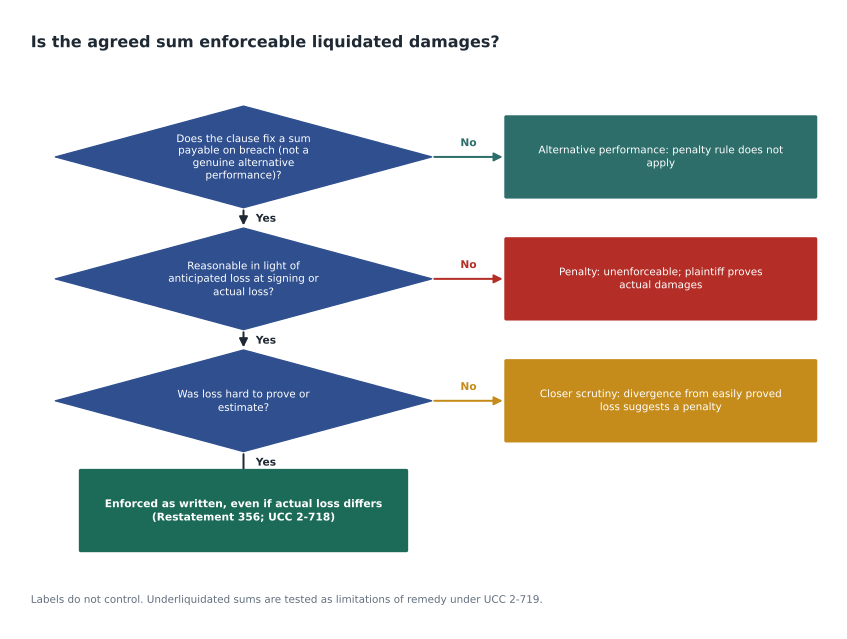
The test has three parts that courts weigh together. First, the amount must be reasonable in light of the loss anticipated when the contract was made or the loss that actually occurred. Most courts accept either: a clause that was a reasonable forecast is enforceable even if the actual loss turned out smaller, and some courts will enforce a clause that was not a good forecast if it matches the actual loss. A few courts refuse to enforce a clause when the breach caused no loss at all. Second, the difficulty of proving the loss matters. When damages would be easy to prove, a liquidated amount that diverges from them is more likely to be treated as a penalty; when damages are uncertain, the parties' forecast deserves more deference. Third, the label the parties use is not decisive. A clause called "liquidated damages and not a penalty" can still be a penalty, and a clause called a "penalty" can be enforceable liquidated damages.
The cases
Wasserman's Inc. v. Township of Middletown (N.J. 1994) restated the modern approach. A township leased land to a business and reserved the right to cancel the lease. If it did, the township would pay the tenant a percentage of the tenant's average gross receipts. The township canceled to sell the property. The New Jersey Supreme Court held that the enforceability of a stipulated damages clause turns on whether it is reasonable under the totality of the circumstances, considering both anticipated and actual loss and the difficulty of assessing damages. A clause tied to gross receipts rather than profits was suspect, because gross receipts bear no necessary relation to the tenant's actual loss. The court remanded to determine reasonableness, emphasizing that a clause between sophisticated parties is presumptively reasonable and that the party challenging it bears the burden of proving it is a penalty.
Truck Rent-A-Center, Inc. v. Puritan Farms 2nd, Inc. (N.Y. 1977) enforced a clause in a seven-year truck lease that required the lessee, on early termination, to pay half of the remaining rent. New York's highest court reasoned that the parties could reasonably have forecast that the lessor's loss on termination would be substantial and uncertain, because the trucks had been specially painted and equipped for the lessee and might be hard to relet; the half-rent figure was a reasonable estimate. Lake River Corp. v. Carborundum Co. (7th Cir. 1985) went the other way. A distributor agreed to bag a product for Carborundum and required a minimum quantity guarantee: if Carborundum shipped less than the minimum, it would pay the full contract price for the shortfall. Judge Posner, applying Illinois law, held the clause a penalty because it gave Lake River the full price without deducting the costs it saved by not bagging the product, so the amount bore no reasonable relation to Lake River's actual or anticipated loss. Posner's opinion questions why the law should refuse to enforce penalties between sophisticated commercial parties, but recognizes that the doctrine is settled.
Penalty substitutes: alternative performance, deposits and acceleration
Lawyers draft around the penalty rule, and courts look through the drafting. A promise to perform in one of two ways, at the promisor's option, is an alternative performance contract, not a liquidated damages clause, so the penalty rule does not apply. A take-or-pay clause in a gas contract, under which the buyer must take a minimum quantity or pay for it, is often analyzed this way, though courts look at whether the "alternative" is a genuine choice or a disguised penalty. Deposits and down payments raise similar issues. Many courts let a seller of land keep a deposit of a modest percentage of the price on the buyer's breach without proof of loss, but refuse forfeiture of large installments that would give the seller a windfall. Under UCC section 2-718(2), a buyer who has made payments and then defaults may recover the excess of its payments over the seller's liquidated damages, or, absent a clause, over the lesser of 20 percent of the buyer's total obligation or 500 dollars. Acceleration clauses in loan agreements, which make the whole debt due on default, are generally enforced because they accelerate an obligation that already exists rather than imposing a new one.
Worked problem
Testing Clause 14 of the cheese cave contract
Clause 14 sets 600 dollars a day for delay after May 1, 2027. Juniper Hill plans to move 3,000 pounds of cheese into the cave each month to age for nine to twelve months, launching a cave-aged line in fall 2027. Lena estimates that without the cave the creamery must rent off-site cold storage at about 300 dollars a day and would lose sales of the new line, which might be worth 4,000 to 9,000 dollars a month in profit once established. Quarrington's lawyer argues that 600 dollars a day is a penalty because rented storage costs only half as much.
Show solution
- Anticipated loss at signing: the storage cost alone is about 300 dollars a day, and lost profits of 4,000 to 9,000 dollars a month equal roughly 130 to 300 dollars a day. A forecast of about 430 to 600 dollars a day is within the range of reasonable estimates.
- Difficulty of proof: profits from a cheese line that does not yet exist would be hard to prove with reasonable certainty (Kenford; Lesson 3). That difficulty is exactly why the parties may agree on a figure.
- Actual loss: if the delay occurs and Juniper Hill's actual loss turns out lower, most courts still enforce a clause that was a reasonable forecast. If the delay causes no loss at all, for example because Juniper Hill had already abandoned the cave-aged line, some courts would refuse enforcement.
- Drafting advice: Lena should not ask for a much higher figure, which would invite a penalty challenge. She could ask Quarrington to agree that the clause does not limit Juniper Hill's other remedies for defective work, and she should make sure the clause states the facts that make loss difficult to prove.
Answer: Clause 14 is likely enforceable. The figure is a reasonable forecast of hard-to-prove losses. Asking for substantially more would increase the risk that a court treats it as a penalty.
Limitations of remedy under UCC section 2-719
Sellers of goods commonly limit the buyer's remedies, and UCC section 2-719 governs those clauses. Under subsection (1), an agreement may provide remedies in addition to or in substitution for those provided by Article 2 and may limit or alter the measure of damages, as by limiting the buyer's remedies to return of the goods and repayment of the price or to repair and replacement of nonconforming goods. A remedy is optional unless the agreement expressly says it is exclusive. Under subsection (2), where circumstances cause an exclusive or limited remedy to fail of its essential purpose, the buyer may resort to the general remedies of Article 2. Under subsection (3), consequential damages may be limited or excluded unless the limitation or exclusion is unconscionable. Limitation of consequential damages for injury to the person in the case of consumer goods is prima facie unconscionable, but limitation of damages where the loss is commercial is not.
A repair or replace remedy fails of its essential purpose when the seller cannot or will not make the goods conform within a reasonable time. A buyer stuck with a machine that the seller tries and fails to fix for months has not received the minimum adequate remedy the clause promised, and may then seek ordinary damages. Courts are divided on what happens to a separate exclusion of consequential damages when the limited remedy fails. Under the independent approach, illustrated by Chatlos Systems, Inc. v. National Cash Register Corp. (3d Cir. 1980), the consequential damages exclusion is a separate allocation of risk that survives unless it is itself unconscionable. Under the dependent approach, illustrated by RRX Industries, Inc. v. Lab-Con, Inc. (9th Cir. 1985), the two clauses are read together, and when the limited remedy fails the buyer may recover consequential damages too. Many courts decide case by case, asking whether the parties intended the exclusion to apply even if the repair remedy failed.
Calderwood applies the provision to the Calloway terms. Suppose, contrary to the assumption in Lesson 2, that the court holds Calloway's terms part of the contract. Calloway did replace the undersized coils, within about three weeks. As to the coils, the repair remedy arguably worked. But the core harm, the spoilage of cheese during a seven-week delay in completing the installation, is not something repair or replacement could cure. Juniper Hill will argue that a remedy limited to repair cannot fulfill its purpose when the breach is delay, and that the exclusion of consequential damages is unconscionable as applied to a small family creamery that had no realistic ability to bargain over a seller's preprinted form. Calloway will answer that the parties were merchants, that commercial losses are expressly excluded from the presumption of unconscionability, and that a jurisdiction following Chatlos would enforce the exclusion. The answer will depend on the jurisdiction's approach and the court's view of the facts.
Exculpatory clauses and releases
Agreements that limit tort liability raise more serious concerns, because the interests at stake include bodily safety. Most states enforce releases of negligence liability for recreational activities if the release is clear and conspicuous, but refuse to enforce releases of liability for gross negligence, recklessness or intentional misconduct. Courts also refuse to enforce exculpatory clauses that affect the public interest. The leading statement is Tunkl v. Regents of University of California (Cal. 1963), which held a hospital admission form's release unenforceable. The court listed factors suggesting a public interest: the business is suitable for public regulation, it performs a service of great importance to the public, it holds itself out as willing to serve any member of the public, it has a decisive advantage in bargaining strength, it uses a standardized adhesion contract with no option to pay for protection, and the customer is placed under the seller's control. The Haldane County Fair's unsigned fine-print release on the back of admission tickets, which Section B analyzed in Torts, fares badly under almost any approach: a release that a patron never signed and likely never saw is weak evidence of assent, and many courts would also hold that a release cannot protect against the gross negligence of a fireworks operator who knew its shells had burst low before.
Other clauses that shape remedies
Many contract terms that do not mention damages still determine remedies. A forum selection clause decides where the remedy is sought. An arbitration clause replaces a court with an arbitrator and usually bars class proceedings; AT&T Mobility LLC v. Concepcion (2011) held that the Federal Arbitration Act preempts state rules that would refuse to enforce class arbitration waivers in consumer contracts. A jury waiver clause, enforceable in most jurisdictions if knowing and voluntary, takes the measure of damages away from the jury. A clause making time of the essence, like the one in Juniper Hill's purchase order, affects whether delay is a material breach that justifies termination. A fee-shifting clause, discussed in Lesson 11, overrides the American rule. And a cap on liability, such as a provision limiting a contractor's total liability to the contract price, is a limitation of remedy that courts usually enforce between commercial parties unless it is unconscionable or would excuse intentional wrongdoing.
Common mistakes
MistakeRelying on a label such as "liquidated damages and not a penalty" to make a clause enforceable.
InsteadCourts apply Restatement section 356 and UCC section 2-718 to the substance: the amount must be reasonable in light of anticipated or actual loss and the difficulty of proof.
MistakeTreating any clause whose amount exceeds actual loss as a penalty.
InsteadA clause that was a reasonable forecast at signing is usually enforced even if actual loss turns out lower; the question is unreasonable size.
MistakeAssuming a repair or replace remedy always limits the buyer.
InsteadIf the limited remedy fails of its essential purpose, section 2-719(2) restores the general remedies of Article 2.
MistakeAssuming that when the limited remedy fails, the consequential damages exclusion falls too.
InsteadCourts split between the independent approach (Chatlos) and the dependent approach (RRX); many decide based on the parties' intent.
MistakeAssuming that a recreational release protects against all liability.
InsteadMost states refuse to enforce releases of gross negligence or recklessness, and Tunkl refuses releases that affect the public interest.
Summary and key terms
- Parties may agree on remedies to reduce the cost and uncertainty of proving damages, but courts police the agreements.
- Liquidated damages are enforceable only at an amount reasonable in light of anticipated or actual loss and the difficulty of proof (Restatement section 356; UCC section 2-718(1)).
- Wasserman's applies a totality of circumstances reasonableness test and puts the burden on the party challenging the clause; Truck Rent-A-Center enforced a clause, Lake River struck one.
- Alternative performance, deposits and acceleration clauses are analyzed separately, though courts look through disguised penalties; UCC section 2-718(2) governs a defaulting buyer's restitution.
- Under section 2-719, parties may make repair or replacement exclusive, but if it fails of its essential purpose general remedies return; consequential damages exclusions stand unless unconscionable.
- Courts divide on whether a consequential damages exclusion survives failure of the limited remedy (Chatlos versus RRX).
- Releases of negligence are often enforced in recreation, but not for gross negligence or when they affect the public interest (Tunkl).
- Arbitration, forum, jury waiver, time of the essence and liability cap clauses also shape the remedies available.
- Liquidated damages
- A contract term fixing the damages payable on breach; enforceable if reasonable.
- Penalty
- A term fixing an unreasonably large amount on breach, designed to coerce performance; unenforceable.
- Alternative performance
- A contract giving the promisor a choice between performances, not subject to the penalty rule if the choice is genuine.
- Exclusive remedy
- A remedy the agreement expressly makes the buyer's sole remedy, such as repair or replacement (UCC section 2-719(1)(b)).
- Failure of essential purpose
- The condition, under UCC section 2-719(2), in which a limited remedy does not give the buyer the minimum adequate remedy, restoring general remedies.
- Exculpatory clause
- A term releasing a party from liability for its own negligence or other wrongdoing.
- Unconscionability
- A doctrine refusing enforcement of terms that are unreasonably favorable to one party in light of an absence of meaningful choice.
- Acceleration clause
- A loan term making the entire debt due on default.
Practice problems
Work each problem on paper first, then reveal the answer to check.
A software license provides that if the licensee breaches the confidentiality clause it will pay 1,000,000 dollars, regardless of the harm. The licensee leaks a minor feature description that causes no measurable harm. Is the clause enforceable?
Show answer
Likely not. A fixed sum unrelated to the nature or extent of the disclosure is unreasonably large in light of anticipated and actual loss and looks like a penalty, though the licensor will argue that harm from disclosure is hard to prove.
A machine's warranty limits the buyer to repair or replacement. The seller tries five times over eight months and cannot make the machine work. What can the buyer do?
Show answer
Argue that the limited remedy has failed of its essential purpose under section 2-719(2) and seek general remedies, such as revocation of acceptance and damages. Whether it can recover consequential damages despite an exclusion depends on the jurisdiction's approach.
A consumer buys a space heater whose warranty excludes consequential damages. The heater overheats and burns her hand. Is the exclusion enforceable as to her injury?
Show answer
Presumptively not. Under section 2-719(3), limitation of consequential damages for injury to the person in the case of consumer goods is prima facie unconscionable.
A buyer of land deposits 10 percent of the price and then breaches. The contract lets the seller keep the deposit. The seller resells at a higher price. Can the seller keep the deposit?
Show answer
Many courts would let the seller keep a reasonable deposit as liquidated damages, especially if it was a reasonable forecast of loss at signing. Courts that focus on actual loss might order its return when the seller suffered no loss.
Lesson quiz · 5 questions
Score 60% or more to complete this lesson.
Create a free account to save your progress, take quizzes and earn a certificate.