
LAWU-304 · Lesson 7 of 12 · 25 min
Injunctions
▶ Video coming soon A video version of this lesson is on the way.
The new file in Calderwood's box is labeled Albescu Stables v. Brackenridge Stone Co. Mirela and Dorin Albescu have run a horse boarding and riding school on eighty acres outside Brennan Falls since 2011. In 2024, Brackenridge Stone, which has quarried limestone a mile to the east since the 1980s, bought the parcel next to the Albescus and opened a new pit four hundred yards from their paddocks. Since spring 2026, Brackenridge has been blasting as early as 6:30 in the morning, three or four days a week. The horses bolt at each blast; two have been injured on fencing, and several boarders have moved their horses elsewhere. Dust from the crusher coats the paddocks, the arena and the hay. The Albescus want the blasting and the dust to stop. Brackenridge employs sixty people and supplies crushed stone to the county's road projects, and it says the new pit is essential to its business. "Money will not fix this," Mirela Albescu wrote to her lawyer. Calderwood asks whether she is right.
What an injunction is
An injunction is a court order directing a party to do or refrain from doing something. A prohibitory injunction forbids conduct: stop blasting before eight in the morning. A mandatory injunction requires affirmative action: install a dust suppression system on the crusher. The distinction matters because courts are more cautious about mandatory injunctions, which may require supervision and impose greater burdens, though the line is often a matter of phrasing. Injunctions can also be classified by purpose, following a typology developed by Owen Fiss: preventive injunctions forbid future wrongs; reparative injunctions require the defendant to correct the effects of past wrongs, such as removing a structure built on the plaintiff's land; and structural injunctions reorganize an institution, the subject of Lesson 8. An injunction may be preliminary, issued before trial to preserve the status quo or prevent irreparable harm during litigation, or permanent, issued after a final determination on the merits. This lesson addresses permanent injunctions.
The threat requirement
Because injunctions look forward, the plaintiff must show a real threat of future harm, not merely a past wrong. If the defendant has stopped the conduct, the court asks whether it is likely to resume. In United States v. W.T. Grant Co. (1953), the Supreme Court held that a defendant's voluntary cessation of challenged conduct does not make an injunction suit moot, but that the plaintiff must show some cognizable danger of recurrent violation, something more than the mere possibility that serves to keep the case alive. Courts consider the defendant's history, the sincerity of its promises, whether it has an incentive to resume and whether the cessation was timed to avoid a ruling. A defendant whose blasting has stopped only because of winter weather, and who plans to resume in spring, poses an obvious threat.
Courts sometimes enter prophylactic injunctions that forbid conduct that is not itself unlawful in order to prevent violations. An order requiring Brackenridge to give the Albescus a day's notice of each blast, or to monitor vibration at the property line, goes beyond forbidding the nuisance itself, but courts may impose such measures when they are reasonably related to preventing the wrong and the defendant's past conduct shows they are needed.
The eBay factors
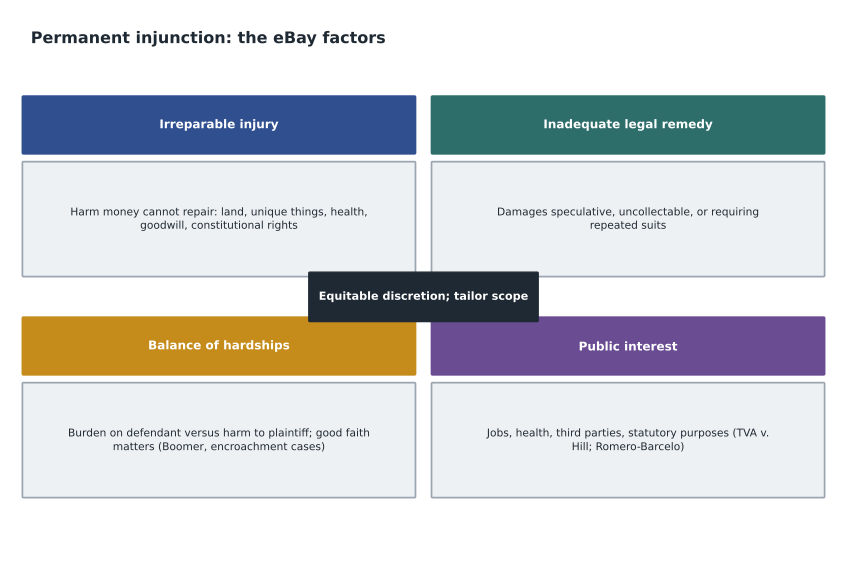
In eBay Inc. v. MercExchange, L.L.C. (2006), MercExchange held a patent on a method for online sales and won a jury verdict that eBay infringed. The Federal Circuit had applied a general rule that courts issue permanent injunctions against patent infringement absent exceptional circumstances. The Supreme Court unanimously rejected that rule. According to well-established principles of equity, it said, a plaintiff seeking a permanent injunction must demonstrate (1) that it has suffered an irreparable injury; (2) that remedies available at law, such as monetary damages, are inadequate to compensate for that injury; (3) that, considering the balance of hardships between the plaintiff and defendant, a remedy in equity is warranted; and (4) that the public interest would not be disserved by a permanent injunction. The decision whether to grant an injunction rests within the equitable discretion of the district court, exercised consistently with traditional principles of equity.
Two concurrences framed the debate that followed. Chief Justice Roberts, joined by Justices Scalia and Ginsburg, noted that courts have granted injunctions in the vast majority of patent cases since the early nineteenth century, and that this long tradition should guide the exercise of discretion. Justice Kennedy, joined by Justices Stevens, Souter and Breyer, emphasized that the patent landscape had changed, that firms using patents primarily to obtain licensing fees might use the threat of an injunction as a bargaining tool to charge exorbitant fees, and that damages may be sufficient in such cases. After eBay, courts have applied the four factors not only to patents but to copyright, trademark and other claims; in Salinger v. Colting (2d Cir. 2010), for example, the Second Circuit held that eBay applies to preliminary injunctions in copyright cases and abandoned its presumption of irreparable harm. Congress responded in trademark law: the Trademark Modernization Act of 2020 restored a rebuttable presumption of irreparable harm for plaintiffs who establish infringement.
Irreparable injury and inadequacy
The first two factors overlap and are usually analyzed together. Harm is irreparable when money damages cannot adequately compensate for it. Courts have recognized several recurring categories. Harm to interests in land is traditionally irreparable, because each parcel is unique and the owner is entitled to use her land as she chooses. Harm to unique personal property, such as a work of art or a family heirloom, is irreparable. Harm to health, safety and the environment is often irreparable. Loss of goodwill, customer relationships and market position may be irreparable when damages would be speculative. Violations of constitutional rights, particularly First Amendment rights, are often treated as irreparable. And damages are inadequate when the harm is continuing and would require a multiplicity of suits, or when the defendant is insolvent and could not pay a judgment.
The Albescus' case fits several categories at once. Their injury is to land they occupy and use for a business. The harm is continuing: each blast is a new injury, and damages for past harm would not stop the next one. The harm to the horses and to the business's reputation with boarders is difficult to measure. Dust raises health questions for horses and people. Brackenridge will argue that the Albescus' losses are economic and measurable: lost boarding fees, veterinary bills, fence repairs and the cost of cleaning. If the harm can be reduced to a monthly figure, it says, damages are adequate.
The balance of hardships
The third factor compares the hardship the injunction would impose on the defendant with the hardship the plaintiff would suffer without it. Courts often weigh the defendant's good faith: a defendant who knowingly encroaches on the plaintiff's rights, or who builds in defiance of the plaintiff's objections, receives less sympathy than one who acted innocently. A classic application is the encroachment case, in which a builder mistakenly puts a structure a few inches onto a neighbor's land. If the encroachment was innocent, the harm to the neighbor small and the cost of removal enormous, courts often deny a mandatory injunction and award damages instead. If the encroachment was deliberate, they order removal even at great cost.
Boomer v. Atlantic Cement Co. (N.Y. 1970) is the most famous balancing case. A cement plant near Albany, built at a cost of more than 45 million dollars and employing over 300 people, polluted neighboring properties with dust and vibration. The neighbors proved a nuisance, and New York's rule at the time was that a nuisance causing substantial damage would be enjoined. The Court of Appeals refused to order the plant closed. Instead it granted an injunction conditioned on the payment of permanent damages: the plant would be enjoined unless it paid the neighbors the full permanent loss to their properties, which the trial court set at a total of 185,000 dollars. Once paid, the damages would bind future owners and the plant could continue operating. Judge Jasen's dissent argued that the result licensed a continuing wrong and amounted to a private condemnation for a private use. Boomer remains a touchstone for courts considering whether to substitute damages for an injunction when the defendant's activity has large social value.
The public interest
The fourth factor asks about effects on third parties and the public. A quarry provides jobs and road stone; a cement plant provides jobs and building material; a hospital or a school provides public services. On the other side, the public has an interest in health, clean air and water, and the enforcement of statutes. The public interest can cut either way, and courts consider it explicitly.
Statutes can also limit or direct equitable discretion. In Tennessee Valley Authority v. Hill (1978), the Court held that the Endangered Species Act required an injunction against completing a nearly finished dam that would destroy the only known habitat of the snail darter, because Congress had made the preservation of endangered species the highest of priorities. But in Weinberger v. Romero-Barcelo (1982), it held that the Federal Water Pollution Control Act did not require a court to enjoin the Navy's discharge of ordnance into waters near Puerto Rico pending a permit, because the statute did not foreclose the traditional equitable discretion to order compliance by other means. The lesson is that courts presume Congress intends to preserve equitable discretion unless the statute clearly says otherwise.
Property rules and liability rules
In a famous 1972 article, Guido Calabresi and A. Douglas Melamed offered a framework for thinking about the choice between injunctions and damages. An entitlement protected by a property rule can be taken from its holder only with the holder's consent, at a price the holder accepts. An injunction protects an entitlement with a property rule: the defendant who wants to blast early must buy the plaintiff's consent. An entitlement protected by a liability rule can be taken by anyone willing to pay a court-determined price. Damages protect an entitlement with a liability rule: the defendant may blast and pay. The authors identified four possible rules for a nuisance dispute. The plaintiff may be entitled to be free of the nuisance, protected by an injunction (rule one) or by damages (rule two, as in Boomer). Or the defendant may be entitled to continue, protected by denying relief (rule three) or by requiring the plaintiff to pay the defendant to stop (rule four).
Rule four may look strange, but it was applied in Spur Industries, Inc. v. Del E. Webb Development Co. (Ariz. 1972). A cattle feedlot had operated in a rural area for years when a developer built Sun City, a retirement community, nearby. The flies and odors were a public nuisance to the residents, and the Arizona Supreme Court enjoined the feedlot. But because the developer had come to the nuisance and profited by doing so, the court required the developer to indemnify the feedlot for the cost of moving or shutting down. Calderwood notes the parallel to Albescu: the Albescus were there first, so the coming-to-the-nuisance argument runs in their favor.
Economic analysis suggests that property rules work well when the parties can bargain cheaply, because the injunction sets a starting point and the parties will negotiate to an efficient result. Liability rules work better when bargaining is difficult, such as when there are many parties, or when one party could hold out for an extortionate price. Judge Posner used this reasoning in Walgreen Co. v. Sara Creek Property Co. (7th Cir. 1992), affirming an injunction enforcing a shopping mall lease clause that prohibited the landlord from leasing space to another pharmacy. Damages for violating an exclusivity clause, he explained, would be costly to compute and uncertain, because they depended on predicting the effect of a competitor on Walgreen's sales over many years, while an injunction would let the parties bargain to their own solution. Only two parties were involved, so bargaining costs were low.
Worked problem
Shaping the decree in Albescu v. Brackenridge
After a bench trial, the court finds that Brackenridge's early-morning blasting and uncontrolled crusher dust are a private nuisance. Brackenridge proves that shutting down the new pit would cost it about 2.4 million dollars a year in lost revenue and would cost about forty jobs. The Albescus prove about 70,000 dollars a year in lost boarding fees, veterinary bills and repairs, and present expert testimony that blasting between 9:00 a.m. and 4:00 p.m., with smaller charges and advance notice, would sharply reduce the horses' panic, and that water sprays and a covered conveyor would control dust at a capital cost of about 300,000 dollars. What should the decree say?
Show solution
- Irreparable injury and inadequacy: injury to the use of land, continuing harm and hard-to-measure losses to an established business support equitable relief.
- Balance of hardships: shutting the pit would impose a burden far out of proportion to the Albescus' harm, so a total prohibition is unlikely. But a tailored injunction limiting blasting hours, requiring smaller charges and notice, and requiring dust controls imposes moderate costs and addresses most of the harm.
- Public interest: the quarry's jobs and road stone favor continued operation; the public interest in health and in respecting property rights favors the controls.
- Good faith: Brackenridge opened a new pit next to an established stable and blasted at 6:30 a.m. over the Albescus' objections, which weighs against it.
- Decree: enjoin blasting outside 9:00 a.m. to 4:00 p.m. on weekdays; require 24 hours' notice to the Albescus; limit charge sizes to levels the experts identified; require installation of water sprays and a covered conveyor within 120 days; award damages for past harm; and retain jurisdiction to modify. Under Rule 65(d), the decree must state its terms specifically and describe the acts restrained in reasonable detail.
Answer: A tailored injunction plus damages for past harm. The court protects the Albescus' entitlement with a property rule for the core harms and leaves the quarry operating, rather than choosing between closure and a Boomer-style permanent damages award.
Form, scope and persons bound
Federal Rule of Civil Procedure 65(d) requires every injunction to state the reasons why it issued, state its terms specifically, and describe in reasonable detail, and not by referring to the complaint or other document, the act or acts restrained or required. The rule protects the defendant's right to know what conduct is forbidden before it can be held in contempt. An injunction binds the parties, their officers, agents, servants, employees and attorneys, and other persons in active concert or participation with them who receive actual notice of the order by personal service or otherwise. It does not bind independent strangers.
An injunction should be no broader than necessary to remedy the wrong. In Califano v. Yamasaki (1979), the Court said that injunctive relief should be no more burdensome to the defendant than necessary to provide complete relief to the plaintiffs. A decree that forbids all blasting when only early-morning blasting is unreasonable fails that test. The scope principle has become central in public law cases, where the question is whether relief may extend beyond the plaintiffs. Lesson 8 examines that question and the Supreme Court's 2025 decision in Trump v. CASA.
Modification and dissolution
Injunctions often last for years, and circumstances change. Federal Rule 60(b)(5) permits a court to relieve a party from a judgment when applying it prospectively is no longer equitable. The older standard of United States v. Swift and Co. (1932) required a clear showing of grievous wrong evoked by new and unforeseen conditions. Rufo v. Inmates of Suffolk County Jail (1992) adopted a more flexible standard for institutional reform decrees: a party seeking modification must show a significant change in factual conditions or in law, and the proposed modification must be suitably tailored to the changed circumstance. If Brackenridge later develops blasting technology that produces little vibration, it can move to modify the decree's hour limits. If the Albescus sell the farm to a developer who builds houses, the dispute changes again.
Common mistakes
MistakeAssuming a plaintiff who proves a continuing wrong is entitled to an injunction.
InsteadUnder eBay, the plaintiff must show irreparable injury, inadequate legal remedies, a balance of hardships favoring relief and no disservice to the public interest; the decision is discretionary.
MistakeTreating voluntary cessation as ending the need for an injunction.
InsteadW.T. Grant requires a cognizable danger of recurrence; a defendant's stopping does not moot the case, but the plaintiff must show a real threat.
MistakeChoosing only between total prohibition and no relief.
InsteadCourts tailor injunctions to the wrong, as in limits on hours and methods, and may combine them with damages for past harm.
MistakeAssuming statutes always require an injunction once a violation is proved.
InsteadRomero-Barcelo presumes Congress preserves equitable discretion unless the statute clearly forecloses it, as in TVA v. Hill.
MistakeDrafting an injunction that incorporates the complaint by reference.
InsteadRule 65(d) requires specific terms and a reasonably detailed description of the acts restrained or required within the order itself.
Summary and key terms
- Injunctions may be prohibitory or mandatory, and preventive, reparative or structural; permanent injunctions follow a final judgment on the merits.
- The plaintiff must show a cognizable danger of future harm; voluntary cessation does not moot the case (W.T. Grant).
- eBay requires irreparable injury, inadequate legal remedies, a favorable balance of hardships and no disservice to the public interest, and rejects categorical rules.
- Irreparable harm commonly includes harm to land, unique property, health, goodwill and constitutional rights, and continuing harms requiring repeated suits.
- Boomer substituted permanent damages for an injunction against a valuable plant; Spur required a developer who came to the nuisance to indemnify the feedlot.
- Statutes may direct discretion (TVA v. Hill) but are presumed to preserve it (Romero-Barcelo).
- Calabresi and Melamed's property and liability rules explain when injunctions or damages are better; Walgreen enforced an exclusivity clause by injunction.
- Rule 65(d) requires specific orders, binds parties and those in active concert with notice, and relief should be no broader than necessary (Califano v. Yamasaki); Rufo permits modification on significant changes.
- Injunction
- A court order directing a party to do or refrain from doing an act, enforceable by contempt.
- Prohibitory injunction
- An injunction forbidding conduct.
- Mandatory injunction
- An injunction requiring affirmative action.
- Preventive injunction
- An injunction forbidding a future wrong.
- Reparative injunction
- An injunction requiring the defendant to correct the continuing effects of a past wrong.
- Irreparable injury
- Harm that money damages cannot adequately remedy.
- Balance of hardships
- The comparison of the burden of an injunction on the defendant with the harm to the plaintiff without one.
- Property rule
- Protection of an entitlement that can be taken only with the holder's consent, typically by injunction.
- Liability rule
- Protection of an entitlement that can be taken on payment of court-determined damages.
- Coming to the nuisance
- The plaintiff's arrival after the defendant's activity began; a factor in nuisance cases, as in Spur Industries.
Practice problems
Work each problem on paper first, then reveal the answer to check.
A neighbor builds a garage that encroaches eight inches onto the plaintiff's land. The builder relied on a survey that turned out to be wrong. Removing the garage would cost 60,000 dollars; the strip is worth about 500 dollars. What remedy is likely?
Show answer
Many courts would deny a mandatory injunction because the encroachment was innocent and the hardship of removal grossly disproportionate, and award damages, possibly including the value of an easement or a forced sale of the strip. A deliberate encroachment would more likely be ordered removed.
A software company stops collecting users' location data the day after a privacy suit is filed, but says it may resume if competitors do. Is an injunction still possible?
Show answer
Yes. Under W.T. Grant, voluntary cessation does not moot the case, and the company's statement that it may resume shows a cognizable danger of recurrence.
How did Boomer v. Atlantic Cement depart from New York's earlier nuisance rule?
Show answer
Instead of enjoining a nuisance causing substantial damage, the court conditioned the injunction on payment of permanent damages, allowing the plant to keep operating once it paid.
A court orders a defendant to 'comply with all applicable environmental laws.' What is wrong with the order?
Show answer
It lacks the specificity Rule 65(d) requires. It does not describe in reasonable detail the acts required or restrained, so the defendant cannot know what conduct would be contempt.
Lesson quiz · 5 questions
Score 60% or more to complete this lesson.
Create a free account to save your progress, take quizzes and earn a certificate.