
LAWU-304 · Lesson 6 of 12 · 24 min
Punitive damages
▶ Video coming soon A video version of this lesson is on the way.
Calderwood reads from a deposition excerpt in the Okoro file, prepared for teaching. Brightfall Pyrotechnics' operations manager testifies that the company had two low-burst incidents in 2025 with six-inch shells from the same supplier, that the supplier blamed humidity in storage, and that Brightfall kept buying the shells because they were about a third cheaper than the alternatives. Brightfall did not widen its spectator setback for the 2026 fair, even though the rope line at 280 feet was already short of the 420 feet the state's adopted fireworks code requires for six-inch shells. Five minutes before the shell that burned Nadia Okoro, another shell burst low, and the announcer asked the front-lawn crowd to move back fifty feet. The show went on. "Compensatory damages," Calderwood says, "put Nadia back where she was, as well as money can. The question today is whether the law should do more than that to Brightfall, and if so, how much more the Constitution allows."
What punitive damages are for
Punitive damages, also called exemplary damages, are awarded beyond compensation to punish a defendant for outrageous conduct and to deter it and others from similar conduct. Restatement (Second) of Torts section 908 permits them for conduct that is outrageous because of the defendant's evil motive or reckless indifference to the rights of others. They depart from the rightful position principle by design. The plaintiff ends up better off than if the wrong had never occurred, and the justification lies in public purposes rather than the plaintiff's loss.
Two lines of justification run through the cases. The retributive justification holds that some conduct deserves punishment and that civil juries may express community condemnation. The deterrence justification holds that compensatory damages alone underdeter when wrongdoers often escape liability. If only one victim in ten sues, a defendant who pays only compensatory damages to that one has no reason to stop. Judge Posner developed the deterrence account in Kemezy v. Peters (7th Cir. 1996), listing reasons for punitive damages: to make sure tortfeasors bear the full cost of their conduct when they might otherwise escape detection, to deter conduct that would be profitable even after paying compensation, to provide a substitute for vengeance, and to compensate for losses the law does not otherwise reach, such as attorney fees. In Mathias v. Accor Economy Lodging, Inc. (7th Cir. 2003), Posner applied that reasoning to uphold punitive damages of 186,000 dollars for each of two hotel guests bitten by bedbugs, against compensatory damages of 5,000 dollars each, a ratio of about 37 to 1. The motel knew of the infestation, refused to pay for extermination and kept renting the rooms. The small compensatory award, he explained, would not deter such conduct, and the plaintiffs would not have sued at all without the prospect of punitive damages.
The standard of culpability
States define the required culpability in different terms, but they converge. Typical formulations require actual malice, willful and wanton conduct, conscious disregard of a known risk to others, or fraud, oppression or malice. Ordinary negligence, even serious negligence, is not enough. Many states, by statute or decision, require proof by clear and convincing evidence. Some require a showing that the defendant was aware of the probable dangerous consequences of its conduct and deliberately failed to avoid them.
Grimshaw v. Ford Motor Co. (Cal. Ct. App. 1981), the Pinto case, is the most famous application. A Pinto's fuel tank ruptured in a rear-end collision and the car burst into flames, killing the driver and severely burning a thirteen-year-old passenger. Evidence showed that Ford's engineers knew of the tank's vulnerability and that inexpensive fixes were available, but management decided not to make them. The jury awarded 125 million dollars in punitive damages, which the trial court reduced to 3.5 million dollars as a condition of denying a new trial. The court of appeal affirmed the reduced award, holding that Ford's conscious disregard of public safety in order to maximize profits was malice within the meaning of California's statute. Brightfall's case looks similar in structure: knowledge of the defect from prior incidents, a cheaper choice, and a decision to continue despite risk to spectators.
Corporate defendants
When the defendant is a corporation, someone must decide whose state of mind counts. Under the complicity rule of Restatement (Second) of Torts section 909, punitive damages may be awarded against a principal because of an act by an agent only if the principal authorized the act, the agent was unfit and the principal was reckless in employing him, the agent was employed in a managerial capacity and was acting within the scope of employment, or the principal or a managerial agent ratified or approved the act. Other states impose punitive damages vicariously for any employee's malicious conduct within the scope of employment. For Title VII, Kolstad v. American Dental Association (1999) held that an employer may avoid vicarious punitive liability for the discriminatory decisions of managerial agents that are contrary to its good-faith efforts to comply with the statute. Brightfall's case does not depend on vicarious liability: the decision to keep using the shells and the short setback was made by its operations manager and approved by its owner.
Procedure, evidence and statutory limits
Punitive damages bring special procedures. Many states bifurcate trials so that the jury decides liability and compensatory damages before hearing evidence of the defendant's wealth, which is relevant to how much it takes to punish but prejudicial on liability. Evidence of wealth is admissible in most states, though Kemezy held that the plaintiff need not introduce it. States differ on whether punitive damages are insurable. Some prohibit insurance coverage as against public policy, because the wrongdoer would not feel the punishment, while others permit it, at least for vicarious liability. Federal statutes sometimes cap punitive damages: under 42 U.S.C. section 1981a(b)(3), combined compensatory and punitive damages for intentional employment discrimination under Title VII and the Americans with Disabilities Act are capped at amounts from 50,000 to 300,000 dollars, depending on the employer's size.
Most states have enacted limits of their own. Some cap punitive damages at a multiple of compensatory damages, such as two or three times, or at a fixed sum, whichever is greater. Some have split-recovery statutes that direct part of a punitive award to the state or a public fund, on the theory that the plaintiff has already been compensated. A handful of states do not permit punitive damages at all at common law and allow them only where a statute authorizes them; Nebraska's constitution has been read to forbid them entirely. Contract law forbids punitive damages for breach of contract as such (Restatement (Second) of Contracts section 355), but they may be awarded when the breach also constitutes a tort for which punitive damages are recoverable, the most common example being an insurer's bad faith refusal to settle or pay a claim.
The constitutional limits
In the 1990s the Supreme Court held that the Due Process Clause of the Fourteenth Amendment imposes substantive and procedural limits on punitive damages. In Pacific Mutual Life Insurance Co. v. Haslip (1991), the Court upheld Alabama's common-law method of jury determination with post-verdict review but warned that unlimited jury discretion could violate due process. In Honda Motor Co. v. Oberg (1994), it held that a state must provide judicial review of the amount of punitive awards. Then came the cases that set the modern framework.
In BMW of North America, Inc. v. Gore (1996), BMW had a policy of selling new cars that had been repainted after minor damage in transit as new, without disclosure, if the repair cost was less than three percent of the car's price. Dr. Ira Gore bought a repainted BMW and sued. The jury awarded 4,000 dollars in compensatory damages, the reduction in the car's value, and 4 million dollars in punitive damages, based partly on BMW's sales of repainted cars in other states. The Alabama Supreme Court reduced the punitive award to 2 million dollars. The United States Supreme Court held even that award grossly excessive, identifying three guideposts: the degree of reprehensibility of the defendant's conduct, the disparity between the actual or potential harm suffered by the plaintiff and the punitive award, and the difference between the punitive award and the civil penalties authorized or imposed in comparable cases. The ratio in Gore was 500 to 1, the harm was purely economic, and Alabama could not punish BMW for lawful conduct in other states.
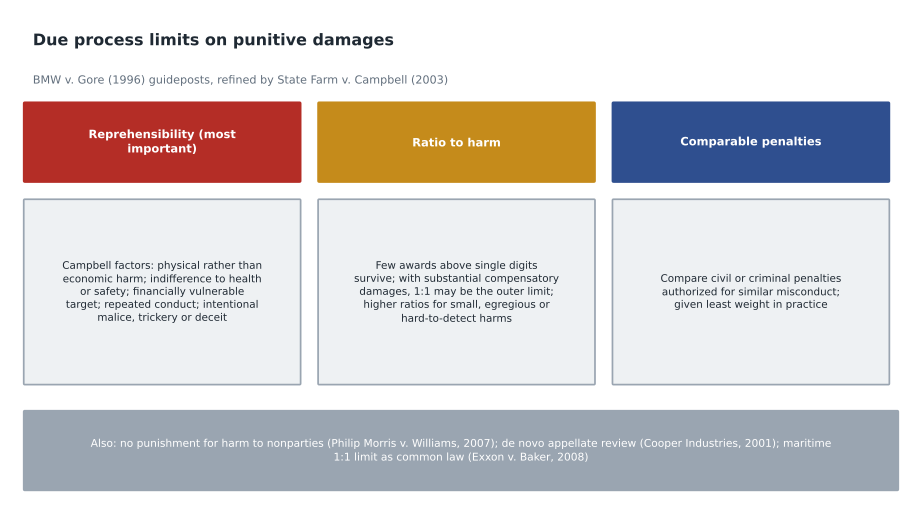
State Farm Mutual Automobile Insurance Co. v. Campbell (2003) refined the guideposts. State Farm refused to settle a claim against its insured, Curtis Campbell, within policy limits, assured him his assets were safe, then refused to pay an excess verdict and advised him to sell his house. Campbell later sued State Farm for bad faith. A Utah jury awarded 1 million dollars in compensatory damages and 145 million dollars in punitive damages, much of it based on evidence of State Farm's nationwide claims practices. The Supreme Court held the award unconstitutional. It explained that reprehensibility depends on whether the harm was physical as opposed to economic, whether the conduct evinced an indifference to or reckless disregard of the health or safety of others, whether the target had financial vulnerability, whether the conduct involved repeated actions or was an isolated incident, and whether the harm was the result of intentional malice, trickery or deceit, or mere accident. A state may not punish a defendant for dissimilar conduct, or for conduct in other states, merely because it was wrongful. On ratios, the Court declined to set a bright line but said that in practice few awards exceeding a single-digit ratio between punitive and compensatory damages will satisfy due process, and that when compensatory damages are substantial, a lesser ratio, perhaps only equal to compensatory damages, can reach the outermost limit. A higher ratio may be justified where a particularly egregious act results in only a small amount of economic damages, or where the injury is hard to detect.
In Philip Morris USA v. Williams (2007), the widow of a long-time smoker won 821,000 dollars in compensatory damages (later reduced by a statutory cap) and 79.5 million dollars in punitive damages. The Supreme Court held that the Due Process Clause forbids a state to use a punitive award to punish a defendant for injury it inflicted on nonparties, though the jury may consider harm to others in assessing reprehensibility. States must provide procedures, such as instructions, to ensure the jury does not cross the line. And in Exxon Shipping Co. v. Baker (2008), arising from the Exxon Valdez oil spill, the Court exercised its authority as a common-law court in admiralty, not its constitutional authority, to hold that punitive damages in maritime cases should not exceed a one-to-one ratio with compensatory damages in cases of that kind. That cut the award to about 507.5 million dollars. The Court relied on studies showing that the median ratio of punitive to compensatory awards was below one to one, and emphasized the value of predictability.
Applying the limits to Brightfall
Worked problem
Would a large award against Brightfall survive review?
Assume a jury finds Brightfall liable to Nadia Okoro and awards 1,200,000 dollars in compensatory damages, including about 700,000 dollars in noneconomic damages for pain, suffering and disfigurement. On clear and convincing evidence of conscious disregard, it awards 9,000,000 dollars in punitive damages. Brightfall moves for remittitur on state law grounds and for reduction on due process grounds. The state has no statutory cap on punitive damages. Assume the state's fireworks regulations provide civil penalties of up to 10,000 dollars per violation.
Show solution
- Reprehensibility: every Campbell factor points toward high reprehensibility except financial vulnerability. The harm was physical; the conduct showed indifference to the safety of spectators; it was repeated, with two low-burst incidents in 2025 and another minutes before the injury; and Brightfall chose cheaper shells knowing the risk. This is the kind of conduct punitive damages exist to address.
- Ratio: 9,000,000 to 1,200,000 is 7.5 to 1, within the single-digit range. But compensatory damages are substantial, and a significant part of the compensatory award for emotional suffering already contains a punitive element, as Campbell observed of such awards. Under Campbell, a court may conclude that a lower ratio, perhaps one to one to three to one, is the outer limit.
- Comparable penalties: civil penalties of 10,000 dollars per violation are small, but the conduct also risked loss of licenses and criminal liability if a spectator had died. Courts give this guidepost the least weight.
- Harm to others: the jury may consider that Brightfall's conduct endangered many spectators in assessing reprehensibility, but under Williams it may not punish Brightfall for injuries to Grace Okoro, Harold Lindgren or the Pedersens, who are not parties to Nadia's case. The trial court should so instruct.
- Likely outcome: a reviewing court applying de novo review under Cooper Industries v. Leatherman Tool Group (2001) might reduce the award to a figure in the range of 1.2 to 3.6 million dollars, citing Campbell's guidance for substantial compensatory awards. A court that emphasizes the extreme reprehensibility and the physical harm might sustain a higher ratio.
Answer: Punitive damages are clearly available on these facts, but a 7.5 to 1 award on a seven-figure compensatory verdict is at serious risk of reduction. Plaintiff's counsel should consider asking the jury for a figure closer to the low single digits.
Calderwood adds that Cooper Industries v. Leatherman Tool Group held that appellate courts review the constitutionality of punitive awards de novo, because the amount is not a finding of fact. State-law review for excessiveness, by contrast, uses the deferential standards described in Lesson 4. A defendant seeking reduction therefore argues both: that the award is excessive under state law, and that it is unconstitutional under Gore and Campbell.
The debate
Punitive damages remain controversial. Defenders argue that they are essential to deter corporate conduct that would otherwise be profitable, that they fill gaps in public enforcement and that juries reflect community values. Critics argue that awards are unpredictable, that they produce windfalls for plaintiffs and their lawyers, that they punish shareholders for managers' decisions, and that punishment should be imposed through criminal law with its protections. Empirical work, some of it relied on in Exxon, suggests that most punitive awards are modest and roughly proportional to compensatory awards, but that a small number of very large awards drive perceptions. Hannah Lindqvist asks whether the Supreme Court's ratio guidance has turned an individualized judgment into arithmetic. Calderwood says that is the criticism Justice Ginsburg pressed in her Campbell dissent, and that lower courts still begin their analysis with reprehensibility for a reason: the ratio guidepost only makes sense once the court knows how bad the conduct was.
Common mistakes
MistakeAsking for punitive damages for ordinary negligence or for breach of contract.
InsteadPunitive damages require malice, conscious disregard or similar culpability, often by clear and convincing evidence, and are not available for breach of contract unless the conduct is also a tort (Restatement (Second) of Contracts section 355).
MistakeTreating a single-digit ratio as automatically constitutional.
InsteadCampbell says that when compensatory damages are substantial, a one-to-one ratio may be the outer limit; reprehensibility drives the analysis.
MistakeLetting the jury punish the defendant for harm to people who are not parties.
InsteadPhilip Morris v. Williams forbids punishment for harm to nonparties, though such harm may bear on reprehensibility.
MistakeApplying Exxon's one-to-one ratio as a constitutional rule in state tort cases.
InsteadExxon was a federal maritime common-law decision, not a due process holding.
MistakeReviewing the constitutionality of a punitive award for abuse of discretion.
InsteadCooper Industries requires de novo appellate review of the constitutional question.
Summary and key terms
- Punitive damages punish and deter outrageous conduct beyond the rightful position (Restatement (Second) of Torts section 908).
- Deterrence theory explains higher awards when compensatory damages are small or wrongdoing often escapes detection (Kemezy; Mathias).
- States require malice, conscious disregard or similar culpability, often by clear and convincing evidence; Grimshaw upheld a reduced award for Ford's conscious disregard of safety.
- Corporate liability for punitive damages follows the complicity rule of section 909 in many states; Kolstad gives employers a good-faith compliance defense under Title VII.
- States regulate punitive damages through bifurcation, caps, split-recovery statutes and insurance rules; federal employment discrimination damages are capped by section 1981a.
- Gore's guideposts are reprehensibility, ratio and comparable penalties; Campbell lists reprehensibility factors and warns against ratios above single digits and, with substantial compensatory damages, above one to one.
- Williams forbids punishing harm to nonparties; Cooper Industries requires de novo review; Exxon set a one-to-one maritime limit.
- Brightfall's knowing use of shells that had burst low before is highly reprehensible, but a large ratio on a substantial compensatory award faces reduction.
- Punitive damages
- Damages beyond compensation awarded to punish and deter outrageous conduct.
- Conscious disregard
- Awareness of a probable dangerous consequence and deliberate failure to avoid it; a common punitive damages standard.
- Complicity rule
- The rule of Restatement section 909 limiting a principal's punitive liability for an agent's acts to cases of authorization, reckless employment, managerial agents or ratification.
- Bifurcation
- Separating a trial so that punitive damages evidence, such as the defendant's wealth, is heard only after liability is decided.
- Split-recovery statute
- A statute directing part of a punitive damages award to the state or a public fund.
- Gore guideposts
- Reprehensibility, the ratio of punitive to compensatory damages and comparable civil penalties.
- Single-digit ratio
- Campbell's guidance that few punitive awards exceeding a single-digit ratio to compensatory damages will satisfy due process.
- Reprehensibility
- The degree of blameworthiness of the defendant's conduct, the most important Gore guidepost.
Practice problems
Work each problem on paper first, then reveal the answer to check.
A car dealer fraudulently rolls back the odometer on a used car, causing 3,000 dollars of economic loss. The jury awards 300,000 dollars in punitive damages, citing evidence that the dealer did the same to dozens of other cars. Is the award constitutional?
Show answer
It is at serious risk. The ratio is 100 to 1 and the harm was economic. Repeated deceit and trickery raise reprehensibility, and a small compensatory award may justify a higher ratio than usual, but under Williams the jury may not punish for harm to the other buyers, only consider it in assessing reprehensibility.
Why did the Supreme Court in Exxon Shipping limit punitive damages to a one-to-one ratio?
Show answer
As a matter of federal maritime common law, to promote predictability, based on studies showing that median punitive awards were below compensatory awards. It was not a due process holding.
A restaurant chain's shift manager, acting within the scope of employment, assaults a customer. In a state following Restatement section 909, may the chain be liable for punitive damages?
Show answer
Only if the chain authorized or ratified the act, was reckless in hiring or keeping the manager, or the manager was employed in a managerial capacity. A shift manager may or may not qualify as a managerial agent depending on his authority.
In what kind of case might a court sustain a ratio well above single digits?
Show answer
One where a particularly egregious act causes only a small amount of economic damages, or where the injury is hard to detect, as in Mathias v. Accor Economy Lodging.
Lesson quiz · 5 questions
Score 60% or more to complete this lesson.
Create a free account to save your progress, take quizzes and earn a certificate.