
LAWU-304 · Lesson 10 of 12 · 25 min
Restitution
▶ Video coming soon A video version of this lesson is on the way.
Calderwood opens the lesson with a question about the Juniper Hill file that the class set aside in Lesson 2. In May 2026, after the barn's single-phase power and an estimating omission had already delayed the Calloway installation, Calloway demanded a second price increase of 15,000 dollars and said it would not finish the job without it. With cheese already aging and the June 1 deadline gone, Owen Marsh paid, writing "paid under protest" on the check. "That money is not damages for late performance," Calderwood says. "Juniper Hill did not lose it because Calloway breached. It lost it because Calloway took it. When the question is what the defendant got rather than what the plaintiff lost, the law of restitution supplies the answer."
The principle of unjust enrichment
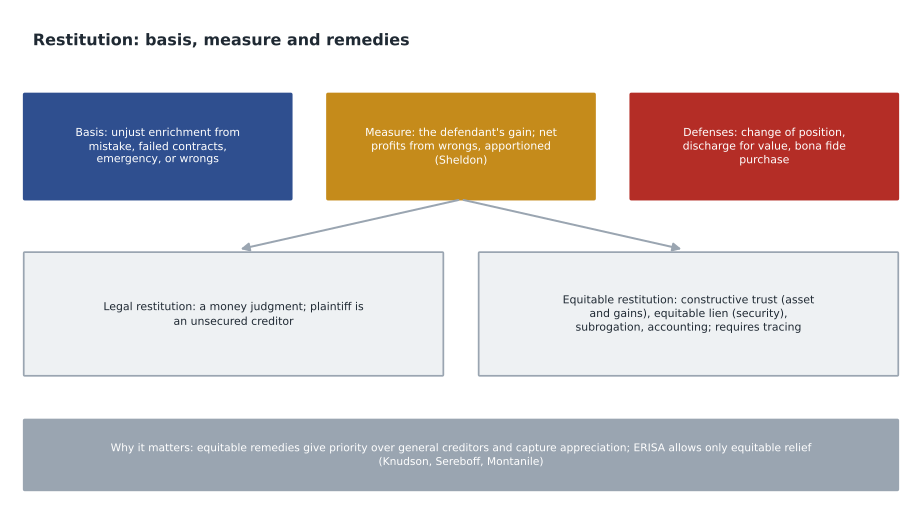
The Restatement (Third) of Restitution and Unjust Enrichment, completed by the American Law Institute in 2011, opens with a simple statement in section 1: a person who is unjustly enriched at the expense of another is subject to liability in restitution. Restitution measures the defendant's gain, not the plaintiff's loss. Often the two are the same, as when one person pays another by mistake. Sometimes they differ, as when a wrongdoer makes a profit from the plaintiff's property that exceeds anything the plaintiff lost. Restitution also has a distinct set of remedies, some legal and some equitable, which can give a plaintiff priority over the defendant's other creditors.
The law of restitution grew from several sources: the common law action of assumpsit, including quasi-contract or implied-in-law contract; equitable remedies such as the constructive trust; and the law of rescission. For much of the twentieth century American lawyers learned it in fragments, and the Third Restatement was written in part to make the subject coherent again. Its central insight is that restitution is a source of obligation in its own right, alongside contract and tort. A claim in restitution does not depend on a promise or on fault. It depends on an enrichment that the law regards as unjust, typically because it was obtained by mistake, by wrongdoing, by the plaintiff's performance under a contract that failed, or in an emergency when the plaintiff acted to protect someone else's interests.
Mistaken payments
The simplest restitution claim is for money paid by mistake. If Juniper Hill pays a feed supplier's invoice twice, the supplier is liable to return the second payment, even though it did nothing wrong. Restitution does not require fault on the defendant's part. The principal defense is change of position: a recipient who, in good faith and without notice of the mistake, changes its position in reliance on the payment, so that requiring restitution would be inequitable, has a defense to the extent of the change. A recipient who simply deposited the money and spent it on ordinary bills has usually not changed its position, because it would have spent other money on those bills anyway.
A second defense, discharge for value, protects a creditor who receives a mistaken payment in satisfaction of a real debt. In Banque Worms v. BankAmerica International (N.Y. 1991), a bank mistakenly wired money to Banque Worms, which was owed that amount by the bank's customer. New York's highest court held that Banque Worms could keep the money, because it received it in good faith as payment of a debt actually owed and without notice of the mistake. The rule reflects the importance of finality in payment systems.
Restitution and contracts
Restitution often arises when a contract fails or is breached. A party who has been induced to contract by fraud, duress or mistake may rescind the contract and recover what it gave, returning what it received. Economic duress is the doctrine that governs Juniper Hill's 15,000-dollar payment. A modification or payment is voidable for duress when it is induced by an improper threat that leaves the victim no reasonable alternative (Restatement (Second) of Contracts section 175). A threat to breach a contract is improper when it is made in bad faith or exploits the victim's vulnerability rather than reflecting a genuine need to renegotiate. Calloway's threat not to finish the installation unless paid, made when Juniper Hill had cheese aging and no alternative supplier, is a strong candidate. If a court finds duress, Juniper Hill can recover the 15,000 dollars in restitution, measured by what Calloway received. Writing "paid under protest" on the check helps, because it shows Juniper Hill did not voluntarily agree to the modification and preserved its objection.
Restitution also serves a party that has performed and then suffered a breach by the other side. Instead of expectation damages, the nonbreaching party may recover the reasonable value of its performance. This matters most when the contract was a losing one for the plaintiff. In United States ex rel. Coastal Steel Erectors, Inc. v. Algernon Blair, Inc. (4th Cir. 1973), a subcontractor that had partly performed was wrongfully terminated when the prime contractor refused to pay for crane rental. The Fourth Circuit held that the subcontractor could recover the reasonable value of its labor and equipment, even if that exceeded what it would have received under the contract, because the prime contractor's breach meant it could not invoke the contract price as a limit. The Restatement (Third) takes a narrower view, generally limiting restitution for a performing party to the contract price when the defendant's breach is the basis of the claim, in order to prevent a plaintiff from escaping its own bad bargain.
Even a breaching party may sometimes recover in restitution. In Britton v. Turner (N.H. 1834), a farm laborer agreed to work for a year for 120 dollars, worked about nine and a half months and quit without cause. The New Hampshire court held that he could recover the reasonable value of his work, less the employer's damages from his breach, because the employer would otherwise receive a windfall. Many states now follow that approach, at least where the breach was not willful, and Restatement (Second) of Contracts section 374 adopts it.
Emergency intervention
The law generally denies restitution to volunteers who confer benefits that were not requested, to avoid forcing people to pay for things they did not choose. Officious intermeddlers get nothing. But a person who acts in an emergency to protect another's life, health or property, without an opportunity to obtain consent, may recover. In Cotnam v. Wisdom (Ark. 1907), a surgeon operated on a man found unconscious after a streetcar accident; the man died without regaining consciousness. The court held that the surgeon could recover the reasonable value of his services from the estate. The law implies a promise to pay, in the language of the old cases, or recognizes unjust enrichment, in modern terms. Medical providers who treat unconscious patients still rely on this principle.
Restitution for wrongs and disgorgement
When the defendant has profited by committing a wrong against the plaintiff, the plaintiff may elect to recover the defendant's profits instead of its own losses. This was once called waiver of tort and suit in assumpsit: the plaintiff waived the tort and sued as if the defendant had promised to pay. The modern idea is simpler: a conscious wrongdoer should not keep the profits of the wrong. Restitution for wrongs is especially important when the defendant's gain exceeds the plaintiff's loss, which is common in cases of trespass, conversion, misappropriation of intellectual property and breach of fiduciary duty.
In Olwell v. Nye and Nissen Co. (Wash. 1946), the defendant, without permission, used an egg-washing machine that the plaintiff had stored on its premises, for about three years. The plaintiff had no plans to use the machine and suffered little loss. The Washington Supreme Court held that the plaintiff could recover the defendant's savings in labor costs from using the machine, which far exceeded any rental value. In Edwards v. Lee's Administrator (Ky. 1936), Edwards discovered the Great Onyx Cave and exhibited it to tourists for profit, but about a third of the cave lay beneath his neighbor Lee's land. The court awarded Lee a third of Edwards's net profits from the cave tours, even though Lee could not have exploited the cave himself, because the only entrance was on Edwards's land.
Disgorgement is limited to the defendant's net profits attributable to the wrong. When the defendant's own skill, labor or capital contributed to the profits, courts apportion. In Sheldon v. Metro-Goldwyn Pictures Corp. (1940), the Supreme Court approved an award of only a fifth of a film's profits for copyright infringement, because most of the profits were attributable to the actors, the producers and other contributions of the defendant rather than the infringed play. Conscious wrongdoers bear the risk of uncertainty in apportionment, and are denied deductions for costs that were themselves part of the wrong. A fiduciary who profits from a breach of loyalty must disgorge all profits, even if the beneficiary suffered no loss, as Snepp v. United States (1980) illustrates: a former CIA agent who published a book without the prepublication review his employment agreement required was ordered to hold his profits in a constructive trust for the government.
Disgorgement also appears in public enforcement. In Liu v. SEC (2020), the Supreme Court held that a disgorgement award that does not exceed a wrongdoer's net profits and is awarded for victims is permissible equitable relief under the securities laws. Drawing on the Third Restatement, the Court said that courts must deduct legitimate expenses and generally may not impose joint and several liability for disgorgement on wrongdoers who did not act in concert. The word restitution also appears in criminal law, where it means something different. In Ellingburg v. United States (2026), the Court unanimously held that restitution ordered under the Mandatory Victims Restitution Act is criminal punishment for purposes of the Ex Post Facto Clause. Calderwood warns the class not to confuse criminal restitution, which compensates victims as part of a sentence, with the civil law of unjust enrichment.
Equitable remedies: constructive trusts and equitable liens
Restitution can be given as a money judgment, which makes the plaintiff an unsecured creditor like any other. But when the defendant holds specific property that it obtained from the plaintiff, or acquired with the plaintiff's money, equity offers more. A constructive trust treats the defendant as holding the property in trust for the plaintiff and orders it transferred. The plaintiff gets the asset itself, including any increase in its value. An equitable lien gives the plaintiff a security interest in the property to secure the restitution claim, which is the better choice when the property has fallen in value or was bought partly with the defendant's own money. Subrogation lets a plaintiff who paid another's debt step into the shoes of the creditor it paid, taking over the creditor's rights and security.
The advantages of these remedies are priority and gains. A plaintiff with a constructive trust over a specific asset takes it ahead of the defendant's general creditors, because the asset is treated as never having belonged beneficially to the defendant. And a plaintiff whose money was used to buy an asset that rose in value can claim the asset and the gain, which a money judgment would not give it. The limits are equally important. A bona fide purchaser who acquires the property for value and without notice of the plaintiff's claim takes it free of the constructive trust. And the plaintiff must trace its property into the asset it claims.
Tracing
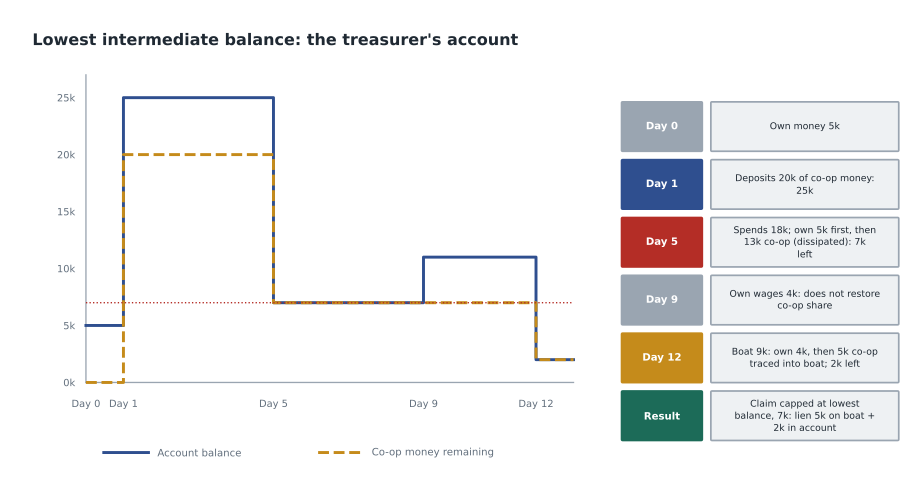
Tracing is the process of identifying the plaintiff's property, or its product, in the defendant's hands. When the wrongdoer exchanges the plaintiff's property for something else, such as using stolen money to buy a car, the plaintiff can trace into the car. Difficulties arise when the wrongdoer commingles the plaintiff's money with its own in a bank account and then makes withdrawals. Courts have developed presumptions. Under the rule of In re Hallett's Estate (Ch. 1880), a wrongdoer who withdraws from a commingled account is presumed to spend its own money first, leaving the plaintiff's money in the account. If the wrongdoer later uses the account to buy an asset and dissipates the rest, In re Oatway (Ch. 1903) allows the plaintiff to claim the asset instead, so the presumptions cannot be turned against the victim. The lowest intermediate balance rule limits the plaintiff's claim to the lowest balance the account reached after the commingling: money withdrawn and spent is gone, and later deposits of the wrongdoer's own money do not restore the plaintiff's funds unless the wrongdoer intended them to.
Worked problem
Tracing the cooperative's money
The treasurer of the fictional Merrin County Dairy Cooperative, of which Juniper Hill is a member, deposits 20,000 dollars of co-op funds into his personal account, which already holds 5,000 dollars of his own. Five days later he withdraws 18,000 dollars and spends it on a vacation and gambling. Four days after that he deposits his own 4,000-dollar paycheck. Three days later he withdraws 9,000 dollars to buy a used boat, now worth about 8,000 dollars. He has no other significant assets and owes his credit card companies 30,000 dollars. What can the co-op claim?
Show solution
- Day 5: under Hallett's presumption, the treasurer spent his own 5,000 dollars first, then 13,000 dollars of the co-op's money. That 13,000 dollars was dissipated and cannot be traced; the co-op has only an unsecured claim for it. The co-op's money remaining in the account is 7,000 dollars, the lowest intermediate balance.
- Day 9: the 4,000-dollar paycheck is the treasurer's own money. It does not replenish the co-op's share unless he intended it to; the co-op's traceable share stays at 7,000 dollars.
- Day 12: the 9,000-dollar withdrawal for the boat came, under Hallett, first from the treasurer's 4,000 dollars and then from 5,000 dollars of the co-op's money. Under Oatway and the Third Restatement's approach, the co-op may trace that 5,000 dollars into the boat.
- Remedies: the co-op may claim an equitable lien on the boat for 5,000 dollars, or a constructive trust over a five-ninths share of the boat. Because the boat has fallen in value, a lien for the full 5,000 dollars is better. It may also claim the 2,000 dollars left in the account. Its traceable recovery is therefore 7,000 dollars, ahead of the credit card companies.
- The remaining 13,000 dollars is an unsecured restitution or conversion claim, sharing pro rata with the treasurer's other creditors.
Answer: 7,000 dollars by tracing (a 5,000-dollar equitable lien on the boat plus the 2,000 dollars in the account), with priority over general creditors, and an unsecured claim for the rest.
Legal and equitable restitution
Because some restitution remedies are equitable and others legal, the distinction can decide whether a remedy is available at all. ERISA section 502(a)(3) authorizes plan fiduciaries to obtain only "appropriate equitable relief." In Great-West Life and Annuity Insurance Co. v. Knudson (2002), a health plan sought reimbursement from a beneficiary who had recovered from a tortfeasor. The Supreme Court held that the claim was for legal restitution, a money judgment imposing personal liability, and therefore not available under section 502(a)(3), because the funds were not in the beneficiary's possession but in a special needs trust. In Sereboff v. Mid Atlantic Medical Services, Inc. (2006), by contrast, the plan sought specifically identifiable funds held by the beneficiaries, and the Court held that an equitable lien by agreement was available. And in Montanile v. Board of Trustees of the National Elevator Industry Health Benefit Plan (2016), the Court held that when a beneficiary has dissipated the settlement funds on nontraceable items, such as services or travel, the plan cannot enforce an equitable lien against the beneficiary's general assets. The plan must act while the funds are still identifiable. These cases show the practical importance of tracing and of the line between legal and equitable relief.
Common mistakes
MistakeMeasuring restitution by the plaintiff's loss.
InsteadRestitution measures the defendant's unjust gain, which can exceed the plaintiff's loss (Olwell; Edwards v. Lee's Administrator).
MistakeRequiring wrongdoing for every restitution claim.
InsteadMistaken payments and emergency services support restitution without fault; change of position and discharge for value are the main defenses.
MistakeAwarding a wrongdoer's gross revenues as disgorgement.
InsteadDisgorgement is limited to net profits attributable to the wrong, with apportionment where the defendant contributed (Sheldon; Liu).
MistakeTreating a constructive trust as available for any money owed.
InsteadThe plaintiff must trace its property into a specific asset held by the defendant; dissipated funds support only an unsecured claim (Montanile).
MistakeLetting a later deposit of the wrongdoer's own money restore the plaintiff's share of a commingled account.
InsteadUnder the lowest intermediate balance rule, the claim is capped at the lowest balance after commingling unless the wrongdoer intended to replenish the funds.
Summary and key terms
- Restitution imposes liability for unjust enrichment at another's expense and measures the defendant's gain (Restatement (Third) of Restitution section 1).
- Mistaken payments are recoverable subject to change of position and discharge for value (Banque Worms).
- Payments extracted by economic duress, like Juniper Hill's 15,000 dollars, are recoverable in restitution.
- A nonbreaching party may recover the reasonable value of its performance (Algernon Blair), though the Third Restatement generally caps it at the contract price; a breaching party may recover net benefit conferred (Britton v. Turner; section 374).
- Emergency services support restitution (Cotnam v. Wisdom), but officious intermeddlers recover nothing.
- Conscious wrongdoers must disgorge net profits (Olwell; Edwards; Snepp), apportioned where appropriate (Sheldon); Liu limits SEC disgorgement to net profits for victims.
- Constructive trusts and equitable liens give priority over general creditors and can capture gains; bona fide purchasers take free; tracing follows Hallett, Oatway and the lowest intermediate balance rule.
- Under ERISA, only equitable restitution of identifiable funds is available (Knudson; Sereboff; Montanile).
- Unjust enrichment
- A benefit received at another's expense in circumstances that make retention unjust; the basis of restitution.
- Change of position
- A defense for a good-faith recipient who relied on a benefit so that restitution would be inequitable.
- Discharge for value
- A defense for a creditor who receives a mistaken payment in good faith in satisfaction of a real debt.
- Economic duress
- An improper threat, often to breach a contract, that leaves the victim no reasonable alternative and makes a payment or modification voidable.
- Disgorgement
- Restitution of the defendant's profits from a wrong.
- Constructive trust
- An equitable remedy treating the defendant as holding specific property in trust for the plaintiff.
- Equitable lien
- An equitable security interest in specific property to secure a restitution claim.
- Tracing
- Identifying the plaintiff's property or its product in the defendant's hands.
- Lowest intermediate balance rule
- The rule capping a claim to commingled funds at the lowest balance reached after the plaintiff's money was deposited.
- Bona fide purchaser
- One who acquires property for value without notice of another's claim and takes it free of a constructive trust.
Practice problems
Work each problem on paper first, then reveal the answer to check.
A bank mistakenly credits 50,000 dollars to a customer's account. The customer, knowing it is a mistake, spends it on a car. Can the bank recover, and how?
Show answer
Yes. The customer had notice of the mistake, so change of position is unavailable. The bank may obtain a money judgment and can trace into the car, seeking a constructive trust or equitable lien.
A trespasser grazes cattle on a landowner's unused pasture for a summer, saving 12,000 dollars in feed costs. The pasture would have rented for 3,000 dollars. What can the landowner recover?
Show answer
Damages of about 3,000 dollars for the rental value, or, in restitution for a conscious wrong, the trespasser's gain, which may be measured by the 12,000 dollars saved (compare Olwell).
Why might a plaintiff whose embezzled money bought stock that doubled in value prefer a constructive trust to an equitable lien?
Show answer
A constructive trust gives the plaintiff the stock and its gain, while an equitable lien secures only the amount of the claim. A lien is better if the asset falls in value.
A health plan learns that a beneficiary received a settlement and spent it all on rent, travel and restaurant meals. Can the plan recover under ERISA section 502(a)(3)?
Show answer
No. Under Montanile, once the funds are dissipated on nontraceable items, the plan cannot enforce an equitable lien against the beneficiary's general assets.
Lesson quiz · 5 questions
Score 60% or more to complete this lesson.
Create a free account to save your progress, take quizzes and earn a certificate.