
LAWU-303 · Lesson 9 of 12 · 23 min
Parentage and assisted reproduction
▶ Video coming soon A video version of this lesson is on the way.
Professor Marchbanks sets the Whitcombe-Osei file aside for a class. Its parentage questions are simple: Genevieve gave birth to both children during the marriage, Kofi is their genetic father, and both are on the birth certificates. "That is the easy case," she says, "and it is getting less typical every year." She hands out a second, shorter file, also a composite with every detail changed. Samira Nassar and Freya Okonkwo married in Brennan Falls in 2019. They asked a close friend, Cormac Dunst, to be a sperm donor. The three signed a one-page agreement they found online, stating that Cormac would have no parental rights or obligations, and Freya conceived through at-home insemination, without a doctor or clinic. Their daughter, Juno, was born in 2022. Cormac has visited about once a month and is called "Uncle Cormac." Samira and Freya separated in the spring of 2026. Freya now argues that Samira is not Juno's legal parent, and Cormac, who has grown close to Juno, says he would like to be recognized as her father.
This lesson asks who the law treats as a child's legal parents. It begins with the old rules for marital and nonmarital children, traces the constitutional cases on unmarried fathers, covers genetic testing and voluntary acknowledgments, and then turns to the Uniform Parentage Act and the law of assisted reproduction, including donors, surrogacy and disputes over embryos.
From legitimacy to equality
At common law, a child born outside marriage was filius nullius, the child of no one, with no right to inherit from or receive support from the father. States gradually softened the rule, and the Supreme Court eventually held that most distinctions disadvantaging nonmarital children violate equal protection. In Levy v. Louisiana, 391 U.S. 68 (1968), it struck down a law barring nonmarital children from suing for the wrongful death of their mother, and in later cases it subjected classifications based on birth outside marriage to intermediate scrutiny, applied in Clark v. Jeter, 486 U.S. 456 (1988), to strike down a six-year limitations period for paternity suits seeking support. Federal law now requires states to allow paternity to be established until the child turns at least eighteen.
The marital presumption
The oldest rule of parentage is the marital presumption: a child born to a married woman is presumed to be the child of her husband. The presumption once was nearly conclusive, protecting children from the stigma of illegitimacy and families from intrusion. Today it is rebuttable in most states, usually by genetic testing in a proceeding brought within a limited time, often two years after the child's birth.
The Supreme Court upheld a conclusive version of the presumption in Michael H. v. Gerald D., 491 U.S. 110 (1989). Carole, married to Gerald, had a child with Michael, who was shown by blood tests to be the genetic father and who had lived with the child for parts of her first three years. California law made Gerald the presumed father and barred Michael from rebutting the presumption. A plurality, in an opinion by Justice Scalia, held that Michael had no protected liberty interest, because the relevant tradition protected the marital family against claims by an adulterous natural father. The decision remains good law, but most states have since given genetic fathers some opportunity to challenge the presumption.
Since Obergefell, the marital presumption applies to married couples regardless of sex. Pavan v. Smith (2017) required Arkansas to list a birth mother's wife on the birth certificate on the same terms as a husband. Most states have rewritten their parentage statutes in gender-neutral terms, and the Uniform Parentage Act (2017) presumes that the spouse of the woman who gives birth is a parent, whatever the spouse's sex.
Unmarried fathers
A series of cases in the 1970s and 1980s defined the constitutional protection of unmarried fathers. In Stanley v. Illinois, 405 U.S. 645 (1972), Illinois took custody of the children of Peter Stanley, who had lived with them and their mother for eighteen years, when the mother died, because the state presumed unmarried fathers unfit. The Court held that due process required a hearing on his fitness. In Quilloin v. Walcott, 434 U.S. 246 (1978), by contrast, it held that a father who had never sought custody or taken significant responsibility for his eleven-year-old son could not block the son's adoption by the mother's husband. In Caban v. Mohammed, 441 U.S. 380 (1979), it struck down a New York law that let unmarried mothers but not unmarried fathers veto adoptions, where the father had lived with and supported his children.
Lehr v. Robertson, 463 U.S. 248 (1983), synthesized the rule. Jonathan Lehr never lived with or supported his daughter and never registered with New York's putative father registry, which would have entitled him to notice of an adoption. When the child was adopted by the mother's husband without notice to him, the Court held that he had no due process claim. The mere existence of a biological link does not merit constitutional protection, the Court said; it gives a father an opportunity to develop a relationship, and the Constitution protects the relationship he develops by grasping that opportunity. Many states now maintain putative father registries, and a father who fails to register within the statutory period may lose the right to notice of an adoption.
Genetic testing and voluntary acknowledgments
Genetic testing has made biological paternity easy to establish, and federal law requires states to order it in contested cases. But parentage law has never depended on genetics alone, and the question is often whether genetic evidence should be allowed to overturn an established relationship. Many states apply paternity by estoppel, refusing to let a man who held himself out as a child's father, or a mother who allowed him to do so, disprove paternity when doing so would harm the child. Others allow disestablishment of paternity on new genetic evidence, sometimes only within limited periods.
Most paternity for nonmarital children is established not in court but by a voluntary acknowledgment of paternity, a form signed by the mother and the man at the hospital or later, which federal law requires states to offer. Under 42 U.S.C. section 666(a)(5), a signed acknowledgment is a legal finding of paternity, subject to rescission within the earlier of sixty days or the date of a proceeding involving the child, and after that may be challenged only on the basis of fraud, duress or material mistake of fact. The Uniform Parentage Act (2017) extends acknowledgments to non-genetic intended parents in assisted reproduction and to presumed parents, so that, for example, a birth mother's partner who consented to assisted reproduction may sign one.
The Uniform Parentage Act
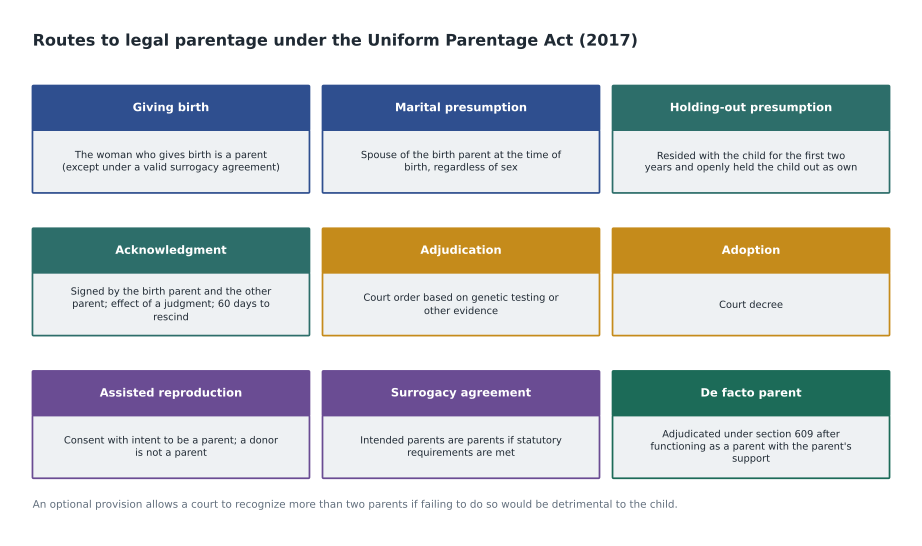
The Uniform Law Commission has issued three versions of the Uniform Parentage Act. The 1973 act abolished most distinctions based on marriage and created presumptions of paternity. The 2002 act added provisions for assisted reproduction and gestational agreements. The 2017 act made the entire framework gender neutral, added a holding-out presumption and de facto parentage, updated surrogacy provisions and allowed acknowledgments by non-genetic intended parents. About a dozen states, including Washington, Vermont, California, Maine, Rhode Island, Connecticut and Massachusetts, have adopted the 2017 act or legislation closely based on it; Westmarch has adopted it in the course's invented code.
Under UPA (2017), a person is presumed to be a parent if married to the woman who gave birth when the child was born or within a set period before; or if the person resided in the same household with the child for the first two years of the child's life, including any temporary absences, and openly held out the child as his or her own. The act also provides, in section 609, for adjudication of a de facto parent who, among other requirements, resided with the child for a significant period, consistently took full and permanent responsibility for the child without expectation of financial compensation, held the child out as his or her own, established a bonded and dependent relationship with the child that the parent fostered or supported, and whose recognition is in the child's best interest. An optional provision allows a court to recognize more than two parents if failing to do so would be detrimental to the child, an approach California adopted by statute in 2013.
Assisted reproduction and donors
Assisted reproduction separates genetic, gestational and social parenthood, and the law has had to decide which counts. The basic rules in UPA (2002) and (2017), and in most states, are that a donor is not a parent of a child conceived by assisted reproduction, and that a person who consents to assisted reproduction by a woman with the intent to be a parent of the resulting child is a parent. Consent must ordinarily be in a signed record, but under UPA (2017), section 704, the failure to sign a consent does not preclude a finding of parentage if the person and the woman who gave birth agreed before conception that both would be parents, or if the person resided with the child for the first two years and openly held the child out as his or her own.
Older statutes, based on the 1973 act, protected donors only when sperm was provided to a licensed physician for use in artificial insemination of a married woman. In Jhordan C. v. Mary K., 179 Cal. App. 3d 386 (1986), a California court held that a known donor who provided sperm directly to a single woman, who inseminated herself at home, was not protected by the donor statute and could be adjudicated the father, because the physician requirement had not been met. That decision illustrates the risks of home insemination under older statutes. UPA (2002) and (2017) dropped the physician requirement: a donor is not a parent whether or not a clinic is involved.
California's Supreme Court also addressed two-mother families before marriage equality. In Elisa B. v. Superior Court, 117 P.3d 660 (Cal. 2005), it held that a woman who agreed to raise children with her partner, who gave birth to twins conceived with donor sperm, received the children into her home and held them out as her own was a presumed parent obligated to pay child support. The court rejected the argument that a child can have only one mother. In K.M. v. E.G., 117 P.3d 673 (Cal. 2005), decided the same day, it held that a woman who provided ova to her lesbian partner, so that they could raise the resulting children in their joint home, was a parent despite signing a standard donor waiver.
Surrogacy
Surrogacy comes in two forms. In traditional or genetic surrogacy, the woman who carries the pregnancy uses her own egg. In gestational surrogacy, an embryo created from the intended parents' or donors' gametes is transferred to the gestational carrier, who has no genetic connection to the child. Almost all surrogacy in the United States today is gestational.
The first major case was In re Baby M, 537 A.2d 1227 (N.J. 1988). Mary Beth Whitehead agreed to be inseminated with William Stern's sperm and to surrender the child to Stern and his wife for 10,000 dollars, but after the birth she refused. The New Jersey Supreme Court held the contract void as against public policy and the laws against baby selling, restored Whitehead's status as the legal mother, awarded custody to Stern under the best interests standard and remanded for visitation. The case led several states to ban or restrict surrogacy contracts.
Gestational surrogacy produced a different answer. In Johnson v. Calvert, 851 P.2d 776 (Cal. 1993), a gestational carrier, Anna Johnson, carried an embryo created from the gametes of Mark and Crispina Calvert, then sought to keep the child. Under California's parentage statute both Johnson (by giving birth) and Crispina Calvert (by genetics) had claims to be the mother. The California Supreme Court broke the tie with an intent test: the woman who intended to bring about the birth of a child she intended to raise as her own is the natural mother. The court also rejected arguments that enforcing the arrangement violated public policy or the carrier's constitutional rights.
State law has since moved steadily toward permitting and regulating surrogacy. Most states now allow gestational surrogacy, by statute or case law, often requiring a written agreement, independent counsel for the carrier, medical and mental health screening, and a court order of parentage before or after birth. UPA (2017) regulates both gestational and genetic agreements, with additional protections for genetic surrogates, who may withdraw consent until seventy-two hours after birth. New York, long one of the most restrictive states, legalized compensated gestational surrogacy under its Child-Parent Security Act, effective in 2021. Michigan, which had criminalized compensated surrogacy contracts since 1988, repealed that prohibition in legislation that took effect in April 2025, adopting a statutory framework that gives intended parents parentage without adoption. A few states still restrict surrogacy or leave it unregulated, and couples with international arrangements face additional immigration and citizenship issues.
Embryos
In vitro fertilization often produces more embryos than are transferred, and divorcing couples sometimes dispute what to do with frozen embryos. In Davis v. Davis, 842 S.W.2d 588 (Tenn. 1992), the Tennessee Supreme Court held that embryos are neither persons nor property but occupy an interim category entitled to special respect. Disputes should be resolved first by the parties' current wishes, then by any prior agreement, and failing those by balancing the parties' interests, ordinarily in favor of the party wishing to avoid procreation, assuming the other party has a reasonable possibility of becoming a parent by other means. Most courts follow a contract approach, enforcing the consent forms couples sign at the clinic, while some, including New Jersey and Massachusetts, refuse to enforce agreements that would compel a person to become a parent against his or her current wishes.
The status of embryos drew national attention when the Alabama Supreme Court held in LePage v. Center for Reproductive Medicine, decided in February 2024, that frozen embryos are minor children for purposes of Alabama's Wrongful Death of a Minor Act, so that parents could sue a clinic for the accidental destruction of their embryos. Several clinics paused IVF services. On March 6, 2024, Alabama enacted a law granting civil and criminal immunity to providers and recipients of IVF services for the damage to or death of an embryo, while leaving the court's interpretation of the wrongful death statute in place.
Worked problem
Who are Juno's legal parents?
Apply Westmarch's invented adoption of UPA (2017) to the Nassar-Okonkwo file. Samira and Freya were married when Juno was born. Cormac provided sperm under a signed agreement stating he would have no parental rights, and Freya inseminated at home. Samira was present at the birth, is listed on the birth certificate and has parented Juno with Freya since birth. Cormac has visited monthly. Freya now says Samira is not a parent; Cormac says he wants to be recognized as a father.
Show solution
- Freya: a parent by giving birth.
- Samira: presumed a parent because she was married to Freya when Juno was born. Independently, she consented to assisted reproduction with intent to be a parent; even without a signed consent form, she and Freya agreed before conception that both would be parents, and she resided with Juno for her first two years and held her out as her own (UPA 2017, sections 703 and 704). The marital presumption can be rebutted only in a timely proceeding, and the holding-out and consent grounds independently establish parentage. Freya's argument fails.
- Cormac: a donor is not a parent under UPA (2017), whether or not a physician was involved, and the written agreement confirms the parties' intent. Under the 1973 act's physician requirement, as in Jhordan C., the result might have been different, which is why the version of the statute matters.
- De facto parent: monthly visits as an uncle figure do not satisfy section 609's requirements of residence, full and permanent responsibility and a dependent relationship fostered by a parent.
- More than two parents: Westmarch would need to have adopted the optional provision, and recognition would require a finding that failing to recognize Cormac would be detrimental to Juno. On these facts it is unlikely.
- Conclusion: Juno has two legal parents, Freya and Samira, and custody between them is decided under the best interests standard. The parties may agree that Cormac continues to visit, but he has no enforceable right.
Summary and key terms
- Classifications disadvantaging nonmarital children receive intermediate scrutiny (Levy, Clark v. Jeter).
- The marital presumption, upheld in conclusive form in Michael H., is now rebuttable in most states and gender neutral after Obergefell and Pavan.
- Unmarried fathers who develop a relationship with their children receive constitutional protection (Stanley, Caban); those who do not may lose it (Quilloin, Lehr).
- Voluntary acknowledgments establish most nonmarital paternity and can be rescinded within sixty days.
- UPA (2017) is gender neutral and adds holding-out presumptions, de facto parentage and an optional rule for more than two parents.
- Donors are not parents; people who consent to assisted reproduction with intent to parent are (Jhordan C. shows the risk of older statutes).
- Baby M voided a traditional surrogacy contract; Johnson v. Calvert adopted an intent test for gestational surrogacy; New York (2021) and Michigan (2025) now permit compensated surrogacy.
- Embryo disputes are resolved by agreement or balancing (Davis v. Davis); LePage (Ala. 2024) treated embryos as children under a wrongful death statute, prompting an immunity law.
Practice problems
Work each problem on paper first, then reveal the answer to check.
An unmarried man signs a voluntary acknowledgment of paternity at the hospital. Eighteen months later, genetic testing shows he is not the father. Can he rescind the acknowledgment?
Show answer
Not simply by choice; the sixty-day rescission period has passed. He may challenge it only for fraud, duress or material mistake of fact, and even then many states consider the child's interests and may apply paternity by estoppel.
A married couple uses a clinic and donor sperm. The husband signs the clinic's consent form. After the divorce, he argues he owes no child support because he is not the genetic father. What result?
Show answer
He is a legal parent because he consented to assisted reproduction with intent to be a parent, and the marital presumption applies too. He owes support.
A divorcing couple's IVF consent form says that on divorce, frozen embryos will be donated to research. The wife now wants to use them. Under the majority contract approach, what happens?
Show answer
Most courts enforce the agreement, so the embryos would be donated to research. In states like New Jersey and Massachusetts that refuse to enforce agreements compelling parenthood, the court might reach the same result by balancing, which usually favors avoiding procreation.
Lesson quiz · 5 questions
Score 60% or more to complete this lesson.
Create a free account to save your progress, take quizzes and earn a certificate.