
LAWU-303 · Lesson 7 of 12 · 23 min
Custody
▶ Video coming soon A video version of this lesson is on the way.
Esme Osei-Whitcombe is ten. She plays the cello, is in the fifth grade at Sorrel Lane Elementary and told the custody evaluator that she wants to "stay in Brennan Falls, but with both of them." Emmett is six, likes dinosaurs and soccer, and has a mild speech delay for which he sees a therapist twice a week at the school. Since the separation in March, the children have spent Monday through Thursday with Kofi in the family house and Friday through Sunday with Genevieve in an apartment she rented ten minutes away, under a temporary order entered in June. Genevieve's job offer in Portland, Oregon, begins in January 2027. She asks the court to designate her as the primary residential parent and allow her to move with the children, with Kofi to have them for most of the summer, alternate winter breaks and one long weekend a month. Kofi asks to be named the primary residential parent in Westmarch.
Professor Marchbanks tells the class that custody cases are the hardest she heard as a magistrate, and the hardest to predict. "Both parents love these children," she says. "Both are good parents. Whatever the court decides, the children will lose something. The law's job is to decide which loss is smaller, and to do it with rules that do not depend entirely on which judge you draw."
The vocabulary of custody
Custody has two components. Legal custody, increasingly called decision-making responsibility, is the authority to make major decisions about a child's education, health care and religious upbringing. Physical custody, increasingly called parenting time or residential responsibility, is where the child lives and who provides day-to-day care. Each can be sole or joint. Joint legal custody with one parent having primary physical custody is the most common arrangement, but shared physical custody, in which the children spend substantial time in each home, has become far more common in the last two decades.
Many states have replaced the language of custody and visitation, which suggests a winner and a loser, with allocations of parental responsibilities set out in a parenting plan. A parenting plan specifies the residential schedule, holiday and vacation time, decision-making authority, the method of resolving disputes, transportation and communication between the parents and the children. Westmarch's invented code requires a proposed parenting plan from each parent in every contested case.
From preferences to best interests
At common law, fathers had a nearly absolute right to custody of their children, who were treated as part of the father's household and economic unit. During the nineteenth century, courts shifted to the tender years doctrine, which presumed that young children should be with their mothers unless the mother was unfit. That presumption dominated custody law until the 1970s, when it gave way to sex-neutral standards, both because of changing views of parenting and because of equal protection concerns. Every state now decides custody under the best interests of the child standard.
Section 402 of the UMDA lists the factors that many states use, either directly or with additions: the wishes of the child's parents; the wishes of the child; the interaction and interrelationship of the child with parents, siblings and others who significantly affect the child's best interest; the child's adjustment to home, school and community; and the mental and physical health of all individuals involved. The UMDA adds that the court shall not consider conduct of a proposed custodian that does not affect his or her relationship to the child. Modern statutes typically add factors such as each parent's past performance of caretaking functions, each parent's willingness to support the child's relationship with the other parent, domestic violence and the child's developmental needs.
The best interests standard is criticized for its indeterminacy. It asks a judge to predict the future of a family, using factors that point in different directions, with no rule for weighing them. It invites litigation by giving each parent an argument and encourages strategic behavior, such as threatening a custody fight to gain leverage over money. Legislatures and courts have responded by adding presumptions and preferences that narrow the inquiry.
Primary caretaker, approximation and joint custody
One response was the primary caretaker presumption, adopted by the West Virginia Supreme Court in Garska v. McCoy, 278 S.E.2d 357 (W. Va. 1981). It gave custody of young children to the parent who had performed most of the daily care, such as feeding, bathing, arranging medical care and putting the child to bed, unless that parent was unfit. The presumption was simple and focused on past behavior rather than predictions, but critics argued that it ignored the other parent's relationship with the child and penalized parents who worked outside the home. West Virginia later replaced it by statute with the approximation standard proposed by the ALI Principles, section 2.08, which allocates custodial time so that each parent's share approximates the proportion of caretaking that parent performed before the separation, subject to exceptions. West Virginia remains the only state to adopt the ALI approximation standard, but it is influential as a way to anchor best interests in history rather than prediction.
A second response was joint custody. Many states adopted preferences or presumptions for joint legal custody beginning in the 1980s. More recently, a shared parenting movement has pushed for presumptions of joint physical custody or equal parenting time. Kentucky became the first state, in 2018, to enact a rebuttable presumption that joint custody and equally shared parenting time are in a child's best interest in permanent custody orders; the presumption does not apply when a domestic violence order has been or is being entered against a party. Several other states, including Arkansas, have since adopted similar presumptions, and others have adopted statutes directing courts to maximize each parent's time consistent with the child's welfare. Supporters say equal time reflects modern parenting and reduces litigation. Critics worry that equal time is impractical when parents live far apart or cannot cooperate, and that a presumption can put children at risk in families with violence that has not been proven.
The child's voice
Courts consider a child's preference, giving it more weight as the child matures. A few states give a teenager's choice controlling or near-controlling weight; Georgia, for example, allows a child of fourteen to select the parent with whom he or she will live, subject to the court's determination that the choice is not contrary to the child's best interests. Most states leave the weight to the judge. Judges usually hear from children in chambers rather than in open court, or through a guardian ad litem, an attorney for the child or a custody evaluator. A guardian ad litem investigates and recommends what is best for the child; an attorney for the child, in states that use that model, advocates for the child's expressed wishes. Custody evaluations by mental health professionals are common in contested cases and are often the most influential evidence.
Esme's statement that she wants to stay in Brennan Falls with both parents will matter, but a ten-year-old's preference is rarely decisive, and an evaluator will consider whether it reflects her own judgment or loyalty to the parent she is with most of the week. Emmett's views, at six, will receive little weight. His needs, including continuity in his speech therapy, will receive a great deal.
Factors courts may not use
Some considerations are forbidden or limited. Race may not be used, as Palmore v. Sidoti (1984) held. Religion may be considered only when a parent's religious practices cause or threaten demonstrable harm to the child; a court may not prefer one faith or no faith. Courts generally require a nexus between a parent's conduct and harm to the child before considering lifestyle choices, and the older practice of treating a parent's sexual orientation as relevant has been rejected by courts across the country. A parent's physical disability is not a basis for denying custody in itself; in In re Marriage of Carney, 598 P.2d 36 (Cal. 1979), the California Supreme Court reversed a custody change based on the father's quadriplegia, holding that the court must consider how the disability actually affects the parent's ability to care for the child, with the help of others if needed. Many states now have statutes to the same effect.
Third parties and de facto parents
Grandparents, stepparents and others who have cared for a child may seek custody or visitation, but Troxel v. Granville (2000) requires courts to give special weight to a fit parent's decisions. Most states now require a nonparent seeking custody over a parent's objection to show unfitness, extraordinary circumstances or that the parent's custody would be detrimental to the child. Grandparent visitation statutes typically require a showing that denying visitation would harm the child, and some limit petitions to cases in which the parents are divorced or a parent has died.
A growing number of states recognize de facto parents, also called psychological parents or persons in loco parentis, who have functioned as a child's parent with the legal parent's consent and are treated as parents for custody purposes. In Brooke S.B. v. Elizabeth A.C.C., 28 N.Y.3d 1 (2016), the New York Court of Appeals overruled its earlier decision in Alison D. v. Virginia M. (1991) and held that a former same-sex partner without a biological or adoptive relationship to the child has standing to seek custody and visitation if she proves by clear and convincing evidence that the couple agreed to conceive and raise the child together. The Uniform Parentage Act (2017), section 609, allows a court to adjudicate a person a de facto parent who resided with the child, consistently took full and permanent responsibility for the child, held the child out as his or her own, and established a bonded and dependent relationship with the child that the legal parent fostered or supported, among other requirements. Lesson 9 returns to the UPA.
Modification
A custody order can be modified, but the standard is higher than for the original decision, to protect children's stability. Most states require a substantial and material change in circumstances since the last order, plus a showing that modification would serve the child's best interests. UMDA section 409 goes further, barring modification motions within two years of the decree except on affidavits showing that the child's present environment may seriously endanger the child's health, and permitting modification afterward only if the child's present environment seriously endangers the child or the parents agree, or the child has been integrated into the other parent's family with consent. Few states follow the UMDA's restrictions in full, but many impose a waiting period or a heightened showing for changing primary residence.
Relocation
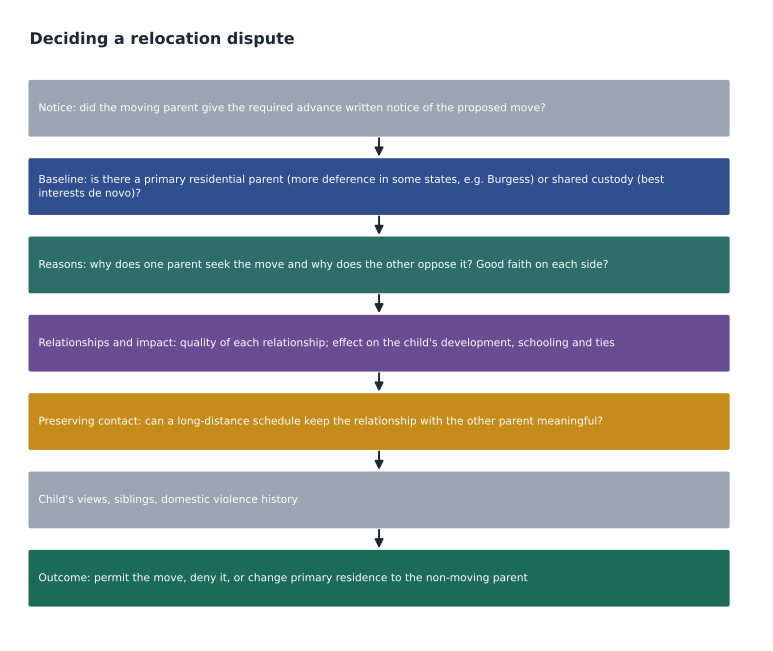
Relocation, sometimes called a move-away, is one of the most difficult custody problems, because it forces a choice between a parent's legitimate opportunity and a child's relationship with the other parent. Most states require a parent who intends to move a child a significant distance to give advance written notice to the other parent, who may object and ask the court to block the move or modify custody. The legal standards vary widely.
California's Supreme Court illustrates the evolution. In In re Marriage of Burgess, 913 P.2d 473 (Cal. 1996), it held that a parent with sole physical custody has a presumptive right to change the child's residence and need not prove that the move is necessary; the noncustodial parent must show that the move would cause detriment to the child sufficient to justify a change of custody. In In re Marriage of LaMusga, 88 P.3d 81 (Cal. 2004), it clarified that courts may consider the effect of the move on the child's relationship with the noncustodial parent, and listed factors including the children's interest in stability, the distance of the move, the children's ages, their relationship with both parents, their wishes, the reasons for the move and the extent to which the parents currently share custody. When parents share joint physical custody, California courts decide the move de novo under the best interests standard.
New York's leading case, Tropea v. Tropea, 87 N.Y.2d 727 (1996), rejected a rigid test that required the relocating parent to show exceptional circumstances when a move would interfere with the other parent's meaningful access. The Court of Appeals held that each relocation request must be considered on its own merits, with predominant emphasis on the child's best interests, weighing factors such as each parent's reasons for seeking or opposing the move, the quality of the relationships between the child and each parent, the impact of the move on the quantity and quality of the child's future contact with the noncustodial parent, the degree to which the custodial parent's and child's lives may be enhanced economically, emotionally and educationally by the move, and the feasibility of preserving the relationship through suitable visitation arrangements. Many states follow a Tropea-style multifactor approach. Some have statutes allocating the burden of proof to the moving parent, others to the objecting parent, and others to neither.
The Whitcombe-Osei case is harder for Genevieve than a typical move-away case, for three reasons. First, the parents currently share physical custody, with the children spending more nights with Kofi, so there is no primary residential parent whose decisions receive deference. Second, Emmett's speech therapy and both children's school and community ties weigh toward continuity. Third, Portland is more than a thousand miles from Brennan Falls, which makes it difficult to preserve Kofi's weekday involvement. In Genevieve's favor are a genuine career opportunity rather than a move intended to frustrate Kofi's relationship, her willingness to pay for travel, and the possibility of extended summer and holiday time. Marchbanks tells the class that, in her experience, courts in this posture more often deny the relocation as to the children and leave the relocating parent to decide whether to move alone, though outcomes vary by state and by judge.
Enforcement and high-conflict cases
Custody orders are enforced by contempt, make-up parenting time, attorney's fees and, in extreme cases, modification. Interference with custody is a crime in many states, and international abduction is covered by the Hague Convention, discussed in Lesson 11. In high-conflict cases, courts appoint parenting coordinators to resolve day-to-day disputes, order co-parenting classes and require communication through monitored apps. Claims that one parent has alienated a child from the other are among the most contested issues in family courts, and several states have recently restricted the use of unproven reunification treatments ordered on the basis of alienation claims, a development tied to the federal Keeping Children Safe from Family Violence Act, discussed in Lesson 10.
Worked problem
Analyzing Genevieve's relocation request
Apply a Tropea-style multifactor test to Genevieve's request to relocate the children to Portland in January 2027. Assume the custody evaluator reports that both parents are loving and capable, that the children are closely bonded to both, that Kofi has done somewhat more of the daily caretaking since 2020, that Emmett's speech therapist recommends continuity through at least the end of the school year, and that Esme is anxious about changing schools.
Show solution
- Reasons: Genevieve's reason is a significant professional opportunity; Kofi's reason for opposing is to preserve his daily role. Both are in good faith.
- Relationships: the children are bonded to both parents, with Kofi somewhat more involved in daily care. Under an approximation-style view, this favors Kofi.
- Impact on contact: a move of more than a thousand miles would end Kofi's weekday involvement; a long-distance schedule could preserve substantial time but not daily care.
- Enhancement: Genevieve's higher income could benefit the children, but her income is already high, so the economic gain to them is modest. Educational and emotional effects of the move are uncertain and, for Emmett, possibly negative in the short term.
- Child's wishes: Esme's preference to stay is entitled to some weight; Emmett's to little.
- Feasibility of alternatives: Genevieve could delay the start date, decline the job or move alone with an extended long-distance schedule. Kofi could not easily move, given his teaching position and the children's ties.
- Likely result: the court would probably deny relocation of the children, name Kofi the primary residential parent if Genevieve moves, and give Genevieve substantial holiday and summer time, or approve a shared schedule if she stays. The outcome could change if Genevieve were the clear primary caretaker.
Summary and key terms
- Custody has a decision-making component and a residential component; each may be sole or joint, often set out in a parenting plan.
- The paternal preference and tender years doctrine have given way to the best interests standard in every state.
- UMDA section 402 factors include parents' and child's wishes, relationships, adjustment and health; conduct is relevant only if it affects the child.
- West Virginia's primary caretaker presumption (Garska) was replaced by the ALI approximation standard; Kentucky (2018) adopted a joint custody and equal time presumption.
- Race may not be considered (Palmore); religion, lifestyle and disability matter only if they harm the child (Carney).
- Third parties must overcome the special weight given to fit parents (Troxel); de facto parents may have standing (Brooke S.B., UPA section 609).
- Modification requires a substantial change and best interests, sometimes with waiting periods.
- Relocation standards range from presumptions for the custodial parent (Burgess) to multifactor balancing (Tropea, LaMusga).
Practice problems
Work each problem on paper first, then reveal the answer to check.
A father argues that the mother should lose primary custody because she has started living with a same-sex partner. There is no evidence of harm to the children. How should the court respond?
Show answer
Reject the argument. Modern courts require a nexus between a parent's conduct and harm to the child, and a parent's sexual orientation or relationship is not, by itself, relevant to best interests.
A mother with primary physical custody under a California order wants to move with the child to another state for a new job. The father has every-other-weekend time. Who bears the burden?
Show answer
Under Burgess, the custodial parent has a presumptive right to relocate; the father must show that the move would cause detriment to the child sufficient to justify reconsidering custody. Under LaMusga, the court then weighs the effect on the child's relationship with him among other factors.
A grandmother who has provided after-school care for three years seeks court-ordered visitation over the objection of both parents, who are married and fit. What result?
Show answer
Likely denial. Troxel requires special weight for fit parents' decisions, and many statutes do not allow grandparent petitions against an intact family; those that do usually require a showing of harm.
Lesson quiz · 5 questions
Score 60% or more to complete this lesson.
Create a free account to save your progress, take quizzes and earn a certificate.