
LAWU-303 · Lesson 12 of 12 · 23 min
Capstone: a divorce from intake to decree
▶ Video coming soon A video version of this lesson is on the way.
For the last class, Professor Marchbanks hands out a new file and asks the students to treat it as a first meeting with a client. "Every topic in this course will be in this file," she says, "because every topic is in every real divorce, whether or not anyone notices. Your memo should tell the client what will probably happen, what could go wrong and what she should do first." The file is fictional, like the others, and set in Westmarch under the invented code the course has used all semester: equitable distribution of marital property, an irretrievable breakdown ground with a sixty-day waiting period, the UPAA for premarital agreements, heightened scrutiny for marital agreements in the manner of the Massachusetts and Connecticut cases, an income shares guideline with a cross-credit at ninety-two overnights, advisory alimony durations of 70 percent of the months of marriage for marriages of ten to fifteen years and 80 percent for fifteen to twenty years, and the UCCJEA, UIFSA and UPA (2017).
The Delahaye-Trevanion file
The client is Cosima Delahaye, fifty, principal of a public middle school in Brennan Falls, earning 142,000 dollars a year. She married Leopold Trevanion, now fifty-two, in a church ceremony in Brennan Falls in May 2008. They have two children: Ansel, fourteen, a ninth grader who plays the trumpet and has a part-time job at a bakery, and Mirabel, nine, a fourth grader with type 1 diabetes, which requires daily monitoring and close coordination with her school nurse. Cosima has handled Mirabel's medical care since the diagnosis at age four.
Leopold is a senior software engineer. For most of the marriage he worked for a Brennan Falls firm, earning a salary that rose to about 210,000 dollars. In August 2026 he accepted a position as an engineering director with a cloud services company in Seattle, Washington, with a base salary of 290,000 dollars plus restricted stock units (RSUs) granted in September 2026 that vest in equal installments over four years, and he moved there alone. The parties have not lived together since. Leopold also holds stock options from his former employer, granted in 2023 and 2025; the 2023 grant is fully vested, and half of the 2025 grant vested before he left, with the rest forfeited on his departure.
In 2019, Cosima learned that Leopold had been having an affair. The couple reconciled after counseling, and in March 2020 they signed a postnuptial agreement that Leopold's lawyer drafted and Cosima signed after a single meeting with a lawyer her sister recommended. It provides that if the parties divorce, each will keep the retirement accounts in his or her name, that Cosima will receive the family home free of mortgage, and that Leopold will pay alimony of 4,000 dollars a month for six years. At the time, Leopold's retirement accounts were worth about 400,000 dollars and Cosima's pension and accounts about 180,000. Today Leopold's 401(k) and IRA are worth 1.1 million dollars, much of the growth from contributions and from the strong market; Cosima's pension accrual and 403(b) are worth about 390,000 dollars. The house, titled jointly, is worth 640,000 dollars, with a 160,000-dollar mortgage. The agreement does not mention stock options or RSUs.
Other facts matter. In 2016, Cosima inherited 150,000 dollars from her father and deposited it in a brokerage account in her own name, which now holds about 240,000 dollars; she has never added marital funds, but in 2022 she withdrew 30,000 dollars to replace the roof of the family home. Between January and August 2026, Leopold transferred 68,000 dollars from the couple's joint savings to a cryptocurrency exchange, where most of it was lost in leveraged trading. On October 14, 2026, Leopold filed a petition for dissolution in the King County Superior Court in Seattle, asking for a parenting plan giving him primary residence of Ansel, who has told him he would like to live in Seattle, and for division of all property. Cosima was served by mail in Brennan Falls. She has never been to Washington except for a weekend visit in September to see the apartment, with both children.
Cosima wants to stay in Brennan Falls with both children, keep the house, and receive what she considers a fair share of everything else. She is also worried that Leopold will take Ansel to Seattle over the winter break and not bring him back.
Model memo
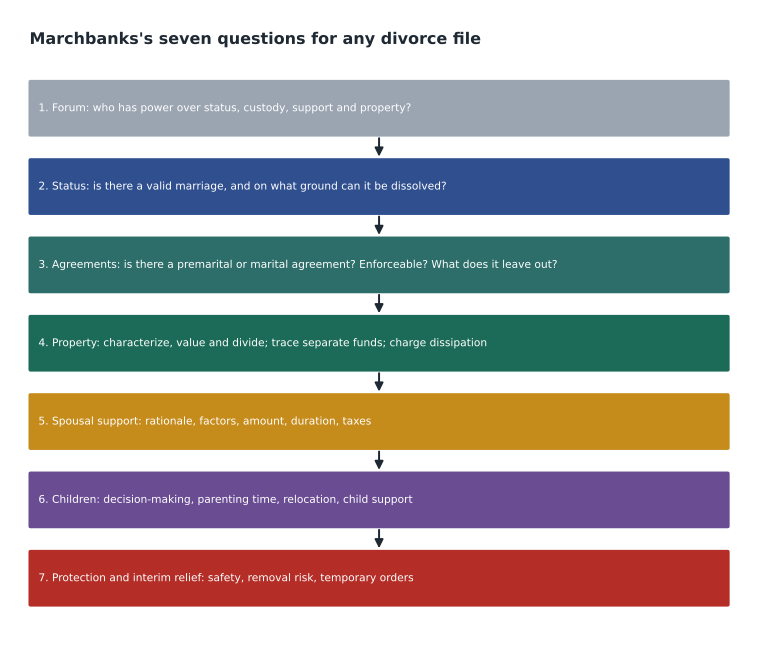
Marchbanks distributes the model answer after the students have written theirs. It follows her seven questions.
Issue one: forum. Washington may grant a dissolution of the marriage if Leopold is domiciled there, because divorce is a status determination and Washington can adjudicate status based on one spouse's domicile, subject to its own residency and procedural rules (Williams v. North Carolina). But it cannot decide custody. Under the UCCJEA, Westmarch is the children's home state: they have lived there all their lives, and Cosima remains there. Washington has no home state jurisdiction and, while Westmarch has it, cannot take significant connection jurisdiction; a weekend visit gives Washington nothing. Washington also likely lacks personal jurisdiction over Cosima to divide property outside Washington, award alimony against her interest or order her to pay support. Her only contact with Washington is a brief visit, which is not enough under the minimum contacts standard and Kulko v. Superior Court. UIFSA's long-arm bases do not reach her either. Recommendation: file promptly in the Merrin County Superior Court for dissolution, custody, support and property division, and move in Washington to dismiss for lack of personal jurisdiction and to decline custody jurisdiction. The Westmarch and Washington judges should communicate under UCCJEA section 206, and Washington must defer to Westmarch on custody. If Washington nonetheless dissolves the marriage first, Westmarch can still decide the financial issues under the divisible divorce doctrine (Estin, Vanderbilt), because Washington's decree could not cut off Cosima's rights without personal jurisdiction over her.
Issue two: status. The 2008 ceremony was solemnized under a license in Brennan Falls; there is no suggestion of a defect. Either party may obtain a divorce on the irretrievable breakdown ground. The affair in 2019 was condoned by the reconciliation and is irrelevant to the no-fault ground. Under Westmarch's invented rule that pre-separation fault may be considered in alimony, it may have limited relevance, but because Cosima will be seeking support rather than resisting it, the fault is of little strategic value and raising it will increase costs and conflict.
Issue three: the postnuptial agreement. As a marital agreement, it is subject to heightened scrutiny under Westmarch's invented rule, modeled on Ansin v. Craven-Ansin and Bedrick v. Bedrick: the court asks whether each party had the opportunity to obtain independent counsel, whether there was fraud or coercion, whether all material assets were fully disclosed, whether each party knowingly waived rights to a judicial division, and whether the terms were fair and reasonable when signed and are not unconscionable at divorce. Cosima met with a lawyer once, which may be enough for the counsel requirement, and the agreement appears to have been made without coercion during a voluntary reconciliation. Disclosure needs investigation: did Leopold disclose his options and his retirement balances? The terms looked roughly balanced in 2020, when the retirement accounts were 400,000 and 180,000 dollars and Cosima received the house. Today, the retirement split gives Leopold 1.1 million dollars against Cosima's 390,000, a gap far larger than either party expected. Cosima has a reasonable argument that enforcing the retirement clause would be unconscionable at divorce in light of changed circumstances, as in Bedrick, though Leopold will argue that market growth is the kind of change parties anticipate. The agreement is silent on options and RSUs, so they are divided under ordinary law. Recommendation: plead that the agreement is unenforceable in whole or as to the retirement clause, while preparing to accept it if a court would enforce it, because the house and alimony terms are valuable to Cosima.
Issue four: property. Characterization comes first. The house is marital by joint title. Cosima's inheritance was separate when received and has remained separate in an account in her name with no marital deposits, so the account is separate except that the 30,000-dollar withdrawal for the roof of a marital home is a contribution of separate funds to marital property, which under Westmarch's gift presumption is likely treated as a gift to the marriage rather than reimbursable, unless the court finds otherwise. Retirement accounts are marital to the extent of contributions during the marriage and their growth, and Leopold's premarital balances, if any, must be traced. The vested 2023 options and the vested half of the 2025 grant were earned during the marriage and are marital. The forfeited half has no value. The Seattle RSUs were granted after the separation in August 2026 but before the filing; under Westmarch's filing-date cutoff they were acquired during the marriage, but their vesting depends on Leopold's future work. Many courts apply a time rule, following In re Marriage of Hug (Cal. Ct. App. 1984), allocating the marital share of employee stock compensation by comparing the period of the marriage to the period from grant (or start of employment) to vesting. Here the marital portion of the period is a few weeks, so the marital share is small; Leopold will argue the RSUs compensate only future work and are separate. The 68,000 dollars lost in cryptocurrency trading is classic dissipation: spending marital funds for a purpose unrelated to the marriage while it was breaking down. The court should charge it to Leopold in the division.
Division follows. The marriage lasted more than eighteen years to the filing date. Cosima has been the primary caretaker of both children, particularly Mirabel's medical needs, and earns about half of Leopold's base salary. An equal division of the marital estate, adjusted to charge Leopold with the dissipated 68,000 dollars, is a reasonable starting point; Cosima can argue for a modestly larger share based on her caretaking and lower earning capacity. If the postnuptial agreement is enforced, the retirement accounts and house follow its terms, and the remaining marital property (options, joint accounts, cars) is divided equitably, with the dissipation charged to Leopold. Retirement accounts not governed by the agreement will be divided by QDRO, and transfers incident to divorce are tax-free under Internal Revenue Code section 1041. Beneficiary designations on Leopold's 401(k), life insurance and IRA must be changed after the decree to avoid the problems of Egelhoff and Kennedy, and Cosima should update her own will and designations.
Issue five: spousal support. If the agreement is enforced, Cosima receives 4,000 dollars a month for six years, which is enforceable and, because the agreement was made after 2018 and the divorce instrument will be executed after 2018, neither deductible by Leopold nor taxable to Cosima. If the agreement is not enforced, Westmarch's factors and advisory guideline apply. Cosima earns 142,000 dollars and is self-supporting, so a pure need theory is weak, but the long marriage, the disparity in earnings, the marital standard of living, her role as the children's primary caretaker and Leopold's increased income in Seattle support an award under compensation and partnership theories. Westmarch's advisory duration for an eighteen-year marriage is 80 percent of the months of marriage, about fourteen and a half years at most. A court might award less than the agreement's figure, given Cosima's income, or more, given Leopold's. The agreement's alimony term is therefore a reasonable fallback for Cosima, and the decision whether to attack the agreement as a whole or only its retirement clause should take that into account.
Issue six: children. Westmarch will decide custody. Under the best interests standard, Cosima's history as primary caretaker, the children's ties to their schools and community, Mirabel's medical needs and the stability of her care strongly favor primary residence with Cosima. Ansel's preference to live in Seattle is entitled to real weight at fourteen, but a court will ask whether it reflects a mature judgment or a teenager's attraction to a new city, and will consider the value of keeping siblings together. The likely outcome is primary residence for both children with Cosima, joint decision-making if the parents can cooperate, and substantial summer and holiday time for Leopold, with travel costs allocated to him as the relocating parent. A parenting plan should specify Mirabel's diabetes management in both homes and require that Leopold be trained by her care team. If Ansel continues to want to move, the court may revisit the issue later under the modification standard.
Child support will be calculated under the income shares guideline. Combined incomes of more than 430,000 dollars a year exceed Westmarch's schedule, so the court will extrapolate or decide based on the children's needs and the parents' standard of living. Leopold's share will be about two thirds of the obligation. Because he will have the children for far fewer than ninety-two overnights, no shared parenting adjustment applies. Mirabel's uncovered medical expenses, including diabetes supplies and devices, are add-ons allocated in proportion to income. Westmarch will have continuing, exclusive jurisdiction over the support order under UIFSA as long as Cosima and the children live there, and Leopold's Washington employer must honor a Westmarch income withholding order.
Issue seven: protection and interim relief. The immediate risk is that Leopold will keep Ansel in Seattle after the winter break. Cosima should ask the Westmarch court for temporary orders before the break: a temporary parenting schedule, an order that neither parent may remove the children from Westmarch except for court-approved visits with a fixed return date, and temporary child support and spousal support. Under Westmarch's automatic orders on filing, neither party may remove the children from the state without consent or a court order. If Leopold keeps Ansel in Washington, the Westmarch order can be registered and enforced there under UCCJEA's expedited enforcement provisions, and a court may issue a warrant to take physical custody if needed. Nothing in the file suggests domestic violence, so a protection order is not warranted, but Cosima should be told how one works in case circumstances change. The Hague Convention does not apply to an interstate case, but if Leopold ever proposes international travel, passports and mirror orders should be addressed.
Debrief
The students' memos differ most on the postnuptial agreement. Priya Natarajan argues Cosima should accept it, because six years of guaranteed alimony and the house free of mortgage are worth more than a fight over retirement accounts she might lose. Hannah Lindqvist argues the retirement clause is exactly the kind of term the heightened scrutiny cases were written for. Marchbanks says both are right, and that the choice belongs to the client. "Your job is to tell her what each road costs and where it probably leads," she says. "Then she decides. And then you do it well."
Daniel Reyes asks what Marchbanks found hardest when she moved from practice to the bench. She takes a while to answer. "Remembering that the file is not the family," she says. "Everything you will do in this field happens to people who did not want to be in court. The law we studied is a set of tools for making that a little less damaging. Use them carefully." Jordan Kimura writes her three questions at the top of his notes one last time: Who has power to decide? What rule decides? What facts move the decision-maker?
Worked problem
Checklist for the first ten days
List the actions Cosima's lawyer should take in the first ten days after the meeting, in order of priority.
Show solution
- File a petition for dissolution, custody, support and property division in the Merrin County Superior Court, alleging Westmarch's home state jurisdiction over the children and personal jurisdiction over Leopold, who lived in Westmarch for the entire marriage and was domiciled there until August 2026.
- Move for temporary orders: parenting schedule for the winter break with a fixed return date, a no-removal order, temporary child and spousal support, and exclusive use of the home.
- Retain Washington counsel to move to dismiss Leopold's Washington petition for lack of personal jurisdiction over Cosima and to ask the Washington court to decline custody jurisdiction under the UCCJEA and communicate with the Westmarch court.
- Serve financial disclosure demands, including stock option and RSU grant documents, brokerage and cryptocurrency exchange records, and retirement plan statements; send preservation letters.
- Gather Cosima's evidence: inheritance records and statements for her separate account, roof invoices, records of Mirabel's care, school records and the 2020 negotiation and disclosure documents for the postnuptial agreement.
- Advise Cosima on communications with the children and Leopold, on not discussing the case with Ansel, and on updating her own will and beneficiary designations once the court permits.
Summary and key terms
- Begin every divorce with forum: status needs one spouse's domicile, custody needs UCCJEA jurisdiction, and money needs personal jurisdiction.
- Check the validity of the marriage and the ground for divorce before turning to the economics.
- Test any premarital or marital agreement against the applicable standard and identify what it does not cover.
- Characterize, value and divide property, charging dissipation and tracing separate funds.
- Analyze spousal support under the state's rationale, factors, guidelines and duration rules, remembering the post-2018 tax rules.
- Decide custody under the best interests standard and calculate child support under the guideline, with add-ons and interstate enforcement in view.
- Secure interim orders and protections early, including against removal of the children.
- The client decides strategy; the lawyer explains costs and likely outcomes.
Practice problems
Work each problem on paper first, then reveal the answer to check.
Suppose Leopold had moved to Seattle with both children in March 2026 and filed in Washington in October 2026, while Cosima remained in Brennan Falls. Which state would have custody jurisdiction?
Show answer
Probably Washington. From March to October 14 is about seven months, so by the filing date Washington would be the children's home state. Westmarch would no longer have extended home state jurisdiction, because more than six months had passed since the children left. Cosima could still ask the Washington court to decline jurisdiction under section 208 if Leopold took the children without her agreement, because a court generally must decline when its jurisdiction rests on unjustifiable conduct, or under section 207 as an inconvenient forum.
Leopold argues that the RSUs granted in September 2026 are entirely his separate property because they vest only if he keeps working in Seattle. How should Cosima respond?
Show answer
That the RSUs were granted before the filing date, Westmarch's cutoff, and that under a time rule the marital share reflects the portion of the vesting period that fell within the marriage. She should concede that the marital share is small, because only a few weeks of the four-year vesting period preceded the filing, and focus her efforts on larger assets.
If the court enforces the postnuptial agreement, is the 4,000-dollar monthly alimony taxable to Cosima?
Show answer
No. Because the divorce instrument will be executed after December 31, 2018, the alimony is neither deductible by Leopold nor includible in Cosima's income under the Tax Cuts and Jobs Act.
Lesson quiz · 5 questions
Score 60% or more to complete this lesson.
Create a free account to save your progress, take quizzes and earn a certificate.