
LAWU-303 · Lesson 1 of 12 · 28 min
Family law and the Constitution
▶ Video coming soon A video version of this lesson is on the way.
Professor Josephine Marchbanks begins the first class of Family Law by setting a battered accordion file on the lectern. Before she taught at Larkhaven, she spent ten years representing parents and spouses in the Merrin County family court, first at a legal aid office and then in a two-lawyer practice, and six more years as a domestic relations magistrate hearing motions for temporary custody, support and protective orders. "Most of my former clients never met a federal judge," she tells the room. "Their cases were decided by state statutes, state judges and, usually, by a settlement worked out in a hallway. But every one of those cases happened inside a frame the United States Supreme Court built. We start with the frame."
The file, she explains, is the Whitcombe-Osei file, a composite drawn from her years in practice with every name and detail changed. It will run through the semester. Genevieve Whitcombe is a pediatric dentist who owns Clearpoint Pediatric Dentistry in Brennan Falls. Kofi Osei is a music teacher who went to part-time work when their first child was born. They married in June 2013 and have two children, Esme, who is ten, and Emmett, who is six. They separated in March 2026, and Genevieve filed for divorce in the Merrin County Superior Court in May 2026. Their assets include a house, the dental practice, a cabin Kofi inherited from his grandmother, two retirement accounts and a premarital agreement signed four days before the wedding. Genevieve has been offered a position as clinical director of a children's dental group in Portland, Oregon, beginning in January 2027, and she wants to take the children with her. Kofi wants them to stay.
The course places the couple in the fictional State of Westmarch, which the American Law program has used since the first year. For this course Professor Marchbanks gives Westmarch a family code assembled from common American models, and she labels each invented rule as Westmarch law so it cannot be confused with the law of a real state. Westmarch is an equitable distribution state. It grants divorce on a single no-fault ground of irretrievable breakdown and also keeps several fault grounds. It has adopted the Uniform Premarital Agreement Act, the Uniform Interstate Family Support Act, the Uniform Child Custody Jurisdiction and Enforcement Act and the Uniform Parentage Act (2017), and it uses an income shares child support guideline. Real cases and statutes from the states and the federal system are taught alongside, because a family lawyer in any state has to know where her state sits among the others.
Why family law is state law
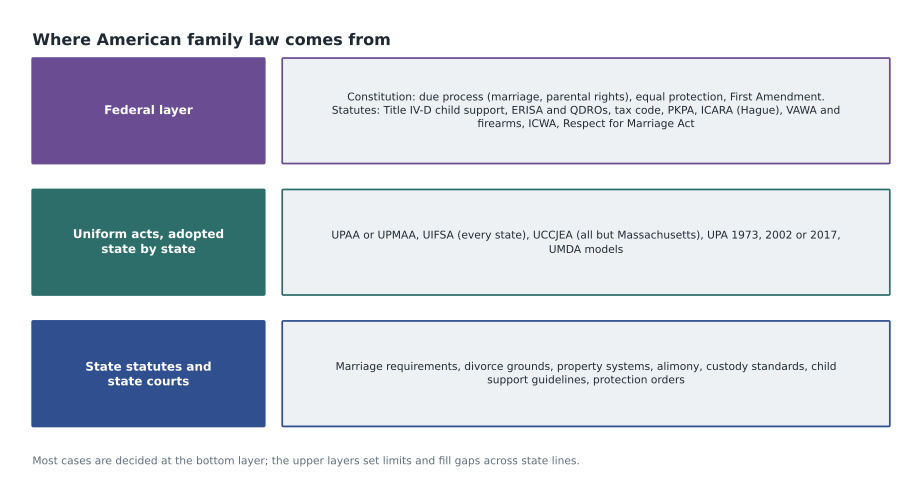
The regulation of marriage, divorce and the parent and child relationship has always belonged primarily to the states. The Supreme Court has said so repeatedly, most famously in the line that the whole subject of domestic relations belongs to the laws of the states and not to the laws of the United States. Congress has no general power to write a national divorce code, and the federal courts have long refused to hear certain family cases even when the parties are diverse. In Ankenbrandt v. Richards, 504 U.S. 689 (1992), the Court confirmed that the domestic relations exception to diversity jurisdiction is real but narrow: it removes from federal diversity jurisdiction only cases involving the issuance of a divorce, alimony or child custody decree. A mother's tort suit against her former husband and his companion for abusing her children could proceed in federal court, because it sought damages, not a decree.
The practical result is fifty different family codes, plus the District of Columbia and the territories. States differ on who may marry and at what age, on whether common-law marriage exists, on whether property acquired during marriage is community property or is divided equitably, on how long alimony lasts, on whether there is a presumption of joint custody, and on how child support is calculated. Uniform laws reduce the variation in some areas. Every state has adopted some version of the Uniform Interstate Family Support Act, because Congress required it as a condition of federal child support funding, and nearly every state has adopted the Uniform Child Custody Jurisdiction and Enforcement Act. In substantive areas such as property division and alimony, the variation is much greater.
Federal law still matters, in two ways. The first is constitutional. State family law must respect the liberty protected by the Due Process Clause of the Fourteenth Amendment, the Equal Protection Clause and, sometimes, the First Amendment. The second is statutory. Congress regulates the edges of family law through its spending, commerce and treaty powers: the federal child support program under Title IV-D of the Social Security Act, the Employee Retirement Income Security Act's rules on dividing pensions, the Internal Revenue Code's treatment of alimony and dependents, the Parental Kidnapping Prevention Act, the International Child Abduction Remedies Act implementing the Hague Abduction Convention, the Violence Against Women Act, the federal firearms prohibitions tied to protective orders and misdemeanor domestic violence convictions, and the Indian Child Welfare Act. Each appears later in the course.
The liberty of family life
The Supreme Court's protection of family life began a century ago, in cases about schools. In Meyer v. Nebraska, 262 U.S. 390 (1923), the Court struck down a law that forbade teaching modern foreign languages to young children, describing the liberty protected by the Fourteenth Amendment as including the right to marry, establish a home and bring up children. Two years later, in Pierce v. Society of Sisters, 268 U.S. 510 (1925), it struck down an Oregon law requiring children to attend public schools, declaring that the child is not the mere creature of the state. These decisions are the foundation of what lawyers call parental rights: a parent's fundamental interest in the care, custody and control of a child.
Parental rights have limits. In Prince v. Massachusetts, 321 U.S. 158 (1944), the Court upheld the conviction of a guardian who let her nine-year-old niece sell religious magazines on the street in violation of child labor laws, observing that the state as parens patriae may restrict a parent's control to protect a child's welfare. In Wisconsin v. Yoder, 406 U.S. 205 (1972), by contrast, Amish parents won an exemption from compulsory schooling beyond the eighth grade, because the state's interest in two more years of formal education did not outweigh the parents' religious liberty and their interest in directing their children's upbringing. Hannah Lindqvist, the former history teacher, points out that the two cases look less inconsistent once you notice the facts: Prince involved a child in the street at night, while Yoder involved a long-settled community with a working alternative to high school. Marchbanks agrees. "Family law constitutional cases are always about the facts. The doctrine gives you the questions, not the answers."
The modern statement of parental rights is Troxel v. Granville, 530 U.S. 57 (2000). Washington's statute allowed any person to petition for visitation at any time if visitation would serve the child's best interests. Paternal grandparents used it to seek more time with their granddaughters than the mother, a fit parent, wanted to allow. A plurality of four justices, in an opinion by Justice O'Connor, held the statute unconstitutional as applied because the trial court gave no special weight to a fit parent's decision and effectively placed the burden on her to disprove that visitation would be in the children's interest. The plurality did not decide whether every nonparental visitation statute must require a showing of harm, and states have since rewritten their grandparent visitation laws in different ways. Troxel returns in Lesson 7.
Other cases protect the family as a unit. In Moore v. City of East Cleveland, 431 U.S. 494 (1977), a plurality struck down a housing ordinance that made it a crime for a grandmother to live with two grandsons who were cousins rather than brothers, reasoning that the Constitution protects the sanctity of the extended family, not only the nuclear one. In Village of Belle Terre v. Boraas, 416 U.S. 1 (1974), decided three years earlier, the Court had upheld a zoning ordinance limiting the number of unrelated people who could share a house. Read together, the cases suggest that relationships of blood, marriage and adoption receive constitutional weight that other households do not, a distinction many students find hard to defend and that some state courts have rejected under their own constitutions.
The right to marry
Marriage has been treated as a fundamental right since Loving v. Virginia, 388 U.S. 1 (1967). Mildred Jeter and Richard Loving married in the District of Columbia and returned to Virginia, where they were convicted under the state's ban on interracial marriage. A unanimous Court struck down the ban on two grounds: it was racial discrimination that violated equal protection, and it deprived the Lovings of the freedom to marry, one of the vital personal rights essential to the orderly pursuit of happiness, without due process.
The right to marry was extended beyond race in Zablocki v. Redhail, 434 U.S. 374 (1978). Wisconsin required any resident with a child support obligation to obtain a court's permission before marrying, and permission could be granted only if the person proved compliance with the support order and that the children were not likely to become public charges. Roger Redhail, who was unemployed and owed support for a child born when he was a high school student, was denied a marriage license. The Court held that because the statute significantly interfered with the right to marry, it had to be supported by sufficiently important state interests and closely tailored to effectuate only those interests. It failed that test: the state had other ways to collect support, and the statute simply prevented marriage without delivering any money to the child.
In Turner v. Safley, 482 U.S. 78 (1987), the Court applied a deferential standard for prison regulations but still struck down a Missouri prison rule that permitted inmates to marry only with the superintendent's approval for compelling reasons, usually pregnancy. Even in prison, marriage carries expressions of commitment, religious significance and legal benefits that the state could not deny on the record before the Court.
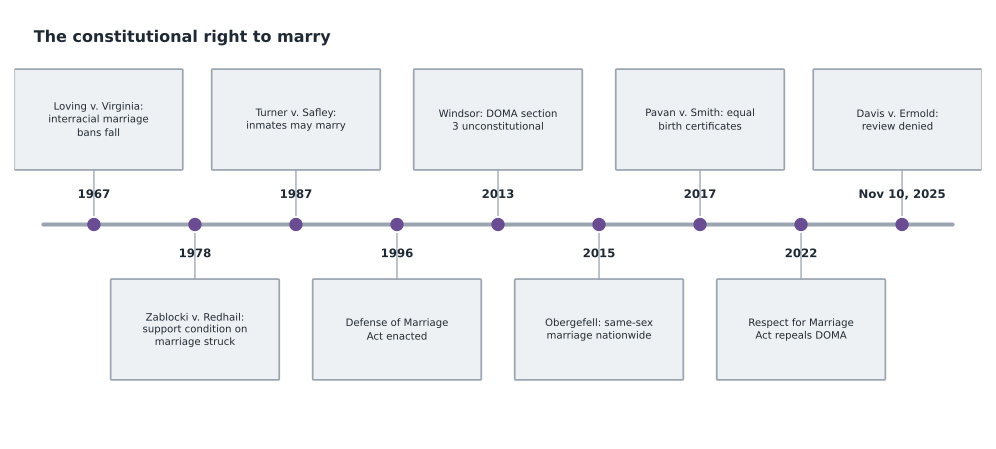
Same-sex marriage reached the Court through federal law first. The Defense of Marriage Act of 1996 defined marriage for all federal purposes as a union of one man and one woman (section 3) and declared that no state needed to recognize a same-sex marriage from another state (section 2). In United States v. Windsor, 570 U.S. 744 (2013), Edith Windsor sought a refund of more than 360,000 dollars in federal estate tax that she would not have owed if her marriage to Thea Spyer, valid under New York law, had been recognized. The Court held section 3 unconstitutional as a deprivation of the liberty protected by the Fifth Amendment, because it singled out a class of marriages that states had chosen to recognize and treated them as second-class.
Two years later, in Obergefell v. Hodges, 576 U.S. 644 (2015), the Court held five to four that the Fourteenth Amendment requires states to license marriages between two people of the same sex and to recognize such marriages lawfully performed in other states. Justice Kennedy's majority opinion identified four principles that make marriage fundamental: individual autonomy in choosing whom to marry, the unique support marriage gives to a committed two-person union, the protection it provides to children and families, and its role as a keystone of the social order through which states confer many benefits. The four dissenting justices argued that the Constitution left the question to the democratic process. In Pavan v. Smith, 582 U.S. 563 (2017), the Court summarily reversed an Arkansas decision that allowed the state to list the husband of a birth mother on a birth certificate but not her wife, holding that Obergefell required equal access to the constellation of benefits linked to marriage.
After Dobbs v. Jackson Women's Health Organization, 597 U.S. 215 (2022), overruled the abortion precedents, some asked whether marriage precedents were also at risk. The Dobbs majority stated that nothing in its opinion should be understood to cast doubt on precedents that do not concern abortion, while Justice Thomas wrote separately that the Court should reconsider all of its substantive due process precedents, including Obergefell. Congress responded with the Respect for Marriage Act, Public Law 117-228, signed on December 13, 2022. It repealed what remained of the Defense of Marriage Act, defined marriage for federal purposes to include any marriage valid in the state where it was entered into, and required every state to give full faith and credit to marriages validly performed in other states, regardless of the sex, race, ethnicity or national origin of the spouses. It did not require any state to issue marriage licenses to same-sex couples; that obligation still rests on Obergefell. It also protected religious organizations from being required to provide services for the celebration of a marriage.
The question returned to the Court in a petition by Kim Davis, the former Kentucky county clerk who refused to issue marriage licenses after Obergefell. A jury had awarded David Ermold and David Moore 50,000 dollars each in damages, the Sixth Circuit affirmed, and Davis asked the Supreme Court to hold that the First Amendment protected her refusal and to overrule Obergefell. On November 10, 2025, the Court denied review in Davis v. Ermold without comment and with no noted dissent. A denial of certiorari decides nothing about the merits, but as of November 2026 Obergefell remains binding law in every state.
Equal protection and access to the courts
Equal protection reshaped family law in the 1970s, when the Court began to strike down sex-based rules. In Orr v. Orr, 440 U.S. 268 (1979), it invalidated an Alabama statute that allowed courts to order husbands, but never wives, to pay alimony. The state's legitimate goals of helping needy spouses and compensating for past discrimination could be served by individual hearings that asked which spouse was in need, so a sex-based classification was unnecessary. Today every state's alimony law is gender neutral, as are custody standards; the old tender years presumption favoring mothers of young children has been abandoned or held unconstitutional nearly everywhere.
Race may not be used in custody decisions. In Palmore v. Sidoti, 466 U.S. 429 (1984), a Florida court transferred custody of a three-year-old from her white mother to her white father because the mother had married a Black man, reasoning that the child would suffer from social stigma. A unanimous Court reversed. The reality of private biases may be outside the reach of the law, the Court said, but the law cannot, directly or indirectly, give them effect.
Due process also guarantees access to the courts that control family status. In Boddie v. Connecticut, 401 U.S. 371 (1971), the Court held that a state may not deny a divorce to indigent spouses because they cannot pay court fees, since the state monopolizes the means of dissolving a marriage. In M.L.B. v. S.L.J., 519 U.S. 102 (1996), it held that Mississippi could not condition a mother's appeal from the termination of her parental rights on her ability to pay more than 2,000 dollars for a record. On the other hand, in Lassiter v. Department of Social Services, 452 U.S. 18 (1981), the Court declined to require appointed counsel in every termination case, leaving the question to case-by-case analysis; most states now provide counsel by statute. And in Santosky v. Kramer, 455 U.S. 745 (1982), it held that the state must prove the grounds for terminating parental rights by at least clear and convincing evidence.
Religion and the family
The First Amendment enters family law in several ways. Courts may not decide religious questions, so a divorce court generally cannot rule on which parent's faith is correct; it may consider religious practices only when they cause demonstrable harm to a child. Courts enforce some religious agreements, such as a ketubah's promise to appear before a rabbinical tribunal, using neutral principles of contract law, as Lesson 3 explains. And parents' free exercise claims sometimes succeed against the state. In Mahmoud v. Taylor, decided June 27, 2025, the Court held six to three that a Maryland school board burdened parents' religious exercise by introducing storybooks with LGBTQ themes into elementary instruction without notice or the opportunity to opt out, and it held that the parents were entitled to a preliminary injunction requiring notice and an opportunity to opt out while the litigation continued. Justice Alito's majority opinion relied heavily on Yoder. The dissent, by Justice Sotomayor, warned that the decision would make public school administration unworkable. Whatever its reach turns out to be, Mahmoud shows that the parental rights line of cases remains active.
Federal statutes and Indian children
The Indian Child Welfare Act of 1978 is the most significant federal statute regulating family law directly. It sets minimum federal standards for removing Indian children from their families and placing them in foster or adoptive homes, including placement preferences for the child's extended family, other members of the child's tribe and other Indian families, and it gives tribes jurisdiction and rights of intervention. In Haaland v. Brackeen, 599 U.S. 255 (2023), the Court rejected, seven to two, challenges arguing that ICWA exceeded Congress's power over Indian affairs and commandeered state officials. It held that the individual and state plaintiffs lacked standing to bring their equal protection challenge to the placement preferences, leaving that question undecided. Justice Barrett wrote for the majority; Justices Thomas and Alito dissented. A family lawyer handling any custody, adoption or guardianship case must ask early whether the child may be an Indian child within ICWA, because failing to follow the Act can unravel a placement years later.
Worked problem
Mapping the constitutional issues in the Whitcombe-Osei file
Marchbanks asks the class to list every point in the Whitcombe-Osei file where federal constitutional law could matter, and to say for each whether it is likely to change the outcome. Consider the Westmarch divorce itself, a court order splitting time with the children, a possible request by Kofi's mother for court-ordered visits with the grandchildren, Genevieve's relocation and an argument by Kofi that the children should continue attending services at his church.
Show solution
- The divorce: Westmarch must give both spouses access to its courts (Boddie). Nothing in the facts suggests a fee barrier, so this is background rather than an issue.
- The custody order: the court must apply a sex-neutral best interests standard and may not rely on race (Palmore). Both parents are fit, so each has a constitutionally protected interest, but between two fit parents the state may still allocate time under the best interests standard.
- The grandmother's petition: Troxel requires the court to give special weight to the decision of a fit parent. If both parents oppose court-ordered grandparent visits, the petition is likely to fail under most post-Troxel statutes. If one parent supports it, the analysis is different, because the court is resolving a dispute between parents.
- Relocation: the right to travel is sometimes raised by relocating parents, but courts treat it as one factor within the best interests analysis rather than a trump. Lesson 7 covers the cases.
- Religion: the court may not prefer one parent's religion. It can allocate decision-making authority over religious upbringing to one parent, or leave each parent free to share faith during parenting time, but it can restrict a parent's religious practices with the child only on evidence of harm.
- Conclusion: the Constitution sets limits but will rarely decide this case. Westmarch statutes and the facts will.
Marchbanks ends the class with a warning that runs through the course. "Most family law is discretion," she says. "Statutes list factors, and judges weigh them. The Constitution tells the judge what she may not weigh, and the uniform acts tell her when she may decide at all. Your job is to know those boundaries cold, so that you can spend your time on the part that wins cases: the facts." Jordan Kimura writes the three questions she puts on the board at the end of every class into his notes: Who has power to decide? What rule decides? What facts move the decision-maker?
Summary and key terms
- Family law is primarily state law; federal courts will not issue divorce, alimony or custody decrees (Ankenbrandt).
- The Fourteenth Amendment protects parents' rights to raise their children (Meyer, Pierce, Troxel), subject to the state's parens patriae power (Prince).
- Marriage is a fundamental right (Loving, Zablocki, Turner), extended to same-sex couples in Obergefell (2015) and Pavan (2017).
- The Respect for Marriage Act (2022) repealed DOMA and requires interstate recognition of valid marriages; the Court denied review in Davis v. Ermold on November 10, 2025.
- Equal protection forbids sex-based alimony rules (Orr) and race-based custody decisions (Palmore).
- Due process guarantees access to divorce courts (Boddie) and heightened proof for terminating parental rights (Santosky).
- Mahmoud v. Taylor (2025) shows parental free exercise claims remain active; Haaland v. Brackeen (2023) upheld ICWA against the challenges the Court reached.
- Federal statutes govern the edges of family law: child support enforcement, pensions, taxes, interstate custody, abduction, domestic violence and Indian children.
Practice problems
Work each problem on paper first, then reveal the answer to check.
A wife sues her former husband in federal court, invoking diversity jurisdiction, for damages for fraud in concealing assets during their divorce. He moves to dismiss under the domestic relations exception. Should the motion be granted?
Show answer
Probably not. Under Ankenbrandt the exception covers only cases seeking a divorce, alimony or custody decree. A damages claim for fraud is within diversity jurisdiction, although the court might abstain if the claim would require it to modify the divorce decree.
A state requires that any person who owes past-due child support obtain a judge's approval before marrying. Is the statute valid?
Show answer
No. Zablocki v. Redhail struck down a materially similar Wisconsin law because it directly and substantially interfered with the right to marry without advancing the state's interest in collecting support.
A trial judge grants grandparents weekly visitation over the objection of a fit single mother, finding that the visits would be in the child's best interests and placing no weight on the mother's decision. What is the strongest constitutional objection?
Show answer
Troxel v. Granville: the court failed to give special weight to a fit parent's decision about her child's relationships and effectively required her to disprove that visitation was in the child's interest.
After Dobbs, may a state refuse to license a marriage between two women?
Show answer
No. Obergefell remains binding and requires states to license same-sex marriages. The Respect for Marriage Act separately requires recognition of such marriages performed elsewhere.
Lesson quiz · 5 questions
Score 60% or more to complete this lesson.
Create a free account to save your progress, take quizzes and earn a certificate.