
LAWU-303 · Lesson 2 of 12 · 24 min
Marriage
▶ Video coming soon A video version of this lesson is on the way.
Professor Marchbanks opens the second class by projecting a single page from the Whitcombe-Osei file: a Westmarch marriage certificate dated June 15, 2013. The license was issued by the Merrin County clerk, and the ceremony took place in the garden of Kofi's parents' house in Brennan Falls before two witnesses. The officiant's signature is covered by a sticky note. "Names changed," she says. "What matters is that the officiant was Kofi's college roommate, who became a minister through a website the week before the wedding. Genevieve's lawyer has not raised it yet. If she does, is there a marriage to dissolve?"
The question sounds academic, but the answer controls everything. If the marriage is valid, the divorce court divides marital property, may award alimony and treats the premarital agreement as a contract made in contemplation of a real marriage. If it is void, there is nothing to dissolve, and property claims must be pursued, if at all, under contract, partnership or equitable theories available to unmarried couples. This lesson covers what makes a marriage valid, how states treat marriages that fail their requirements, common-law and putative marriages, and the rights of couples who never marry.
Marriage as status and contract
American law has long described marriage as more than a contract. In Maynard v. Hill, 125 U.S. 190 (1888), the Supreme Court explained that although marriage begins with an agreement, once formed it creates a relation whose rights and obligations are fixed by law rather than by the parties. That is why spouses cannot dissolve a marriage by mutual agreement without a court, why the state sets the minimum terms of support, and why, until the late twentieth century, agreements that tried to alter the incidents of marriage were viewed with suspicion. The status view also explains why the state, not the parties, decides who may marry.
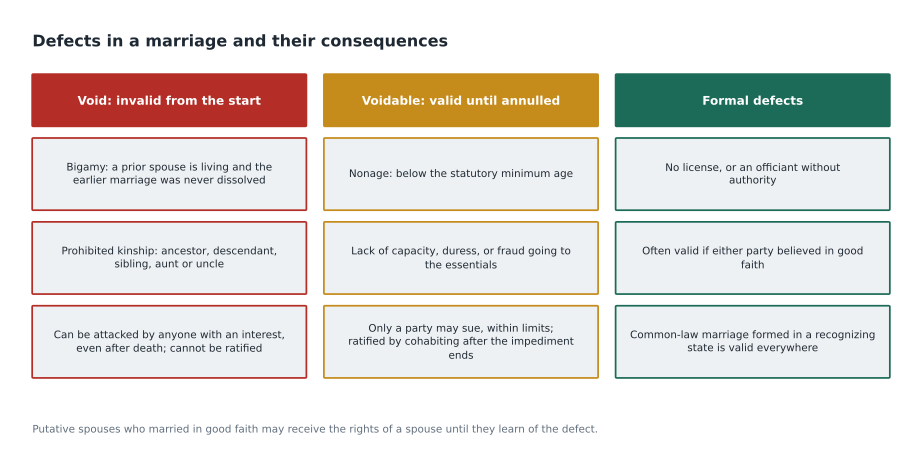
Every state imposes two kinds of requirements. Substantive requirements concern who may marry: capacity, consent, age, the absence of an existing marriage and the absence of a prohibited family relationship. Formal requirements concern how a marriage is entered: obtaining a license, solemnization before an authorized officiant, and recording. The consequences of failing each kind differ, and states classify defects as making a marriage either void or voidable.
Substantive requirements
Age. Every state sets a minimum marriage age, and most allowed marriage below eighteen with parental consent or judicial approval for much of their history. That has changed quickly. Delaware became the first state to ban all marriage under eighteen, without exceptions, in 2018, followed the same year by New Jersey. By late 2026, eighteen states and the District of Columbia had enacted such bans, including New York, Pennsylvania, Massachusetts, Michigan, Minnesota, Virginia, Washington, Oklahoma, Missouri and, in 2026, California. In the remaining states minors may still marry in some circumstances, usually at sixteen or seventeen with consent or court approval. A marriage below the statutory age is generally voidable rather than void, and the underage spouse may usually ratify it by continuing to cohabit after reaching the required age.
Existing marriage. Every state prohibits bigamy, and a marriage entered while either party has a living spouse from an undissolved marriage is void. The Supreme Court upheld federal criminal prohibitions on polygamy against a free exercise challenge in Reynolds v. United States, 98 U.S. 145 (1879), and no court has since required a state to recognize plural marriage. Bigamy problems arise most often by accident: a spouse who believed a prior divorce was final, or who obtained a divorce that turns out to be invalid. Two doctrines soften the result. Most states presume that the most recent marriage is valid, placing the burden on the party attacking it to prove that the earlier marriage had not been dissolved. And when the impediment is removed, for example by a later divorce, some states treat a couple who continue to live together in good faith as validly married from that point, especially in states that recognize common-law marriage.
Kinship. All states prohibit marriage between ancestors and descendants and between siblings, including half siblings, and nearly all prohibit marriage between an aunt or uncle and a niece or nephew. About half the states permit first cousins to marry, some with conditions such as age or infertility. Marriages within the prohibited degrees are generally void. A few states also historically prohibited marriages between people related by marriage, such as a stepparent and stepchild, but those prohibitions have largely disappeared outside the parent and child relationship.
Capacity and consent. Each party must have the mental capacity to understand the nature of marriage and its duties and must consent freely. A marriage entered under duress, or by a person too intoxicated or mentally impaired to understand the ceremony, is voidable. So is a marriage induced by fraud, but only fraud of a particular kind. The traditional rule, from Reynolds v. Reynolds, 85 Mass. 605 (1862), is that the fraud must go to the essentials of the marriage relationship. There, the wife concealed that she was pregnant by another man, and the court annulled the marriage. Misrepresentations about wealth, social position or character generally do not qualify. Modern courts have expanded the category somewhat, annulling marriages entered with a secret intention never to live together or never to have children, or entered solely to obtain an immigration benefit, but the line remains narrower than in contract law.
Sex of the parties. Before Obergefell, most states limited marriage to one man and one woman. Those restrictions are now unenforceable. Several states that created civil unions or domestic partnerships before Obergefell converted them into marriages or closed them to new entrants; others, such as Colorado and Illinois, still offer civil unions as an alternative status open to any couple.
Formal requirements
Every state requires a marriage license, issued by a county or municipal clerk on application by both parties, sometimes with a short waiting period before or after issuance. The license is a public record of the intent to marry and the clerk's check of substantive requirements. The marriage must then be solemnized before an officiant authorized by statute, typically a judge, a magistrate, a mayor or a member of the clergy, and in many states one or two witnesses. After the ceremony, the officiant returns the completed license for recording.
Formal defects are treated more leniently than substantive ones. Courts presume that a ceremonial marriage is valid, and many statutes provide that a marriage solemnized before a person who lacked authority is nonetheless valid if either party believed in good faith that the officiant was authorized. The officiant in the Whitcombe-Osei file presents that issue. Ministers ordained online by organizations that confer ordination on request have generated litigation; a few courts have questioned whether such ministers are clergy within the meaning of their statutes, but most states accept them, and nearly all would protect couples who relied in good faith. Westmarch's invented code follows the majority approach: a marriage solemnized by a person who lacked authority is valid if either party believed the person had authority. Genevieve and Kofi, who hired a friend they believed was a minister and obtained a license, have a valid marriage.
A few states allow variations. Colorado permits self-solemnization, in which the couple marries without an officiant, and a few other jurisdictions, including Pennsylvania and the District of Columbia, also allow couples to solemnize their own marriages. Montana, alone among the states, permits double proxy marriage, in which neither party is present, a provision used mostly by members of the military. Marriage by video conference became common during the COVID-19 pandemic, and some states, including New York, allowed remote solemnization.
Common-law marriage
A common-law marriage is formed without a license or ceremony, by the parties' present agreement to be married, usually followed by cohabitation and holding themselves out to the community as spouses. Once formed, it is a marriage for all purposes and can be dissolved only by divorce. No set period of cohabitation is required; the length of the relationship is evidence of the agreement, not a substitute for it. The usual difficulty is proof, because the agreement is rarely written down and the dispute often arises after one partner dies or the relationship ends.
Only a minority of jurisdictions still allow common-law marriages to be formed. Colorado, Iowa, Kansas, Montana, Rhode Island, Texas and the District of Columbia recognize them fully. Utah recognizes them only when a court or administrative order validates the relationship, and New Hampshire recognizes them only for inheritance purposes after a three-year period of cohabitation ending in death. Oklahoma's status is uncertain. Several states abolished common-law marriage prospectively in recent decades, including Pennsylvania (effective in 2005), Alabama (effective January 1, 2017) and South Carolina (by a 2019 decision of its supreme court, Stone v. Thompson). In those states, common-law marriages formed before the cutoff remain valid.
The place of formation controls. Under the general conflict of laws rule, a marriage valid where contracted is valid everywhere, so a state that does not permit common-law marriage will usually recognize one validly formed in Texas or Colorado. Couples cannot, however, create a common-law marriage merely by vacationing for a weekend in a common-law state; courts require that the parties actually agreed to be married while in that state, and many look skeptically at brief visits.
Putative spouses and the presumption of validity
A putative spouse is a person who participated in a marriage ceremony believing in good faith that the marriage was valid, when in fact it was void, often because the other party was still married. The Uniform Marriage and Divorce Act, section 209, and statutes in states such as California and Texas give a putative spouse the rights of a legal spouse, including a share of property acquired during the putative marriage and, in some states, support, until the putative spouse learns that the marriage is invalid. If a legal spouse and a putative spouse both claim the same property, courts divide it in whatever manner is just. The doctrine protects only the innocent party; the bigamist acquires no rights.
Daniel Reyes asks whether the putative spouse doctrine matters after a divorce has been granted. Marchbanks says it matters most in estates and benefits cases, where a second spouse who thought she was married learns, after her husband dies, that his first divorce was never finalized. Courts then must decide whether she is entitled to inherit, to Social Security survivor benefits or to pension payments. Federal programs have their own rules: the Social Security Act, for example, treats a person as a spouse if she went through a marriage ceremony in good faith that would have been valid except for a legal impediment, under certain conditions.
Void and voidable marriages and annulment
A void marriage is invalid from its inception; it needs no judicial decree, can be attacked by anyone with an interest, including after the death of a spouse, and cannot be ratified. A voidable marriage is valid until a court annuls it, can be challenged only by a party (or sometimes a guardian), must be challenged within limits set by statute, and can be ratified by continued cohabitation after the impediment ends. Bigamy and prohibited kinship make a marriage void. Nonage, incapacity, fraud and duress usually make it voidable.
An annulment declares that no valid marriage existed. Historically it was the only escape from a marriage in states that made divorce difficult, and courts stretched the fraud doctrine accordingly. Today annulment matters for religious reasons, for some benefits (a person receiving alimony or a survivor's pension that ends on remarriage may argue that an annulled remarriage revives the benefit, with mixed results), and in short marriages where the parties want a declaration that there was never a marriage. Most states now allow courts in annulment proceedings to divide property and award support on the same basis as in divorce, and children of void or voidable marriages are legitimate under modern statutes.
Interstate recognition
The general rule, stated in section 283 of the Restatement (Second) of Conflict of Laws, is that a marriage valid where contracted is valid everywhere, unless it violates the strong public policy of another state that had the most significant relationship to the spouses and the marriage when it was entered. In In re May's Estate, 305 N.Y. 486 (1953), New York recognized an uncle and niece marriage validly performed in Rhode Island, where an exception for Jewish marriages permitted it, even though New York prohibited such marriages. Some states once had marriage evasion statutes voiding marriages contracted elsewhere by residents to evade home state restrictions, modeled on a 1912 uniform act, but most have been repealed. Massachusetts repealed its version in 2008. The Respect for Marriage Act now requires recognition of out-of-state marriages regardless of the sex, race, ethnicity or national origin of the spouses, which removes the public policy exception for those characteristics but not, for example, for marriages within prohibited degrees of kinship or involving a minor.
Couples who do not marry
Many couples live together without marrying, and the law gives them far fewer rights. When an unmarried relationship ends, there is no divorce court to divide property or award support. Partners must rely on general law: express or implied contracts, partnership or joint venture, constructive and resulting trusts, and unjust enrichment. The leading case is Marvin v. Marvin, 557 P.2d 106 (Cal. 1976), in which the California Supreme Court held that cohabitants may enforce express contracts, including oral ones, about property and support, so long as the contract does not rest on sexual services as consideration, and may also recover under implied contract and equitable theories. On remand, Michelle Triola Marvin could not prove the contract she alleged, and her award was ultimately reversed.
Not every state followed Marvin. In Hewitt v. Hewitt, 394 N.E.2d 1204 (Ill. 1979), the Illinois Supreme Court refused to enforce property claims between cohabitants who had lived together for fifteen years and raised three children, reasoning that recognizing such claims would revive the common-law marriage the legislature had abolished. In Blumenthal v. Brewer, 2016 IL 118781, the court reaffirmed Hewitt as to claims that arise from the relationship itself, while noting that claims independent of it remain available. Other states, including Minnesota and Texas, require cohabitation agreements to be in writing to be enforceable. The practical lesson is that unmarried couples who want predictable rights should put their agreements in writing, and that their lawyers must check the state's approach before relying on equitable theories.
Worked problem
Is there a marriage to dissolve?
Suppose the facts in the Whitcombe-Osei file were different. Genevieve and Kofi obtained a Westmarch license, but the friend who officiated had not been ordained by anyone and both knew it; they called it a symbolic ceremony and planned a church wedding that never happened. They then lived together for twelve years, filed joint tax returns, wore rings and introduced each other as husband and wife. Westmarch, like most states, does not recognize common-law marriages formed within it. During a two-year period, from 2017 to 2019, the family lived in Texas while Kofi completed a graduate program. Is there a valid marriage?
Show solution
- Ceremonial marriage: Westmarch's good-faith rule protects couples who believed the officiant was authorized. Here both knew he was not, so the ceremony did not create a valid marriage under Westmarch law.
- Common-law marriage in Westmarch: not available, because Westmarch does not permit common-law marriages to be formed within the state.
- Common-law marriage in Texas: Texas recognizes informal marriage if the parties agreed to be married, lived together in Texas as spouses and represented to others in Texas that they were married. The facts strongly suggest all three: two years of cohabitation in Texas, joint returns, rings and introductions as spouses.
- Recognition: under the place of celebration rule, Westmarch would recognize a common-law marriage validly formed in Texas, and the Respect for Marriage Act reinforces interstate recognition of valid marriages.
- Conclusion: there is likely a valid marriage, formed in Texas no later than 2019. The property division would treat assets acquired from the date of marriage as marital, which raises a further question about when the marriage began. Evidence of the agreement during the Texas years will matter.
Priya Natarajan wants to know whether the answer would change if the couple had been in Texas for only a long weekend. Marchbanks says it likely would: courts are skeptical of claims that a common-law marriage was formed during a brief visit, especially when the parties did nothing in that state to hold themselves out as married. "The doctrine rewards couples who lived as spouses in a place that recognizes it," she says, "not couples looking for a loophole after the fact."
Summary and key terms
- Marriage is both contract and status; the state sets the terms of entry and exit (Maynard v. Hill).
- Substantive requirements cover age, existing marriage, kinship, capacity and consent; formal requirements cover license, solemnization and recording.
- Eighteen states and the District of Columbia ban all marriage under eighteen as of late 2026.
- Bigamous and incestuous marriages are void; nonage, incapacity, fraud going to the essentials and duress make a marriage voidable.
- Formal defects rarely invalidate a marriage when the parties acted in good faith.
- Common-law marriage can be formed in only a few jurisdictions, but valid common-law marriages are recognized elsewhere.
- Putative spouses who married in good faith receive protection; the place of celebration rule governs interstate recognition.
- Unmarried cohabitants rely on contract and equity, and states split between Marvin and Hewitt.
Practice problems
Work each problem on paper first, then reveal the answer to check.
Ana marries Ben in a church ceremony without knowing that Ben's divorce from his first wife was never finalized. Ben dies ten years later. Can Ana inherit as his surviving spouse?
Show answer
Not as a legal spouse, because the marriage was void for bigamy. But if the state recognizes the putative spouse doctrine, Ana's good faith may entitle her to a share of property acquired during the relationship, and she may qualify for some federal benefits as a deemed spouse.
Two people who live in a state that abolished common-law marriage spend a weekend in Colorado, where they tell a hotel clerk they are married. Have they formed a common-law marriage?
Show answer
Probably not. Courts require a present agreement to be married and usually conduct showing the relationship in the recognizing state; a weekend visit and a statement to a clerk are weak evidence, and many courts reject such claims.
A wife learns after the wedding that her husband lied about his income and his education. Can she obtain an annulment for fraud?
Show answer
Generally no. The fraud must go to the essentials of the marriage, such as concealed pregnancy by another or an undisclosed intention never to live together. Lies about wealth or background usually do not qualify, though she may seek a divorce.
Lesson quiz · 5 questions
Score 60% or more to complete this lesson.
Create a free account to save your progress, take quizzes and earn a certificate.