
LAWU-303 · Lesson 5 of 12 · 24 min
Property division
▶ Video coming soon A video version of this lesson is on the way.
Professor Marchbanks writes the Whitcombe-Osei balance sheet on the board in two columns, one for what the couple owns and one for what they owe. The house on Sorrel Lane in Brennan Falls, bought in 2014 for 380,000 dollars and titled in both names, is now worth about 520,000 dollars, with a mortgage balance of 210,000. Genevieve paid the 60,000-dollar down payment from savings she had before the marriage. Clearpoint Pediatric Dentistry, in Genevieve's name, is worth somewhere between 900,000 and 1.4 million dollars depending on whose expert is believed. A cabin at Lake Orrin, which Kofi inherited from his grandmother in 2019, is worth about 180,000 dollars; in 2021 the couple spent 25,000 dollars from their joint account on a new roof and rented the cabin to summer visitors for two seasons, depositing the rent in the joint account. Genevieve's 401(k) is worth 310,000 dollars, of which 40,000 was there on the wedding day. Kofi has a defined benefit pension with the Westmarch Teachers' Retirement System, which he began earning in 2009. There are two cars, Kofi's guitar collection, a home equity line of credit and the remaining dental school loans.
"Every one of these items raises a different question," Marchbanks says. "Before we divide anything, we have to ask three things in order. Which system does the state use? Is each asset marital or separate? And how should the marital estate be divided?" This lesson takes the questions in that order and ends with valuation, retirement benefits and the federal rules that override state law.
Three systems
The common-law states once used a title system: property belonged to the spouse who held title, and on divorce each spouse kept what was in his or her name. Because husbands usually held title and earned the income, the title system left many wives with little after long marriages, softened only by alimony. Every common-law state has abandoned it in favor of equitable distribution, which gives the court power to divide marital property between the spouses fairly, regardless of title.
Nine states follow community property, a system inherited from Spanish and French civil law: Arizona, California, Idaho, Louisiana, Nevada, New Mexico, Texas, Washington and Wisconsin, the last by adoption of the Uniform Marital Property Act. Property acquired during marriage by either spouse's labor is owned equally by both from the moment of acquisition, not only on divorce. Several other states, including Alaska, Tennessee, Kentucky and Florida, allow couples to opt into community property treatment for assets they place in a community property trust, mainly for tax reasons; those arrangements matter little in ordinary divorces.
On divorce, the difference between the systems has narrowed. Both community property and equitable distribution states divide only marital or community property, and both allow each spouse to keep separate property, with important exceptions. California, Louisiana and New Mexico require equal division of community property in most cases. Texas divides the community estate in a manner the court deems just and right, Nevada divides it equally unless there is a compelling reason not to, and Washington divides all property, community and separate, in a manner that is just and equitable. Among equitable distribution states, some begin with a presumption of equal division, such as North Carolina, Arkansas and Wisconsin, while others simply weigh statutory factors.
A minority of equitable distribution states, including Massachusetts, Connecticut and Vermont, follow an all-property or hotchpot approach: the court may divide any property either spouse owns, however and whenever acquired, including gifts and inheritances, although the source of the property is a factor. The UMDA offered both models; its Alternative A, section 307, is the all-property version. Most states, including Westmarch in the course's invented code, follow the dual-property approach and divide only marital property.
Characterization: marital or separate
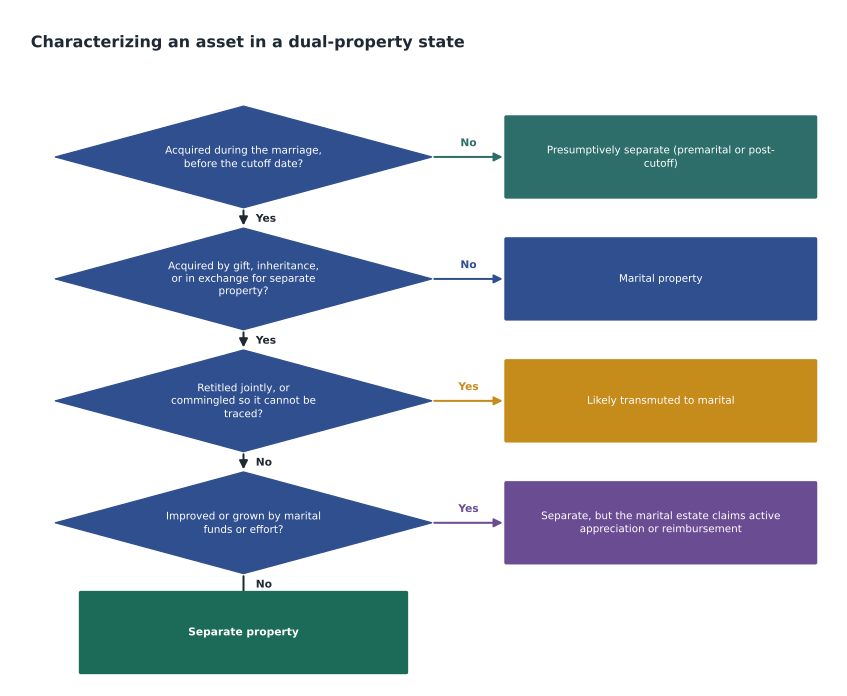
Marital property generally includes everything acquired by either spouse during the marriage, other than by gift, bequest, devise or descent, regardless of how title is held. Separate property includes property owned before the marriage, property acquired during the marriage by gift or inheritance, property acquired in exchange for separate property, property excluded by a valid agreement and, in most states, the increase in value of separate property that results from passive forces such as inflation or market changes. Most states presume that property acquired during the marriage is marital, and the spouse claiming separate property must prove it, often by clear and convincing evidence or a preponderance.
States differ on when the marital period ends. Some use the date of separation, others the date the divorce petition was filed, others the date of the decree. Westmarch's invented code uses the filing date, May 4, 2026, for characterization, and the trial date for valuation unless the court finds another date more equitable.
Income from separate property is another dividing line. In most equitable distribution states and in most community property states, income from separate property, such as rent, interest and dividends, is separate. Texas, Idaho, Louisiana and Wisconsin follow the civil law rule that such income is community property. The Lake Orrin rent illustrates a related point: even where income from separate property is separate, depositing it in a joint account can change its character.
Transmutation, commingling and tracing
Transmutation is the change of property from separate to marital, or the reverse, by the spouses' agreement or conduct. The most common forms are retitling and commingling. When a spouse places separate property in joint names, many states presume a gift to the marriage, which the donor spouse can rebut only by clear evidence that no gift was intended. Other states, including California by statute for transmutations after 1984, require an express written declaration by the spouse whose interest is adversely affected. When separate funds are mixed with marital funds in an account and used for both purposes, the separate character survives only if the owning spouse can trace the separate funds to an identifiable asset.
The Sorrel Lane house shows how these rules work. Genevieve used 60,000 dollars of premarital savings for the down payment on a house titled in both names. In a state that presumes a gift from joint titling, the entire house is marital unless she proves she intended to keep the down payment separate. In a state that allows reimbursement of traceable separate contributions to joint property, such as California under Family Code section 2640, she can recover the 60,000 dollars, without interest or appreciation, unless she waived the right in writing. Westmarch's invented code follows the gift presumption, but its premarital agreement adds a twist: it says jointly titled property is divided equally. The house is therefore marital, and Genevieve's down payment is not reimbursed. Hannah Lindqvist observes that Genevieve's own agreement is what defeats her claim. Marchbanks smiles. "Clients rarely read the parts that cut against them."
Appreciation of separate property
When separate property increases in value during the marriage, the question is why. Passive appreciation caused by market forces generally stays separate. Active appreciation caused by the contributions or efforts of either spouse during the marriage is marital, in whole or in part, in most states. Courts allocate the increase by asking how much resulted from marital effort or funds and how much from outside forces, and they often need expert testimony to do it. Some states instead give the marital estate a right of reimbursement for marital contributions, such as mortgage payments made with marital earnings or improvements paid for with marital funds.
Kofi's cabin is separate property, because he inherited it. But 25,000 dollars of marital funds paid for the roof, and the rent was deposited in the joint account. The marital estate likely has a claim for reimbursement of the 25,000 dollars, or for the portion of the cabin's appreciation attributable to the roof. The rent, once deposited in a joint account and spent on family expenses, has lost any separate character. Genevieve's lawyer may also argue that renting the cabin turned it into a marital business, but because the rental activity was modest and the cabin's value reflects mainly the lake market, a court is likely to treat most of the appreciation as passive.
The 401(k) raises a classic tracing problem. Of its current 310,000 dollars, 40,000 was there on the wedding day. That premarital balance, plus the investment growth attributable to it, is separate. Contributions made from earnings during the marriage, and their growth, are marital. Account statements usually make the calculation possible: an expert can track the premarital balance through the market returns of the account's investments. If statements are missing, the spouse claiming separate property bears the risk.
Dividing the marital estate
Once the marital estate is identified and valued, the court divides it. Equitable distribution statutes list factors that typically include the length of the marriage; each spouse's age, health, income and earning capacity; each spouse's contributions to the acquisition of marital property, including contributions as a homemaker; the value of each spouse's separate property; the economic circumstances of each spouse when the division takes effect, including the desirability of awarding the family home to the custodial parent; tax consequences; and dissipation. Equitable does not mean equal, but in practice many courts begin with an equal division and depart from it only for good reason. Homemaking contributions are counted as equal to financial ones in nearly every state.
Courts can divide property in kind, order one asset sold and the proceeds split, or award an asset to one spouse and offset it with other property or a payment over time. Debts are divided too, usually on the same principles: debts incurred for marital purposes are marital, and debts incurred for one spouse's separate purposes are separate. Genevieve's premarital dental school loans are her separate debt. The home equity line, drawn for family expenses, is marital.
Valuation: businesses and goodwill
A closely held business must be valued, and in a professional practice like Clearpoint, most of the dispute is about goodwill, the value of the business beyond its tangible assets. Courts distinguish enterprise goodwill, which attaches to the business itself through its location, staff, systems and name, from personal goodwill, which depends on the skill, reputation and relationships of the individual professional. Most states treat enterprise goodwill as divisible property and personal goodwill as nondivisible, reasoning that personal goodwill is really future earning capacity, which will be considered in setting alimony. A few states, including California, treat both as community property. The difference can be hundreds of thousands of dollars. Clearpoint's two valuations differ largely because Genevieve's expert attributes most of the goodwill to her personally.
In the Whitcombe-Osei file, the premarital agreement makes Clearpoint Genevieve's separate property, so its value matters only indirectly: for the reimbursement claim discussed in Lesson 3, for evaluating each spouse's economic circumstances, and for alimony and child support. Many divorcing couples have no such agreement, and for them the valuation of a business is often the most expensive part of the case.
Degrees and enhanced earning capacity
A professional degree earned during the marriage, often with the other spouse's support, presents a distinct problem. In O'Brien v. O'Brien, 66 N.Y.2d 576 (1985), the New York Court of Appeals held that a medical license acquired during the marriage was marital property subject to equitable distribution, valued as the present value of the enhanced earnings it would produce. Almost every other state rejected that approach. In Mahoney v. Mahoney, 453 A.2d 527 (N.J. 1982), the New Jersey Supreme Court held that a degree is not property but that a spouse who supported the other through school may receive reimbursement alimony for the financial contributions. Many states follow some version of reimbursement. New York itself abandoned O'Brien by statute in 2015: chapter 269 of the Laws of 2015 amended Domestic Relations Law section 236 to provide that the court shall not consider the value of a spouse's enhanced earning capacity arising from a license, degree, celebrity goodwill or career enhancement as marital property, while still allowing the court to consider the other spouse's direct or indirect contributions to the enhancement in dividing marital property.
Retirement benefits
Retirement benefits are often the largest marital asset after the home. Defined contribution plans, such as 401(k) accounts, have an account balance and are divided by tracing as described above. Defined benefit plans, such as Kofi's teachers' pension, promise a monthly payment at retirement based on years of service and salary, and the marital share is usually calculated with a coverture fraction: the number of years of service during the marriage divided by the total years of service. The fraction is applied to the benefit, either now, by valuing the pension and offsetting it with other property (the immediate offset method), or later, by dividing each payment when it is made (the deferred distribution method). Courts often prefer deferred distribution when valuation is uncertain or other assets are insufficient for an offset.
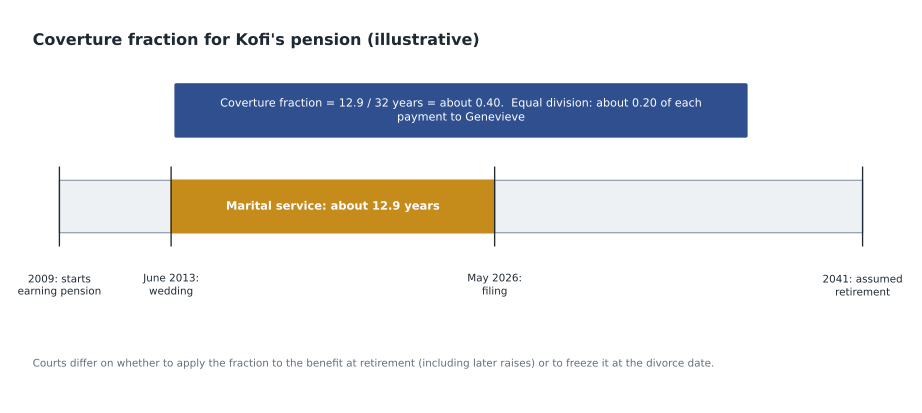
Applied to Kofi's pension, the marital period runs from June 2013 to May 2026, about 12.9 years. If he retires in 2041 with 32 years of service, the coverture fraction is about 12.9 over 32, roughly 0.40, and an equal division would give Genevieve about one fifth of each payment. Many courts apply the fraction to the benefit Kofi eventually receives, which includes later raises, while others freeze it at his salary on the date of divorce. Public pensions are not covered by ERISA, so the order dividing Kofi's pension must comply with the Westmarch retirement system's own rules for domestic relations orders.
Private plans covered by the Employee Retirement Income Security Act are protected by an anti-alienation rule, which forbids assigning benefits. The Retirement Equity Act of 1984 created an exception for a qualified domestic relations order (QDRO), a state court order that creates or recognizes an alternate payee's right to receive benefits and meets specific requirements set out in 29 U.S.C. section 1056(d)(3). Genevieve's 401(k) will be divided by QDRO. Transfers of retirement funds between spouses under a QDRO or incident to divorce are not taxable at the time of transfer, and Internal Revenue Code section 1041 provides more generally that transfers of property between spouses, or between former spouses incident to divorce, produce no gain or loss.
Federal limits on state property law
Federal law preempts state property division in several areas. In McCarty v. McCarty, 453 U.S. 210 (1981), the Supreme Court held that military retired pay could not be divided as community property. Congress responded with the Uniformed Services Former Spouses' Protection Act of 1982, which allows states to treat disposable military retired pay as divisible property. But disposable retired pay excludes amounts waived to receive veterans' disability benefits. In Mansell v. Mansell, 490 U.S. 581 (1989), the Court held that states may not divide the waived portion. In Howell v. Howell, 581 U.S. 214 (2017), it held that a state court may not order a veteran to reimburse or indemnify a former spouse for the reduction in her share caused by a later waiver, although the court may take the possibility of a waiver into account when dividing other property or setting support.
Social Security benefits are not divisible property, and in Hisquierdo v. Hisquierdo, 439 U.S. 572 (1979), the Court held that federal law also prevents states from dividing Railroad Retirement Act benefits. Courts in some states consider the parties' expected Social Security benefits in dividing other property, while others forbid even that. A former spouse married for at least ten years may receive benefits on the other's record under the Social Security Act itself.
Federal law also affects beneficiary designations. Most states have revocation-on-divorce statutes that automatically revoke a former spouse's designation as beneficiary of a will, trust or life insurance policy. In Sveen v. Melin, 584 U.S. 811 (2018), the Court held that applying Minnesota's statute to a life insurance policy purchased before the statute was enacted did not violate the Contracts Clause. But ERISA preempts such statutes as applied to ERISA plans, under Egelhoff v. Egelhoff, 532 U.S. 141 (2001), and plan administrators must pay according to the plan documents, as the Court held in Kennedy v. Plan Administrator for DuPont Savings and Investment Plan, 555 U.S. 285 (2009). A careful divorce lawyer therefore makes sure that beneficiary designations are changed, and that any waiver of rights in the decree is backed by the plan's own procedures.
Worked problem
Building the Whitcombe-Osei marital estate
Using the values on the board and Westmarch's invented rules (dual-property equitable distribution, gift presumption from joint titling, filing date for characterization, reimbursement for marital funds used to improve separate property), identify the marital estate and propose a division. Assume the 401(k)'s premarital balance and growth are worth 70,000 dollars today.
Show solution
- House: marital by joint titling and the agreement's equal-division clause. Equity 520,000 minus 210,000 equals 310,000 dollars.
- Clearpoint: Genevieve's separate property under the premarital agreement; the marital estate may claim reimbursement of the 80,000 dollars of joint savings invested in 2016 (Lesson 3).
- Cabin: Kofi's separate property by inheritance; the marital estate is reimbursed 25,000 dollars for the roof. The rent deposited in the joint account was spent and is not separately traceable.
- 401(k): 310,000 minus 70,000 separate equals 240,000 dollars marital, divided by QDRO.
- Pension: marital share by coverture fraction, divided by a domestic relations order under the Westmarch retirement system's rules, with deferred distribution because no reliable present value has been agreed.
- Debts: the home equity line is marital; the dental school loans are Genevieve's separate debt.
- Division: an equal division of the marital estate is the likely starting point. Genevieve owes the estate 80,000 dollars of reimbursement and Kofi owes 25,000, a net 55,000 in Kofi's favor. Factors such as Kofi's lower earning capacity and his career sacrifice might support a modestly larger share for him, but in a short to medium marriage with a valid agreement, courts often stay close to equal.
Summary and key terms
- Common-law states now use equitable distribution; nine states use community property; some states divide all property, most only marital property.
- Property acquired during the marriage is presumed marital; gifts, inheritances and premarital property are separate.
- Retitling and commingling can transmute separate property; tracing preserves it.
- Active appreciation of separate property is usually marital; passive appreciation is separate.
- Equitable distribution weighs statutory factors and counts homemaking; many courts start at equal.
- Most states divide enterprise goodwill but not personal goodwill; New York abandoned O'Brien by statute in 2015.
- Pensions are divided by coverture fraction and QDRO; section 1041 makes transfers incident to divorce tax-free.
- Federal law limits division of military disability waivers (Mansell, Howell), Social Security and railroad benefits (Hisquierdo), and ERISA beneficiary rules (Egelhoff, Kennedy).
Practice problems
Work each problem on paper first, then reveal the answer to check.
A wife inherits 100,000 dollars and deposits it in a joint account the couple uses for all household expenses. Five years later the account holds 30,000 dollars. Is any of it separate?
Show answer
Probably not. Unless she can trace the inheritance into an identifiable asset, the commingled funds are likely marital, and many states would also presume a gift from depositing them in a joint account.
A husband owned a business before marriage worth 200,000 dollars. During the marriage he worked in it full time and it grew to 1 million dollars. How is the increase treated?
Show answer
Most states treat appreciation caused by a spouse's efforts during the marriage as marital. The court will decide how much of the 800,000 dollar increase resulted from his efforts rather than passive market forces, usually with expert testimony.
A veteran's divorce decree gives his former wife half of his military retired pay. Years later he waives part of the retired pay to receive VA disability benefits, reducing her share. Can the state court order him to make up the difference?
Show answer
No. Howell v. Howell (2017) holds that federal law preempts a state order requiring reimbursement or indemnification for a reduction caused by a disability waiver. The court may consider the possibility when setting support in a later modification, within the limits of state law.
Lesson quiz · 5 questions
Score 60% or more to complete this lesson.
Create a free account to save your progress, take quizzes and earn a certificate.