
LAWU-303 · Lesson 8 of 12 · 22 min
Child support
▶ Video coming soon A video version of this lesson is on the way.
The child support worksheet in the Whitcombe-Osei file is two pages of boxes and arithmetic, printed from the Westmarch courts' online calculator. Professor Marchbanks tells the class that it is the most important document in most divorce files and the least interesting to read. "Custody cases go on for years," she says. "Alimony may be waived. But almost every parent who leaves a marriage with children owes child support or receives it, and the amount is set by a formula most judges apply in under ten minutes. Understanding the formula is how you protect your client."
Unlike alimony, child support rests on a premise nobody disputes: both parents owe a duty to support their children, regardless of marriage, divorce or custody. The duty belongs to the child, which is why parents cannot bargain it away in a premarital agreement or a settlement. This lesson covers the federal framework that shaped state child support law, the guideline models states use, income and deviations, shared parenting adjustments, duration, modification and enforcement, including the constitutional limits on jailing parents who cannot pay.
The federal framework
Child support was once a matter of judicial discretion, enforced, if at all, by a custodial parent's private contempt motion. That changed when Congress tied child support to federal welfare spending. Title IV-D of the Social Security Act, enacted in 1975, created the federal and state child support enforcement program, now called the Office of Child Support Services at the federal level and IV-D agencies in each state. The program establishes paternity, establishes and enforces support orders and collects payments for families receiving public assistance and, on application, for any family. The Child Support Enforcement Amendments of 1984 required states to adopt advisory numeric guidelines. The Family Support Act of 1988 required that the guidelines be presumptive: the amount produced by the guideline is presumed correct, and a court may deviate only with a written or specific finding that the guideline amount would be unjust or inappropriate. States must review their guidelines at least every four years.
The Personal Responsibility and Work Opportunity Reconciliation Act of 1996 added a second wave of requirements as conditions of federal funding. States had to adopt the Uniform Interstate Family Support Act, create new hire registries so that employers report new employees and income withholding can begin quickly, establish state case registries and centralized collection units, and adopt enforcement tools such as license suspension and liens. A 2016 federal rule, Flexibility, Efficiency, and Modernization in Child Support Enforcement Programs, published December 20, 2016, required state guidelines to be based on the parent's actual earnings and income and other evidence of ability to pay, to consider the basic subsistence needs of the paying parent through a low-income adjustment, and to stop treating incarceration as voluntary unemployment that bars modification.
Guideline models
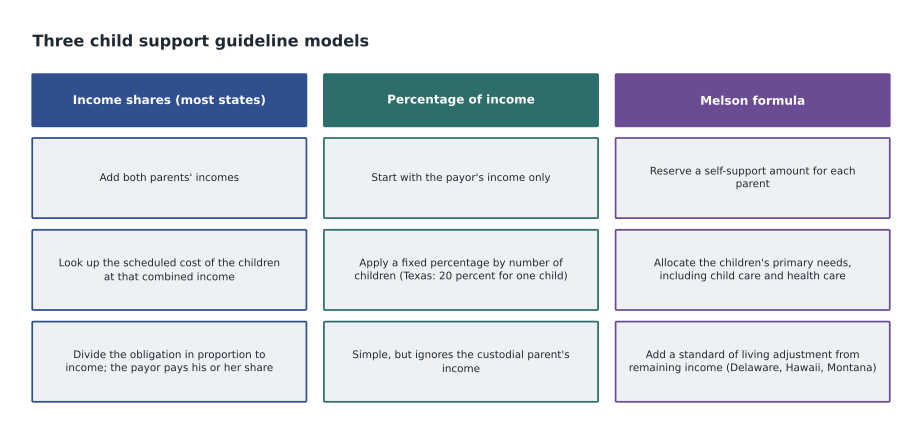
States use three basic models. The income shares model, used by the large majority of states and by Westmarch in the course's invented code, rests on the idea that children should receive the same proportion of parental income they would have received if the parents lived together. The court adds the parents' incomes, finds the basic support obligation for that combined income and number of children in a schedule based on economic studies of household spending on children, and divides the obligation between the parents in proportion to their shares of combined income. The custodial parent's share is presumed spent directly on the children; the noncustodial parent pays his or her share as support.
The percentage of income model, used by a smaller group of states, applies a fixed percentage to the noncustodial parent's income, varying with the number of children. Texas, for example, applies percentages of the obligor's net resources up to a cap that the state adjusts periodically, starting at 20 percent for one child. The model is simpler but ignores the custodial parent's income.
The Melson formula, developed by Delaware Family Court Judge Elwood F. Melson and used in Delaware, Hawaii and Montana, first sets aside a self-support reserve for each parent, then allocates the children's primary support needs, including child care and health care, in proportion to the parents' remaining incomes, and then adds a standard of living adjustment so that children share in each parent's additional income. It is the most complex model and the most explicit about the paying parent's own needs.
Income, imputation and deviations
Guidelines define income broadly to include wages, salary, self-employment income after ordinary and necessary business expenses, bonuses, commissions, interest, dividends, rent, pensions, Social Security and disability benefits, and sometimes spousal support received. Self-employment income is a frequent battleground, because business owners can control their reported income through expenses, retained earnings and payments to family members. Courts look through the business to the parent's actual economic resources. Genevieve's income from Clearpoint, for example, will be analyzed by an accountant who adds back discretionary expenses such as a car the practice leases for her personal use.
Income may be imputed to a parent who is voluntarily unemployed or underemployed. Courts consider the parent's work history, education, skills, health, the local job market and the reasons for the reduced work. A parent who leaves a job to avoid support will have income imputed; a parent who reduces work to care for a young child or a child with special needs may not, at least for a time. Under the 2016 federal rule, imputation must be based on the specific circumstances of the parent rather than a standard assumption such as full-time work at the minimum wage. The dispute over Kofi's part-time work, discussed in Lesson 6, matters in child support too, because imputing full-time income to him would increase his share of the obligation.
Guideline amounts may be adjusted by deviation when a court finds that applying the guideline would be unjust or inappropriate. Common grounds include extraordinary medical or educational needs, a child's own income, the parent's support of other children, and very high or very low income. Every schedule tops out at some level of combined income. Above that level, states either extrapolate the schedule or leave the amount to the court's discretion based on the child's reasonable needs and the parents' standard of living. Courts often say that a child is entitled to share in a wealthy parent's standard of living but that child support is not a vehicle for transferring wealth to the other parent.
Most guidelines also require add-ons allocated in proportion to income: work-related child care costs, the cost of health insurance for the children and uninsured medical, dental and therapy expenses. Emmett's speech therapy, to the extent not covered by insurance or the school, is such an expense.
Shared parenting adjustments
When children spend substantial time in both homes, both parents spend money on them directly, and a guideline that assumes all spending happens in one household overstates the noncustodial parent's obligation. Most states therefore adjust support when the nonresidential parent has the children for more than a threshold number of overnights, often 25 to 35 percent of the year. A common method is the cross-credit: the basic obligation is multiplied by 1.5 to reflect the higher total cost of maintaining two homes, each parent's share is computed, each share is multiplied by the percentage of time the children spend with the other parent, and the difference is paid by the parent who owes more.
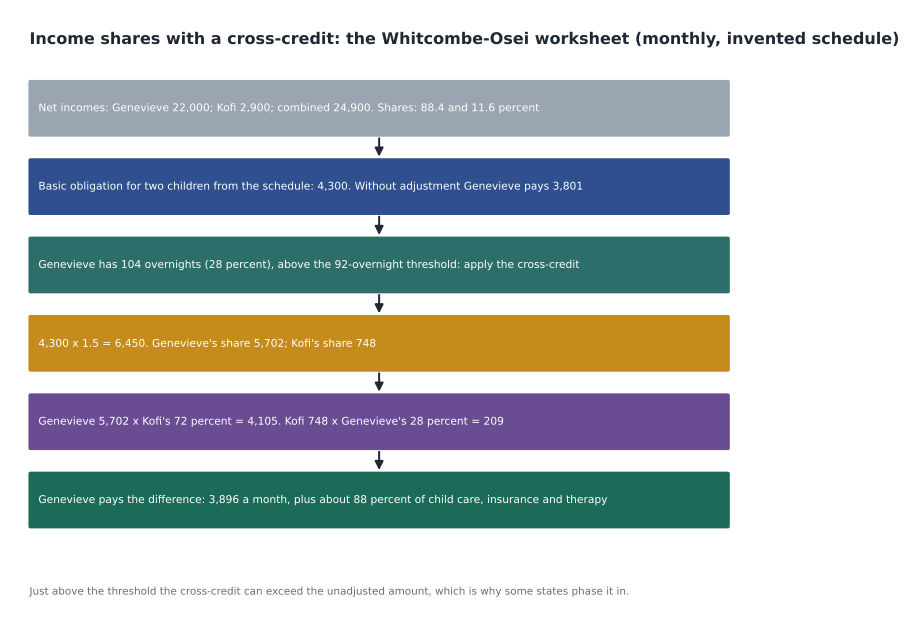
The worksheet in the Whitcombe-Osei file assumes Kofi becomes the primary residential parent and Genevieve has the children 104 nights a year, about 28 percent. Their monthly net incomes are 22,000 dollars and 2,900 dollars, so combined net income is 24,900 dollars and Genevieve's share is about 88.4 percent. Westmarch's invented schedule gives a basic obligation of 4,300 dollars a month for two children at that income, near the top of the schedule. Without an adjustment, Genevieve would pay 88.4 percent of 4,300, or 3,801 dollars a month. Westmarch's cross-credit applies when the nonresidential parent has at least 92 overnights. Multiplying 4,300 by 1.5 gives 6,450; Genevieve's share is 5,702 and Kofi's 748. Genevieve's share times Kofi's 72 percent of time is 4,105, Kofi's share times Genevieve's 28 percent is 209, and Genevieve pays the difference, 3,896 dollars a month, plus about 88 percent of child care, the children's health insurance and Emmett's uncovered therapy.
Jordan Kimura notices that the adjusted amount is higher than the unadjusted one. Marchbanks says that is a known feature of the cross-credit method just above the threshold, especially when incomes are very unequal: the 1.5 multiplier increases the total more than the time credit reduces the higher earner's share. Some states phase in the adjustment gradually or compare the two results to avoid such cliffs. "Never trust a calculator you have not run by hand at least once," she says.
Duration and college
Support generally continues until the child reaches the age of majority, usually eighteen, or graduates from high school if later, often subject to an outside age such as nineteen. Some states extend it longer: New York requires support until twenty-one, and several states require support for a disabled adult child who cannot be self-supporting. Support ends earlier if the child is emancipated by marriage, military service or self-support.
College support is an area of sharp variation. A minority of states, including New Jersey, Massachusetts, Illinois and New York in some form, allow courts to order divorced parents to contribute to a child's college expenses, applying factors such as the parents' resources and the child's aptitude. Most states do not, unless the parents agreed to it. In Curtis v. Kline, 666 A.2d 265 (Pa. 1995), the Pennsylvania Supreme Court struck down a statute authorizing college support orders against divorced parents, holding that it violated equal protection because married parents have no such obligation. Other state courts have rejected that reasoning. Parents frequently address college in settlement agreements, which are enforceable as contracts.
Modification
Child support is modifiable on a showing of a substantial change in circumstances. Many states define a substantial change by a numerical threshold, such as a difference of 10 or 15 percent between the existing order and the amount the guideline would now produce. IV-D agencies must review orders periodically on request. Under the 2016 federal rule, states must allow incarcerated parents to seek modification and may not treat incarceration as voluntary unemployment that bars it.
Modification can only operate prospectively. The Bradley Amendment of 1986, codified at 42 U.S.C. section 666(a)(9), requires states to treat each support installment as a judgment by operation of law on the date it is due, entitled to full faith and credit, and bars retroactive modification of installments that accrued before the parent filed a motion to modify. A parent who loses a job must file promptly; arrears that accumulate before filing cannot be reduced even if the parent could not pay.
Enforcement
Every new or modified order must provide for immediate income withholding, under which the employer deducts support from wages and sends it to the state disbursement unit, unless the parents agree in writing to an alternative or the court finds good cause. Arrears are collected through intercepts of federal and state tax refunds, liens on property, credit bureau reporting, seizure of bank accounts, suspension of driver's, professional, occupational and recreational licenses, and denial of passports to parents who owe more than a threshold set by federal law, currently 2,500 dollars. Unpaid support is a domestic support obligation in bankruptcy, nondischargeable and entitled to first priority.
Civil contempt remains common, and it raises constitutional questions because it can lead to jail. In Turner v. Rogers, 564 U.S. 431 (2011), Michael Turner was jailed for a year for civil contempt for failing to pay support, after a hearing at which neither he nor the custodial parent had counsel. The Supreme Court held that the Due Process Clause does not automatically require the state to provide counsel to an indigent parent facing incarceration in a civil contempt proceeding when the opposing parent is also unrepresented, but it does require alternative procedural safeguards: notice to the parent that ability to pay is a critical issue, a form to elicit relevant financial information, an opportunity at the hearing to respond to questions about financial status, and an express finding by the court that the parent has the ability to pay. Because civil contempt is meant to coerce compliance, a parent who cannot pay cannot be jailed for civil contempt, since he does not hold the keys to his cell. The Court reversed because Turner received none of those safeguards.
Criminal penalties also exist. Every state criminalizes willful nonsupport. Federally, the Child Support Recovery Act of 1992, as amended by the Deadbeat Parents Punishment Act of 1998, codified at 18 U.S.C. section 228, makes it a crime to willfully fail to pay support for a child in another state if the obligation has remained unpaid for more than a year or exceeds 5,000 dollars, with greater penalties for larger or older debts and for traveling across state lines to evade support.
Interstate orders and UIFSA
Because parents often live in different states, Congress and the states adopted rules to prevent conflicting orders. The Uniform Interstate Family Support Act, adopted in every state in its 2008 version, which implements the Hague Child Support Convention, creates a one-order system. The state that issued an order has continuing, exclusive jurisdiction to modify it as long as the obligor, the obligee or the child continues to reside there, unless the parties consent to another state's jurisdiction. Other states must register and enforce the order but may not modify it. If all parties and the child have left the issuing state, a state where the nonmoving party resides may modify it after registration. The federal Full Faith and Credit for Child Support Orders Act, 28 U.S.C. section 1738B, imposes the same rules on all states. UIFSA's long-arm provision lists bases for personal jurisdiction over a nonresident in a support case, such as personal service in the state, residence with the child in the state, or the child's residence in the state as a result of the nonresident's acts. Lesson 11 returns to interstate cases.
Worked problem
Setting and protecting the Whitcombe-Osei support order
Assume the court denies relocation of the children, Genevieve moves to Portland anyway in January 2027, and Kofi becomes the primary residential parent with Genevieve having 70 overnights a year. Genevieve's income rises to 30,000 dollars a month net. Explain how support will be recalculated, where, and what Kofi should do if payments stop.
Show solution
- Recalculation: with 70 overnights, about 19 percent, Genevieve no longer meets Westmarch's 92-overnight threshold, so the shared parenting adjustment drops away and she pays her income share of the basic obligation plus add-ons. Combined income now exceeds the schedule, so the court will extrapolate or set an amount based on the children's needs and the parents' standard of living.
- Forum: under UIFSA and section 1738B, Westmarch keeps continuing, exclusive jurisdiction because Kofi and the children still live there. Oregon may enforce the Westmarch order but may not modify it.
- Travel costs: the court may allocate the cost of long-distance travel for parenting time, typically to the relocating parent, either as an add-on or as a deviation.
- Collection: Genevieve's new employer in Oregon will receive an income withholding order, which an Oregon employer must honor directly under UIFSA. If payments stop, Kofi can ask the Westmarch IV-D agency to enforce, use tax intercepts and license remedies, and seek contempt; any contempt proceeding must follow Turner's safeguards if Genevieve is unrepresented and claims inability to pay.
- Modification: if Genevieve's income drops, she must move promptly to modify, because the Bradley Amendment bars retroactive reduction of accrued installments.
Summary and key terms
- Child support belongs to the child and cannot be waived by the parents.
- Title IV-D (1975), the 1984 amendments, the Family Support Act (1988) and PRWORA (1996) built the modern system of presumptive guidelines and enforcement.
- Most states use income shares; others use percentage of income or the Melson formula.
- Income is defined broadly and may be imputed; the 2016 federal rule requires guidelines based on actual ability to pay and bars treating incarceration as voluntary unemployment.
- Shared parenting adjustments, often by cross-credit, apply above an overnight threshold.
- Support usually ends at majority or high school graduation; college support is available in only some states.
- Modification is prospective only under the Bradley Amendment.
- Enforcement includes income withholding, intercepts, license and passport sanctions and contempt, subject to Turner v. Rogers' safeguards; UIFSA creates a one-order system across states.
Practice problems
Work each problem on paper first, then reveal the answer to check.
A father loses his job in March and files a motion to modify support in September. What can the court do about the support that accrued from March to September?
Show answer
Nothing to reduce it. Under the Bradley Amendment, installments that accrued before the motion was filed are judgments and cannot be retroactively modified. The court can modify support from the filing date forward.
At a civil contempt hearing, an unrepresented mother who owes support says she has no job and no money. The court jails her without asking about her finances. Is that permissible?
Show answer
No. Under Turner v. Rogers, the court must provide procedural safeguards, including notice that ability to pay is critical, an opportunity to respond, and an express finding of ability to pay before jailing her for civil contempt.
A support order was issued in Ohio. The father moves to Florida and the mother and child move to Georgia. Which state can modify the order?
Show answer
Ohio no longer has continuing, exclusive jurisdiction because no party or child resides there. Under UIFSA, a party seeking modification generally must register the order and seek modification in the state where the other party resides: the mother would file in Florida, or the father in Georgia, unless the parties consent to another forum.
Lesson quiz · 5 questions
Score 60% or more to complete this lesson.
Create a free account to save your progress, take quizzes and earn a certificate.