
LAWU-303 · Lesson 6 of 12 · 22 min
Spousal support
▶ Video coming soon A video version of this lesson is on the way.
Kofi Osei earned 68,000 dollars a year as a full-time high school music teacher in 2015. After Emmett was born in 2020, he and Genevieve agreed that he would cut back to a part-time position teaching elementary music three days a week, so that one parent would be home for school pickups, medical appointments and the long summer. His salary fell to 41,000 dollars. Over the same years, Clearpoint grew from two treatment chairs to nine, and Genevieve's income from the practice rose to about 380,000 dollars a year. Professor Marchbanks puts the two numbers side by side on the board. "If there were no premarital agreement," she asks, "would Kofi be entitled to alimony? For how long? And why?"
The question of why matters more than any other in this area. Spousal support, which the statutes variously call alimony or maintenance, is the most contested and least predictable part of American divorce law. Courts and legislatures have never fully agreed about its purpose, and the answer to the purpose question drives the answers to the questions of amount and duration. This lesson covers the justifications for spousal support, the forms it takes, the factors and guidelines courts use, modification and termination, enforcement, and the tax rules that changed in 2019.
Why award spousal support?
Traditional alimony rested on the husband's common-law duty to support his wife. Because a wife could not easily support herself and because divorce was granted only for fault, alimony continued the husband's duty when his misconduct ended the marriage. Equal protection made that rationale unavailable: Orr v. Orr (1979) required gender-neutral support statutes, and no-fault divorce removed the link to wrongdoing. Something had to replace it.
Four modern rationales compete. Need-based theories, reflected in the Uniform Marriage and Divorce Act, treat alimony as a safety net for a spouse who cannot meet reasonable needs after the divorce. Rehabilitative theories treat it as a bridge, supporting a spouse while he or she gains education or experience to become self-supporting. Compensation theories, developed most fully in the American Law Institute's Principles of the Law of Family Dissolution (2002), treat support as payment for losses: when one spouse's earning capacity was reduced by caring for children or supporting the other's career, the marriage's end should not leave that loss entirely on the spouse who sacrificed. Partnership theories treat marriage as an economic partnership whose gains, including the higher earner's enhanced earning capacity, should be shared for some period after it ends.
Marcus Webb says the rationale he finds most convincing is compensation, because it explains why the length of the marriage and the presence of children matter. Priya Natarajan disagrees: "Compensation for what? Kofi chose part-time work. Genevieve didn't make him." Marchbanks lets the argument run, then points out that under every theory except pure need, the fact that the couple jointly decided Kofi would reduce his work is relevant. "Choices made by the marriage are the marriage's choices," she says. "Most statutes say so expressly."
Forms of support
Courts award several kinds of support, often in combination. Temporary support, also called pendente lite support, maintains the status quo while the case is pending and is usually calculated by a formula or guideline. Rehabilitative support lasts for a set period, such as the time needed to finish a degree or reenter a profession, and may be conditioned on a plan. Bridge-the-gap support covers a short transition to single life, typically limited to a few years. Reimbursement support repays a spouse who contributed to the other's education or training, the remedy many states adopted after rejecting the treatment of degrees as property. Durational support lasts for a fixed period tied to the length of the marriage. Indefinite or permanent support continues until the death of either party, the recipient's remarriage or a court order, and has historically been reserved for long marriages in which the recipient cannot become self-supporting. Lump sum support, a fixed total payable at once or in installments, is generally neither modifiable nor terminable on remarriage.
Statutory factors
Section 308 of the UMDA, followed in many states, allows maintenance only if the spouse seeking it lacks sufficient property to provide for reasonable needs and is unable to support himself or herself through appropriate employment, or is the custodian of a child whose condition or circumstances make it appropriate that the custodian not be required to seek employment outside the home. If that threshold is met, the court sets the amount and duration considering factors that include the financial resources of the party seeking support, the time needed to acquire education or training, the standard of living established during the marriage, the duration of the marriage, the age and physical and emotional condition of the spouse seeking support, and the ability of the paying spouse to meet his or her own needs while paying.
Most state statutes list similar factors and add others: each spouse's contributions to the marriage, including homemaking and child care; contributions to the other's education or career; the tax consequences; the parties' property, including what each receives in the property division; and, in some states, marital misconduct. Because the factors are many and their weight is left to the trial judge, outcomes in similar cases vary widely, and appellate courts review alimony awards only for abuse of discretion.
Guidelines and formulas
The unpredictability of factor-based alimony has led many jurisdictions to adopt formulas, at least for temporary support, and some for final awards. A common structure starts with a percentage of the payor's income minus a percentage of the recipient's income, subject to a cap so that the recipient's total income does not exceed a set share of the couple's combined income. The American Academy of Matrimonial Lawyers proposed such a formula in 2007: 30 percent of the payor's gross income minus 20 percent of the payee's gross income, capped so that the payee's income plus support does not exceed 40 percent of the combined gross income. Many counties in California and elsewhere use local formulas for temporary support while barring their use for final awards. New York enacted statutory guidelines for temporary and post-divorce maintenance in chapter 269 of the Laws of 2015, the same law that abolished the treatment of enhanced earning capacity as property, with an income cap that is adjusted periodically and advisory durations based on the length of the marriage.
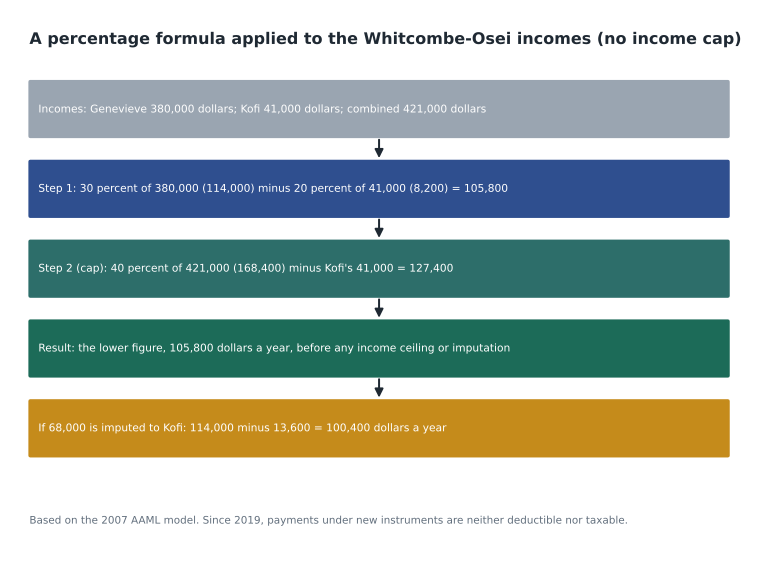
Applied to the Whitcombe-Osei incomes without any income cap, the AAML formula would produce annual support of 30 percent of 380,000 dollars, or 114,000, minus 20 percent of 41,000, or 8,200, for a total of 105,800 dollars. The cap would be 40 percent of 421,000 dollars, or 168,400, minus Kofi's 41,000, equal to 127,400. The lower figure, 105,800 dollars a year, would control. Many real guideline systems would reduce that sharply, because they apply only up to a combined income ceiling and leave higher incomes to the court's discretion, and because they would impute income to Kofi at his full-time earning capacity if the court found his part-time work voluntary. That last question, whether Kofi should be treated as able to earn 68,000 dollars, is likely to be the center of the dispute.
Duration
Legislatures have increasingly limited the duration of support. Massachusetts's Alimony Reform Act of 2011 is the leading example. It divides alimony into general term, rehabilitative, reimbursement and transitional forms and limits general term alimony by the length of the marriage: no more than 50 percent of the number of months of the marriage for marriages of five years or less, 60 percent for marriages of five to ten years, 70 percent for ten to fifteen years and 80 percent for fifteen to twenty years. For marriages longer than twenty years, the court may order alimony for an indefinite length of time. General term alimony ends when the payor reaches full retirement age under Social Security, unless the court finds good reason to extend it, and it may be suspended, reduced or terminated if the recipient cohabits with another person for at least three months. Under those rules, a marriage of twelve years and eleven months, like the Whitcombe-Osei marriage measured to the filing date, would support general term alimony for no more than 70 percent of 155 months, about nine years.
Other states have followed. Florida eliminated permanent alimony in 2023, replacing it with bridge-the-gap, rehabilitative and durational alimony and limiting durational alimony by the length of the marriage; long marriages of twenty years or more support longer durational awards. Several other states have adopted durational guidelines or presumptions. The trend reflects both the compensation and rehabilitation rationales, which tie support to the losses and adjustments caused by the marriage, and political pressure from payors who argued that indefinite alimony after a short or medium marriage was unfair.
The ALI approach
The ALI Principles would replace alimony with compensatory payments for specific losses. A spouse who was the primary caretaker of children, or who cared for a sick or elderly relative of the other spouse, would receive payments compensating for the resulting loss in earning capacity. A spouse at the end of a long marriage would receive payments reflecting a share of the income disparity, increasing with the length of the marriage. The ALI proposed presumptive formulas tied to the income difference and the duration of the marriage or of child care. No state has adopted the Principles' alimony provisions as a whole, but they have influenced courts and legislatures, especially in emphasizing that support should depend on predictable factors rather than on the judge's view of the parties.
Under the ALI's approach, Kofi's case is strong. He was the primary caretaker of two children for six years and reduced his employment to do it, and he will remain the more involved parent if the children stay in Westmarch. His claim would not depend on need, which he can meet, but on compensation for the earning capacity he gave up.
Modification and termination
Periodic support is modifiable on a showing of a substantial and material change in circumstances not contemplated when the order was entered, unless the parties' agreement and state law make it nonmodifiable. Common changes include a significant drop or increase in the payor's income, the recipient's new employment, illness and retirement. Courts generally allow modification on good-faith retirement at a normal age, but not on a payor's voluntary reduction of income to avoid support, in which case income may be imputed. Remarriage of the recipient ends periodic alimony by statute in nearly every state, and death of either party ends it unless the agreement provides otherwise. Payors are often required to maintain life insurance to secure the obligation.
Cohabitation is the most litigated ground for modification. Many statutes now permit or require a court to reduce, suspend or terminate alimony when the recipient lives with another person in a relationship resembling marriage, sometimes defined by factors such as shared finances, joint residence and holding out as a couple. The rationale is that a recipient should not be able to avoid the remarriage rule by not remarrying. The cases are fact-intensive, and investigators are common.
Enforcement
Spousal support orders are enforceable by income withholding, contempt, money judgments and the other remedies available for child support, which Lesson 8 describes. They also receive protection in bankruptcy. A domestic support obligation, defined in section 101(14A) of the Bankruptcy Code to include alimony, maintenance and support owed to a spouse, former spouse or child, is not dischargeable under section 523(a)(5) and has first priority among unsecured claims under section 507(a)(1). Since the 2005 amendments, property settlement obligations owed to a spouse or former spouse are also nondischargeable in Chapter 7 under section 523(a)(15), though they may be dischargeable in a completed Chapter 13 plan. Labeling a payment as support or as property therefore still matters, and bankruptcy courts look to substance rather than labels.
Taxes
For decades, alimony was deductible by the payor and taxable to the recipient under former Internal Revenue Code sections 215 and 71, which allowed couples to shift income from a high-bracket payor to a low-bracket recipient and share the savings. The Tax Cuts and Jobs Act of 2017 repealed those rules for any divorce or separation instrument executed after December 31, 2018. Under current law, alimony paid under a post-2018 instrument is neither deductible by the payor nor included in the recipient's income. Instruments executed on or before that date keep the old treatment unless they are modified after 2018 and the modification both changes the payment terms and expressly states that the repeal applies. Because the Whitcombe-Osei divorce will be finalized after 2018, any alimony Genevieve pays would come from her after-tax income, which is one reason guideline formulas designed under the old tax rules have been revised in several states.
Worked problem
What would a court award without the agreement?
Assume the Whitcombe-Osei premarital agreement did not exist and Westmarch used UMDA-style factors with an advisory durational guideline similar to Massachusetts's. Genevieve earns about 380,000 dollars a year; Kofi earns 41,000 dollars part-time and could earn about 68,000 full-time. The marriage lasted almost thirteen years to the filing date. Assume the children will remain primarily with Kofi in Westmarch. Analyze Kofi's claim and Genevieve's best responses.
Show solution
- Threshold: Kofi can meet basic needs on his own income, so a pure need test is weak. But the standard of living during the marriage, his reduced career, and his role as primary caretaker support an award under most modern statutes.
- Imputation: Genevieve will argue Kofi can work full-time now that both children are in school. Kofi will respond that the part-time arrangement was a joint decision, that he remains the primary caretaker, and that full-time teaching jobs are not readily available midyear. Many courts would impute full-time income after a transition period rather than immediately.
- Amount: a formula like the AAML's produces about 105,800 dollars a year on actual incomes, or about 100,400 dollars if 68,000 is imputed. Courts using discretion in high-income cases often award less, focusing on reasonable needs measured by the marital standard of living rather than on a percentage of a large income.
- Duration: under a 70 percent durational rule, no more than about nine years. A rehabilitative or transitional award of a few years, followed by modification review, is another likely result.
- Taxes: payments would not be deductible to Genevieve or taxable to Kofi, which favors a lower nominal amount than under the pre-2019 rules.
- With the agreement: the waiver applies because the marriage lasted less than fifteen years, and under Westmarch's UPAA it is enforceable. Kofi's economic claims must be pursued through the property division and child support.
Daniel Reyes asks why anyone litigates alimony if the outcome is so uncertain. Marchbanks answers that the uncertainty is exactly why most cases settle. "Each side's lawyer can tell the client that the judge might do something terrible," she says. "Both are right. So they split the difference, and the settlement looks a lot like the formula."
Summary and key terms
- Alimony's rationale has shifted from the husband's duty to need, rehabilitation, compensation for lost earning capacity and partnership.
- Forms include temporary, rehabilitative, bridge-the-gap, reimbursement, durational, indefinite and lump sum support.
- UMDA section 308 requires need and inability to self-support, then weighs factors; most statutes count homemaking and career sacrifices.
- Formulas such as the AAML's (30 percent of payor income minus 20 percent of payee income, capped at 40 percent of combined income) are widely used for temporary support.
- Massachusetts (2011) and Florida (2023) limited duration by the length of the marriage; Florida eliminated permanent alimony.
- The ALI Principles would award compensatory payments for losses tied to child care and long marriages.
- Periodic support is modifiable for substantial change and usually ends on remarriage or death; cohabitation statutes are common.
- Support is nondischargeable in bankruptcy; since 2019 alimony under new instruments is neither deductible nor taxable.
Practice problems
Work each problem on paper first, then reveal the answer to check.
After a twenty-two-year marriage, a 58-year-old wife who has not worked outside the home since her twenties seeks alimony. Her husband earns 200,000 dollars. Under Massachusetts's Alimony Reform Act, what duration is available?
Show answer
Because the marriage exceeded twenty years, the court may order general term alimony for an indefinite length of time, subject to the presumption that it ends when the payor reaches full retirement age unless the court finds good reason to extend it.
A payor under a 2016 divorce decree pays 3,000 dollars a month in alimony. In 2025 the parties modify the amount to 2,500 dollars without mentioning taxes. Is the alimony still deductible?
Show answer
Yes. A post-2018 modification brings in the new rules only if it changes the payments and expressly states that the repeal of the deduction applies. This modification did not say so.
A payor quits a 150,000-dollar job and takes a 50,000-dollar job to reduce his alimony. How will a court likely respond to his modification petition?
Show answer
Deny it or impute income at his former earning capacity, because the reduction was voluntary and in bad faith. Good-faith changes, such as a layoff or normal retirement, are treated differently.
Lesson quiz · 5 questions
Score 60% or more to complete this lesson.
Create a free account to save your progress, take quizzes and earn a certificate.