
LAWU-303 · Lesson 4 of 12 · 23 min
Divorce
▶ Video coming soon A video version of this lesson is on the way.
The divorce petition in the Whitcombe-Osei file is four pages long. Genevieve Whitcombe filed it in the Merrin County Superior Court on May 4, 2026, alleging that she and Kofi Osei had lived in Westmarch for more than ninety days, that they separated on March 14, 2026, and that the marriage is irretrievably broken. It asks the court to dissolve the marriage, enforce the premarital agreement, divide the remaining property, allocate parental responsibilities for Esme and Emmett, set child support and permit her to relocate with the children to Oregon. Kofi was served at home a week later by a process server. His response, filed by his lawyer within the thirty days Westmarch allows, admits the breakdown and contests almost everything else.
"Look at what nobody is fighting about," Professor Marchbanks says. "Whether they get divorced. Fifty years ago that would have been the whole case. Today it is the one thing that is certain." This lesson traces how American divorce moved from fault to no-fault, what role fault still plays, how a divorce case proceeds, and when a court has power to grant a divorce and to decide the financial and custody questions that come with it.
Fault divorce
Divorce in colonial and early America was rare. Some colonies granted divorces by legislative act; others allowed courts to grant them only for specified wrongs. By the twentieth century every state had a judicial divorce statute, but nearly all required proof of fault. The common grounds were adultery, cruelty, desertion, habitual drunkenness, imprisonment for a felony and, in some states, insanity. The innocent spouse had to prove that the other spouse had committed one of these wrongs, and the guilty spouse could not obtain a divorce at all.
Fault divorce came with defenses designed to keep marriages intact. Recrimination barred a divorce if the plaintiff had also committed a marital wrong, so that two adulterous spouses could not divorce each other. Condonation barred a divorce for misconduct the plaintiff had forgiven, usually shown by resuming cohabitation. Connivance barred relief to a spouse who had consented to or encouraged the misconduct, and collusion barred a divorce obtained by the spouses' agreement to fabricate or suppress evidence. Provocation could defeat a claim of cruelty or desertion.
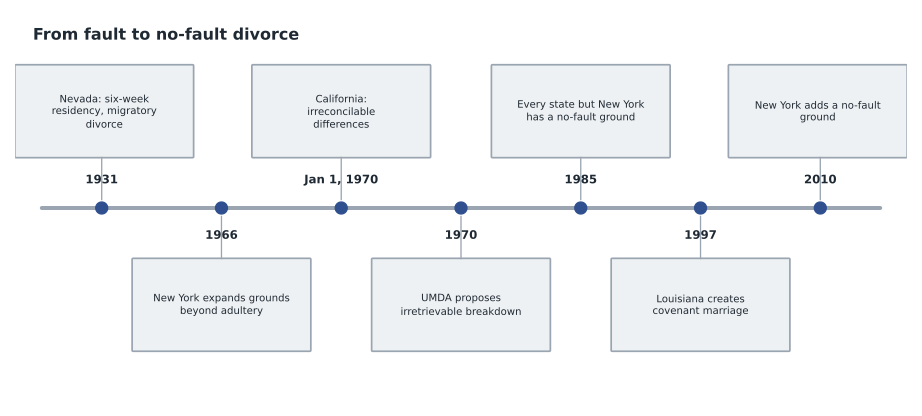
In practice the system bent under pressure. Couples who both wanted out staged adultery for photographers, testified to cruelty that never happened, or traveled to states with short residency requirements. Nevada reduced its residency period to six weeks in 1931 and became the destination for migratory divorce. New York, which allowed divorce only for adultery until 1966, was notorious for perjured testimony. By the 1960s, lawyers, judges and reformers agreed that fault divorce produced dishonesty without saving marriages.
The no-fault revolution
California's Family Law Act of 1969, effective January 1, 1970, replaced fault grounds with two grounds for dissolution: irreconcilable differences that have caused the irremediable breakdown of the marriage, and incurable insanity. It also replaced the word divorce with dissolution and abolished fault-based defenses. The same year, the Uniform Law Commission approved the Uniform Marriage and Divorce Act (UMDA), which allowed dissolution if the court found the marriage irretrievably broken, as shown by living separate and apart for 180 days or by serious marital discord adversely affecting the attitude of one or both parties toward the marriage.
Within fifteen years nearly every state had added a no-fault ground. New York was the last. Its 2010 amendment to Domestic Relations Law section 170 added a ground that the relationship has broken down irretrievably for at least six months, sworn to under oath by one party, with the divorce granted only after economic issues and custody are resolved. Today every state permits divorce without proof of fault.
States take two approaches. About a third, including California, Colorado and Florida, are pure no-fault states that have eliminated fault grounds entirely. The rest keep fault grounds alongside no-fault grounds, often because fault can affect alimony or property, or because a fault ground allows a faster divorce than the no-fault ground's separation period. North Carolina, for example, requires one year of separation for its no-fault ground, while Virginia requires one year, or six months if there are no minor children and the parties have a separation agreement. Westmarch's invented code grants divorce on irretrievable breakdown, proved by the testimony of either spouse, with a sixty-day waiting period after service, and also keeps adultery, cruelty and desertion as grounds that may be pleaded when relevant to alimony.
Under modern no-fault statutes, one spouse's insistence that the marriage is over is usually enough. Courts rarely deny a divorce when one spouse testifies that the marriage has broken down, even if the other wants to reconcile. A spouse who opposes the divorce can delay it by contesting the separation date or seeking counseling, and some statutes allow a court to continue the case for a period of reconciliation, but cannot prevent it.
Does fault still matter?
Fault has not disappeared. Its role depends on the state and on the issue. In most states, marital misconduct is irrelevant to property division, but some states allow courts to consider fault in dividing property, and nearly all consider economic fault, also called dissipation or waste: spending marital assets on an affair, gambling or other purposes unrelated to the marriage after it began to break down. A spouse who dissipates assets is usually charged with them in the division.
Fault matters more often in alimony. In some states, a dependent spouse's adultery bars or limits alimony. North Carolina, for example, bars alimony to a dependent spouse who committed illicit sexual behavior during the marriage and before separation, unless the supporting spouse also did so, and requires alimony when the supporting spouse committed it. Georgia bars alimony to a spouse whose adultery or desertion caused the separation. Other states treat misconduct as one factor among many. Pure no-fault states usually exclude it, although domestic violence is increasingly relevant to support and is central to custody, as Lessons 7 and 10 explain.
Fault also survives in tort. Some states allow claims for intentional infliction of emotional distress or assault between spouses, and a handful, including North Carolina, Mississippi, Hawaii, New Mexico, South Dakota and Utah, still recognize the heart balm torts of alienation of affections or criminal conversation, which permit a spouse to sue a third party who interfered with the marriage. North Carolina juries have returned substantial verdicts in such cases. Most states abolished those torts decades ago.
Covenant marriage
In reaction to no-fault divorce, three states created an optional form of marriage designed to be harder to exit. Louisiana enacted covenant marriage in 1997, Arizona in 1998 and Arkansas in 2001. Couples who choose it must receive premarital counseling and agree that divorce will be available only for specified fault grounds, such as adultery, a felony conviction, abandonment or abuse, or after a long period of separation, typically two years. Very few couples choose covenant marriage, and the main legal question it raises, whether other states will honor its restrictions when a covenant spouse files for divorce elsewhere, has no settled answer. Most commentators expect a forum state to apply its own divorce grounds.
Jurisdiction to divorce
Divorce changes status, and status is treated as a kind of res located wherever either spouse is domiciled. In Williams v. North Carolina, 317 U.S. 287 (1942) (Williams I), two North Carolina residents went to Nevada, lived there for six weeks, obtained divorces from their spouses who were not served in Nevada and did not appear, married each other and returned home. North Carolina prosecuted them for bigamous cohabitation. The Supreme Court held that a divorce granted by a state where one spouse is domiciled is entitled to full faith and credit in every other state, even though the other spouse did not appear. In Williams v. North Carolina, 325 U.S. 226 (1945) (Williams II), however, the Court held that North Carolina could relitigate whether the couple had actually been domiciled in Nevada, because the absent spouses had not had a chance to contest it, and the convictions were upheld.
When both spouses participate, the answer is different. In Sherrer v. Sherrer, 334 U.S. 343 (1948), the Court held that a spouse who appeared in the divorce proceeding and had the opportunity to contest jurisdiction cannot later collaterally attack the decree on the ground that the other spouse was not domiciled in the divorcing state. Third parties are generally bound as well.
States may impose residency requirements before granting a divorce. In Sosna v. Iowa, 419 U.S. 393 (1975), the Court upheld Iowa's one-year residency requirement against a challenge based on the right to travel, reasoning that the state had legitimate interests in avoiding intrusion into matters of concern to other states and in insulating its decrees from collateral attack. Residency periods today range from none in a few states to six months or a year in many. Westmarch requires ninety days.
Divisible divorce
Jurisdiction over status is not jurisdiction over money. The Supreme Court developed the doctrine of divisible divorce to separate the two. In Estin v. Estin, 334 U.S. 541 (1948), a wife obtained a New York separation decree awarding her support. The husband then obtained an ex parte Nevada divorce. The Court held that New York must recognize the Nevada divorce as dissolving the marriage, but the Nevada court, lacking personal jurisdiction over the wife, could not extinguish her New York support judgment. In Vanderbilt v. Vanderbilt, 354 U.S. 416 (1957), the Court extended the principle, holding that an ex parte divorce does not cut off a spouse's right to seek support even if no support order existed before the divorce, because a court without personal jurisdiction over the absent spouse cannot terminate her rights.
The result is that an ex parte divorce is effective to end the marriage but cannot decide alimony, child support or the division of property outside the forum. Those require personal jurisdiction over the respondent under the minimum contacts standard. In Kulko v. Superior Court, 436 U.S. 84 (1978), a father living in New York allowed his daughter, and later his son, to live with their mother in California. When the mother sued in California for custody and increased child support, the Court held that California lacked personal jurisdiction over the father: acquiescing in a child's wish to live with the other parent was not purposeful availment of California. Custody jurisdiction, by contrast, is governed by the UCCJEA rather than minimum contacts, as Lesson 11 explains, and property located in the forum can be divided under in rem jurisdiction. Child support jurisdiction is governed by the long-arm provisions of UIFSA, which codify the bases the Court would accept.
In the Whitcombe-Osei file, jurisdiction is easy. Both spouses live in Westmarch, Kofi was served there, and the children have always lived there. The Merrin County Superior Court can dissolve the marriage, divide all the property, award support and decide custody. Jurisdiction will become a live issue only if Genevieve moves to Oregon before the case is finished, which is why her lawyer has advised her not to move the children without an order.
How a divorce case proceeds
A divorce begins with a petition or complaint, served on the other spouse, who files a response. Many states impose automatic temporary restraining orders when the petition is filed, forbidding both spouses from transferring or concealing marital property, changing insurance beneficiaries or removing the children from the state without consent or a court order. California's are among the best known, and Westmarch's invented code includes similar provisions. Either spouse may then ask for temporary orders, called pendente lite orders, for support, use of the house, custody and attorney's fees while the case is pending.
Financial disclosure is mandatory in most states. Each spouse files a sworn financial statement listing income, expenses, assets and debts, often with supporting documents. Formal discovery follows if needed: interrogatories, document requests, depositions and subpoenas to banks and employers. Valuations of businesses, pensions and real estate require experts. Courts appoint guardians ad litem or custody evaluators when parenting is disputed.
Most divorces settle. Courts require or encourage mediation, especially on parenting issues, though many states exempt cases involving domestic violence or allow a screening process. Collaborative law, in which both spouses and their lawyers agree to negotiate in good faith and the lawyers agree to withdraw if the case goes to court, is authorized by statute in many states, some of which adopted the Uniform Collaborative Law Act. Arbitration of property and support issues is permitted in many states; arbitration of custody is more limited. A negotiated settlement is written into a marital settlement agreement, which the court reviews and either incorporates into the decree, leaving it enforceable as a contract, or merges into the decree, making it enforceable as a judgment. Support terms remain modifiable unless the agreement and law permit otherwise, while property terms are generally final.
A growing share of divorces involve at least one self-represented party. Courts have responded with simplified forms, self-help centers and, in some states, summary dissolution procedures for short marriages without children or significant property. Marchbanks tells the class that in her years as a magistrate, more than half the parties who appeared before her had no lawyer. "Whatever else you do in practice," she says, "remember that the system you are learning works for people who cannot afford you."
Legal separation and foreign divorces
Most states also allow legal separation, sometimes called divorce from bed and board, which permits the court to divide property, award support and decide custody without dissolving the marriage. Couples choose it for religious reasons, to preserve health insurance or other benefits, or because they are not ready to divorce. Divorces granted in other countries are not entitled to full faith and credit, but American courts recognize them as a matter of comity when at least one spouse was domiciled in the foreign country and the other had notice and an opportunity to be heard. So-called mail-order or quickie foreign divorces, obtained without either spouse's domicile in the foreign country, are generally not recognized, though a spouse who participated in obtaining one may be estopped from attacking it.
Worked problem
Fault, timing and jurisdiction in the Whitcombe-Osei divorce
Kofi's first lawyer considered pleading adultery, because Genevieve began a relationship with a dentist she met at a conference in April 2026, a month after the separation. Westmarch permits fault to be considered in alimony only if the misconduct occurred before separation. Kofi also asks whether he could stop the divorce from being final until the custody issues are resolved, and what happens if Genevieve moves to Oregon in January 2027 before the case is tried.
Show solution
- Grounds: Genevieve's testimony that the marriage is irretrievably broken is sufficient. Kofi cannot prevent the divorce by refusing to agree.
- Adultery: the relationship began after the separation, so under Westmarch's invented rule it is irrelevant to alimony. In a state like North Carolina, post-separation conduct may be admissible to corroborate earlier misconduct, but standing alone it does not bar support. Pleading it would raise costs and tensions without legal benefit.
- Timing: the court can grant the divorce after the sixty-day waiting period, but most courts decide all issues in a single judgment. Kofi can ask the court not to bifurcate status from custody and property, which courts generally avoid absent good reason.
- Jurisdiction after a move: the Westmarch court acquired personal jurisdiction over both spouses when the case began and keeps it. Under the UCCJEA, Westmarch is the children's home state and will retain exclusive, continuing jurisdiction over custody so long as Kofi remains there. Genevieve's move does not change the forum.
- Conclusion: the divorce will be granted; the fights are about money, the agreement, custody and relocation.
Summary and key terms
- Fault divorce required proof of a marital wrong and allowed defenses such as recrimination, condonation, connivance and collusion.
- California's 1969 Family Law Act and the UMDA launched no-fault divorce; New York became the last state to add a no-fault ground in 2010.
- Today every state allows divorce without fault; about a third have eliminated fault grounds entirely.
- Fault still matters for alimony in some states, dissipation in nearly all, heart balm torts in a few, and custody where conduct affects children.
- Louisiana, Arizona and Arkansas offer covenant marriage.
- A divorce based on one spouse's domicile is entitled to full faith and credit (Williams I), but domicile may be relitigated by an absent spouse (Williams II) and not by one who appeared (Sherrer).
- Residency requirements are constitutional (Sosna).
- Support and property outside the forum require personal jurisdiction (Estin, Vanderbilt, Kulko).
Practice problems
Work each problem on paper first, then reveal the answer to check.
A husband moves from Ohio to Nevada, lives there for six weeks and obtains a divorce. His wife, who stayed in Ohio, was served by mail and did not appear. Is the divorce valid in Ohio?
Show answer
Presumptively yes under Williams I, if the husband was domiciled in Nevada. But because the wife did not appear, Ohio may relitigate whether he truly became a Nevada domiciliary under Williams II. Even if the divorce is valid, it cannot cut off her right to support (Estin, Vanderbilt).
In a state that keeps fault grounds, a wife sues for divorce on the ground of her husband's adultery. He proves that she resumed living with him for a year after learning of it. What defense does he have?
Show answer
Condonation, if the state still recognizes it: by resuming cohabitation with knowledge of the misconduct, she forgave it. She can still seek a no-fault divorce.
A mother in California sues a father in New York for child support. The father's only connection to California is that he agreed to let the child live there with the mother. Does California have personal jurisdiction over him?
Show answer
No, under Kulko v. Superior Court. Agreeing to a child's residence with the other parent is not purposeful availment of the state. The mother can seek support through UIFSA in New York or by establishing another basis for jurisdiction.
Lesson quiz · 5 questions
Score 60% or more to complete this lesson.
Create a free account to save your progress, take quizzes and earn a certificate.