
LAWU-303 · Lesson 11 of 12 · 25 min
Interstate and international family cases
▶ Video coming soon A video version of this lesson is on the way.
"Families move," Professor Marchbanks says, "and when they move, two courts may each think they have the right to decide where a child lives. Before the uniform acts, the parent who lost in one state could drive to another and start over. Some did, with the children in the back seat." She puts two variations of the Whitcombe-Osei file on the screen. In the first, Kofi took Esme and Emmett to his sister's house in Raleigh, North Carolina, in March 2026, right after the separation, enrolled them in school there and filed for custody in North Carolina in July, while Genevieve stayed in Brennan Falls. In the second, which takes place after a decree, Genevieve moves to Portland with the children under a court order and, two years later, asks an Oregon court to change the parenting schedule. In both, the question is which state's court may decide.
The second half of the class turns to an international file, a composite with all details changed. Sanne Vos, a Dutch citizen, and Dario Calvetti, an American, married in 2017 and lived in Brennan Falls until 2023, when they moved to Utrecht so that Sanne could take a university research post. Their daughter Lotte was born in Westmarch in 2020 and has lived in Utrecht since she was three. In September 2026, during a visit to his parents in Westmarch, Dario told Sanne that he and Lotte would not be returning. Sanne has filed a petition in federal court in Westmarch under the Hague Abduction Convention. This lesson covers the UCCJEA and the federal Parental Kidnapping Prevention Act, the interstate support rules already introduced in Lesson 8, and the Hague Convention as interpreted by the Supreme Court.
From the UCCJA to the UCCJEA
For most of the twentieth century, a state could take jurisdiction over custody whenever a child was physically present, and custody orders were treated as modifiable and therefore not entitled to full faith and credit. Parents who lost in one state could take the child to another and relitigate. The Uniform Child Custody Jurisdiction Act of 1968 (UCCJA) tried to stop this by establishing jurisdictional bases, including the child's home state and a significant connection test, but its alternative bases allowed concurrent jurisdiction and conflicting orders. Congress responded with the Parental Kidnapping Prevention Act of 1980 (PKPA), 28 U.S.C. section 1738A, which requires states to give full faith and credit to custody determinations made consistently with its provisions, gives priority to the home state and preserves the issuing state's continuing jurisdiction. In Thompson v. Thompson, 484 U.S. 174 (1988), the Supreme Court held that the PKPA does not create an implied federal cause of action to decide which of two conflicting state custody orders is valid; the remedy lies in state courts, with review by the Supreme Court.
The Uniform Child Custody Jurisdiction and Enforcement Act of 1997 (UCCJEA) harmonized state law with the PKPA. It has been adopted in forty-nine states, the District of Columbia and the territories. Massachusetts is the exception; it still applies its own Massachusetts Child Custody Jurisdiction Act, based on the older UCCJA. Its Senate unanimously passed a UCCJEA bill in July 2025, which was referred to a House committee. The UCCJEA applies to child custody proceedings broadly, including divorce, separation, neglect, guardianship, paternity, termination of parental rights and protection orders, but not to adoption or to emergency medical care, and not to child support, which is governed by UIFSA.
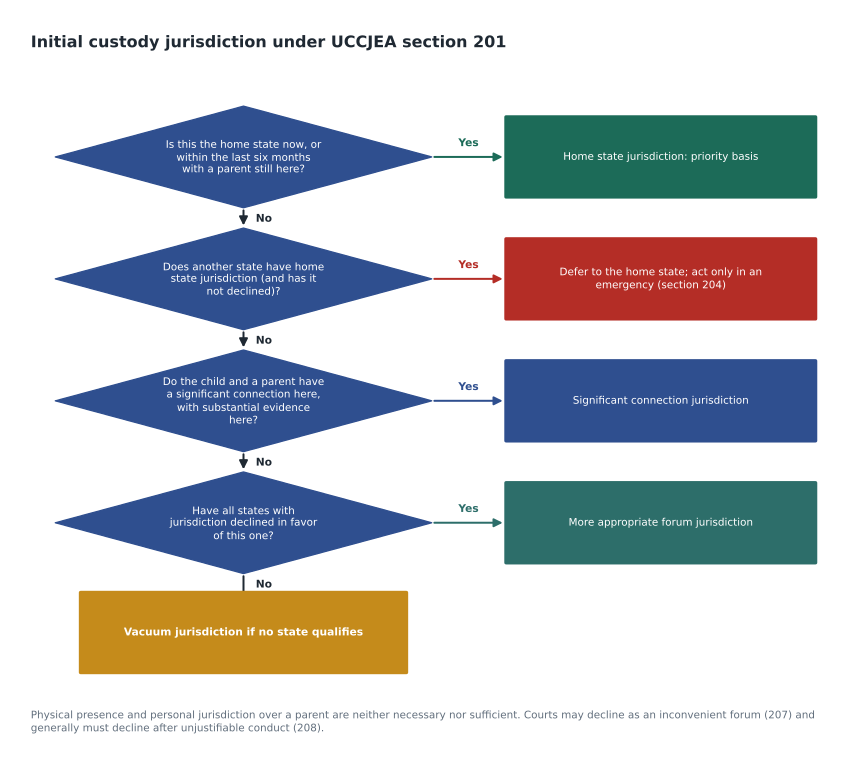
Initial jurisdiction
Section 201 of the UCCJEA makes home state jurisdiction the priority basis. A child's home state is the state in which the child lived with a parent or a person acting as a parent for at least six consecutive months immediately before the custody proceeding began, or, for a child under six months old, since birth. Temporary absences count as part of the period. A state also has home state jurisdiction if it was the child's home state within six months before the proceeding began, the child is absent, and a parent or person acting as a parent continues to live in the state. This extended home state rule is what prevents a parent from moving a child and immediately filing in the new state.
Only if no state has home state jurisdiction, or the home state declines to exercise it, may a court take jurisdiction based on a significant connection: the child and at least one parent have a significant connection with the state other than mere physical presence, and substantial evidence about the child's care, protection, training and personal relationships is available there. If every state with jurisdiction under those bases has declined in favor of another forum, that more appropriate forum may act, and if no state qualifies at all, a state may assume jurisdiction under the vacuum basis. Physical presence of the child, or personal jurisdiction over a parent, is neither necessary nor sufficient. All persons entitled to notice must receive it, along with an opportunity to be heard, but minimum contacts are not required, because custody is treated as a status determination.
In the first Whitcombe-Osei variation, North Carolina does not have home state jurisdiction in July 2026, because the children had lived there only four months. Westmarch does: it was the children's home state within six months before the North Carolina proceeding began, and Genevieve still lives there. Because Westmarch has home state jurisdiction, North Carolina lacks significant connection jurisdiction. Under section 206, if Genevieve files in Westmarch, the North Carolina court must stay its proceeding and communicate with the Westmarch court, and must defer to it. North Carolina could act only under section 204's temporary emergency jurisdiction if the children were in danger, and any emergency order would last only until the Westmarch court acts.
Exclusive, continuing jurisdiction
Once a state makes a custody determination consistent with the act, section 202 gives it exclusive, continuing jurisdiction over the determination until either a court of that state determines that neither the child, nor the child and one parent, has a significant connection with the state and substantial evidence is no longer available there, or a court of any state determines that the child, the child's parents and any person acting as a parent no longer reside in the issuing state. Section 203 permits another state to modify the order only if it would have initial jurisdiction and either the issuing state has determined it no longer has exclusive, continuing jurisdiction or that the other state would be a more convenient forum, or a court determines that the child and both parents no longer reside in the issuing state.
In the second Whitcombe-Osei variation, Westmarch issued the decree. Two years after Genevieve and the children move to Portland, Oregon is the children's home state, but Kofi still lives in Westmarch. Westmarch retains exclusive, continuing jurisdiction unless it decides that the children no longer have a significant connection with Westmarch, which is unlikely while they spend summers with their father there, or that Oregon is a more convenient forum. Oregon may not modify the decree on its own. Genevieve must ask the Westmarch court either to modify the schedule or to decline jurisdiction in Oregon's favor.
Declining jurisdiction
A court with jurisdiction may decline it. Under section 207, a court may decline if it finds that it is an inconvenient forum and a court of another state is more appropriate, considering factors such as whether domestic violence has occurred and which state could best protect the parties and the child, the length of time the child has resided outside the state, the distance between the courts, the parties' relative financial circumstances, any agreement on forum, the nature and location of evidence, each court's ability to decide promptly and the familiarity of each court with the facts. Under section 208, a court must generally decline jurisdiction if the person invoking it has engaged in unjustifiable conduct, such as wrongfully removing or concealing the child, unless the other parties acquiesce or no other state would have jurisdiction. If Kofi had been in North Carolina long enough to make it the home state, a court could still decline because he created that jurisdiction by taking the children without agreement.
Enforcement
The UCCJEA's second half provides tools for enforcing custody orders across state lines. A party may register an out-of-state custody determination in another state, which must recognize and enforce it if the issuing court had jurisdiction under the act. A petition for expedited enforcement must be heard promptly, often the next judicial day after service, and the court must order the petitioner to take immediate physical custody unless the respondent proves a narrow defense, such as that the issuing court lacked jurisdiction or the order was vacated. If the child is likely to suffer serious harm or be removed from the state, the court may issue a warrant to take physical custody of the child. Prosecutors and other public officials may be authorized to locate children and enforce orders. The UCCJEA also treats a foreign country as a state for jurisdiction and enforcement purposes, so long as the foreign custody law does not violate fundamental principles of human rights.
Interstate support, revisited
Lesson 8 introduced UIFSA's one-order system. The jurisdictional rules for support differ from those for custody in one essential way: support orders require personal jurisdiction over the obligor, because they impose a money obligation. UIFSA's long-arm provision codifies the bases for personal jurisdiction over a nonresident, including personal service in the state, consent, residence with the child in the state, residence in the state and payment of prenatal expenses or support, the child's residence in the state as a result of the obligor's acts or directives, and sexual intercourse in the state that may have resulted in the child's conception, along with any other basis consistent with the Constitution. Kulko v. Superior Court (1978) shows the limits. A family case that crosses state lines can therefore involve one forum for custody under the UCCJEA and a different forum for support under UIFSA. The 2008 version of UIFSA also implements the Hague Convention of 2007 on the International Recovery of Child Support, which entered into force for the United States on January 1, 2017, making support orders from other member countries enforceable through state IV-D agencies.
The Hague Abduction Convention
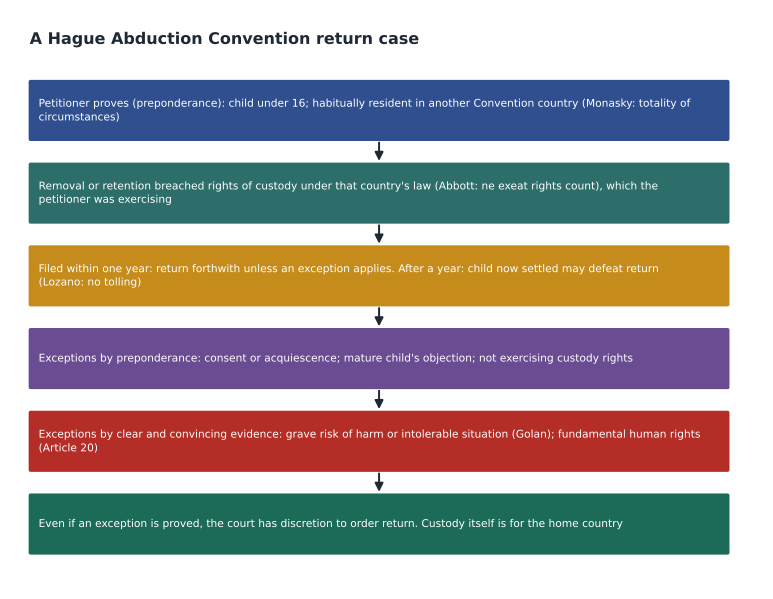
The Hague Convention on the Civil Aspects of International Child Abduction of 1980 is a treaty among more than one hundred countries. The United States implements it through the International Child Abduction Remedies Act (ICARA), now codified at 22 U.S.C. sections 9001 to 9011, which gives state and federal courts concurrent jurisdiction over return petitions. The Convention applies to children under sixteen. Its central principle is that a child wrongfully removed from, or retained outside, the country of habitual residence must be promptly returned there, so that the courts of that country can decide custody. A Hague court does not decide custody; it decides where custody should be decided.
A removal or retention is wrongful under Article 3 if it breaches rights of custody under the law of the country where the child was habitually resident immediately before the removal or retention, and those rights were actually being exercised or would have been but for the removal. The petitioner must prove these elements by a preponderance of the evidence. If the petition is filed within one year of the wrongful removal or retention, Article 12 requires the court to order the child's return forthwith, subject to the exceptions.
The Supreme Court's Hague decisions
The Supreme Court has decided several cases interpreting the Convention. In Abbott v. Abbott, 560 U.S. 1 (2010), a father had a ne exeat right under Chilean law, the right to consent before the child left the country, but no other custody rights. The Court held that a ne exeat right is a right of custody under the Convention, because it gives the parent a right to determine the child's place of residence, so the mother's removal of the child to Texas without consent was wrongful.
In Chafin v. Chafin, 568 U.S. 165 (2013), the Court held that an appeal from a return order does not become moot when the child has been returned to the foreign country, because the appellate court can still grant effective relief by ordering re-return. In Lozano v. Montoya Alvarez, 572 U.S. 1 (2014), it held that the one-year period in Article 12 is not subject to equitable tolling, even when the abducting parent concealed the child; after a year, a court may decline return if the child is now settled in the new environment, although it retains discretion to order return.
In Monasky v. Taglieri, 589 U.S. 68 (2020), the Court addressed habitual residence. An American mother and Italian father lived in Italy, where their daughter was born; when the child was eight weeks old, the mother took her to Ohio. The mother argued that an infant could have no habitual residence without the parents' actual agreement on where to raise her. The Court unanimously rejected an actual agreement requirement, holding that habitual residence depends on the totality of the circumstances specific to the case, focusing on where the child is at home, and that a trial court's determination is reviewed only for clear error. For an infant, the parents' intentions and circumstances are especially relevant.
In Golan v. Saada, 596 U.S. 666 (2022), the Court addressed the grave risk exception of Article 13(b), which allows a court to refuse return if there is a grave risk that return would expose the child to physical or psychological harm or otherwise place the child in an intolerable situation. The district court had found that the father's abuse of the mother in Italy posed a grave risk to the child but, following Second Circuit precedent, ordered return with protective measures. The Supreme Court, unanimously and in an opinion by Justice Sotomayor, held that a court is not required to examine every possible ameliorative measure before denying return once it finds a grave risk. A court may consider such measures, but it may decline to consider measures that the parties have not raised, that are unworkable, that would draw it into custody matters reserved to the courts of the habitual residence, or that would unduly prolong proceedings, and it must keep in mind that the child's safety is a primary concern of the Convention.
Exceptions
ICARA allocates burdens of proof. The respondent must prove the grave risk exception and the Article 20 exception, which permits refusal if return would not be permitted by the fundamental principles of the requested state relating to human rights, by clear and convincing evidence. The respondent must prove the other exceptions by a preponderance: that the petition was filed more than a year after the removal and the child is now settled; that the petitioner was not exercising custody rights or consented to or later acquiesced in the removal or retention; or that the child objects to being returned and has attained an age and degree of maturity at which it is appropriate to take account of the child's views. Courts construe the exceptions narrowly and retain discretion to order return even when an exception is established.
Other tools
The Convention does not apply to removals to or from countries that are not parties, or between the United States and countries with which it has not accepted accession. Other tools then become important: the UCCJEA's enforcement provisions for foreign orders, criminal statutes such as the International Parental Kidnapping Crime Act, 18 U.S.C. section 1204, and state custodial interference laws. Prevention matters too. Federal passport regulations require both parents' consent, or a court order, for issuing a passport to a child under sixteen. Courts in custody cases may order a parent to surrender passports, post a bond or obtain an order mirroring the custody terms in the other country before international travel. The Uniform Child Abduction Prevention Act, adopted in a number of states, lists risk factors and preventive measures a court may order.
Worked problem
Analyzing Sanne's Hague petition
Sanne Vos has petitioned for Lotte's return to the Netherlands. Lotte, now six, lived in Brennan Falls until she was three and has lived in Utrecht since 2023, attending school there. Dario argues that the family always intended to return to the United States, that Lotte is an American citizen born in Westmarch, and that Lotte told a court interviewer she likes living near her grandparents in Brennan Falls. Under Dutch law, married parents share parental authority. The petition was filed in October 2026, a month after the retention began.
Show solution
- Age: Lotte is under sixteen.
- Habitual residence: under Monasky, the totality of the circumstances decides, focusing on where the child is at home. Three years in Utrecht, schooling there, a parent's job and the family's daily life point strongly to the Netherlands. Citizenship and a general intent to return someday are relevant but do not outweigh where Lotte actually lived. The Netherlands is likely her habitual residence.
- Rights of custody: shared parental authority under Dutch law gives Sanne rights of custody, which she was exercising. Dario's retention after the visit breached them.
- Timing: filed within a year, so return must be ordered unless an exception is proven.
- Exceptions: no grave risk is alleged. Dario cannot show consent or acquiescence to a permanent stay; agreeing to a visit is not consent to retention. A six-year-old's statement that she likes her grandparents' home is unlikely to be a mature objection to return.
- Result: return to the Netherlands should be ordered promptly. Custody, including whether Lotte should move to the United States, is for the Dutch courts. If Dario appeals after Lotte returns, Chafin holds the appeal is not moot.
Summary and key terms
- The UCCJA (1968) and PKPA (1980) tried to stop forum shopping in custody; Thompson v. Thompson (1988) found no federal cause of action under the PKPA.
- The UCCJEA (1997), adopted everywhere except Massachusetts, gives priority to the home state, including for six months after the child leaves if a parent remains.
- Significant connection jurisdiction is available only if there is no home state or the home state declines.
- The issuing state keeps exclusive, continuing jurisdiction while the child or a parent remains connected; another state may modify only in limited circumstances.
- Courts may decline as an inconvenient forum and generally must decline when jurisdiction rests on unjustifiable conduct.
- Support requires personal jurisdiction; UIFSA's long-arm and one-order rules govern interstate support, and the 2007 Hague Child Support Convention entered into force for the United States on January 1, 2017.
- The Hague Abduction Convention requires prompt return of a wrongfully removed child under sixteen to the country of habitual residence, subject to narrow exceptions.
- Abbott (2010), Chafin (2013), Lozano (2014), Monasky (2020) and Golan (2022) define rights of custody, mootness, the one-year rule, habitual residence and the grave risk exception.
Practice problems
Work each problem on paper first, then reveal the answer to check.
A mother moves with her child from Texas to Arizona and files for custody in Arizona two months later. The father still lives in Texas. Which state has jurisdiction?
Show answer
Texas. It was the child's home state within six months before the proceeding began, and the father still lives there. Arizona has no home state jurisdiction and cannot take significant connection jurisdiction while Texas has home state jurisdiction.
A New York court entered a custody decree. The mother and child have lived in Florida for five years; the father still lives in New York and sees the child for a month each summer there. The mother asks a Florida court to modify the decree. May it?
Show answer
Not on its own. New York retains exclusive, continuing jurisdiction because the father still resides there and the child has a significant connection. Florida may modify only if New York determines it no longer has exclusive, continuing jurisdiction or that Florida is a more convenient forum.
A father wrongfully retains a child in the United States after a visit and hides the child. The mother files a Hague petition fourteen months later. Can the court refuse return because the child is settled, even though the delay was caused by concealment?
Show answer
Yes, it may. Lozano v. Montoya Alvarez holds the one-year period is not subject to equitable tolling. The court may still order return in its discretion, and concealment is relevant to whether the child is truly settled and to the exercise of discretion.
Lesson quiz · 5 questions
Score 60% or more to complete this lesson.
Create a free account to save your progress, take quizzes and earn a certificate.