
LAWU-303 · Lesson 3 of 12 · 24 min
Premarital and marital agreements
▶ Video coming soon A video version of this lesson is on the way.
The premarital agreement in the Whitcombe-Osei file is eleven pages long. Professor Marchbanks hands out copies with the signature page on top: Genevieve Whitcombe and Kofi Osei signed it on June 11, 2013, four days before their wedding, in the office of the Brennan Falls lawyer who drafted it for Genevieve. Kofi had no lawyer. A paragraph near the end recites that he was advised to consult independent counsel and chose not to. Attached is a financial disclosure schedule. Genevieve's lists 60,000 dollars in savings, a car, a small retirement account and 210,000 dollars of dental school loans. Kofi's lists a checking account, a guitar collection and his teachers' retirement contributions.
The agreement's core terms are typical. Each party keeps as separate property everything owned before the marriage and its income and appreciation. Any business either party starts during the marriage is that party's separate property if it is held in that party's name. Property titled jointly is divided equally. Each party waives spousal support, except that if the marriage lasts more than fifteen years, the lower-earning spouse receives support for half the length of the marriage. The agreement says nothing about children except a sentence recognizing that child support is governed by law. Genevieve started Clearpoint Pediatric Dentistry in 2016, in her own name, using a bank loan and 80,000 dollars from the couple's joint savings. If the agreement is enforced, the practice, by far the couple's most valuable asset, belongs to Genevieve alone, and Kofi receives no alimony because the marriage lasted less than fifteen years before the separation.
"Kofi's lawyer will attack this agreement," Marchbanks says. "Your job today is to learn how."
From suspicion to enforcement
For most of American history, courts refused to enforce agreements that contemplated divorce. An agreement that settled property rights on death was acceptable, because it did not undermine the marriage, but one that fixed the terms of a divorce was thought to encourage it and to interfere with the state's control of marital status. That view changed in Posner v. Posner, 233 So. 2d 381 (Fla. 1970), in which the Florida Supreme Court held that an antenuptial agreement providing for alimony on divorce was not void as against public policy, given that divorce had become common and that parties could rationally plan for it. Other states followed within two decades.
The modern approach treats premarital agreements largely as contracts, with protections reflecting the relationship. In Simeone v. Simeone, 581 A.2d 162 (Pa. 1990), a twenty-three-year-old nurse earning a modest salary signed an agreement with a thirty-nine-year-old neurosurgeon on the eve of their wedding, without independent counsel, limiting her to alimony pendente lite capped at 25,000 dollars. The Pennsylvania Supreme Court enforced it, rejecting older decisions that required courts to evaluate the reasonableness of the bargain. Women were no longer presumed to be the weaker party, the court said, and parties to a premarital agreement are bound by its terms just like parties to any other contract, provided there was full and fair disclosure and no fraud, misrepresentation or duress. The court refused to inquire whether the bargain was fair or whether the wife understood its terms.
Not every state goes as far as Pennsylvania. Many apply a two-part test asking whether the agreement was fair when signed and, in some states, whether enforcing it would be unconscionable in light of circumstances at the time of divorce. This second look doctrine, applied in states such as Connecticut and New Jersey in some form, allows a court to refuse enforcement of terms that have become oppressive because of unforeseen changes, such as a serious illness. Other states reject any second look as inconsistent with contract principles.
The Uniform Premarital Agreement Act
The Uniform Premarital Agreement Act of 1983 (UPAA) has been adopted, often with amendments, in more than half the states, including California, Texas and Westmarch in the course's invented code. It requires a premarital agreement to be in writing and signed by both parties, and it becomes effective on marriage. Section 3 allows the parties to contract about property rights, disposition on separation, divorce or death, spousal support, wills and life insurance, choice of law and any other matter not in violation of public policy or criminal law. The right of a child to support may not be adversely affected.
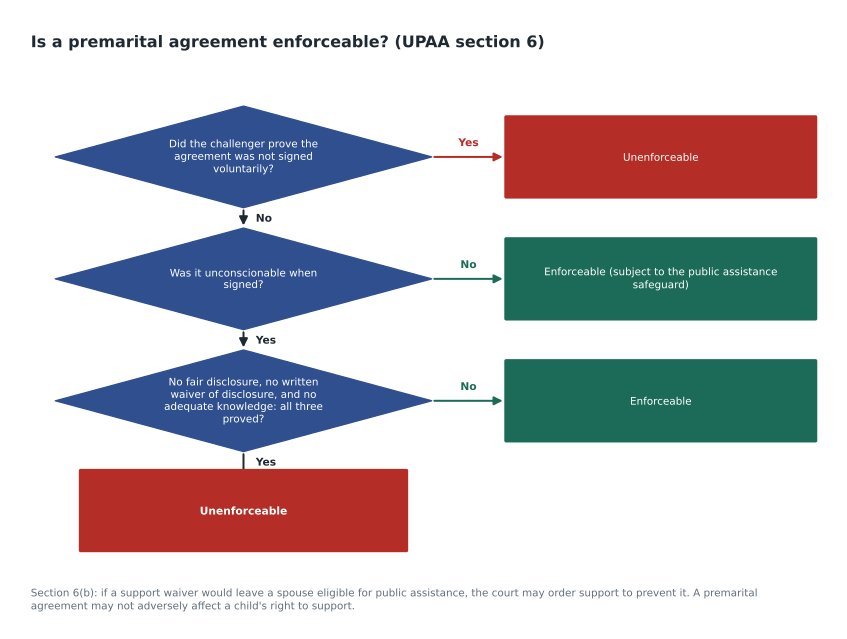
Section 6 is the heart of the act. A premarital agreement is not enforceable if the party against whom enforcement is sought proves either that he or she did not execute the agreement voluntarily, or that the agreement was unconscionable when it was executed and, before execution, that party was not provided a fair and reasonable disclosure of the other party's property and financial obligations, did not voluntarily and expressly waive in writing any right to disclosure beyond what was provided, and did not have, or reasonably could not have had, adequate knowledge of the other party's property and obligations. The burden is on the challenger. Unconscionability is decided by the court as a matter of law. Observe how demanding the second route is: unconscionability alone is not enough, and disclosure failures alone are not enough. The challenger must prove both, and all three disclosure elements.
Section 6(b) adds one public-policy safeguard: if a provision modifying or eliminating spousal support causes one party to be eligible for public assistance at the time of separation or divorce, a court may require the other party to provide support to the extent necessary to avoid that eligibility. Several states, including California, have gone further. California adopted the UPAA but has amended it more than once, and its version now says a spousal support waiver is unenforceable if the party against whom enforcement is sought was not represented by independent counsel when the agreement was signed, or if the waiver is unconscionable at the time of enforcement.
Voluntariness and the Bonds case
Most litigation focuses on voluntariness. Courts consider the timing of the presentation, whether the challenger had independent counsel, the parties' relative sophistication, the presence of pressure such as wedding invitations already sent or a pregnancy, and whether the challenger understood the terms. In In re Marriage of Bonds, 5 P.3d 815 (Cal. 2000), the baseball player Barry Bonds and Susann (Sun) Bonds signed a premarital agreement the day before they flew to Las Vegas to marry. She had immigrated from Sweden, had limited English, and was not represented, though she had been told she could consult a lawyer. The California Supreme Court held that the agreement was voluntarily executed: the absence of counsel was a factor but not dispositive, and the trial court's findings that she understood the agreement and was not coerced were supported by substantial evidence.
The California legislature responded the next year by amending Family Code section 1615 to define when an agreement is not voluntary. Unless the party was represented by independent counsel, or waived representation in a separate writing after being fully informed of the terms and basic effect of the agreement, the agreement is deemed involuntary. The party must also have had at least seven calendar days between first being presented with the final agreement and advised to seek counsel and the time of signing, and must not have signed under duress, fraud or undue influence. Other states impose no such waiting period, but the seven-day rule has become a common drafting practice nationwide.
Kofi's case on voluntariness has some force. He received the agreement shortly before the wedding, he had no lawyer, and the guests were already traveling. But Westmarch follows the UPAA without California's amendments, and courts in UPAA states have enforced agreements signed in similar circumstances when the challenger was an educated adult who had the agreement in hand for a few days and was told to consult a lawyer. Marcus Webb, the engineer, asks whether it matters that Kofi read the agreement. Marchbanks says it matters a great deal: a party who reads an agreement, asks questions and signs it cannot easily claim he did not understand it, and the recital that he declined counsel will be used against him.
Disclosure and unconscionability
Disclosure need not be exact, but it must be fair and reasonable. A summary of significant assets and debts with approximate values is usually enough; hiding a major asset or grossly undervaluing it is not. The UPAA's structure, however, means that even poor disclosure does not defeat an agreement unless the agreement was also unconscionable when signed. Unconscionability under the UPAA is measured at execution, not at divorce, and courts generally require terms so one-sided that no reasonable person would accept them and no fair person would offer them, often combined with procedural unfairness.
Genevieve's disclosure looks adequate: she listed her savings, her car, her retirement account and her debts. The agreement's terms, while favorable to her, include a support provision for a long marriage and an equal division of joint property. A court is unlikely to find it unconscionable when signed, when neither party owned a business and both had modest incomes. Kofi's stronger argument may be about interpretation. Clearpoint was started with 80,000 dollars from joint savings. The agreement makes the business Genevieve's separate property if held in her name, but does it give Kofi a claim to reimbursement of the marital contribution? Courts construe premarital agreements under ordinary contract principles, and ambiguities may be resolved against the drafter. Waivers of statutory rights to marital property must usually be clear.
Spousal support waivers
Spousal support waivers raise distinct concerns because they can leave a spouse without resources after a long marriage, and because the state has an interest in preventing dependence on public assistance. Courts once refused to enforce them at all. In In re Marriage of Pendleton and Fireman, 5 P.3d 839 (Cal. 2000), decided the same day as Bonds, the California Supreme Court held that a spousal support waiver in a premarital agreement between two sophisticated, represented parties was not per se unenforceable, leaving open whether enforcement might be refused when circumstances at divorce render it unjust. The UPAA permits support waivers subject to the public assistance safeguard. The American Law Institute's Principles of the Law of Family Dissolution (2002) would allow courts to refuse enforcement when there has been a substantial change, such as the birth of a child or the passage of many years, and enforcement would work a substantial injustice.
The fifteen-year threshold in the Whitcombe-Osei agreement is a common drafting device, sometimes called a sunset or step-up clause. Here, the marriage lasted twelve years and nine months before separation. Kofi will argue that his move to part-time work after the children were born, a choice the couple made together, is exactly the kind of change the parties did not anticipate in 2013. In a pure UPAA state, that argument has little traction unless the waiver would leave him eligible for public assistance, which on these facts it would not; he earns a teacher's salary. In a second look state, it might succeed.
The Uniform Premarital and Marital Agreements Act
In 2012 the Uniform Law Commission approved a successor act, the Uniform Premarital and Marital Agreements Act (UPMAA), which applies the same standards to agreements signed before and during marriage. It has been adopted by only a few states, including Colorado and North Dakota. It is more protective of the less advantaged party in three ways. It requires that a party have access to independent legal representation, meaning reasonable time to decide whether to retain a lawyer and to locate, obtain advice from and consider that advice, plus the financial ability to retain a lawyer or an agreement by the other party to pay. If a party is not represented, the agreement must include a plain-language notice of waiver of rights or an explanation of the rights being modified. And it requires reasonably accurate disclosure of assets, liabilities and income, unless waived. An agreement is unenforceable if any of these requirements is not met, or if it was unconscionable when signed, or, under an optional provision, if enforcement would result in substantial hardship because of a material change in circumstances not anticipated when the agreement was signed. Under the UPMAA, Kofi's lack of counsel and of a plain-language waiver notice would likely defeat the agreement.
Marital agreements
A marital or postnuptial agreement is made during the marriage, often when the couple is reconciling after a separation or when one spouse is receiving an inheritance or starting a business. Courts disagree about how to treat them. Some apply the same standards as premarital agreements. Others apply heightened scrutiny, reasoning that spouses owe each other fiduciary duties and that a spouse already in a marriage has less freedom to walk away than an engaged person. In Ansin v. Craven-Ansin, 929 N.E.2d 955 (Mass. 2010), the Massachusetts Supreme Judicial Court held that marital agreements are enforceable but must be carefully scrutinized: each party must have had the opportunity to obtain independent counsel, there must have been no fraud or coercion, all material assets must have been fully disclosed, each spouse must have knowingly and explicitly agreed in writing to waive the right to a judicial division of assets, and the terms must have been fair and reasonable at execution and conscionable at divorce. In Bedrick v. Bedrick, 17 A.3d 17 (Conn. 2011), the Connecticut Supreme Court applied a similar standard and refused to enforce a postnuptial agreement that had become unconscionable in light of the parties' changed circumstances over many years. In Pacelli v. Pacelli, 725 A.2d 56 (N.J. Super. Ct. App. Div. 1999), a New Jersey appellate court refused to enforce a midmarriage agreement that a husband extracted by threatening divorce.
Religious agreements
Religious marriage contracts present a First Amendment problem: courts may not resolve religious questions, but they may enforce secular obligations using neutral principles of law. In Avitzur v. Avitzur, 446 N.E.2d 136 (N.Y. 1983), the New York Court of Appeals enforced a clause in a ketubah, a Jewish marriage contract, by which the husband promised to appear before a rabbinical tribunal (beth din) so that the wife could obtain a religious divorce. Ordering him to appear was simply specific performance of a secular promise to arbitrate. Courts have reached mixed results on agreements to pay a mahr, the payment promised to the wife in an Islamic marriage contract; some enforce it as a contract, while others refuse when it was signed under circumstances or for purposes that make it unenforceable under state law. New York also enacted statutes to address the problem of a spouse who refuses to remove barriers to the other's remarriage.
Worked problem
Will the Whitcombe-Osei agreement be enforced?
Apply Westmarch's version of the UPAA to the agreement. Kofi argues that he did not sign voluntarily, that the agreement is unconscionable, and that in any event the business provision does not deprive him of a share of the 80,000 dollars of joint savings invested in Clearpoint. He also argues that the alimony waiver should not apply because his career sacrifice was unforeseen.
Show solution
- Writing and signature: satisfied.
- Voluntariness: Kofi had the agreement for at least four days, was advised in writing to consult counsel, read it and signed. Pressure from the impending wedding is relevant but, under Bonds and similar UPAA decisions, not usually enough. A court applying the unamended UPAA would likely find the agreement voluntary.
- Unconscionability at execution: in 2013 neither party had a business, incomes were modest, and the agreement protected the lower earner in a long marriage and divided joint property equally. Not unconscionable. Because the challenger must show unconscionability plus all three disclosure failures, the disclosure argument need not be reached.
- Interpretation of the business clause: the clause makes Clearpoint Genevieve's separate property, but it is silent on reimbursement of marital funds used to start it. Kofi has a reasonable argument that the joint savings were jointly titled property, which the agreement says is divided equally, and that the marital estate is entitled to reimbursement of 80,000 dollars, possibly with interest. Ambiguity may be construed against Genevieve as the drafter.
- Alimony waiver: under the UPAA, the waiver is enforceable unless it would leave Kofi eligible for public assistance. It would not. A second look argument based on his reduced career would succeed only in a state that allows review of circumstances at divorce.
- Conclusion: the agreement is likely enforceable. Kofi's best route is a reimbursement claim for the joint savings, and his best leverage is the cost and uncertainty of litigating voluntariness.
Jordan Kimura notes that the outcome would likely flip in California or in a UPMAA state, because Kofi had no lawyer, no seven-day period and no plain-language waiver. Marchbanks nods. "That is why the first question in every premarital agreement case is which law applies. Most agreements contain a choice of law clause, and the UPAA honors it. Draft as though the agreement will be tested in the least friendly state your clients might move to."
Summary and key terms
- Courts once refused to enforce agreements contemplating divorce; Posner (Fla. 1970) began the shift.
- Simeone (Pa. 1990) treats premarital agreements like other contracts, requiring full disclosure and the absence of fraud or duress.
- Under UPAA section 6, a challenger must prove involuntariness, or unconscionability at execution plus all three disclosure failures.
- Child support cannot be adversely affected; a support waiver cannot leave a spouse on public assistance.
- Bonds (Cal. 2000) upheld an agreement signed without counsel; California then adopted the seven-day and counsel rules.
- The UPMAA (2012) requires access to independent counsel, plain-language notice if unrepresented and disclosure, and applies to marital agreements too.
- Marital agreements receive heightened scrutiny in many states (Ansin, Bedrick, Pacelli).
- Religious marriage contracts may be enforced under neutral principles of law (Avitzur).
Practice problems
Work each problem on paper first, then reveal the answer to check.
A premarital agreement is presented the night before the wedding. The wife, a lawyer herself, reads it, makes two handwritten changes that the husband accepts, and signs. In a UPAA state, is the agreement voluntary?
Show answer
Very likely. Timing is a factor, but her sophistication, her negotiation of changes and her understanding of the terms strongly support voluntariness.
A husband concealed a 2 million dollar trust interest when signing a premarital agreement. The agreement gives each spouse only the property in his or her name. Can the wife avoid it under the UPAA?
Show answer
Only if she also proves the agreement was unconscionable when executed, that she did not waive disclosure in writing, and that she lacked adequate knowledge of the trust. If she proves all of those, it is unenforceable. In a state applying Simeone-style contract law, the nondisclosure alone may be enough.
A premarital agreement provides that neither spouse will pay child support for any children of the marriage. Is that provision enforceable?
Show answer
No. Under UPAA section 3(b) and the law of every state, the right of a child to support may not be adversely affected by a premarital agreement.
Lesson quiz · 5 questions
Score 60% or more to complete this lesson.
Create a free account to save your progress, take quizzes and earn a certificate.