
LAWU-303 · Lesson 10 of 12 · 24 min
Domestic violence and protective orders
▶ Video coming soon A video version of this lesson is on the way.
Professor Marchbanks begins this class differently. She reminds the room that some students may have personal experience with what the course is about to discuss, that the material is handled at the level of law and procedure rather than detail, and that the school's counseling office and the clinic's family violence project are available. Then she turns to the work. "As a magistrate," she says, "I heard protection order petitions every morning before nine. Most were decided in less than twenty minutes. Some of those twenty minutes were the most consequential of anyone's life. The law here is mostly procedure, and procedure is what keeps those minutes fair."
The teaching file for the lesson is again a composite, separate from the Whitcombe-Osei divorce. Willa Kestner and Dorian Kestner have been married for nine years and have a seven-year-old son. Over the past year, Willa says, Dorian has taken control of the family's bank accounts, installed a location tracking application on her phone without her knowledge, repeatedly threatened to take their son and leave the state if she ever left him, and, during an argument in October 2026, pushed her against a wall hard enough to bruise her arm. She went to the courthouse the next morning and asked for a protection order. This lesson covers civil protection orders, the conduct they reach, the procedure for obtaining them, their remedies and enforcement, the federal laws that give them force across state lines, the firearms rules tied to them, and the role of domestic violence in custody and divorce.
Civil protection orders
Every state now provides a civil protection order, sometimes called a restraining order, order of protection or protection from abuse order, that a victim of domestic violence can obtain without a criminal prosecution. Pennsylvania's Protection From Abuse Act of 1976 is generally credited as the first modern statute, and by the end of the 1980s every state had one. Civil orders give the petitioner control over the process, do not require a prosecutor's decision to charge, use the civil preponderance of the evidence standard in most states, and can provide practical relief that a criminal case cannot, such as temporary custody and exclusive use of the home.
Statutes define both who may seek an order and what conduct justifies one. Eligible relationships typically include current and former spouses, people who share a child, family and household members, and current or former dating partners. Covered conduct includes physical abuse, attempts to cause bodily injury, placing a person in fear of imminent serious bodily injury, sexual assault, stalking, harassment and, in many states, threats against children or pets. Some states provide separate orders for stalking, sexual assault or harassment by people outside family relationships, and many provide extreme risk protection orders, a distinct proceeding focused on firearms, which can be sought by family members or police.
Coercive control
Domestic violence research has emphasized for decades that abuse often consists less of isolated physical incidents than of a pattern of domination: isolating a partner from friends and family, controlling money, monitoring communications and movement, threatening children and degrading the partner. Traditional statutes focused on physical violence and threats often failed to capture that pattern. Several states have amended their protection order statutes to include coercive control. Hawaii did so in 2020, California in legislation effective in 2021, and Connecticut in 2021, defining it as a pattern of behavior that unreasonably interferes with a person's free will and personal liberty, with examples such as isolating the person, controlling finances, monitoring communications and threatening to harm children or pets. Other states have considered similar bills, and a few have made coercive control a crime.
Willa's petition is a good illustration. The push in October is the kind of incident every statute covers. But the financial control, the secret tracking and the threats to take the child out of state are the context that explains her fear, and in a coercive control state they are themselves grounds for an order. Even in states without such a provision, courts admit evidence of the pattern to show the reasonableness of the petitioner's fear and the risk of future harm.
Procedure
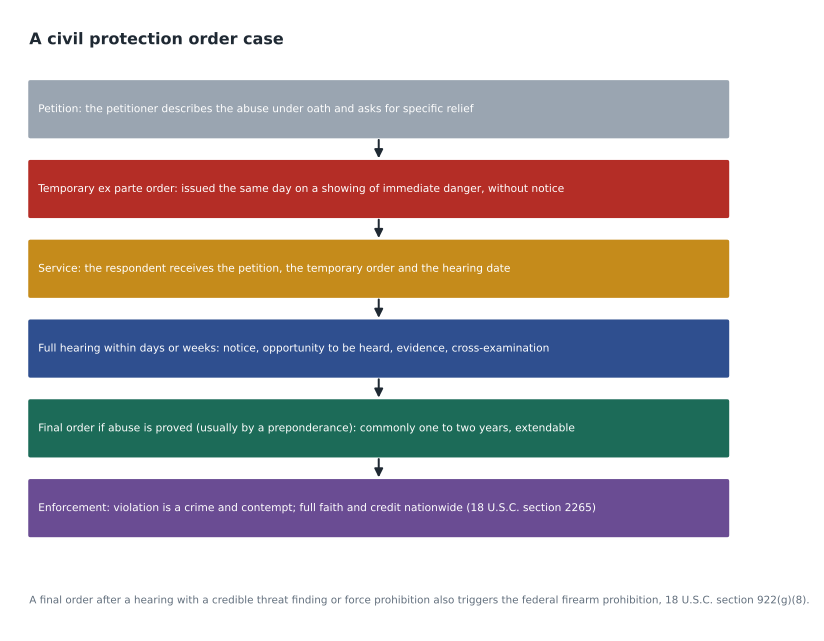
Protection order statutes balance urgency against due process. A petitioner may obtain a temporary ex parte order, issued without notice to the respondent, if the court finds from the petition or testimony that the petitioner faces an immediate and present danger of abuse. Courts in many jurisdictions provide emergency orders by telephone after hours through on-call judges. The temporary order lasts only until a full hearing, usually held within ten to twenty-one days, at which the respondent, who must be served with the petition and order, may appear, present evidence and cross-examine witnesses. Courts have generally upheld ex parte procedures against due process challenges because of the short duration of the temporary order, the requirement of a sworn showing, the prompt hearing and the gravity of the interests at stake.
At the full hearing, the petitioner must usually prove abuse by a preponderance of the evidence, although a few states require clear and convincing evidence for some remedies. Many petitioners and respondents appear without counsel. Respondents facing a related criminal charge often decline to testify, invoking the privilege against self-incrimination, and courts must manage the interaction between the civil and criminal cases. If the court finds abuse, it issues a final order for a set period, commonly one or two years, and in some states longer or indefinite, with extensions available on a showing of continuing need.
Many respondents agree to entry of an order without admitting the allegations, sometimes called a consent order without findings. Such orders are enforceable, but courts and advocates have noted that they can complicate later custody and firearms questions, because some consequences depend on a judicial finding of abuse or a credible threat.
Remedies
Protection orders can include a wide range of relief: orders to refrain from abuse, harassment and contact; stay-away orders covering the petitioner's home, workplace and the children's school; exclusive use and possession of the shared residence, even if the respondent holds title; temporary custody and parenting time arrangements, sometimes with supervised exchanges or supervised visitation; temporary child support and, in some states, spousal support; possession of a car or pets; orders not to dispose of property; and orders to surrender firearms. Many statutes also authorize counseling or batterer intervention programs and payment of the petitioner's costs.
Courts disfavor mutual protection orders, which restrain both parties, because they can confuse police, imply that both parties were equally responsible and undermine the petitioner's safety. Federal law reinforces the point. Under 18 U.S.C. section 2265(c), a mutual order is entitled to full faith and credit against the original petitioner only if the respondent filed a cross-petition and the court made specific findings that each party was entitled to an order.
Enforcement
Violating a protection order is a crime in every state and may also be punished as contempt. Most states have adopted mandatory or preferred arrest policies for domestic violence and protection order violations, under which police must or should arrest when they have probable cause, rather than mediate on the scene. These policies were adopted after studies in the 1980s suggested arrest deterred repeat violence and after lawsuits challenging police inaction, though later research produced mixed results, and some scholars have argued that mandatory arrest and no-drop prosecution policies reduce victims' autonomy.
The Supreme Court has held that the Constitution does not guarantee enforcement. In Castle Rock v. Gonzales, 545 U.S. 748 (2005), Jessica Gonzales held a protection order against her estranged husband, which stated that police shall arrest for violations. When he took their three daughters from the front yard, she repeatedly called the police, who did not act; that night he killed the children. She sued the town under section 1983, claiming that the order gave her a property interest in its enforcement. The Court held, seven to two, that she had no protected entitlement because, despite the mandatory language, police retained discretion in deciding how to enforce such orders, and in any event an entitlement to enforcement against a third party was not property for due process purposes. In 2011 the Inter-American Commission on Human Rights concluded that the United States had violated her rights under the American Declaration of the Rights and Duties of Man, but that finding is not binding in American courts. Castle Rock means that remedies for police failures depend on state tort law and statutes, not federal due process.
Federal law
The Violence Against Women Act of 1994, reauthorized in 2000, 2005, 2013 and 2022, made domestic violence a federal concern. It funds state and local programs and training, created federal crimes of interstate domestic violence and interstate violation of a protection order (18 U.S.C. sections 2261 and 2262), and requires every state, tribe and territory to give full faith and credit to protection orders issued by another jurisdiction, so long as the issuing court had jurisdiction and the respondent received reasonable notice and an opportunity to be heard (18 U.S.C. section 2265). A protection order from Westmarch is therefore enforceable by police in Oregon or Texas without registration. VAWA also created immigration protections, including the self-petition process for abused spouses and children of citizens and permanent residents, and the 2000 reauthorization created the U visa for crime victims who assist law enforcement. The 2022 reauthorization expanded tribal jurisdiction over non-Indians who commit certain crimes on tribal lands and included the Keeping Children Safe from Family Violence Act, often called Kayden's Law, discussed below.
Firearms
Federal law prohibits firearm possession by two groups tied to domestic violence. Under 18 U.S.C. section 922(g)(8), a person subject to a court order that restrains him or her from harassing, stalking or threatening an intimate partner or child is prohibited from possessing firearms if the order was issued after a hearing with actual notice and an opportunity to participate, and the order either includes a finding that the person is a credible threat to the physical safety of the partner or child or explicitly prohibits the use, attempted use or threatened use of physical force. Under section 922(g)(9), a person convicted of a misdemeanor crime of domestic violence is permanently prohibited.
The Supreme Court has addressed both provisions. In United States v. Castleman, 572 U.S. 157 (2014), it held that the physical force element of a misdemeanor crime of domestic violence is satisfied by the degree of force that supports a common-law battery conviction, including offensive touching. In Voisine v. United States, 579 U.S. 686 (2016), it held that reckless assaults qualify. And in United States v. Rahimi, 602 U.S. 680 (2024), decided June 21, 2024, the Court rejected, eight to one, a Second Amendment challenge to section 922(g)(8). Chief Justice Roberts's majority opinion applied the history and tradition test of New York State Rifle and Pistol Association v. Bruen (2022) and concluded that historical surety laws and going armed laws established a tradition that when an individual poses a clear threat of physical violence to another, the threatening individual may be disarmed. The Court held that section 922(g)(8)(C)(i), the credible threat finding, was consistent with that tradition as applied to Zackey Rahimi. Justice Thomas dissented. The Bipartisan Safer Communities Act of 2022 also extended the misdemeanor prohibition to people convicted of domestic violence against dating partners, prospectively and with restoration of rights after five years for first offenders in some circumstances.
Because the federal prohibition attaches to final orders after a hearing, not to ex parte temporary orders, many states have their own laws requiring or authorizing courts to order firearm surrender as part of temporary and final protection orders, and some require respondents to file proof of surrender. Willa's lawyer will ask for a surrender provision in the final order and a credible threat finding, which would also trigger the federal prohibition.
Threats and the First Amendment
Protection orders often restrain communications, and stalking and harassment statutes criminalize some speech, which raises First Amendment questions. In Counterman v. Colorado, 600 U.S. 66 (2023), Billy Counterman was convicted under a stalking statute for sending hundreds of unwanted messages to a musician, some of them threatening. The Court held that in a true threats prosecution, the First Amendment requires proof that the defendant had some subjective understanding of the threatening nature of the statements, and that recklessness, meaning conscious disregard of a substantial risk that the communications would be viewed as threatening violence, is sufficient. The decision applies to criminal prosecutions for threats; courts continue to evaluate its effect on civil protection orders and stalking prosecutions based on a course of conduct rather than threats alone.
Domestic violence in custody and divorce
Domestic violence is a central factor in custody law. More than twenty states have adopted a rebuttable presumption that it is detrimental to the child, and not in the child's best interest, to award sole or joint custody to a parent who has committed domestic violence, an approach recommended by the National Council of Juvenile and Family Court Judges' Model Code on Domestic and Family Violence in 1994. Other states list domestic violence as a mandatory factor. Joint custody presumptions, such as Kentucky's, typically do not apply when a domestic violence order has been entered. Courts frequently order supervised visitation or supervised exchanges, and mediation programs screen for domestic violence and may exempt cases from mandatory mediation.
The Keeping Children Safe from Family Violence Act, part of the 2022 VAWA reauthorization and named Kayden's Law after a child killed by her father during court-ordered visitation, offers federal funding incentives to states that adopt laws limiting evidence of past abuse to qualified experts' testimony, prohibit courts from ordering reunification treatment that cuts a child off from a protective parent, and require training for judges on child abuse and domestic violence. Pennsylvania enacted a state Kayden's Law in 2024, and several other states have adopted parts of the federal model. The statute responds to concerns that family courts too often disbelieved abuse allegations and credited claims that the protective parent had alienated the child. Supporters of alienation claims argue that some parents do manipulate children against the other parent. The debate is one of the most contested in family law.
Domestic violence matters in the financial parts of divorce, too. Some states consider it in alimony; a few allow tort claims for abuse to be joined with or brought after the divorce; and economic abuse, such as running up debts in a partner's name or hiding income, can be addressed through dissipation claims and the allocation of debts. Address confidentiality programs in most states allow survivors to use a substitute address on public records, including court filings.
Finally, domestic violence crosses borders. A parent fleeing abuse with a child may face a Hague Convention petition for return, and the grave risk exception, interpreted in Golan v. Saada (2022), discussed in Lesson 11, is often where the abuse is litigated. Dorian's threats to leave the state with the child are relevant to the protection order and to custody, and they justify asking the court to include an order not to remove the child from Westmarch.
Worked problem
Drafting the Kestner protection order request
Willa obtained a temporary ex parte order the day after the October incident, granting her exclusive use of the home, temporary custody of their son and a no-contact order. The full hearing is in fourteen days. Assume Westmarch's invented statute includes coercive control as a ground, authorizes firearm surrender and requires a credible threat finding for surrender. Outline what Willa's lawyer should seek and prove, and what Dorian's lawyer should consider.
Show solution
- Grounds: the push that caused bruising is physical abuse. The financial control, secret tracking and threats to take the child are a pattern of coercive control and also support the reasonableness of her fear.
- Evidence: photographs of the bruise, any medical record, her testimony, screenshots or a technician's report on the tracking application, bank records showing changed access, and messages containing the threats. Witnesses may include friends she confided in.
- Relief: a final order for the maximum statutory period; stay-away and no-contact provisions with an exception for communication about the child through a parenting application; exclusive use of the home; temporary custody with supervised or structured parenting time for Dorian; an order not to remove the child from the state; return of access to accounts or temporary support; removal of tracking software; and firearm surrender with a credible threat finding, which also triggers 18 U.S.C. section 922(g)(8).
- Respondent: Dorian's lawyer should consider his Fifth Amendment exposure if criminal charges are possible, the consequences of a finding for custody presumptions and firearms, whether to contest specific allegations, and whether a consent order without findings is available and advisable. Agreeing to an order without findings may avoid some consequences but will not prevent the court from considering the underlying evidence in custody.
- Interstate effect: the final order will be enforceable in every state under 18 U.S.C. section 2265 if Dorian receives notice and an opportunity to be heard.
Summary and key terms
- Every state provides civil protection orders; Pennsylvania's 1976 act was the first modern statute.
- Eligible relationships include spouses, parents of a shared child, household members and dating partners.
- Several states, including Hawaii, California and Connecticut, now include coercive control.
- Ex parte temporary orders are followed by a prompt full hearing with notice; final orders typically last one to two years.
- Remedies include no-contact and stay-away provisions, exclusive use of the home, temporary custody and support, and firearm surrender; mutual orders are disfavored.
- Castle Rock v. Gonzales (2005) held there is no due process entitlement to police enforcement.
- VAWA requires interstate enforcement of protection orders and created federal crimes and immigration protections.
- Rahimi (2024) upheld section 922(g)(8); Castleman and Voisine broadened the misdemeanor prohibition; Counterman (2023) requires at least recklessness for true threats.
- Many states presume against custody for a parent who committed domestic violence; Kayden's Law (2022) encourages further reform.
Practice problems
Work each problem on paper first, then reveal the answer to check.
A judge issues a temporary ex parte protection order and schedules a hearing for three weeks later. The respondent argues the ex parte order violated due process. Is he likely to succeed?
Show answer
No. Courts generally uphold ex parte orders based on a sworn showing of immediate danger, because they are temporary and followed by a prompt hearing with notice and an opportunity to be heard.
A final protection order issued after a hearing restrains the respondent from threatening his wife and includes a finding that he is a credible threat to her safety. He owns two rifles. What does federal law provide?
Show answer
Under 18 U.S.C. section 922(g)(8) he may not possess firearms while the order is in effect. Rahimi upheld the statute as applied to an order with a credible threat finding.
A wife obtains a protection order in Westmarch. Her husband follows her to a neighboring state and violates it there. Must police in the neighboring state enforce it?
Show answer
Yes. Under 18 U.S.C. section 2265, the order is entitled to full faith and credit if the issuing court had jurisdiction and the husband had notice and an opportunity to be heard. Crossing state lines to violate it may also be a federal crime under section 2262.
Lesson quiz · 5 questions
Score 60% or more to complete this lesson.
Create a free account to save your progress, take quizzes and earn a certificate.