
LAWU-302 · Lesson 9 of 12 · 24 min
Recognition of judgments
▶ Video coming soon A video version of this lesson is on the way.
Winslow Fairlie did not wait for the federal litigation in Westmarch. On October 2, 2026, his Harrowmere lawyer filed suit against Silverline in the Ashcombe County Court, the Harrowmere trial court, where Fairlie's domicile and the crash put him on solid jurisdictional ground. Castellane asks the class to imagine the case a year later. "Suppose a Harrowmere jury returns a verdict for Fairlie, the judge reduces the noneconomic damages to the 350,000-dollar cap, and judgment is entered for 610,000 dollars. Silverline has no money to pay it except a Westmarch bank account and a garage in Brennan Falls. Or suppose the reverse: Silverline wins in Harrowmere on a finding that it was not negligent, and then Hartwell's case in Westmarch comes up for trial. What does the Westmarch court do with the Harrowmere judgment?" This lesson covers the recognition and enforcement of judgments among American states, where the rules are much stricter than the rules for applying another state's law.
Full faith and credit for judgments
Article IV, section 1, of the Constitution provides that full faith and credit shall be given in each state to the public acts, records and judicial proceedings of every other state, and that Congress may prescribe the manner of proving them and their effect. Congress implemented the Clause in 1790, and the current statute, 28 U.S.C. section 1738, provides that judicial proceedings properly authenticated shall have the same full faith and credit in every court within the United States as they have by law or usage in the courts of the state from which they are taken. Section 1738 applies to federal courts as well, which must give state judgments the same preclusive effect the rendering state would give them, as the Supreme Court held in Kremer v. Chemical Construction Corp., 456 U.S. 461 (1982), and Marrese v. American Academy of Orthopaedic Surgeons, 470 U.S. 373 (1985).
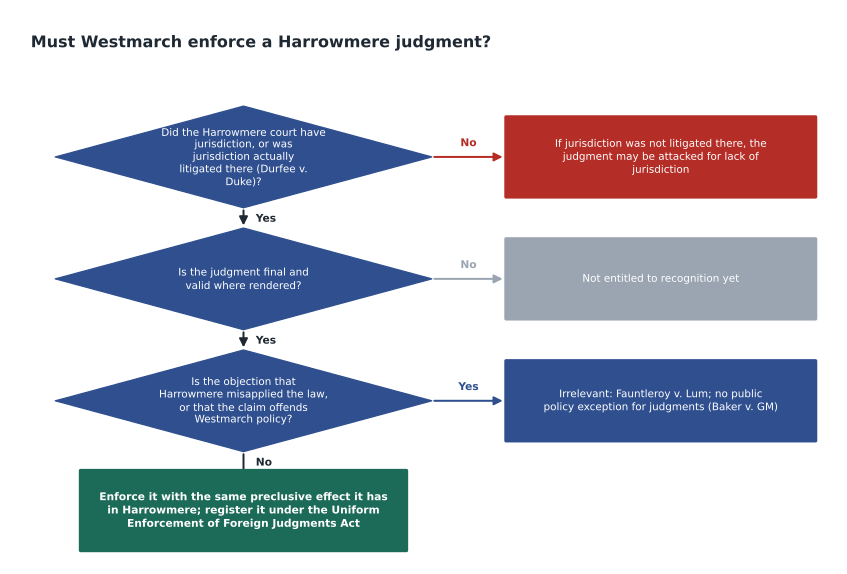
The key phrase is "the same full faith and credit" as the judgment has in the rendering state. The enforcing state must give the judgment the same preclusive effect, both claim preclusion and issue preclusion, that the courts of the rendering state would give it. It may not give the judgment less effect because it disagrees with the result, and in general it should not give the judgment greater effect than the rendering state would either. That makes the rendering state's preclusion law the measure of the judgment's effect everywhere.
No second-guessing: Fauntleroy v. Lum
The most dramatic illustration is Fauntleroy v. Lum, 210 U.S. 230 (1908). Two men made a contract in Mississippi for dealing in cotton futures, a gambling contract that was illegal and unenforceable under Mississippi law. A dispute was submitted to arbitration in Mississippi, and the arbitrator awarded Fauntleroy money. Fauntleroy then sued on the award in Missouri, where he found Lum, and obtained a Missouri judgment. The Missouri court refused to allow Lum to prove that the underlying contract was illegal under Mississippi law. When Fauntleroy sued on the Missouri judgment in Mississippi, the Mississippi courts refused to enforce it, on the ground that it was based on a transaction illegal in Mississippi. The Supreme Court reversed, in an opinion by Justice Holmes: a judgment is conclusive as to all the matters it decides, even if it rests on a mistake of law, and Mississippi had to enforce the Missouri judgment even though it effectively enforced a contract Mississippi law made void.
Fauntleroy means that there is no exception to full faith and credit for judgments based on an erroneous application of law, including an erroneous choice of law. If a Harrowmere court wrongly applies Harrowmere's damages cap to Fairlie's claim, or wrongly refuses to apply it, a Westmarch court enforcing the judgment may not revisit the issue. The remedy for a legal error is an appeal within the rendering state's courts and, where a federal question is involved, review by the Supreme Court.
No public policy exception: Baker v. General Motors
Courts sometimes refused to enforce sister-state judgments that offended local public policy, borrowing the escape device from choice of law. The Supreme Court has rejected that idea. In Baker v. General Motors Corp., 522 U.S. 222 (1998), a former General Motors engineer, Ronald Elwell, settled a wrongful discharge suit against GM in Michigan, and a Michigan court entered a stipulated injunction barring him from testifying against GM in product liability cases without GM's consent. In a later product case in Missouri, the plaintiffs subpoenaed Elwell, and GM argued that the Michigan injunction barred his testimony. The Supreme Court held that the Michigan injunction could not bind the Missouri plaintiffs, who were not parties to it, and could not control Missouri's own proceedings and its power to compel testimony. In reaching that result, the Court restated the general rule: regarding judgments, the full faith and credit obligation is exacting, and there is no roving public policy exception to the full faith and credit due judgments.
Baker also drew an important distinction. The rendering state's judgment is entitled to recognition, but the enforcing state controls the mechanics of enforcement, such as levy, execution and the time and manner of enforcement, under its own law. An injunction purporting to control another state's courts or bind nonparties exceeds what full faith and credit requires. And the enforcing state applies its own statute of limitations to actions on judgments, as the Court held in Watkins v. Conway, 385 U.S. 188 (1966), so long as it does not discriminate against sister-state judgments.
Jurisdiction: the main ground for attack
The principal way to resist a sister-state judgment is to show that the rendering court lacked jurisdiction. A judgment entered without personal jurisdiction over the defendant, or without adequate notice, violates due process and is not entitled to full faith and credit. A defendant who did not appear in the original action may challenge jurisdiction when the plaintiff seeks to enforce the judgment elsewhere, a strategy that preserves the jurisdictional objection but forfeits any defense on the merits if the jurisdictional challenge fails.
But if the jurisdictional question was actually litigated in the rendering court, or the defendant appeared and had the opportunity to litigate it, the rendering court's decision on jurisdiction is itself entitled to full faith and credit. In Durfee v. Duke, 375 U.S. 106 (1963), the question was whether a parcel of land on the Missouri River lay in Nebraska or Missouri, which depended on whether the river had shifted by avulsion or accretion. A Nebraska court, after full litigation, decided that the land was in Nebraska and that it had jurisdiction. The losing party then sued again in Missouri, where the courts treated the boundary and jurisdiction questions as open. The Supreme Court held that Missouri had to respect the Nebraska judgment, including its determination of jurisdiction, because the issue had been fully and fairly litigated and finally decided. Full faith and credit thus generally requires every state to give to a judgment at least the res judicata effect which the judgment would be accorded in the state which rendered it, even as to jurisdiction.
Milliken v. Meyer, 311 U.S. 457 (1940), adds a related point about jurisdiction based on domicile. A Wyoming court entered a judgment against Meyer, a Wyoming domiciliary, who was served personally in Colorado. The Court held that domicile in the state is alone sufficient to bring an absent defendant within the reach of the state's jurisdiction for purposes of a personal judgment by means of appropriate substituted service, and that Colorado had to enforce the Wyoming judgment. Milliken remains the basis for general jurisdiction over individuals in their state of domicile.
Finality, fraud and other limits
Full faith and credit extends to final judgments. A judgment that is still subject to appeal is generally treated as final for preclusion purposes in most states, but enforcement may be stayed pending appeal according to the enforcing state's procedure. Judgments that the rendering state's law treats as modifiable, such as child support or alimony that can be changed for future installments, are entitled to full faith and credit only to the extent they are final and not modifiable under the rendering state's law. Federal statutes now supplement the Clause for family judgments, including the Full Faith and Credit for Child Support Orders Act and the Parental Kidnapping Prevention Act, which require enforcement of child support and custody orders that meet their requirements.
Extrinsic fraud, fraud that prevented a party from presenting a case, such as concealing the suit from the defendant, may be raised in the enforcing state if the rendering state would allow the judgment to be set aside for that reason. Intrinsic fraud, such as perjured testimony at trial, generally may not, because the rendering court's process was available to address it. Judgments of courts lacking subject matter jurisdiction may be challenged in limited circumstances, but in most cases the rendering court's determination of its own competence is binding if the issue was litigated or could have been.
Penal judgments and workers' compensation
The traditional rule that a state will not enforce another sovereign's penal laws, discussed in Lesson 3, survives in a narrow form for judgments. A judgment for a fine or penalty owed to a state may be refused, but a judgment for private compensatory or even punitive damages is not penal in that sense. Workers' compensation awards present a special problem because compensation statutes are often both remedies and exclusive bars. In Thomas v. Washington Gas Light Co., 448 U.S. 261 (1980), a District of Columbia resident injured in Virginia received an award under Virginia's compensation statute and then sought a supplemental award under the District's more generous statute. A plurality held that full faith and credit did not bar the supplemental award, because Virginia's administrative tribunal had no power to decide rights under the District's law, distinguishing Industrial Commission of Wisconsin v. McCartin, 330 U.S. 622 (1947), and limiting Magnolia Petroleum Co. v. Hunt, 320 U.S. 430 (1943), which had required a state to respect a sister state's compensation award.
Divorce, marriage and adoption
Divorce decrees raised some of the hardest full faith and credit questions of the twentieth century. In Williams v. North Carolina, 317 U.S. 287 (1942), the Court held that a Nevada divorce obtained by a spouse domiciled in Nevada, without personal jurisdiction over the other spouse, was entitled to full faith and credit in North Carolina, because domicile of one spouse gives the state jurisdiction over the marital status. In Williams v. North Carolina, 325 U.S. 226 (1945), the second Williams case, the Court held that North Carolina could reexamine whether the spouse had really acquired a Nevada domicile, because the absent spouse had not participated in the Nevada proceeding, and the domicile finding was therefore not binding on her or on North Carolina. If both spouses participated, however, the domicile finding is binding, as the Court held in Sherrer v. Sherrer, 334 U.S. 343 (1948). Estin v. Estin, 334 U.S. 541 (1948), introduced the concept of divisible divorce: an ex parte divorce can end the marriage but cannot terminate a spouse's right to support established by another state's judgment, because that requires personal jurisdiction.
For marriage, the traditional rule recognized a marriage valid where celebrated unless it violated a strong public policy of the domicile. After Obergefell v. Hodges, 576 U.S. 644 (2015), held that the Constitution guarantees same-sex couples the right to marry and requires states to recognize same-sex marriages lawfully performed in other states, the public policy exception no longer applies to those marriages. Congress reinforced the point in the Respect for Marriage Act of 2022, which repealed the provision of the Defense of Marriage Act that had purported to allow states to deny recognition to same-sex marriages from other states and requires states to give full faith and credit to out-of-state marriages without regard to the sex, race, ethnicity or national origin of the parties.
Adoption decrees, as judgments, receive full faith and credit. In V.L. v. E.L., 577 U.S. 404 (2016), the Supreme Court summarily reversed the Alabama Supreme Court, which had refused to recognize a Georgia adoption decree granting parental rights to the same-sex partner of a child's mother on the ground that the Georgia court had misapplied Georgia adoption law. The Court held that the Georgia court had subject matter jurisdiction under Georgia law to issue the decree, so Alabama had to give it full faith and credit even if the Georgia court had erred. V.L. is a modern restatement of Fauntleroy.
Enforcing sister-state judgments in practice
The traditional way to enforce a sister-state money judgment was to bring a new action on the judgment in the enforcing state, obtain a local judgment and then execute it. Nearly every state has simplified the process by adopting the Uniform Enforcement of Foreign Judgments Act, revised in 1964, under which the judgment creditor files an authenticated copy of the sister-state judgment with a clerk of the enforcing state's court, notice is sent to the debtor, and the filed judgment has the same effect as a local judgment, subject to the same procedures for reopening, vacating or staying. The debtor may raise defenses such as lack of jurisdiction or satisfaction, but not the merits. Federal judgments may be registered in other federal districts under 28 U.S.C. section 1963.
Preclusion between the Silverline cases
The class turns to Castellane's second scenario. Suppose the Harrowmere court enters judgment for Silverline in Fairlie's case, finding that Silverline was not negligent in inspecting or maintaining the coach. Can Silverline use that finding against Hartwell and Bergstrom in Westmarch? Daniel Reyes answers no: Hartwell and Bergstrom were not parties to the Fairlie case and did not have a full and fair opportunity to litigate the negligence issue, so issue preclusion cannot be used against them, as a matter of due process. The Supreme Court made that point in Taylor v. Sturgell, 553 U.S. 880 (2008), rejecting virtual representation as a basis for binding nonparties.
Suppose instead Fairlie wins, with a finding that Silverline negligently failed to replace a worn tire. Can Hartwell use that finding against Silverline in Westmarch? That is nonmutual offensive issue preclusion, which federal courts allow in their discretion under Parklane Hosiery Co. v. Shore, 439 U.S. 322 (1979), and many states allow under similar conditions. But full faith and credit requires the Westmarch court to give the Harrowmere judgment the effect Harrowmere would give it. If Harrowmere still requires mutuality, a Westmarch court should not allow nonmutual preclusion based on a Harrowmere judgment, even if Westmarch would allow it for its own judgments. The rendering state's preclusion law controls.
Worked problem
Enforcing Fairlie's judgment in Westmarch
Assume Fairlie obtains a final Harrowmere judgment for 610,000 dollars against Silverline. He registers it in Merrin County under Westmarch's Uniform Enforcement of Foreign Judgments Act. Silverline moves to vacate, arguing (1) the Harrowmere court wrongly excluded evidence of Fairlie's seat belt nonuse; (2) Westmarch's public policy forbids enforcing judgments based on a jury instruction Westmarch considers misleading; and (3) Fairlie lied at trial about his prior back injury. Evaluate each argument.
Show solution
- Argument 1 is an error of law or procedure in the rendering court. Under Fauntleroy, a judgment is conclusive despite errors; Silverline's remedy was an appeal in Harrowmere. Rejected.
- Argument 2 invokes public policy. Baker says there is no roving public policy exception for judgments. Rejected.
- Argument 3 alleges intrinsic fraud (perjury at trial). The Harrowmere proceedings gave Silverline the opportunity to expose it, and most states do not allow intrinsic fraud to be raised collaterally. Rejected unless Harrowmere would vacate on that ground.
- Jurisdiction was not contested and would fail anyway: Silverline is at home in Harrowmere.
- Silverline may seek a stay of enforcement under Westmarch procedure if it is pursuing an appeal in Harrowmere, but the Westmarch court must otherwise enforce.
Answer: The Westmarch court must enforce the judgment. Silverline's arguments are either merits arguments barred by Fauntleroy and Baker or matters for the Harrowmere courts.
Common mistakes
MistakeA state may refuse to enforce a sister-state judgment that is based on a mistake of law.
InsteadFauntleroy v. Lum and V.L. v. E.L. hold that a judgment is conclusive even if it rests on an error of law.
MistakeThere is a public policy exception for judgments, as there is for applying foreign law.
InsteadBaker v. General Motors: there is no roving public policy exception to the full faith and credit due judgments.
MistakeA defendant may always attack a judgment for lack of jurisdiction in the enforcing state.
InsteadOnly if jurisdiction was not litigated (or could not have been) in the rendering court; Durfee v. Duke makes a litigated jurisdictional finding binding.
MistakeThe enforcing state applies its own preclusion law to a sister-state judgment.
InsteadSection 1738 requires the same effect the rendering state would give; the rendering state's preclusion law controls.
Summary and key terms
- Article IV, section 1, and 28 U.S.C. section 1738 require every court in the United States to give a state judgment the same effect it has in the rendering state.
- Fauntleroy v. Lum (1908): judgments are conclusive even if based on a mistake of law; Baker v. General Motors (1998): there is no roving public policy exception for judgments.
- Lack of jurisdiction is the main defense, but Durfee v. Duke (1963) makes a litigated jurisdictional determination binding; Milliken v. Meyer (1940) recognizes jurisdiction based on domicile.
- Enforcement mechanics and limitations on actions on judgments are governed by the enforcing state (Baker; Watkins v. Conway).
- Williams I and II, Sherrer and Estin govern divorce recognition; Obergefell and the Respect for Marriage Act require recognition of same-sex marriages; V.L. v. E.L. (2016) applies full faith and credit to adoption decrees.
- Nearly all states use the Uniform Enforcement of Foreign Judgments Act to register sister-state judgments; nonparties cannot be bound (Taylor v. Sturgell).
- Full faith and credit
- The constitutional and statutory obligation to give sister-state judgments the same effect they have where rendered.
- Claim preclusion
- Bars relitigation of a claim decided by a final judgment between the same parties.
- Issue preclusion
- Bars relitigation of an issue actually litigated and necessarily decided.
- Extrinsic fraud
- Fraud that prevented a party from presenting its case, which may support a collateral attack.
- Divisible divorce
- The rule from Estin that an ex parte divorce ends the marriage but cannot cut off support rights requiring personal jurisdiction.
- Registration of judgments
- Filing a sister-state judgment under the Uniform Enforcement of Foreign Judgments Act so it can be enforced like a local judgment.
Practice problems
Work each problem on paper first, then reveal the answer to check.
Why did Mississippi have to enforce the Missouri judgment in Fauntleroy v. Lum even though the underlying contract was illegal in Mississippi?
Show answer
Because a judgment is conclusive on the merits even if it rests on a mistake of law, and full faith and credit requires giving it the effect it has in Missouri.
What did Baker v. General Motors hold about the Michigan injunction?
Show answer
It could not bar the Missouri plaintiffs, who were not parties, from obtaining Elwell's testimony, and could not control Missouri's own proceedings, although there is no public policy exception to full faith and credit for judgments.
Under Williams II, why could North Carolina reexamine the Nevada court's domicile finding?
Show answer
Because the absent spouse had not participated in the Nevada proceeding, so the domicile finding was not binding on her or on North Carolina.
Why can't Silverline use a Harrowmere judgment in its favor against Hartwell, who was not a party?
Show answer
Due process forbids binding a nonparty who did not have a full and fair opportunity to litigate (Taylor v. Sturgell).
Lesson quiz · 5 questions
Score 60% or more to complete this lesson.
Create a free account to save your progress, take quizzes and earn a certificate.