
LAWU-302 · Lesson 11 of 12 · 27 min
International disputes
▶ Video coming soon A video version of this lesson is on the way.
Northvale Rubber Works answered the passengers' complaint in the District of Westmarch with two motions. The first challenged personal jurisdiction, as Lesson 8 anticipated. The second asked the court, in the alternative, to dismiss the claims against Northvale for forum non conveniens in favor of the Ontario Superior Court of Justice, on the ground that the tire was designed, tested and made in Ontario, Northvale's engineers and records are there, and Ontario courts are fully capable of hearing product liability claims. "International cases add a layer to every question we have studied," Castellane says. "Where can the case be heard becomes whether an American court should hear it at all. Whose law decides it becomes how anyone will prove what foreign law says, and whether American law reaches conduct abroad. And every step, from serving the complaint to taking a deposition, may require a treaty." This lesson surveys the main doctrines that govern transnational litigation in American courts.
Forum non conveniens
Forum non conveniens allows a court that has jurisdiction and venue to decline to exercise it when another forum is far more appropriate. Within the federal system, transfer under 28 U.S.C. section 1404(a) has replaced dismissal, but when the more convenient forum is a foreign court, the federal court can only dismiss. State courts have their own forum non conveniens doctrines, which often track the federal standard.
The modern federal test comes from Gulf Oil Corp. v. Gilbert, 330 U.S. 501 (1947). The court first asks whether an adequate alternative forum exists, in which the defendant is amenable to process and the plaintiff can obtain some remedy. If so, it weighs private interest factors, such as the relative ease of access to sources of proof, the availability of compulsory process for unwilling witnesses, the cost of obtaining willing witnesses, the possibility of a view of premises and all other practical problems, against public interest factors, such as administrative difficulties from court congestion, the local interest in having localized controversies decided at home, the interest in having a diversity case tried in a forum familiar with the governing law, and the unfairness of burdening citizens of an unrelated forum with jury duty. Dismissal is appropriate only if these factors strongly favor the alternative forum, given the deference owed to the plaintiff's choice.
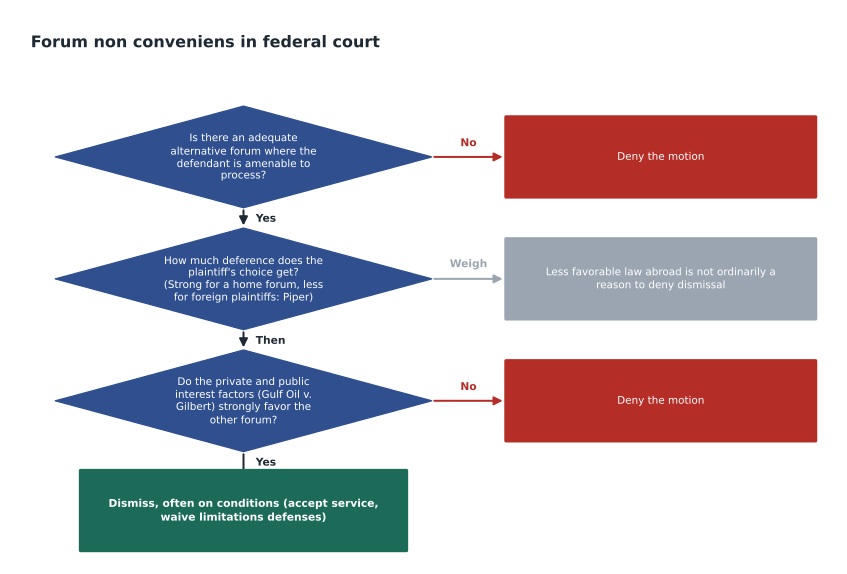
Piper Aircraft Co. v. Reyno, 454 U.S. 235 (1981), shaped the doctrine for international cases. A small commuter plane crashed in the Scottish highlands, killing the pilot and five passengers, all Scottish. The plane had been manufactured in Pennsylvania by Piper and its propellers in Ohio by Hartzell. A California administratrix of the estates sued Piper and Hartzell in California, and the case was transferred to Pennsylvania. She admitted that she sued in the United States because American law on strict liability and damages was more favorable than Scottish law. The Supreme Court held that the possibility of a change in substantive law unfavorable to the plaintiff should ordinarily not be given conclusive or even substantial weight in the forum non conveniens inquiry. Only if the remedy provided by the alternative forum is so clearly inadequate or unsatisfactory that it is no remedy at all should the unfavorable change in law be given substantial weight. The Court also held that a foreign plaintiff's choice of an American forum deserves less deference than a citizen's or resident's choice of a home forum, because the assumption that the chosen forum is convenient is much less reasonable.
Piper made forum non conveniens a powerful tool for American defendants sued by foreign plaintiffs, particularly in mass tort cases arising abroad. Dismissals are often conditioned on the defendant's agreement to submit to the foreign court's jurisdiction, waive limitations defenses that would not have applied in the American action, make witnesses and documents available, and satisfy any final judgment. Some foreign countries responded with blocking statutes that purport to deprive their courts of jurisdiction over cases first filed in the United States, in an attempt to make the foreign forum unavailable.
In Sinochem International Co. v. Malaysia International Shipping Corp., 549 U.S. 422 (2007), the Court held that a federal court may dismiss for forum non conveniens without first resolving whether it has subject matter or personal jurisdiction, when the jurisdictional question is difficult and the forum non conveniens ground is clear, because forum non conveniens is a nonmerits ground for declining to hear a case. Atlantic Marine, covered in Lesson 7, adds that a valid forum selection clause pointing to a foreign forum is enforced through forum non conveniens with the same controlling weight as a transfer under section 1404(a).
Northvale's motion
Section B evaluates Northvale's motion. An adequate alternative forum exists: Northvale is subject to suit in Ontario, and Ontario recognizes product liability claims in negligence, though civil juries are used far less often than in American courts, limits damages for pain and suffering under a judicially created cap, and generally awards costs to the winning party. Under Piper, those less favorable features do not make Ontario inadequate. But the plaintiffs are American residents suing in their home forum, so their choice deserves strong deference, unlike the Scottish plaintiffs' choice in Piper.
The private interest factors are mixed. Northvale's design documents and engineers are in Ontario, but the coach, the tire fragments, the crash site, the driver, the Ferrand mechanics and most of the injured passengers and their doctors are in Westmarch and Harrowmere. The claims against Silverline will proceed in the United States in any event, so dismissing the claims against Northvale would split the case and risk inconsistent results. The public interest factors favor the United States: the accident happened in Harrowmere, the victims live in Westmarch, and the American court may well apply Harrowmere law, which it is better placed to apply than an Ontario court. Priya Natarajan concludes that the motion should be denied, and Castellane agrees that Northvale's better chance lies in its jurisdictional challenge.
Serving process abroad
Serving a foreign defendant requires attention to international agreements. The Hague Convention on the Service Abroad of Judicial and Extrajudicial Documents in Civil or Commercial Matters, adopted in 1965, applies in all cases where there is occasion to transmit a document for service abroad between contracting states, which include Canada and most major trading partners. Each contracting state designates a Central Authority to receive requests for service and arrange service under its law. Federal Rule of Civil Procedure 4(f)(1) authorizes service by any internationally agreed means, such as the Convention.
The Convention is mandatory when it applies, but it applies only when the forum's law requires transmitting documents abroad. In Volkswagenwerk Aktiengesellschaft v. Schlunk, 486 U.S. 694 (1988), the Court held that service on a German manufacturer through its wholly owned American subsidiary, which Illinois law treated as the parent's involuntary agent for service, did not require transmission abroad, so the Convention did not apply. In Water Splash, Inc. v. Menon, 581 U.S. 271 (2017), the Court held that Article 10(a) of the Convention, which preserves the freedom to send judicial documents by postal channels directly to persons abroad, permits service by mail if the receiving state has not objected and service by mail is authorized under otherwise applicable law. Canada has not objected to Article 10(a), so service by mail on Northvale in Ontario may be possible if Westmarch or federal law authorizes it, though prudent lawyers often use the Central Authority as well to avoid later challenges to recognition in Ontario.
Taking evidence abroad
Discovery in transnational cases raises sharper conflicts. American discovery is far broader than discovery in most civil law and many common law countries, and some countries have blocking statutes forbidding their nationals from producing documents for foreign proceedings. The Hague Convention on the Taking of Evidence Abroad in Civil or Commercial Matters of 1970 provides procedures for letters of request through a Central Authority. In Societe Nationale Industrielle Aerospatiale v. U.S. District Court, 482 U.S. 522 (1987), the Court held that the Evidence Convention is not the exclusive means of obtaining evidence from a foreign party subject to the court's jurisdiction. The Federal Rules remain available, but courts must consider comity and should exercise special vigilance to protect foreign litigants from unnecessary or unduly burdensome discovery, weighing the importance of the documents, their specificity, their origin, the availability of alternatives and the competing national interests.
Discovery runs the other way as well. Under 28 U.S.C. section 1782, a federal district court may order a person who resides or is found in its district to give testimony or produce documents for use in a proceeding in a foreign or international tribunal. In Intel Corp. v. Advanced Micro Devices, Inc., 542 U.S. 241 (2004), the Court interpreted the statute broadly, holding that it does not require the evidence to be discoverable under the foreign tribunal's rules, and listed discretionary factors for district courts to weigh. In ZF Automotive US, Inc. v. Luxshare, Ltd., 596 U.S. 619 (2022), the Court unanimously held that a foreign or international tribunal must be a governmental or intergovernmental adjudicative body, so private commercial arbitral panels and ad hoc arbitrations not exercising governmental authority do not qualify. If Silverline brings its own claims against Northvale in Ontario, Northvale could use section 1782 to obtain evidence located in Harrowmere for use in the Ontario case, subject to the Intel factors.
Proving foreign law
When foreign-country law governs an issue, someone must establish its content. Federal Rule of Civil Procedure 44.1, adopted in 1966, requires a party who intends to raise an issue about a foreign country's law to give notice by pleadings or other writing, and provides that in determining foreign law the court may consider any relevant material or source, including testimony, whether or not submitted by a party or admissible under the Federal Rules of Evidence. The court's determination must be treated as a ruling on a question of law, reviewable de novo. Most states have similar rules. In practice, parties submit declarations from foreign law experts, translations of statutes and cases, and treatises, and courts increasingly research foreign law themselves.
Foreign governments sometimes tell American courts what their own law means. In Animal Science Products, Inc. v. Hebei Welcome Pharmaceutical Co., 585 U.S. 33 (2018), American purchasers of vitamin C sued Chinese exporters for price fixing, and the Ministry of Commerce of the People's Republic of China filed a brief stating that Chinese law required the exporters to coordinate prices. The Second Circuit treated the Ministry's statement as binding. The Supreme Court unanimously reversed, holding that a federal court should accord respectful consideration to a foreign government's submission but is not bound to accord conclusive effect to the foreign government's statements. Relevant considerations include the statement's clarity, thoroughness and support, its context and purpose, the transparency of the foreign legal system, the role and authority of the entity making the statement, and its consistency with the government's past positions.
Parallel proceedings and antisuit injunctions
International disputes often proceed in two countries at once. Suppose Northvale, anticipating liability, files a declaratory action in Ontario seeking a declaration that its tires were not defective, while the passengers pursue their claims in Westmarch. American courts generally allow parallel proceedings to continue, applying a principle that the first court to reach judgment may control the second through preclusion, if its judgment is recognized. Federal courts sometimes stay their proceedings in deference to earlier foreign actions under comity-based abstention, considering factors such as the order of filing, the adequacy of the foreign forum, convenience and the risk of inconsistent judgments.
In rare cases, a court may enjoin a party from pursuing litigation abroad. Antisuit injunctions do not purport to bind the foreign court, but they bind the party before the issuing court. Federal circuits are divided on the standard. Some, such as the Fifth and Ninth Circuits, follow a more liberal approach allowing injunctions to prevent vexatious or duplicative foreign litigation; others, such as the Second, Sixth and District of Columbia Circuits, follow a stricter approach requiring a threat to the court's jurisdiction or important public policies, emphasizing comity. The leading case for the restrictive approach is Laker Airways Ltd. v. Sabena, Belgian World Airlines, 731 F.2d 909 (D.C. Cir. 1984), which arose from competing antitrust proceedings in the United States and England.
Extraterritoriality of American statutes
When a plaintiff sues under a federal statute for conduct that occurred partly abroad, the question is whether the statute reaches that conduct. The Supreme Court applies a presumption against extraterritoriality: absent a clearly expressed congressional intent to the contrary, federal laws will be construed to have only domestic application. In Morrison v. National Australia Bank Ltd., 561 U.S. 247 (2010), foreign investors who bought shares of an Australian bank on an Australian exchange sued under section 10(b) of the Securities Exchange Act. The Court held that section 10(b) applies only to transactions in securities listed on domestic exchanges and domestic transactions in other securities, because the focus of the statute is purchases and sales of securities in the United States.
RJR Nabisco, Inc. v. European Community, 579 U.S. 325 (2016), set out a two-step framework. At step one, the court asks whether the presumption has been rebutted, that is, whether the statute gives a clear, affirmative indication that it applies extraterritorially. If not, at step two, the court determines whether the case involves a domestic application of the statute by looking to the statute's focus: if the conduct relevant to the focus occurred in the United States, the case involves a permissible domestic application even if other conduct occurred abroad. RJR held that some of RICO's substantive provisions apply abroad to the extent the predicate statutes do, but that RICO's private right of action requires a domestic injury to business or property.
The Alien Tort Statute, 28 U.S.C. section 1350, which gives district courts jurisdiction over civil actions by aliens for torts committed in violation of the law of nations or a treaty of the United States, produced a series of decisions sharply limiting human rights litigation in American courts. In Kiobel v. Royal Dutch Petroleum Co., 569 U.S. 108 (2013), Nigerian plaintiffs alleged that Dutch and British oil companies aided and abetted human rights abuses by the Nigerian government. The Court held that the presumption against extraterritoriality applies to claims under the Alien Tort Statute and that even where claims touch and concern the territory of the United States, they must do so with sufficient force to displace the presumption; mere corporate presence does not suffice. Jesner v. Arab Bank, PLC, 584 U.S. 241 (2018), held that foreign corporations may not be defendants in suits under the statute. In Nestle USA, Inc. v. Doe, 593 U.S. 628 (2021), plaintiffs who alleged they had been trafficked as children to work on cocoa farms in Ivory Coast sued American companies that bought cocoa there, alleging that the companies made major operational decisions in the United States. The Court held that allegations of general corporate activity in the United States, such as decision making, were not enough to make the claims a domestic application of the statute.
In Abitron Austria GmbH v. Hetronic International, Inc., 600 U.S. 412 (2023), the Court applied the framework to the Lanham Act's trademark infringement provisions, holding that they are not extraterritorial and that the conduct relevant to the statute's focus is infringing use in commerce, which must occur in the United States. A jury verdict of about 96 million dollars, based largely on sales by foreign defendants to foreign customers, was vacated. In Yegiazaryan v. Smagin, 599 U.S. 533 (2023), the Court held that a plaintiff alleges a domestic injury under RICO when the circumstances surrounding the injury indicate it arose in the United States, applying a context-specific inquiry to a foreign plaintiff's efforts to enforce a foreign arbitral award against assets in California.
Foreign sovereigns and the act of state doctrine
Claims against foreign governments and their agencies are governed by the Foreign Sovereign Immunities Act of 1976, 28 U.S.C. sections 1330 and 1602 to 1611, which grants immunity subject to enumerated exceptions, including commercial activity with a nexus to the United States, waiver, expropriation of property in violation of international law and certain terrorism-related claims. The FSIA is the sole basis for obtaining jurisdiction over a foreign state in American courts. Lesson 7 noted Cassirer's holding on choice of law in FSIA cases. Separately, the act of state doctrine, recognized in Banco Nacional de Cuba v. Sabbatino, 376 U.S. 398 (1964), generally precludes American courts from declaring invalid the official acts of a foreign sovereign performed within its own territory. In W.S. Kirkpatrick & Co. v. Environmental Tectonics Corp., 493 U.S. 400 (1990), the Court clarified that the doctrine applies only when a court must decide the validity of such an act, not merely when a case might embarrass a foreign government.
Arbitration and forum clauses in international contracts
Commercial parties can avoid many of these problems by agreeing in advance where and how disputes will be resolved. The Supreme Court has strongly supported such agreements in international cases. In The Bremen v. Zapata Off-Shore Co., 407 U.S. 1 (1972), it held that a forum selection clause in an international towage contract choosing the London Court of Justice was prima facie valid and should be enforced unless enforcement would be unreasonable and unjust or the clause was invalid for fraud or overreaching. In Mitsubishi Motors Corp. v. Soler Chrysler-Plymouth, Inc., 473 U.S. 614 (1985), it held that antitrust claims arising from an international contract were arbitrable, emphasizing the needs of the international commercial system for predictability in dispute resolution. Northvale's supply agreement with Silverline, which chose Ontario law and Toronto courts, illustrates how commercial parties allocate these risks, while the passengers, who never agreed to anything with Northvale, remain free to sue where the law allows.
Worked problem
Planning service and discovery against Northvale
Evander Pascale must serve Northvale in Ontario and obtain its design and testing records. Outline his options and the risks.
Show solution
- Service: Canada is a party to the Hague Service Convention. Pascale can send the summons and complaint, with any required translation (not needed for English-language Ontario), to Ontario's Central Authority, which will arrange service.
- Service by mail: under Water Splash, Article 10(a) permits mail service if Canada has not objected (it has not) and the forum's law authorizes mail service. Using both routes reduces the risk of a later challenge if the judgment must be enforced in Ontario.
- Discovery: once Northvale is a party subject to the court's jurisdiction, Pascale can use Federal Rules discovery; under Aerospatiale, the Evidence Convention is not mandatory, but the court will consider comity and burden.
- Third-party evidence in Ontario: records held by Ontario nonparties may require a letter of request under the Evidence Convention or Ontario's own procedures for assisting foreign courts.
- Foreign law: if Ontario law governs any issue, give notice under Rule 44.1 and retain an Ontario lawyer to provide a declaration.
Answer: Use the Hague Service Convention through the Central Authority, consider mail service as a supplement, pursue party discovery under the Federal Rules with sensitivity to comity, and plan for Rule 44.1 proof of Ontario law.
Common mistakes
MistakeUnder Piper, a forum non conveniens motion must be denied if the foreign forum's law is less favorable to the plaintiff.
InsteadPiper held that an unfavorable change in law ordinarily gets no substantial weight unless the foreign remedy is so inadequate that it is no remedy at all.
MistakeThe Hague Evidence Convention is the exclusive way to obtain evidence from a foreign party.
InsteadAerospatiale held it is not exclusive; courts may use the Federal Rules, with attention to comity.
MistakeA foreign government's statement about its own law binds American courts.
InsteadAnimal Science v. Hebei requires respectful consideration, not conclusive deference.
MistakeThe Alien Tort Statute allows suits against any corporation for human rights abuses abroad.
InsteadKiobel, Jesner and Nestle limit the statute: claims must overcome the presumption against extraterritoriality, foreign corporations cannot be sued, and general corporate activity in the United States is not enough.
Summary and key terms
- Forum non conveniens under Gulf Oil weighs private and public interest factors once an adequate alternative forum exists; Piper gives little weight to less favorable foreign law and less deference to foreign plaintiffs.
- Sinochem allows dismissal for forum non conveniens before deciding jurisdiction; Atlantic Marine extends forum clause enforcement to foreign forums.
- The Hague Service Convention is mandatory when service requires transmission abroad (Schlunk); Water Splash permits mail service where the receiving state has not objected.
- The Hague Evidence Convention is not exclusive (Aerospatiale); section 1782 allows discovery for foreign governmental tribunals (Intel; ZF Automotive).
- Rule 44.1 makes foreign law a question of law; Animal Science v. Hebei requires respectful consideration of foreign governments' views.
- The presumption against extraterritoriality (Morrison; RJR Nabisco; Kiobel; Nestle; Abitron) limits the reach of federal statutes abroad.
- Forum non conveniens
- A court's discretionary power to dismiss a case that would be more appropriately heard in another forum.
- Adequate alternative forum
- A forum where the defendant is amenable to process and some remedy is available.
- Hague Service Convention
- The 1965 treaty establishing Central Authorities to transmit documents for service abroad.
- Section 1782
- The federal statute allowing discovery in the United States for use in foreign or international tribunals.
- Presumption against extraterritoriality
- The canon that federal statutes apply only domestically unless Congress clearly indicates otherwise.
- Antisuit injunction
- An order forbidding a party from pursuing litigation in another forum.
Practice problems
Work each problem on paper first, then reveal the answer to check.
Why did the Supreme Court in Piper give the Scottish plaintiffs' choice of an American forum less deference?
Show answer
Because the assumption that a plaintiff's chosen forum is convenient is much less reasonable when the plaintiff is foreign and the forum is not the plaintiff's home.
What did ZF Automotive v. Luxshare hold about section 1782?
Show answer
A foreign or international tribunal must be a governmental or intergovernmental adjudicative body, so private commercial arbitral panels do not qualify.
In Nestle USA v. Doe, why did the plaintiffs' allegations fail?
Show answer
Allegations of general corporate activity in the United States, such as making operational decisions, were not enough to establish a domestic application of the Alien Tort Statute.
What are the two steps of the RJR Nabisco framework?
Show answer
First, whether the statute clearly indicates extraterritorial application; second, if not, whether the conduct relevant to the statute's focus occurred in the United States.
Lesson quiz · 5 questions
Score 60% or more to complete this lesson.
Create a free account to save your progress, take quizzes and earn a certificate.