
LAWU-302 · Lesson 1 of 12 · 26 min
What conflict of laws decides: domicile, characterization and the three questions
▶ Video coming soon A video version of this lesson is on the way.
Professor Isidore Castellane begins the course without a casebook. He projects a photograph of a Silverline Coach Lines motor coach lying on its side in a drainage ditch beside Route 41, the two-lane highway that climbs out of the Westmarch river valley and crosses into the neighboring State of Harrowmere. "Saturday, September 19," he says. "Thirty-eight members of the Brennan Falls Community Chorale were on their way to a choral festival in Ashcombe, Harrowmere. Twenty miles past the state line, the left front tire came apart, the coach left the road and rolled. Nobody died. A great many people were hurt." The photograph and the people in it are a teaching hypothetical, and so are both states: Westmarch and Harrowmere are invented, which lets the class give each state whatever law the lesson needs. But every rule the class will apply to them is real American law.
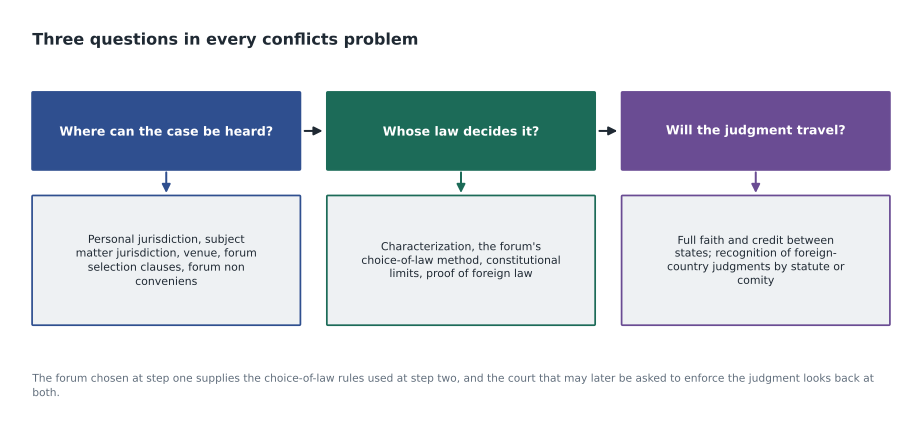
Castellane spent ten years at a New York firm handling cross-border litigation and international arbitration and then four years in a government office that negotiated private international law treaties. He tells Section B that he has one sentence he wants them to carry out of the course. "Every conflicts problem is three questions wearing one coat: where can the case be heard, whose law decides it, and will the judgment travel?" Those three questions organize this lesson, and they organize the course.
The field and its vocabulary
Conflict of laws, which international lawyers call private international law, is the body of rules a court uses when a case has connections to more than one legal system. In the United States those systems are usually the fifty states, the District of Columbia and the territories, each with its own common law and statutes, plus federal law and the laws of foreign countries. The field has three parts. Jurisdiction asks whether a court may hear the case and bind the parties. Choice of law asks which system's rules decide the dispute. Recognition and enforcement of judgments asks whether a judgment rendered in one system will be given effect in another.
Some vocabulary recurs. The forum is the court where the case is pending, and lex fori means the law of the forum. Lex loci delicti is the law of the place of the wrong, lex loci contractus the law of the place of contracting, and lex situs the law of the place where property is located. A connecting factor is the fact a choice-of-law rule uses to point to a legal system: the place of injury, a party's domicile, the place of performance. A choice-of-law rule has two halves: a category (torts, contracts, succession to land) and a connecting factor that selects the governing law for that category.
Students who arrive from Civil Procedure often assume that the first question settles the second: if a Westmarch court hears the case, Westmarch law applies. That is wrong, and it is the most important correction of the first week. A court with jurisdiction frequently applies another state's law. What the forum controls is the method used to choose, because each state's courts apply that state's own choice-of-law rules. The forum also controls procedure. That is why lawyers fight so hard over the forum: the choice of courthouse is often a choice of choice-of-law method, and therefore of the result.
The Silverline file
Castellane hands out a two-page fact sheet that will follow the class through the semester. Silverline Coach Lines, Inc. is a Harrowmere corporation with its headquarters and garages in Ashcombe. The chorale is a Westmarch nonprofit corporation. Its director, Philomena Hartwell, a sixty-one-year-old retired music teacher who lives in Brennan Falls, booked the coach in August 2026 through Silverline's website from her kitchen table. Silverline's online terms contain a clause choosing Harrowmere law, a clause selecting the courts of Harrowmere for any dispute, and a clause limiting Silverline's liability for passengers' baggage, including musical instruments, to 500 dollars per passenger.
The coach had been serviced two weeks before the trip by Ferrand Fleet Service, a garage in Brennan Falls that Silverline uses for its Westmarch runs. The tire that failed was designed and made in Ontario, Canada, by Northvale Rubber Works Ltd. and sold to Silverline through Garrison Tire Distribution LLC, a Harrowmere company. The driver, Curtis Pellegrino, lives in Ashcombe. Among the injured are Hartwell, who suffered a fractured vertebra; Leif Bergstrom, a thirty-four-year-old physical therapist from Brennan Falls, whose arm was broken and whose 18,000-dollar cello was crushed; and Winslow Fairlie, a tenor who has lived for years in Harrowmere, works in Brennan Falls and was about to move there. Behind the coach, Clemency Montclair of Brennan Falls was driving her own car with her friend Honora Tremaine as a passenger; Montclair swerved to avoid the rolling coach, struck a guardrail, and Tremaine was hurt.
Castellane assigns the two states their laws for the semester. Harrowmere caps noneconomic damages in personal injury cases at 350,000 dollars, bars recovery by a plaintiff who is more than half at fault, keeps a guest statute that bars a passenger's negligence claim against a driver who gave a free ride unless the driver was grossly negligent, and has a two-year statute of limitations for personal injury. Harrowmere's courts still follow the traditional First Restatement. Westmarch has no damages cap, uses pure comparative fault, has no guest statute, has a three-year limitations period, and follows the Second Restatement. "Real guest statutes have nearly disappeared," Castellane adds, "but they produced the cases that built modern choice of law, so Harrowmere keeps one for us."
Question one: where can the case be heard?
The first question belongs mainly to Civil Procedure, but conflicts lawyers live with it. The injured passengers could sue in Westmarch, where most of them live, where the trip began and where the coach was serviced. They could sue in Harrowmere, where Silverline is at home and where the crash happened. A Westmarch court would need personal jurisdiction over Silverline. Silverline is not at home in Westmarch under Daimler AG v. Bauman, 571 U.S. 117 (2014), but specific jurisdiction should exist: Silverline marketed charters to Westmarch customers, picked the chorale up in Brennan Falls and had the coach serviced there, and the claims arise out of or relate to those contacts in the sense used in Ford Motor Co. v. Montana Eighth Judicial District Court, 592 U.S. 351 (2021). Jurisdiction over Northvale, an Ontario manufacturer that sold through a distributor, is harder, and Lesson 8 returns to it.
Forum selection clauses complicate the picture. Silverline will argue that its terms require suit in Harrowmere. A contractual forum clause does not strip a court of jurisdiction, but courts usually enforce such clauses unless enforcement would be unreasonable or unjust, following The Bremen v. Zapata Off-Shore Co., 407 U.S. 1 (1972), and, for consumer form contracts, Carnival Cruise Lines, Inc. v. Shute, 499 U.S. 585 (1991). Whether the clause reaches tort claims by passengers who never clicked "I agree" is a question of contract interpretation and of which law governs the clause, which shows how quickly the three questions run into each other.
Question two: whose law decides it?
Suppose the passengers sue in a Westmarch state court. The court must decide, issue by issue, which state's law governs. The damages cap, comparative fault, the guest statute, the limitations period and the baggage limit may each point to a different state. Castellane writes on the board a sentence he will repeat all term: "Never ask which law applies to the case. Ask which law applies to the issue." Modern American courts decide choice of law issue by issue, a practice called issue-by-issue analysis or, when it produces a mix of laws, depecage, from the French word for dismemberment.
To answer the choice-of-law question the court must do three things. It must characterize the issue, deciding which category it belongs to: tort, contract, property, family, procedure. It must identify the connecting factors or interests that its method treats as relevant. And it must decide whether the laws actually differ. If Westmarch and Harrowmere would give the same answer, there is no conflict and the court simply applies forum law. Many apparent conflicts disappear at this step, and a lawyer who briefs an elaborate choice-of-law argument without first showing a real difference in the laws wastes the court's time.
Question three: will the judgment travel?
A judgment is only paper unless it can be enforced where the losing party has assets. Silverline's coaches, bank accounts and real estate are mostly in Harrowmere; Northvale's are in Ontario. A Westmarch judgment against Silverline will have to be enforced in Harrowmere. Between states, the Full Faith and Credit Clause of Article IV, section 1, and its implementing statute, 28 U.S.C. section 1738, require Harrowmere to give the judgment the same effect it has in Westmarch, and Lesson 9 shows how little room that leaves for second-guessing. A Westmarch judgment against Northvale would have to be enforced in Ontario under Canadian law, and an Ontario judgment brought to Westmarch would face Westmarch's statute on foreign-country judgments. Lesson 10 covers that.
Domicile
Domicile is the connecting factor that appears everywhere in conflicts: in choice of law for torts and family matters, in succession to personal property, in divorce jurisdiction and in diversity jurisdiction, where citizenship of a state means domicile. A person's domicile is the place of the person's true, fixed home, to which the person intends to return when absent. The rules are old and stable. Every person has a domicile and only one at a time. A domicile of origin is assigned at birth, usually the domicile of a parent. A new domicile of choice is acquired only when physical presence in a place coincides with an intention to make it home indefinitely. And an existing domicile continues until a new one is acquired, so a person who leaves home with no settled destination keeps the old domicile.
Courts infer intent from objective evidence: where the person votes, pays taxes, registers a car, holds a driver's license, keeps bank accounts, belongs to a church or club, keeps furniture, and what the person says, discounted for self-interest. Residence and domicile are different ideas. A person may reside in several places but be domiciled in only one, and some statutes use residence deliberately, so the lawyer must read the statute to see which concept it means. Students who move to a law school town are a familiar puzzle: courts generally hold that a student can acquire a domicile at school if the student intends to stay indefinitely, but presence for the duration of studies, with plans to leave, is not enough.
Winslow Fairlie shows why the details matter. Fairlie has lived in an apartment in Harrowmere for eleven years, votes there and holds a Harrowmere license, but he has worked in Brennan Falls for six years. In July 2026 he signed a contract to buy a condominium in Brennan Falls, with closing set for October 2026, and told friends he was "moving home to Westmarch for good." On September 19 he was still living in Harrowmere. Hannah Lindqvist argues that intent is clear. Daniel Reyes, who spent three years as a paralegal at a plaintiffs' firm, points out that intent without presence changes nothing: on the day of the crash Fairlie was domiciled in Harrowmere, whatever he planned. Castellane agrees and adds the practical point. In most courts, domicile for choice-of-law purposes is measured at the time of the events, though some modern courts give weight to a post-accident change of domicile when deciding which state's policies are really engaged. Lesson 4 shows why Fairlie's domicile could change the answer for his claim.
Corporations have no domicile in the personal sense, but conflicts rules use analogues: the state of incorporation and the principal place of business, which the Supreme Court in Hertz Corp. v. Friend, 559 U.S. 77 (2010), defined for diversity purposes as the nerve center, the place where the corporation's officers direct, control and coordinate its activities. For Silverline both point to Harrowmere. For an unincorporated association or limited liability company, diversity citizenship follows the citizenship of every member, a rule that sometimes surprises clients.
Characterization
Characterization means assigning an issue to a legal category so that the right choice-of-law rule can be applied. It sounds mechanical, but it is where much of the action is. Is a passenger's claim that the baggage limit is unenforceable a contract issue, governed by the law chosen in the contract, or a tort issue, governed by the law of the place of injury? Is Harrowmere's guest statute a rule about the duty of drivers, which looks like tort, or a rule about the relationship between host and guest, which might look like something else? Is a statute of limitations substantive or procedural? Each answer can send the case to a different body of law.
Traditional courts characterized by reference to forum law: a court asked how its own legal system would classify the issue. That approach had a hidden flexibility. A court that disliked the result of applying the law of the place of injury could recharacterize the issue as one of family law or procedure and reach a different answer. Lesson 3 shows how courts used characterization as an escape device. Modern methods reduce but do not eliminate the problem, because even an interest analysis must decide what kind of rule each law is and what policy it serves.
Courts also characterize foreign rules by function rather than by label. A Harrowmere statute that places a damages cap in its code of civil procedure is still a limit on recovery, and a forum would treat it as substantive. A rule that a contract must be in writing may be a statute of frauds, which most courts treat as substantive, or a rule of evidence, which a forum might treat as procedural. The lesson for practice is to read the competing laws, understand what they do, and characterize them honestly.
Substance and procedure
Every system agrees that the forum applies its own procedure. A Westmarch court will use Westmarch rules for pleadings, discovery, the form of trial and the conduct of the proceedings even if Harrowmere law governs the merits. The hard question is where procedure ends. Traditional law treated statutes of limitations as procedural, so a forum applied its own period even to a claim governed by foreign law, which invited forum shopping for longer periods. Many states responded with borrowing statutes, which require the forum to apply the shorter limitations period of the state where the claim arose, at least against nonresident plaintiffs. The Second Restatement, as amended in 1988, adopted a more functional approach to limitations in section 142, and the Supreme Court held in Sun Oil Co. v. Wortman, 486 U.S. 717 (1988), that the Constitution allows a forum to treat limitations as procedural, a point Lesson 8 develops.
For the Silverline passengers, the difference between Westmarch's three-year period and Harrowmere's two-year period will matter only for a plaintiff who waits more than two years to sue. Castellane uses it anyway to make a practical point. "The first conflicts question in any file is the calendar. If one candidate law has a shorter limitations period, assume it applies until you are sure it doesn't, and file early."
How the rest of the course fits together
Lessons 2 through 6 trace the methods American courts use to choose law: the traditional First Restatement and its escape devices, the interest analysis revolution, the Second Restatement that most states now follow, and the special problems of torts and contracts, including choice-of-law clauses. Lesson 7 turns to federal courts, which must decide whose choice-of-law rules to use in diversity cases. Lesson 8 covers the constitutional limits on a state's power to apply its own law, and the overlap with personal jurisdiction. Lessons 9 and 10 cover the recognition of sister-state and foreign-country judgments. Lesson 11 turns to international disputes: forum non conveniens, service and evidence abroad, proof of foreign law and the reach of American statutes overseas. Lesson 12 is a capstone problem.
Marcus Webb asks whether a conflicts course is mostly about rules that nobody uses anymore. Castellane's answer is that the old rules still decide cases in about nine states for torts and ten for contracts, still supply the starting presumptions in the Second Restatement, and still shape how lawyers argue. More important, conflicts reasoning is now part of everyday litigation. Product cases, class actions, insurance coverage disputes, employment agreements with remote workers, online consumer contracts and family cases routinely cross state lines. "You will not always see the conflicts issue labeled. Your job is to see it before your opponent does."
Worked problem
Spotting the conflicts issues in the Silverline file
Using the fact sheet, list the main issues that may be governed by different laws, and say for each which states have a plausible claim to govern.
Show solution
- Damages: Harrowmere's 350,000-dollar cap on noneconomic damages versus Westmarch's uncapped damages. Harrowmere has the place of injury and Silverline's home; Westmarch has the plaintiffs' domicile and the place where the trip began.
- Comparative fault: Harrowmere's modified 50 percent bar versus Westmarch's pure comparative fault. This matters if a passenger is found partly at fault, for example for not wearing an available seat belt.
- Guest statute: Tremaine's claim against Montclair. Both are Westmarch domiciliaries, the car is registered in Westmarch, but the accident happened in Harrowmere. This is the classic pattern of Babcock v. Jackson.
- Contract terms: the baggage limit, the forum clause and the choice-of-Harrowmere-law clause. Their validity may be governed by the chosen law, by Westmarch consumer protection law or by the law that would apply without the clause.
- Product liability against Northvale: the place of manufacture (Ontario), the place of sale to Silverline (Harrowmere) and the place of injury (Harrowmere) may all claim to govern.
- Limitations: two years in Harrowmere, three years in Westmarch; check for a Westmarch borrowing statute.
- Domicile: Fairlie's domicile on September 19 changes which states have an interest in his claim.
Answer: There are at least six separate issues, and each may need its own choice-of-law analysis. A good memo lists them first and analyzes them one at a time.
Common mistakes
MistakeThe court that hears the case applies its own law.
InsteadThe forum applies its own choice-of-law rules and its own procedure. Those rules often point to another state's law on the merits.
MistakeA person changes domicile as soon as the person decides to move.
InsteadA new domicile requires presence and intent at the same time. Until both are present, the old domicile continues.
MistakeChoice of law is decided once for the whole case.
InsteadModern courts decide choice of law issue by issue (depecage), so different laws may govern damages, fault, immunities and contract terms.
MistakeIf the laws look different on paper, there must be a conflict.
InsteadFirst check whether the laws would actually produce different results on these facts. If not, there is a false or no conflict and forum law applies.
Summary and key terms
- Conflict of laws asks three questions: where a case can be heard, which law governs and whether the judgment will be recognized elsewhere.
- The forum applies its own choice-of-law rules and procedure, but those rules may select another state's substantive law.
- Choice of law is decided issue by issue, after characterizing each issue and confirming that the competing laws actually differ.
- Domicile requires presence plus intent to remain indefinitely; a person has exactly one domicile, which continues until a new one is acquired.
- Corporations are linked to their state of incorporation and principal place of business (the nerve center under Hertz v. Friend).
- The line between substance and procedure matters most for statutes of limitations, which traditional law treated as procedural; borrowing statutes and section 142 of the Second Restatement limit forum shopping.
- Conflict of laws
- The rules courts use when a case has connections with more than one legal system; also called private international law.
- Forum
- The court where the case is pending; its law is the lex fori.
- Connecting factor
- The fact a choice-of-law rule uses to select the governing law, such as the place of injury or a party's domicile.
- Domicile
- A person's true, fixed home, acquired by presence plus intent to remain indefinitely; one at a time.
- Characterization
- Assigning an issue to a legal category (tort, contract, procedure) so that the right choice-of-law rule can be applied.
- Depecage
- Applying the laws of different states to different issues in the same case.
- Borrowing statute
- A statute requiring the forum to apply another state's shorter limitations period to claims arising there.
Practice problems
Work each problem on paper first, then reveal the answer to check.
A law student from Harrowmere attends Larkhaven Law School in Westmarch, leases an apartment for three years, keeps her Harrowmere driver's license and plans to join a Harrowmere firm after graduation. Where is she domiciled?
Show answer
Harrowmere. Presence in Westmarch is not accompanied by an intent to remain indefinitely, and her old domicile continues until a new one is acquired.
A Westmarch court hears a contract case governed by Harrowmere law. Harrowmere allows broad pretrial depositions; Westmarch limits each side to ten. Which rule applies?
Show answer
Westmarch's. Discovery is procedure, and the forum always applies its own procedure.
Why might a plaintiff whose claim is governed by Harrowmere law prefer to sue in Westmarch even though Harrowmere law will apply on the merits?
Show answer
The forum supplies the choice-of-law method, procedure and, traditionally, the statute of limitations. A different method may select different law on some issues, and Westmarch's longer limitations period might apply unless a borrowing statute prevents it.
Name the three questions Castellane says every conflicts problem contains.
Show answer
Where can the case be heard (jurisdiction), whose law decides it (choice of law), and will the judgment travel (recognition and enforcement).
Lesson quiz · 5 questions
Score 60% or more to complete this lesson.
Create a free account to save your progress, take quizzes and earn a certificate.