
LAWU-302 · Lesson 10 of 12 · 24 min
Foreign-country judgments
▶ Video coming soon A video version of this lesson is on the way.
Castellane begins with a case that crosses a national border rather than a state line. Northvale Rubber Works, the Ontario tire maker, has supplied Silverline for years under a master supply agreement that calls for payment in Canadian dollars and contains a clause choosing the law of Ontario and the courts of Toronto. After the crash Silverline stopped paying Northvale's invoices, claiming the tires were defective. Castellane asks the class to suppose that, some months from now, Northvale sues in the Ontario Superior Court of Justice in Toronto and obtains a judgment against Silverline for the unpaid invoices, about 240,000 Canadian dollars, plus interest and costs. Northvale then asks a Westmarch court to recognize and enforce the Ontario judgment against Silverline's Brennan Falls garage. "Full faith and credit does not apply to Canada," Castellane says. "So what does?" This lesson covers the recognition of foreign-country judgments in the United States, where the answer is mostly state law shaped by an old Supreme Court decision and two uniform acts.
No constitutional or federal treaty obligation
The Full Faith and Credit Clause and 28 U.S.C. section 1738 apply only to judgments of American states and territories. No federal statute governs the recognition of foreign-country judgments generally, and the United States is not a party to any treaty in force that requires recognition of foreign court judgments in civil and commercial matters. The United States signed the Hague Convention on Choice of Court Agreements in 2009 and the Hague Convention on the Recognition and Enforcement of Foreign Judgments in Civil or Commercial Matters, the 2019 Judgments Convention, on March 2, 2022, but has ratified neither. Recognition is therefore governed by state law, even in federal court, where diversity cases apply the forum state's law under Erie.
This makes the United States unusual. Many countries recognize foreign judgments only under treaties or on proof of reciprocity, and some are reluctant to enforce American judgments because of large jury awards, punitive damages and broad jurisdiction. American courts, by contrast, are generally open to recognizing foreign judgments, which sometimes leaves American plaintiffs at a disadvantage in enforcing their judgments abroad.
Hilton v. Guyot and comity
The starting point is Hilton v. Guyot, 159 U.S. 113 (1895). A French firm obtained a judgment in France against American merchants and sued on it in federal court in New York. The Supreme Court described comity as neither a matter of absolute obligation nor of mere courtesy and good will, but the recognition which one nation allows within its territory to the legislative, executive or judicial acts of another nation, having due regard both to international duty and convenience, and to the rights of its own citizens. The Court said that a foreign judgment rendered after a full and fair trial by a court of competent jurisdiction, under a system likely to secure impartial justice, with regular proceedings and proper notice, should generally be recognized without retrying the merits, absent fraud or a conflict with public policy.
The Court nonetheless refused to enforce the French judgment, five to four, because France would not have enforced a comparable American judgment without reexamining the merits. That reciprocity requirement has been widely rejected since. In the 1920s, the New York Court of Appeals held that recognition of foreign judgments was a matter of state law and declined to require reciprocity. After Erie made clear that federal courts in diversity must follow state law, Hilton's reciprocity holding lost much of its force. Most states today do not require reciprocity, though a handful include it as a ground for refusal in their statutes, and the issue remains relevant in negotiations over the Hague Judgments Convention.
The Uniform Acts
Most states have codified the law of recognition in one of two uniform acts. The Uniform Foreign Money-Judgments Recognition Act of 1962 codified the common law principles of Hilton without reciprocity. The Uniform Foreign-Country Money Judgments Recognition Act of 2005 updated it, clarifying the scope, allocating the burden of proof, adding a statute of limitations and revising the grounds for nonrecognition. As of 2025, the 2005 Act had been adopted in 29 states and the District of Columbia, the 1962 Act remained in force in 9 states, and 12 states had adopted neither and relied on common law principles. Westmarch, in Castellane's hypothetical, has adopted the 2005 Act.
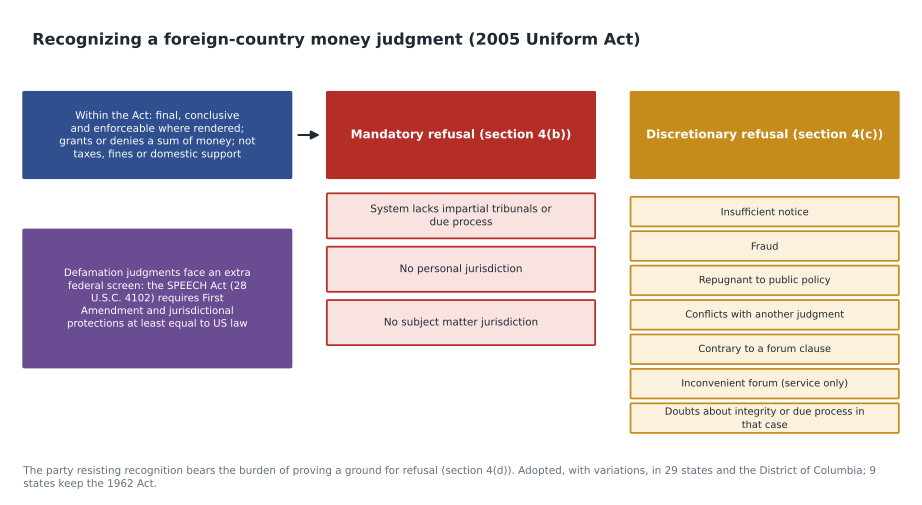
The 2005 Act applies to a foreign-country judgment to the extent it grants or denies recovery of a sum of money and, under the law of the foreign country where rendered, is final, conclusive and enforceable. It does not apply to judgments for taxes, fines or other penalties, or to judgments for divorce, support or maintenance or other judgments rendered in connection with domestic relations, which are left to other law. A party seeking recognition bears the burden of establishing that the Act applies. If it does, the court must recognize the judgment unless one of the grounds for nonrecognition applies, and the party resisting recognition bears the burden of establishing a ground.
Mandatory grounds for nonrecognition
Section 4(b) of the 2005 Act lists three grounds on which a court may not recognize a foreign judgment: the judgment was rendered under a judicial system that does not provide impartial tribunals or procedures compatible with the requirements of due process of law; the foreign court did not have personal jurisdiction over the defendant; or the foreign court did not have jurisdiction over the subject matter.
The systemic due process ground looks at the foreign judicial system as a whole, not at the fairness of the particular proceeding. Courts apply it rarely and require strong evidence. In Society of Lloyd's v. Ashenden, 233 F.3d 473 (7th Cir. 2000), Judge Richard Posner rejected an argument that English procedures were incompatible with due process, observing that the requirement means basic fairness, not identity with American procedure, and that England's legal system is the very fount from which American due process derives. Courts have found systemic defects in extreme cases, such as Bank Melli Iran v. Pahlavi, 58 F.3d 1406 (9th Cir. 1995), which refused to enforce Iranian judgments against the late Shah's sister because she could not have received a fair trial in post-revolutionary Iran.
Personal jurisdiction is measured by American standards, at least in substance. Section 5 of the 2005 Act lists bases on which a foreign judgment may not be refused for lack of personal jurisdiction, including personal service in the foreign country, voluntary appearance other than to contest jurisdiction, prior agreement to submit to the foreign court's jurisdiction, domicile or incorporation in the foreign country, and claims arising from a business office or vehicle operation there. Courts may recognize other bases as well. For Northvale's Ontario judgment, Silverline's agreement in the supply contract to submit disputes to the Toronto courts would satisfy this requirement.
Discretionary grounds
Section 4(c) lists grounds on which a court need not recognize a judgment: the defendant did not receive notice in sufficient time to defend; the judgment was obtained by fraud that deprived the losing party of an adequate opportunity to present its case; the judgment or the cause of action on which it is based is repugnant to the public policy of the state or of the United States; the judgment conflicts with another final and conclusive judgment; the proceeding was contrary to an agreement under which the dispute was to be determined otherwise than by proceedings in that foreign court; jurisdiction was based only on personal service and the foreign court was a seriously inconvenient forum; the judgment was rendered in circumstances that raise substantial doubt about the integrity of the rendering court with respect to the judgment; or the specific proceeding was not compatible with the requirements of due process of law.
The last two grounds, added in 2005, allow courts to look at corruption or unfairness in the particular case even when the foreign system as a whole is acceptable. They were influenced by litigation such as the dispute over an Ecuadorian judgment of about 9.5 billion dollars against Chevron for environmental damage in the Lago Agrio region. In Chevron Corp. v. Donziger, 833 F.3d 74 (2d Cir. 2016), the Second Circuit affirmed a judgment holding that the Ecuadorian judgment had been procured through fraud, including bribery and ghostwriting of the judgment, and barring the plaintiffs' American lawyer from profiting from it in the United States. The case illustrates both the grounds for refusal and the lengths to which a judgment debtor may go to resist enforcement.
The public policy exception for foreign judgments is narrower than its name suggests. The standard is often stated as whether the judgment is repugnant to fundamental notions of what is decent and just in the state where enforcement is sought. A difference in law, such as a foreign rule awarding costs and attorney's fees to the winning party, or a foreign damages rule more generous than the forum's, is not enough. Courts have refused recognition on public policy grounds mainly where the foreign judgment would penalize speech protected by the First Amendment, a concern Congress addressed by statute.
The SPEECH Act
Concerns about libel tourism, the practice of suing American authors and publishers in countries with plaintiff-friendly defamation laws and then seeking to enforce the judgments in the United States, led Congress to enact the Securing the Protection of our Enduring and Established Constitutional Heritage Act, the SPEECH Act, in 2010, codified at 28 U.S.C. sections 4101 to 4105. Under section 4102, a domestic court shall not recognize or enforce a foreign judgment for defamation unless the defamation law applied by the foreign court provided at least as much protection for freedom of speech and press as the First Amendment and the law of the state where the domestic court sits, or the defendant would have been found liable even under American law. The foreign court's exercise of jurisdiction must also have satisfied American due process standards. The party seeking enforcement bears the burden. The SPEECH Act is the only federal statute that directly governs recognition of a category of foreign judgments.
Procedure, limitations and currency
Under the 2005 Act, recognition must be sought by filing an action or, if recognition is raised in a pending action, by counterclaim, cross-claim or affirmative defense. The Act does not adopt the simpler registration procedure available for sister-state judgments, because the grounds for nonrecognition require judicial consideration. Once recognized, the foreign judgment is conclusive between the parties to the same extent as a sister-state judgment and enforceable in the same manner. An action to recognize a foreign-country judgment must be commenced within the earlier of the time during which the judgment is effective in the foreign country or fifteen years from the date it became effective there.
Foreign judgments are often stated in foreign currency. States that have adopted the Uniform Foreign-Money Claims Act allow judgments to be entered in the foreign currency, converted into dollars at the rate on the day before payment, which places the risk of currency fluctuation on the judgment debtor. Other states convert at the date of the foreign judgment or of the American judgment, which can produce windfalls or losses. Northvale's judgment would be in Canadian dollars, and the conversion rule could make a material difference if the exchange rate shifts.
Northvale's Ontario judgment in Westmarch
Hannah Lindqvist works through the hypothetical. Scope: a judgment for a sum of money that is final, conclusive and enforceable in Ontario is within the Act, and the award of costs, which Ontario courts routinely grant to the winning party, is compensatory, not a penalty. Mandatory grounds: Canada's judicial system provides impartial tribunals and due process; the Ontario court had personal jurisdiction because Silverline agreed in the supply contract to the jurisdiction of the Toronto courts; and it had subject matter jurisdiction. Discretionary grounds: Silverline received notice and defended, there is no suggestion of fraud, and an award of costs is not repugnant to Westmarch policy, since many American jurisdictions allow fee shifting by contract or statute.
Marcus Webb asks about a conflict with a future Westmarch judgment. Suppose that by the time Northvale seeks recognition, the federal court in Westmarch has found, in the passengers' litigation, that Northvale's tires were defective, and Silverline argues that the Ontario judgment for the price of defective tires conflicts with that finding. Castellane says the argument would depend on whether the issues are the same and whether the Westmarch judgment is final and binding between Silverline and Northvale. The conflicting-judgments ground in section 4(c)(4) gives the court discretion, and many courts favor the later judgment in such conflicts, but only if both are entitled to recognition and the issues truly overlap.
Enforcing American judgments abroad
The reverse question matters just as much to clients. If the Silverline passengers obtain a Westmarch judgment against Northvale, they will likely need to enforce it in Ontario, where Northvale's assets are. Canadian common law, as developed by the Supreme Court of Canada, is generous to foreign judgments. In Morguard Investments Ltd. v. De Savoye, [1990] 3 S.C.R. 1077, the Court held that judgments of other Canadian provinces should be recognized where the rendering court had a real and substantial connection with the action. In Beals v. Saldanha, 2003 SCC 72, it extended that approach to judgments of foreign countries, enforcing a Florida judgment against Ontario defendants and holding that the defenses of fraud, natural justice and public policy should be narrowly applied. In Chevron Corp. v. Yaiguaje, 2015 SCC 42, it held that a plaintiff seeking recognition and enforcement of a foreign judgment in Ontario need not show a real and substantial connection between the dispute or the defendant and Ontario. Canadian courts have, however, sometimes declined to enforce American punitive damages awards that they regard as grossly excessive.
In many other countries, enforcement of American judgments is more difficult. Some require treaties or reciprocity, some refuse punitive damages altogether, and some review American jurisdictional bases skeptically. That difficulty is one reason international contracts often provide for arbitration rather than litigation. Arbitral awards are enforceable in more than 170 countries under the 1958 New York Convention on the Recognition and Enforcement of Foreign Arbitral Awards, implemented in the United States by Chapter 2 of the Federal Arbitration Act, 9 U.S.C. sections 201 to 208. The 2019 Hague Judgments Convention aims to give court judgments a comparable framework. It entered into force on September 1, 2023, for the European Union and Ukraine, and later for Uruguay, the United Kingdom (July 1, 2025) and several other states, but the United States has signed without ratifying.
The Restatement (Fourth) of Foreign Relations Law
The American Law Institute's Restatement (Fourth) of the Foreign Relations Law of the United States, published in 2018, addresses the recognition of foreign judgments in sections 481 to 490. It generally follows the 2005 Uniform Act, stating that a final, conclusive and enforceable foreign judgment for a sum of money is entitled to recognition unless a ground for nonrecognition applies, rejecting reciprocity as a general requirement and treating recognition of foreign judgments as a matter of state law in the absence of a federal statute or treaty. Courts in states without a uniform act often look to the Restatement for guidance.
Worked problem
Screening a foreign judgment for recognition
A Westmarch company is sued in a foreign country whose courts are generally regarded as independent. It defaults, after receiving notice, and the foreign court enters a judgment for 1.2 million dollars on a contract claim, including an award equal to three times the actual loss as a statutory penalty for late payment. The plaintiff seeks recognition in Westmarch under the 2005 Act. What issues should the defendant raise?
Show solution
- Scope: the Act excludes judgments for fines or other penalties. The portion representing a statutory penalty payable to the private plaintiff may still be compensatory or punitive; if it is a penalty in the sense of punishment for a public wrong, that portion may fall outside the Act.
- Personal jurisdiction: the defendant defaulted, so it may contest jurisdiction now. The court will ask whether the foreign court had a basis for jurisdiction consistent with section 5 or American due process standards.
- As to notice, the defendant received it in sufficient time, so section 4(c)(1) does not help.
- Public policy: treble damages for late payment are unusual but not necessarily repugnant; American law allows multiple damages under some statutes. A court is unlikely to refuse on this ground alone.
- Partial recognition: courts may recognize the compensatory portion and refuse any penal portion.
Answer: The defendant's best arguments are lack of personal jurisdiction and exclusion of any penal portion from the Act's scope; public policy is a weak argument.
Common mistakes
MistakeThe Full Faith and Credit Clause requires recognition of foreign-country judgments.
InsteadIt applies only to American states. Foreign-country judgments are recognized under state law, usually a uniform act, based on comity.
MistakeAmerican courts require reciprocity before recognizing a foreign judgment.
InsteadHilton v. Guyot required it, but most states have abandoned reciprocity; only a handful include it as a ground for refusal.
MistakeA foreign judgment may be refused whenever foreign law differs from forum law.
InsteadThe public policy ground requires repugnance to fundamental notions of what is decent and just; differences such as costs awards are not enough.
MistakeThe United States is a party to the 2019 Hague Judgments Convention.
InsteadThe United States signed it on March 2, 2022, but has not ratified it.
Summary and key terms
- Foreign-country judgments are recognized under state law based on comity; full faith and credit does not apply, and no treaty binds the United States.
- Hilton v. Guyot (1895) defined comity and required reciprocity, which most states have since abandoned.
- The 2005 Uniform Act (29 states and DC as of 2025) requires recognition of final money judgments unless a ground for nonrecognition applies; 9 states keep the 1962 Act and 12 rely on common law.
- Mandatory grounds: systemic lack of impartial tribunals or due process, no personal jurisdiction, no subject matter jurisdiction. Discretionary grounds include notice, fraud, public policy, conflicting judgments, forum clauses, integrity of the court and case-specific due process.
- The SPEECH Act (2010) bars recognition of foreign defamation judgments that do not meet First Amendment standards.
- Canada recognizes foreign judgments generously (Morguard; Beals v. Saldanha; Chevron v. Yaiguaje); the New York Convention makes arbitral awards easier to enforce than court judgments worldwide.
- Comity
- The recognition one nation gives to another's acts and judgments out of international duty and convenience (Hilton v. Guyot).
- Reciprocity
- Recognizing a foreign judgment only if the foreign country would recognize a comparable American judgment.
- 2005 Uniform Act
- The Uniform Foreign-Country Money Judgments Recognition Act, the most widely adopted recognition statute.
- Systemic due process
- The requirement that the foreign judicial system as a whole provide impartial tribunals and fair procedures.
- SPEECH Act
- The 2010 federal statute limiting recognition of foreign defamation judgments.
- New York Convention
- The 1958 treaty on recognition and enforcement of foreign arbitral awards, implemented by 9 U.S.C. sections 201 to 208.
Practice problems
Work each problem on paper first, then reveal the answer to check.
Why did the Supreme Court refuse to enforce the French judgment in Hilton v. Guyot?
Show answer
Because France would not have enforced a comparable American judgment without reexamining the merits; the Court required reciprocity.
Under the 2005 Act, who bears the burden of proving a ground for nonrecognition?
Show answer
The party resisting recognition.
Why did Judge Posner reject the due process challenge to English judgments in Society of Lloyd's v. Ashenden?
Show answer
Because the systemic due process requirement means basic fairness, not identity with American procedure, and England's system is a source of American due process.
What did the Supreme Court of Canada hold in Chevron Corp. v. Yaiguaje?
Show answer
That a plaintiff seeking recognition and enforcement of a foreign judgment in Ontario need not show a real and substantial connection between the dispute or the defendant and Ontario.
Lesson quiz · 5 questions
Score 60% or more to complete this lesson.
Create a free account to save your progress, take quizzes and earn a certificate.