
LAWU-302 · Lesson 6 of 12 · 25 min
Torts and contracts
▶ Video coming soon A video version of this lesson is on the way.
Silverline's online booking terms run to eleven screens. On the ninth, under the heading "Governing Law and Disputes," are three sentences: "This Agreement and any dispute arising out of or relating to it or to the transportation provided under it shall be governed by the law of the State of Harrowmere. Any action shall be brought exclusively in the courts of Harrowmere. Silverline's liability for loss of or damage to baggage, including musical instruments and equipment, is limited to 500 dollars per passenger." Castellane reads them aloud and asks Section B how many of them would survive in a Westmarch court. This lesson applies the methods from Lessons 3 to 5 to the two fields that generate most choice-of-law litigation, torts and contracts, and then examines the most important tool parties have for controlling the answer: the choice-of-law clause.
Torts: the recurring patterns
Most tort conflicts fall into a few patterns, and courts using different methods often converge within each one. When the parties share a domicile and the injury occurs elsewhere, as in Babcock and Tremaine's claim against Montclair, nearly every modern method applies the law of the common domicile to loss-allocating issues such as immunities, guest statutes and caps. When conduct and injury occur in one state and the parties come from different states, most methods apply the law of that state, especially to conduct-regulating issues. The difficult cases are split-domicile cases where the conduct and the injury are in different states, or where each state's law favors its own resident, the pattern Currie called a true conflict.
In true conflicts, courts have developed recognizable tendencies. Many apply the law of the place of injury, as the Second Restatement presumes. Some favor the law of the state where both the conduct and the injury occurred if they coincide. Others apply the law more favorable to the plaintiff when the defendant could have foreseen the application of that law, an approach associated with proposals by Symeon Symeonides and with some state codifications, such as Louisiana's 1991 conflicts code and Oregon's 2009 statute on torts. The Third Restatement's torts chapter, approved as a tentative draft in 2023, also distinguishes between rules that regulate conduct and rules that allocate loss, and supplies priority rules for cases where the laws of more than one state are relevant.
Products liability
Products cases are the most complex tort conflicts because the relevant events are spread out: a product may be designed in one state, manufactured in another, sold in a third and cause injury in a fourth, and the victim may live in a fifth. Courts have considered the place of injury, the place of manufacture, the place of acquisition and the victim's domicile. The place of manufacture favors the defendant's expectations and the regulation of its conduct but would allow a manufacturer to choose its own law by choosing its factory site. The place of injury may be fortuitous, as when a car crashes in a state the family was driving through, as in Phillips v. General Motors. The place of acquisition is often the best indicator of the market the manufacturer chose to serve.
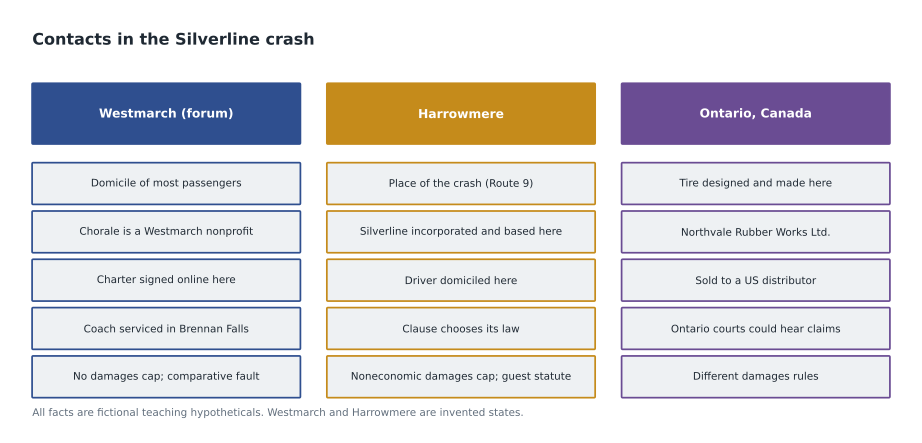
For the Silverline passengers' claims against Northvale Rubber Works, the tire maker, the contacts are spread across three jurisdictions. The tire was designed and made in Ontario, sold to a Harrowmere distributor, Garrison Tire Distribution, and installed on a Harrowmere company's coach; the injuries occurred in Harrowmere; most victims live in Westmarch. Harrowmere is the place of injury and of acquisition and the place where Northvale chose to send its product, which makes Harrowmere law a strong candidate under most methods. Ontario law, as the law of the place of manufacture, is unlikely to govern liability unless it is more favorable to the plaintiffs and they invoke it, and some American courts are reluctant to apply foreign law to protect an American victim from a foreign manufacturer. Lesson 11 returns to Northvale because it will also try to move the case to Ontario.
Contracts without a choice-of-law clause
When a contract contains no effective choice of law, the traditional rule looked to the place of contracting for validity and the place of performance for performance, as Lesson 3 explained. The Second Restatement's section 188 instead applies the law of the state with the most significant relationship to the transaction and the parties with respect to the particular issue, considering the place of contracting, the place of negotiation, the place of performance, the location of the subject matter and the domicile, residence, nationality, place of incorporation and place of business of the parties. Section 188(3) adds that if the place of negotiating and the place of performance are in the same state, that state's law will usually be applied. Sections 189 to 197 provide presumptive rules for particular contracts: the situs for contracts concerning land, the principal location of the insured risk for insurance contracts (section 193), the place where services are to be rendered for service contracts (section 196) and the place of departure or destination for transportation contracts (section 197).
Section 197, which applies to contracts for the transportation of passengers, points presumptively to the law of the state from which the passenger departs or the goods are dispatched, unless another state has a more significant relationship. For the chorale, the place of departure was Brennan Falls, which gives Westmarch a strong presumptive claim to govern the charter contract if the choice-of-law clause fails.
Party autonomy and section 187
Most commercial contracts today contain a choice-of-law clause, and American courts generally enforce them. Party autonomy promotes certainty, allows parties to plan and price their risks, and reduces litigation over the governing law. The First Restatement gave party choice little room, reasoning that private parties could not legislate which law governed, but the modern rule, stated in section 187 of the Second Restatement, is strongly favorable to enforcement, with two limits.
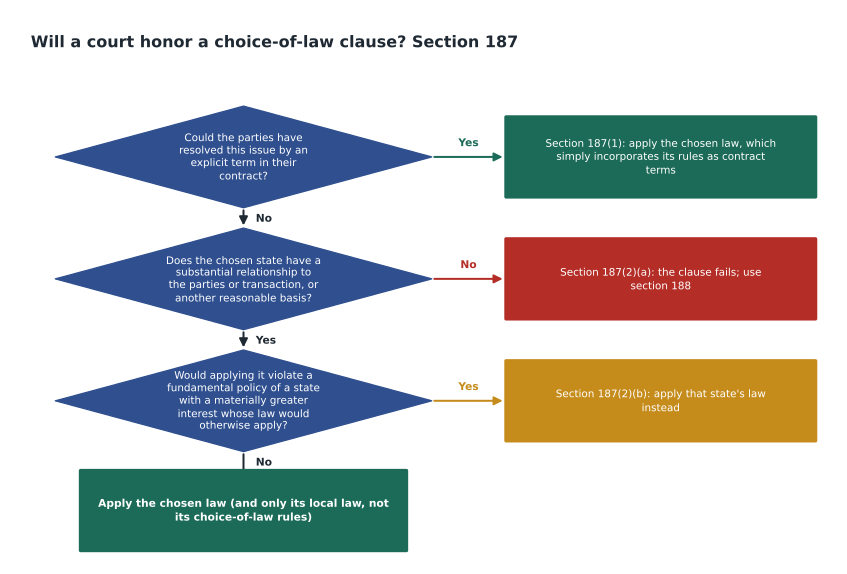
Section 187(1) provides that the law chosen by the parties will be applied if the particular issue is one that the parties could have resolved by an explicit provision in their agreement. On issues of that kind, such as the meaning of terms, the time for delivery or the measure of damages for delay, the parties could simply have written the chosen state's rule into their contract, so a choice-of-law clause operates like incorporation by reference, and no inquiry into the chosen state's connection is needed.
Section 187(2) governs issues the parties could not have resolved by contract, such as capacity, formalities, illegality and the enforceability of terms protected by mandatory law. The chosen law applies unless either (a) the chosen state has no substantial relationship to the parties or the transaction and there is no other reasonable basis for the parties' choice, or (b) application of the chosen law would be contrary to a fundamental policy of a state which has a materially greater interest than the chosen state in the determination of the particular issue and which would be the state of the applicable law in the absence of an effective choice. Section 187(3) adds that, absent a contrary indication, the reference is to the chosen state's local law, not its choice-of-law rules, which avoids renvoi.
Applying section 187: substantial relationship and fundamental policy
The substantial relationship requirement is easy to satisfy. A party's state of incorporation, principal place of business or place of performance is enough. Courts also accept a reasonable basis without a substantial relationship, such as choosing a neutral state with a well-developed body of commercial law. New York has made this explicit by statute: General Obligations Law section 5-1401 allows parties to a contract involving 250,000 dollars or more to choose New York law whether or not the contract bears a reasonable relation to New York, and section 5-1402 allows parties to contracts of one million dollars or more to choose New York courts. These statutes help explain why so many international contracts select New York law.
The fundamental policy exception is where the contest usually lies. Not every difference in law reflects a fundamental policy; otherwise the exception would swallow the rule. The comments to section 187 suggest that a fundamental policy may be embodied in a statute that makes certain contracts illegal or is designed to protect a person against the oppressive use of superior bargaining power. Courts have found fundamental policies in rules protecting employees, consumers, franchisees and insureds. The forum must also find that the state with that policy has a materially greater interest than the chosen state and that its law would apply under section 188 absent the clause.
Noncompetition agreements are the classic battleground. In DeSantis v. Wackenhut Corp., 793 S.W.2d 670 (Tex. 1990), a Florida security company's noncompete with a manager working in Texas chose Florida law, which was more favorable to enforcement. The Texas Supreme Court held that Texas law applied under section 187(2)(b): the enforceability of covenants not to compete against Texas employees was a matter of fundamental Texas policy, Texas had a materially greater interest because the employee lived and worked there and the competition occurred there, and Texas law would govern absent the clause. In Application Group, Inc. v. Hunter Group, Inc., 61 Cal. App. 4th 881 (1998), a California court refused to enforce a Maryland noncompete, governed by a Maryland choice-of-law clause, against a Maryland employee recruited by a California company to work remotely for California clients, reasoning that California's statutory policy against noncompetes protected California employers' freedom to hire. California has since codified its position more aggressively, as the capstone in Lesson 12 discusses.
Scope of the clause
A choice-of-law clause governs only what it covers, and its scope is a matter of contract interpretation, usually under the chosen law. A clause saying that "this agreement shall be governed by the law of Harrowmere" is read by many courts to cover only contract claims, not related torts. A broader clause covering disputes "arising out of or relating to" the agreement may reach tort and statutory claims. In Nedlloyd Lines B.V. v. Superior Court, 3 Cal. 4th 459 (1992), the California Supreme Court, applying section 187, enforced a clause choosing Hong Kong law in a shareholders' agreement and held that a clause providing that the agreement "shall be governed by and construed in accordance with Hong Kong law" also reached the plaintiff's claims for breach of fiduciary duty arising from the relationship. Courts are not uniform on scope, so drafters who want a clause to cover torts should say so expressly, as Silverline did.
Statutory directives and party autonomy
Statutes sometimes override or channel party choice. Uniform Commercial Code section 1-301 allows parties to a transaction bearing a reasonable relation to more than one state to choose the law of any such state, but subjects that freedom to specific provisions, such as Article 9's own rules on perfection and priority of security interests. Consumer protection statutes in many states declare that their protections cannot be waived by a choice of another state's law. California Labor Code section 925, enacted in 2016, provides that an employer may not require an employee who primarily resides and works in California, as a condition of employment, to agree to adjudicate claims outside California or to deprive the employee of California law's protection with respect to controversies arising in California, unless the employee was individually represented by counsel in negotiating the terms. Such statutes are the clearest form of fundamental policy, and under section 6(1) a forum court will follow its own statutory directive.
In maritime cases, federal law supplies the rule. In Great Lakes Insurance SE v. Raiders Retreat Realty Co., 601 U.S. 65 (2024), a marine insurance policy on a yacht chose New York law, and the insured argued that a Pennsylvania statute on bad faith reflected fundamental Pennsylvania policy. The Supreme Court unanimously held that choice-of-law provisions in maritime contracts are presumptively enforceable under federal maritime law, subject to narrow exceptions, such as when the chosen law would contravene a controlling federal statute or conflict with an established federal maritime policy, or when there is no substantial relationship and no other reasonable basis for the choice. The Court declined to recognize an exception for the fundamental public policy of the state whose law would otherwise apply. Great Lakes governs only maritime contracts, but it shows the Court's strong support for party autonomy.
Consumer and adhesion contracts
Online form contracts present particular problems. The customer never negotiates, often does not read, and may not even be the person suing. Courts generally enforce choice-of-law clauses in consumer form contracts when the customer had reasonable notice and the chosen state has a real connection, but they are more willing to find a fundamental policy where the forum's statute protects consumers, and they are skeptical of clauses that operate as a waiver of statutory rights. Clauses in contracts of carriage, insurance, employment and franchise are the most frequently challenged.
The Silverline clauses
Section B works through the three sentences. First, the choice of Harrowmere law. Harrowmere has a substantial relationship because Silverline is incorporated and headquartered there and most of the transportation was to occur there, so section 187(2)(a) is satisfied. The clause expressly covers disputes "relating to" the transportation, which suggests it was meant to cover tort claims arising from the trip, though courts differ on whether a clause in a consumer contract should be read to govern personal injury claims of passengers who never agreed to it.
Second, the baggage limit. Whether a carrier may limit its liability for baggage is not something the parties could resolve by agreement if Westmarch's statute forbids it, so section 187(2) applies. Assume, as Castellane's fact sheet does, that Westmarch's Consumer Transportation Act voids any limitation of liability below actual value for baggage carried in consumer passenger transportation originating in Westmarch. That statute protects consumers against superior bargaining power and is likely a fundamental policy. Westmarch, the place of departure, the customer's home and the passengers' home, probably has a materially greater interest than Harrowmere in this issue, and section 197 would point to Westmarch absent the clause. Bergstrom has a strong argument that the 500-dollar limit fails, though a court might give weight to federal law on interstate passenger carriers, which Castellane notes the class would need to research.
Third, the personal injury claims. Even if the clause reaches torts, section 187(2)(b) asks whether applying Harrowmere's damages cap would be contrary to a fundamental policy of Westmarch. Westmarch has chosen not to cap damages, but the absence of a cap is not necessarily a fundamental policy. The passengers, other than Hartwell, did not sign the contract at all, which raises the question whether the clause binds them. A court is likely to analyze the personal injury claims under the ordinary tort approach in Lesson 5 rather than give the clause decisive effect, although Silverline will argue that the clause reinforces its justified expectation that Harrowmere law governs.
Forum selection and choice of law together
Silverline's clause also chooses Harrowmere's courts. A forum selection clause and a choice-of-law clause interact: if the forum clause is enforced, the case goes to Harrowmere, which will apply its First Restatement rules and probably its own law. Federal courts enforce forum clauses through transfer under 28 U.S.C. section 1404(a) or dismissal for forum non conveniens, following Atlantic Marine Construction Co. v. U.S. District Court, 571 U.S. 49 (2013), which held that a valid forum selection clause should be given controlling weight in all but the most exceptional cases. State courts apply their own law on the enforceability of forum clauses. Lesson 7 covers Atlantic Marine's effect on choice of law.
Worked problem
A noncompete with a choice-of-law clause
A Westmarch software company employs a programmer who lives and works in Harrowmere. Her agreement contains an 18-month noncompete and a clause choosing Westmarch law. Westmarch enforces reasonable noncompetes; Harrowmere has a statute declaring employee noncompetes void. She joins a Harrowmere competitor and is sued in Westmarch. Apply section 187.
Show solution
- Could the parties have resolved the enforceability of the noncompete by agreement? No; whether such a covenant is enforceable at all is a matter of mandatory law, so section 187(2) applies.
- Substantial relationship: the employer is a Westmarch company, so Westmarch has a substantial relationship. Section 187(2)(a) is satisfied.
- Fundamental policy: Harrowmere's statute voiding employee noncompetes reflects a fundamental policy protecting employee mobility (compare DeSantis).
- Materially greater interest: the employee lives and works in Harrowmere, and the competition would occur there. Harrowmere's interest is likely materially greater.
- Would Harrowmere law apply absent the clause? Under section 188 and section 196 (place of services), yes.
- Result: under section 187(2)(b), the Westmarch court would likely apply Harrowmere law and refuse enforcement, unless Westmarch has a statutory directive of its own.
Answer: The clause probably fails on this issue. The employer's practical response is often to sue first in its home forum and hope for a different reading, which is the race Lesson 12 explores.
Common mistakes
MistakeA choice-of-law clause is enforceable only if the parties have a substantial relationship to the chosen state.
InsteadUnder section 187(1), for issues the parties could resolve by contract, no relationship is required; under section 187(2)(a), a reasonable basis suffices even without a substantial relationship.
MistakeAny difference between the chosen law and the forum's law triggers the fundamental policy exception.
InsteadThe policy must be fundamental, the other state must have a materially greater interest, and its law must be the one that would apply absent the clause.
MistakeA clause choosing a state's law always covers tort claims between the parties.
InsteadScope depends on the wording and the court; narrow clauses may cover only contract claims. Nedlloyd read a broad clause to cover fiduciary claims.
MistakeGreat Lakes v. Raiders Retreat requires state courts to enforce all choice-of-law clauses.
InsteadGreat Lakes concerns maritime contracts under federal maritime law.
Summary and key terms
- Tort conflicts fall into patterns: common-domicile cases usually get the domicile's law for loss allocation, and single-state conduct and injury cases get that state's law.
- Products cases weigh the places of manufacture, acquisition and injury and the victim's domicile; the place of acquisition often signals the market the manufacturer chose.
- Without a clause, section 188 applies the most significant relationship test, with presumptions in sections 189 to 197 (section 197 points to the place of departure for passenger transport).
- Section 187 enforces chosen law for issues parties could resolve by contract, and otherwise unless there is no substantial relationship or reasonable basis, or the chosen law violates a fundamental policy of a state with a materially greater interest.
- DeSantis (Tex. 1990) and Application Group (Cal. App. 1998) refused to enforce chosen law for noncompetes; Nedlloyd (Cal. 1992) enforced a broad clause and extended it to fiduciary claims.
- Statutory directives (UCC 1-301, New York GOL 5-1401, California Labor Code 925) shape party autonomy; Great Lakes (2024) makes maritime choice-of-law clauses presumptively enforceable.
- Party autonomy
- The principle that parties may choose the law governing their contract.
- Section 187(1)
- Chosen law applies to issues the parties could have resolved by explicit agreement.
- Section 187(2)(b)
- The fundamental policy exception, applying the law of a state with a materially greater interest whose law would otherwise govern.
- Scope of a clause
- The range of claims (contract, tort, statutory) a choice-of-law clause covers, determined by its wording.
- Statutory directive
- A statute dictating which law applies or forbidding contractual choices of other law.
Practice problems
Work each problem on paper first, then reveal the answer to check.
Why did the Texas Supreme Court refuse to apply Florida law in DeSantis v. Wackenhut?
Show answer
Texas had a fundamental policy on the enforceability of noncompetes against Texas employees, Texas had a materially greater interest because the employee lived and worked there, and Texas law would apply absent the clause.
A contract worth 5 million dollars between a Westmarch buyer and a German seller chooses New York law. Neither party has any connection to New York. Will a New York court honor the choice?
Show answer
Yes. New York General Obligations Law section 5-1401 allows parties to contracts of 250,000 dollars or more to choose New York law regardless of any reasonable relation.
What did Great Lakes Insurance SE v. Raiders Retreat Realty hold?
Show answer
That choice-of-law provisions in maritime contracts are presumptively enforceable under federal maritime law, subject to narrow exceptions that do not include a state's fundamental public policy.
Under section 197, which state's law presumptively governs a contract for the transportation of passengers?
Show answer
The law of the state from which the passenger departs, unless another state has a more significant relationship.
Lesson quiz · 5 questions
Score 60% or more to complete this lesson.
Create a free account to save your progress, take quizzes and earn a certificate.