
LAWU-302 · Lesson 5 of 12 · 25 min
The Second Restatement: the most significant relationship
▶ Video coming soon A video version of this lesson is on the way.
Westmarch, in Castellane's semester-long hypothetical, follows the Restatement (Second) of Conflict of Laws, as most real states do. That means the Silverline passengers' best hope of avoiding Harrowmere's damages cap lies in the most significant relationship test. Castellane opens with the cover of the 1971 volumes and a warning. "Every lawyer who has litigated a Second Restatement case knows the feeling of reading section 6 and realizing that both sides can cite every word of it. Your job is to make the contacts and principles point one way, honestly, by being specific about the issue."
Structure of the Second Restatement
The Second Restatement, prepared under Willis Reese of Columbia as Reporter and adopted by the American Law Institute in 1969 and published in 1971, has three layers. The first is section 6, which states the general principles that guide any choice of law in the absence of a statutory directive. The second is a set of general sections for broad fields, such as section 145 for torts and section 188 for contracts, which tell the court to apply the law of the state with the most significant relationship to the occurrence and the parties, with respect to the particular issue, and list the contacts to be considered. The third layer consists of specific sections for particular kinds of cases and issues, such as section 146 for personal injuries, section 175 for wrongful death and sections 189 to 197 for particular contracts. Those specific sections usually state a presumptive rule, often resembling the First Restatement's rule, which applies unless, with respect to the particular issue, some other state has a more significant relationship.
A court using the Second Restatement therefore normally proceeds in three steps. It identifies the issue and the specific section, if any, that provides a presumptive rule. It examines the contacts listed in the general section. And it evaluates those contacts in light of the section 6 principles to decide whether the presumption holds or another state's relationship is more significant.
Section 6: the principles
Section 6(1) says that a court, subject to constitutional restrictions, will follow a statutory directive of its own state on choice of law. Some statutes contain such directives, for example the Uniform Commercial Code's section 1-301 or statutes declaring that a consumer protection law applies to all residents regardless of a contrary contract clause. When there is no directive, section 6(2) lists the relevant factors: (a) the needs of the interstate and international systems; (b) the relevant policies of the forum; (c) the relevant policies of other interested states and the relative interests of those states in the determination of the particular issue; (d) the protection of justified expectations; (e) the basic policies underlying the particular field of law; (f) certainty, predictability and uniformity of result; and (g) ease in the determination and application of the law to be applied.
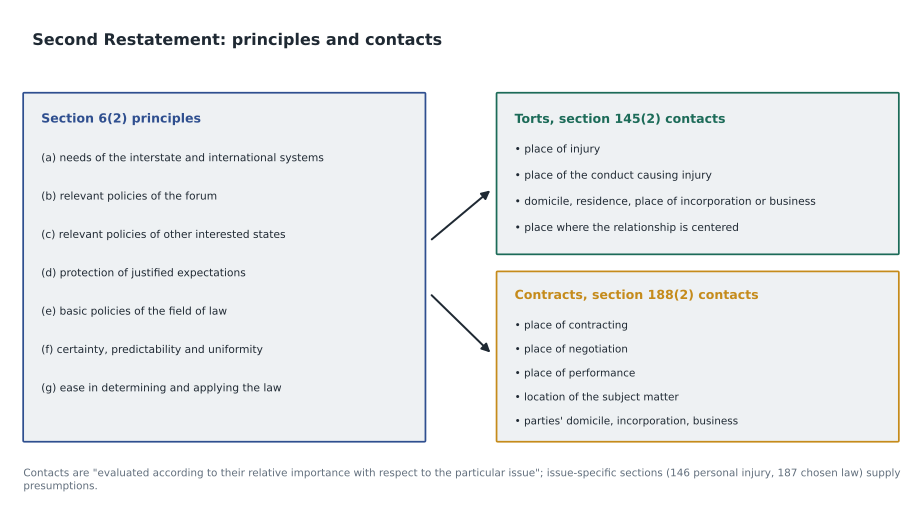
The list is not ranked, and the comments acknowledge that the factors may point in different directions. Factors (b) and (c) bring interest analysis into the method. Factors (d) and (f) emphasize the expectations of parties and the value of predictable rules, which matter most in contract and property cases where parties plan. Factor (a), the needs of the system, asks whether a choice would promote harmonious relations among states and discourage forum shopping. Factor (e) asks about the purposes of the field as a whole, such as compensation and deterrence in tort. Factor (g), ease of application, is usually a tiebreaker in favor of forum law but is supposed to carry little weight.
Section 145: torts generally
Section 145(1) states that the rights and liabilities of the parties with respect to an issue in tort are determined by the local law of the state which, with respect to that issue, has the most significant relationship to the occurrence and the parties under the principles of section 6. Section 145(2) lists the contacts to be taken into account: (a) the place where the injury occurred; (b) the place where the conduct causing the injury occurred; (c) the domicile, residence, nationality, place of incorporation and place of business of the parties; and (d) the place where the relationship, if any, between the parties is centered. The contacts are to be evaluated according to their relative importance with respect to the particular issue. Counting contacts is not enough, and courts that simply tally them are criticized for misreading the Restatement.
The phrase "with respect to the particular issue" is the key to the section. The place of injury may matter a great deal for a rule of conduct, such as whether a driver had to stop at a particular intersection, and much less for a rule allocating loss between parties who share a domicile elsewhere. The comments to section 145 make the point directly: the state where the conduct occurred usually has the dominant interest in standards of conduct, while the state of the parties' common domicile, or where their relationship is centered, may have the dominant interest in issues such as immunities and guest statutes.
Section 146 and the presumption for personal injury
Section 146 provides that in an action for personal injury, the local law of the state where the injury occurred determines the rights and liabilities of the parties, unless, with respect to the particular issue, some other state has a more significant relationship under the principles of section 6 to the occurrence and the parties, in which event the local law of the other state will be applied. Similar presumptions appear in section 147 for injuries to land and tangible things and section 175 for wrongful death. The presumption explains why many Second Restatement courts reach the same result as lex loci delicti in ordinary cases: when an accident happens in one state and the parties have no strong connection elsewhere, the place of injury wins.
Comments to section 146 explain that the place of injury is especially likely to govern when the injury occurred where the conduct occurred and where the injured person resided, and less likely to govern when the place of injury is fortuitous, such as an airplane crash in a state the plane was merely flying over, or when the parties' relationship is centered elsewhere. The presumption is strongest for conduct-regulating rules and weakest for loss-allocating rules among parties who share a home elsewhere.
Other specific tort sections
The Second Restatement contains specific sections for several torts. For fraud and misrepresentation, section 148 points to the place where the plaintiff acted in reliance, if that is also where the representation was received, and otherwise lists contacts. For multistate defamation, such as a statement published nationally, section 150 directs the court to the state with the most significant relationship, which will usually be the state where the plaintiff was domiciled at the time if the matter was published there. Section 171 applies the law selected under section 145 to the measure of damages, which makes damages caps part of the same analysis as liability. Section 172 covers joint torts and section 173 contribution and indemnity. Specific sections are only presumptions; the general principles always remain available.
Applying the Second Restatement: Phillips and Townsend
Two state supreme court decisions in product cases show how the same Restatement can produce different results. In Phillips v. General Motors Corp., 2000 MT 55, a Montana family was killed or injured in Kansas when their General Motors pickup was involved in a collision and its fuel tank ruptured. The family sued in Montana. Kansas law was more favorable to the manufacturer; Montana's product liability law was stricter. The Montana Supreme Court adopted the Second Restatement for tort cases and held that Montana law applied. It reasoned that the place of injury was fortuitous, that the plaintiffs were Montana residents whose losses would be felt in Montana, and that Montana's policies of compensating injured residents and deterring defective products sold to them were strongly engaged, while Kansas had little interest in applying its pro-manufacturer rules to a case involving Montana plaintiffs and a non-Kansas manufacturer.
In Townsend v. Sears, Roebuck & Co., 227 Ill. 2d 147 (2007), a Michigan boy was injured in Michigan by a riding lawn mower bought in Michigan. He sued Sears, based in Illinois, which had participated in the mower's design there. Michigan law capped noneconomic damages and was more protective of defendants; Illinois law was more favorable to the plaintiff. The Illinois Supreme Court held that the section 146 presumption in favor of the place of injury was not overcome. Michigan was the place of injury and the plaintiff's domicile, and the relationship between the parties was centered there. Illinois's interest in regulating conduct by Illinois companies did not outweigh Michigan's interest in the rules governing its own residents injured in Michigan by products sold there. Michigan law applied.
Castellane puts the two decisions side by side. In Phillips the place of injury was not the plaintiffs' home and was fortuitous; in Townsend the place of injury was the plaintiff's home and the place of sale. "The Second Restatement rewards lawyers who notice which contacts coincide," he says. "When the place of injury and the victim's home are the same, the presumption is very hard to overcome. When they diverge, the fight begins."
The Silverline cap in a Westmarch court
Section B works the damages cap as a Westmarch judge applying the Second Restatement would. The issue is whether Harrowmere's 350,000-dollar cap on noneconomic damages limits the recovery of Westmarch passengers Hartwell and Bergstrom against Silverline. Section 146 presumes the law of the place of injury, Harrowmere. Section 171 applies the same analysis to the measure of damages.
Marcus Webb lists the section 145 contacts. Place of injury: Harrowmere, on Route 41. Place of the conduct causing injury: the tire failure happened in Harrowmere, but the relevant conduct, if Silverline was negligent, may include the inspection and maintenance of the coach, which occurred partly in Brennan Falls at Ferrand Fleet Service and partly at Silverline's Ashcombe garage. Domicile and place of business: the plaintiffs in Westmarch, Silverline in Harrowmere. Place where the relationship was centered: the charter was arranged with a Westmarch nonprofit, sold to a Westmarch customer, began in Brennan Falls and was to end there. That contact favors Westmarch.
Then the section 6 principles. Westmarch's policy, reflected in having no cap, is full compensation of injured persons, and its residents bear the losses. Harrowmere's policy, reflected in its cap, protects defendants and their insurers from large awards, and Silverline is a Harrowmere company. That is a true conflict in Currie's terms. Justified expectations: Silverline may have priced its insurance on the assumption that Harrowmere law would govern injuries in Harrowmere, and its contract chose Harrowmere law, which may reinforce that expectation if the clause covers tort claims. The passengers expected nothing in particular. Predictability and the needs of the system favor a rule that does not change with the passengers' domicile, which points to the place of injury. Basic policies of tort law include both compensation and avoiding unfair surprise to defendants.
Jordan Kimura concludes that the presumption favoring Harrowmere is strong but not conclusive. The relationship was centered in Westmarch, Silverline actively sought Westmarch business, and the place of injury, while not fortuitous, was one point on a round trip. A Westmarch court could reasonably go either way, and results under the Second Restatement often turn on the specific court's view of how much weight to give the presumption. Castellane calls that a fair answer and a realistic one. "Write the brief for the result you want, but tell the client the truth: this is a contested issue, and it may be decided on appeal."
Depecage and the other Silverline issues
The Second Restatement's issue-by-issue approach allows different laws to govern different issues. In Tremaine's claim against Montclair, the guest statute issue is easily resolved in favor of Westmarch law: both parties are Westmarch domiciliaries, the car was registered and insured there, the relationship was centered there, and the comments to section 145 point to the common domicile for such issues. But whether Montclair was driving negligently, for example by following too closely on Route 41, is a conduct issue for which Harrowmere's rules of the road govern, because the conduct happened on a Harrowmere highway.
Comparative fault presents a closer question. Suppose Bergstrom was not wearing an available seat belt. Harrowmere bars a plaintiff more than 50 percent at fault and may admit evidence of seat belt nonuse; Westmarch uses pure comparative fault. Comparative fault rules allocate loss, so a court may analyze them like the cap, but they are also connected to conduct on the road. Courts are divided on whether to treat comparative fault as conduct-regulating or loss-allocating, and depecage creates a risk of combining rules from two states in a way neither state would accept, such as Westmarch's uncapped damages with Harrowmere's lenient admission of seat belt evidence. A careful court considers whether the rules are interdependent before splitting them.
Renvoi and limitations in the Second Restatement
Section 8 of the Second Restatement generally rejects renvoi, directing the court to apply the local law of the chosen state, but it allows a court to apply another state's choice-of-law rules when the objective of the particular rule is that the forum reach the same result as a court of that state, as with land titles, or when the other state's choice-of-law rule shows that it has no interest in having its law applied. The second exception is useful in practice: if Harrowmere's own courts would not apply the cap to a case like this, a Westmarch court can treat that as evidence that Harrowmere has no interest in its application.
As revised in 1988, section 142 changed the treatment of statutes of limitations. A forum will generally apply its own statute of limitations barring a claim. But it will apply its own statute permitting a claim unless maintaining the claim would serve no substantial interest of the forum and the claim would be barred under the law of a state having a more significant relationship to the parties and the occurrence. The revision reduces the attraction of forum shopping for longer limitation periods while leaving room for borrowing statutes, which take precedence where they apply.
Evaluating the Second Restatement
Critics, including Lea Brilmayer, have described the Second Restatement as an invitation to judicial discretion dressed as law, and empirical studies have found that Second Restatement courts apply forum law in a large majority of cases. Defenders respond that the presumptive rules give real guidance, that the flexibility allows courts to avoid the arbitrary results of the First Restatement, and that no alternative has proven more predictable in practice. The Third Restatement drafts, introduced in Lesson 2, try to keep the Second Restatement's attention to purposes while giving courts more specific priority rules. For practice in most states, however, the Second Restatement remains the governing framework, and lawyers must master its vocabulary.
Castellane ends with a list of habits for Second Restatement briefs. Name the issue precisely. Find the specific section and its presumption. Present the section 145 or 188 contacts, but explain which ones matter for this issue and why. Discuss the policies of each state's law, with citations to legislative findings or judicial explanations where possible. Address expectations and predictability honestly. And show the court that the result is one that a court in the other state might also accept, because judges are more comfortable with choices that do not look parochial.
Worked problem
A Second Restatement analysis of the baggage limit
Leif Bergstrom sues Silverline for the value of his crushed 18,000-dollar cello. Silverline relies on its 500-dollar baggage limit. Assume the court must decide which state's law governs the validity of the limit without regard to the choice-of-law clause. Outline the Second Restatement analysis.
Show solution
- Characterize: the limit is a contract term, so the issue is contract validity under section 188 (and, if the clause is considered, section 187, covered in Lesson 6).
- Contacts under section 188(2): place of contracting, Westmarch (Hartwell accepted online in Brennan Falls); place of negotiation, none in a real sense (online form); place of performance, both states, since the trip began in Westmarch and was to occur largely in Harrowmere; location of the subject matter, the coach and the instruments, moving between both; domicile and place of business, Westmarch for the chorale and passengers, Harrowmere for Silverline.
- Policies: suppose Westmarch's consumer law voids limits below actual value for baggage carried as part of consumer transportation, to protect consumers who cannot bargain; Harrowmere enforces the limits to keep fares low and predictable.
- Section 6: Westmarch's protective policy is engaged because the customer and passengers are Westmarch residents; Harrowmere's interest in Silverline's pricing is real. Expectations favor whichever law the parties reasonably anticipated, but a consumer's expectations about fine print are weak.
- Likely result: many courts would find Westmarch's relationship more significant for a consumer protection issue, but Silverline's choice-of-law clause, analyzed under section 187, may change the outcome.
Answer: Without the clause, Westmarch law has a good claim to govern the baggage limit. With the clause, the question becomes whether Westmarch's consumer protection is a fundamental policy of a state with a materially greater interest.
Common mistakes
MistakeThe most significant relationship test means counting the contacts and picking the state with the most.
InsteadContacts are evaluated by their relative importance with respect to the particular issue, in light of the section 6 principles. Tallying is a common error.
MistakeSection 146 always requires the law of the place of injury.
InsteadIt creates a presumption that another state's more significant relationship can overcome, as in Phillips v. General Motors.
MistakeThe Second Restatement applies one law to the whole case.
InsteadIt applies issue by issue, and different laws may govern conduct, loss allocation, damages and contract terms.
MistakeSection 6(2)(g), ease of application, means the forum should apply its own law.
InsteadEase of application is a minor factor; the comments say it should not override the others.
Summary and key terms
- The Second Restatement (1971) combines general principles (section 6), general sections with contacts (sections 145 and 188) and specific sections with presumptive rules.
- Section 6(2) lists seven unranked principles, including the policies of the forum and other interested states, justified expectations and predictability.
- Section 145 lists the tort contacts: place of injury, place of conduct, the parties' domiciles and places of business, and where the relationship is centered, evaluated issue by issue.
- Section 146 presumes the law of the place of injury in personal injury cases unless another state has a more significant relationship.
- Phillips v. General Motors (Mont. 2000) overcame the presumption where the place of injury was fortuitous; Townsend v. Sears (Ill. 2007) applied the place-of-injury law where it was also the plaintiff's home.
- Section 8 generally rejects renvoi, and revised section 142 limits use of a forum's longer limitations period when the forum has no substantial interest.
- Most significant relationship
- The Second Restatement test selecting the state whose law governs a particular issue, guided by section 6.
- Section 6 principles
- Seven factors guiding choice of law, from the needs of the interstate system to ease of application.
- Presumptive rule
- A specific section's default choice, such as the place of injury in section 146, that another state's more significant relationship can overcome.
- Statutory directive
- A statute telling courts which law to apply, which section 6(1) says the forum must follow.
- Center of the relationship
- The state where the parties' relationship is based, a contact in section 145(2)(d).
Practice problems
Work each problem on paper first, then reveal the answer to check.
Why did the Montana Supreme Court apply Montana law in Phillips v. General Motors although the accident occurred in Kansas?
Show answer
The place of injury was fortuitous; the plaintiffs were Montana residents whose losses would be felt there, and Montana's compensation and deterrence policies were strongly engaged, while Kansas had little interest in the case.
In Townsend v. Sears, why was the section 146 presumption not overcome?
Show answer
The injury occurred in Michigan, where the plaintiff lived and the mower was bought, and the relationship was centered there; Illinois's interest in regulating its company's conduct did not outweigh Michigan's interest.
Under section 8, when may a Second Restatement court look at another state's choice-of-law rules?
Show answer
When the objective is that the forum reach the same result as the other state's courts (as with land), or when the other state's choice-of-law rule shows it has no interest in having its law applied.
What risk does depecage create when comparative fault and damages rules are split between states?
Show answer
It may combine rules from two states in a way neither state would accept, producing a result more favorable to one party than either state's law as a whole.
Lesson quiz · 5 questions
Score 60% or more to complete this lesson.
Create a free account to save your progress, take quizzes and earn a certificate.