
LAWU-302 · Lesson 12 of 12 · 27 min
Capstone: a multistate and international problem
▶ Video coming soon A video version of this lesson is on the way.
For the final class, Castellane sets the Silverline file aside and distributes a new problem, the Larkspur file, with a two-hour time limit and an instruction to write a memo to the partner in charge. "Use the six steps," he says. "Forum, issues, laws, method, limits, judgment. The best answers will not be the ones that cite the most cases. They will be the ones that see how the pieces depend on each other, and tell the client what to do on Monday morning." The file is entirely fictional, and Westmarch and Harrowmere keep the laws assigned to them for this problem, but the legal rules are real.
The facts
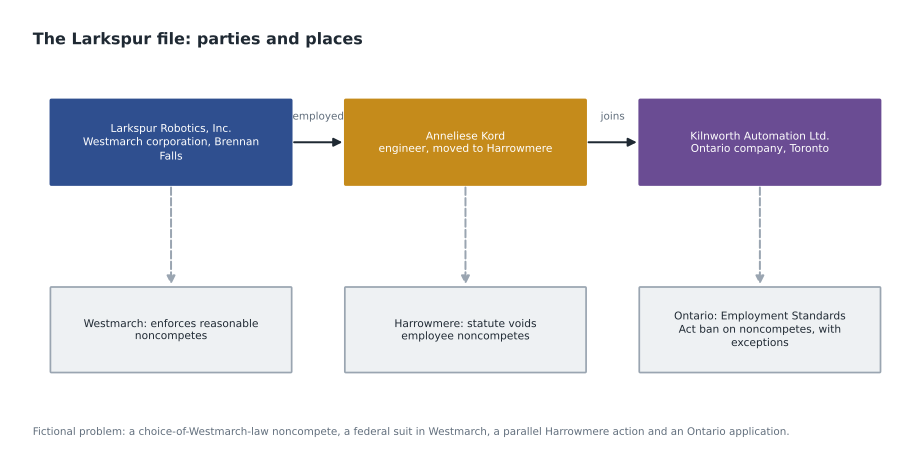
Larkspur Robotics, Inc. is a Westmarch corporation with its only office and factory in Brennan Falls. It designs and makes robots that pick items from warehouse shelves. Anneliese Kord, a controls engineer, joined Larkspur in Brennan Falls in 2019. In March 2022, as a condition of a promotion and a stock option grant, she signed an Employee Confidentiality and Noncompetition Agreement. It provides that for 18 months after leaving Larkspur she will not work for any business that develops warehouse robotics in North America; that she will not use or disclose Larkspur's confidential information; that the agreement is governed by Westmarch law; and that any dispute must be brought exclusively in the state or federal courts located in Westmarch. Westmarch enforces noncompetes that are reasonable in time, geography and scope and protect legitimate business interests.
In June 2024, with Larkspur's permission, Kord moved to Ashcombe, Harrowmere, to be near her family, and worked remotely, visiting Brennan Falls about once a month. Larkspur registered with Harrowmere's tax authorities as her employer. In 2023 Harrowmere had enacted the Employee Mobility Act, which provides that any contract restraining an employee who lives and works in Harrowmere from engaging in a lawful profession is void, regardless of where and when the contract was signed, that an employer may not require such an employee to litigate outside Harrowmere or to give up the protection of Harrowmere law, and that an employee may sue for a declaration and recover attorney's fees. Castellane notes that California enacted similar provisions, in Business and Professions Code section 16600.5 and Labor Code section 925, and that the Harrowmere statute is modeled on them.
On July 30, 2026, according to Larkspur's logs, Kord downloaded about 4,000 files from Larkspur's servers, including source code for the robots' grip-control software, to a personal cloud account. She resigned on August 3. On August 17 she became Director of Engineering at Kilnworth Automation Ltd., an Ontario corporation headquartered in Toronto that makes competing warehouse robots and sells them in the United States through a network of independent integrators, two of whom have installed Kilnworth systems in Westmarch warehouses. Kord works remotely for Kilnworth from Ashcombe. Kilnworth's recruiter contacted her on a professional networking site in May 2026, knowing she worked for Larkspur.
On August 20, 2026, Kord filed an action against Larkspur in the Ashcombe County Court in Harrowmere under the Employee Mobility Act, seeking a declaration that the noncompete and the forum clause are void, and attorney's fees. On August 27, Larkspur sued Kord and Kilnworth in the United States District Court for the District of Westmarch, alleging breach of the noncompete and confidentiality covenants, misappropriation of trade secrets under the federal Defend Trade Secrets Act and the Westmarch Uniform Trade Secrets Act, and tortious interference with contract by Kilnworth. Larkspur seeks a preliminary injunction barring Kord from working for Kilnworth and barring both defendants from using its files. In September, Kilnworth filed an application in the Ontario Superior Court of Justice seeking a declaration that it had not received or used any Larkspur trade secrets. Larkspur's general counsel asks for a memo on where the case will be decided, under what law, and what the company should do.
Step 1: Forum
Jordan Kimura begins with the courts. Three proceedings are pending: Kord's declaratory action in Harrowmere state court, Larkspur's federal action in Westmarch and Kilnworth's Ontario application. Each forum will apply its own choice-of-law rules: Harrowmere's First Restatement, Westmarch's Second Restatement, applied by the federal court under Klaxon, and Ontario's choice-of-law rules. The forum that decides first may bind the others.
Federal jurisdiction in Westmarch is secure. The Defend Trade Secrets Act claim arises under federal law, giving federal question jurisdiction, and the state claims are within supplemental jurisdiction; diversity also exists, since Larkspur is a Westmarch citizen, Kord a Harrowmere citizen and Kilnworth a foreign citizen. Personal jurisdiction over Kord is likely: she signed the agreement in Westmarch while living there, agreed to a Westmarch forum, visited Brennan Falls monthly and allegedly took files from Westmarch servers. A forum selection clause can establish consent to personal jurisdiction, and her ongoing contacts would support specific jurisdiction in any event.
Personal jurisdiction over Kilnworth is harder. Kilnworth has no Westmarch office. Its recruiter knew Kord worked for a Westmarch company, but under Walden v. Fiore, 571 U.S. 277 (2014), the relationship must arise out of contacts that the defendant itself creates with the forum state, not merely its contacts with persons who reside there, and knowledge that the plaintiff is in the forum is not enough. Kilnworth's sales through integrators to Westmarch warehouses are contacts with Westmarch, but Larkspur's claims, which concern hiring Kord in Harrowmere and using information in Ontario, may not arise out of or relate to those sales under Ford. If Kilnworth used Larkspur's code in robots sold in Westmarch, the relationship would be stronger. Federal Rule of Civil Procedure 4(k)(2), which allows federal courts to aggregate a foreign defendant's contacts with the United States as a whole for federal claims when no state has jurisdiction, may help with the Defend Trade Secrets Act claim, since Kilnworth sells in many states.
The forum selection clause in Kord's agreement requires suits in Westmarch. In the federal action, Larkspur will rely on Atlantic Marine to argue that the clause controls. Kord will argue that the clause is void under the Harrowmere statute. In federal court, the enforceability of a forum selection clause is generally a matter of federal law under The Bremen, which allows a court to refuse enforcement if enforcement would contravene a strong public policy of the forum in which suit is brought. The forum here is Westmarch, which has no policy against the clause. Harrowmere's statute is relevant to the merits but probably does not invalidate the forum clause in a Westmarch federal court. In Kord's Harrowmere action, by contrast, the Harrowmere court will apply its own statute and refuse to enforce the clause.
Step 2: Issues
Hannah Lindqvist divides the dispute into issues: (1) whether the noncompete is enforceable; (2) whether the forum clause is enforceable; (3) whether Kord breached the confidentiality covenant; (4) whether Kord and Kilnworth misappropriated trade secrets under federal law; (5) whether they misappropriated trade secrets under state law; (6) whether Kilnworth tortiously interfered with Larkspur's contract; and (7) whether any judgment will be recognized where it needs to be enforced. Characterization matters: issues 1 to 3 are contract issues; issues 5 and 6 are torts; issue 4 is federal law, which needs no choice of law on the merits but raises an extraterritoriality question.
Step 3: Laws
Daniel Reyes identifies the competing laws. Westmarch enforces reasonable noncompetes. Harrowmere voids them for employees who live and work there. Ontario's Employment Standards Act, 2000, as amended in 2021 by the Working for Workers Act, prohibits employers from entering into noncompete agreements with employees, with exceptions for sales of businesses and certain executives, but it applies to employees who work in Ontario, and Kord works in Harrowmere, so the Ontario statute probably does not reach her contract. On trade secrets, Westmarch and Harrowmere have both adopted the Uniform Trade Secrets Act, so their laws are similar, and the federal Defend Trade Secrets Act provides an overlapping federal claim. The laws actually differ only on the noncompete and on the forum clause. That narrows the choice-of-law fight to those issues, and to tortious interference, whose success depends on whether the underlying contract is enforceable.
Step 4: Method
In the Westmarch federal court, Klaxon requires the court to apply Westmarch's choice-of-law rules, the Second Restatement. Priya Natarajan works through section 187. The enforceability of a noncompete is not an issue the parties could resolve by agreement, so section 187(2) applies. Westmarch has a substantial relationship: it is Larkspur's home and was Kord's place of work when she signed. So the clause survives section 187(2)(a). The question is section 187(2)(b): would applying Westmarch law be contrary to a fundamental policy of a state that has a materially greater interest than Westmarch and whose law would apply absent the clause?
Harrowmere's statute reflects a fundamental policy, as DeSantis and Application Group suggest for similar statutes, and Harrowmere has declared that the policy applies regardless of where the contract was signed, which strengthens the claim. Whether Harrowmere has a materially greater interest is the hard question. When the agreement was signed in 2022, every contact was in Westmarch. By 2026, Kord had lived and worked in Harrowmere for two years with Larkspur's consent, and the restraint would operate on her work in Harrowmere. Section 188 and section 196, which looks to the place where the services are rendered, would likely point to Harrowmere for the period after 2024. Larkspur will argue that the relevant time is the time of contracting, that it cannot be stripped of its bargain by an employee's unilateral move, and that its interest in protecting its trade secrets is strong. Kord will argue that Larkspur agreed to her move, that the restraint operates entirely in Harrowmere, and that Harrowmere's interest in its residents' mobility is at its peak.
Natarajan concludes that a Westmarch court applying section 187 could go either way, but Larkspur's position is stronger in Westmarch than anywhere else. In Kord's Harrowmere action, by contrast, the Harrowmere court will follow its statute as a statutory directive, which section 6(1) of the Second Restatement and the First Restatement both respect, and will declare the noncompete void without much analysis. The method is effectively decided by the forum.
Marcus Webb takes the torts. For state-law trade secret misappropriation and tortious interference, the Second Restatement's section 145 contacts are split: the injury is felt by Larkspur in Westmarch; the conduct of downloading occurred in Harrowmere using Westmarch servers; Kilnworth's alleged use occurred in Ontario; and the relationship between Larkspur and Kord was centered in Westmarch for most of its life. Because Westmarch and Harrowmere both follow the Uniform Trade Secrets Act, there is likely a false conflict on misappropriation, and the court can apply Westmarch law. Tortious interference depends on a valid contract; if the noncompete is void under the governing law, Kilnworth's hiring of Kord cannot be tortious interference with the noncompete, though interference with the confidentiality covenant, which Harrowmere's statute does not void, remains possible.
For the federal claim, the question is extraterritoriality. The Defend Trade Secrets Act was added to the Economic Espionage Act, whose section 1837 provides that the chapter applies to conduct outside the United States if the offender is a United States citizen or permanent resident or an organization organized under United States law, or if an act in furtherance of the offense was committed in the United States. Courts have read section 1837 as applying to civil claims, so that a defendant's use of trade secrets abroad may be reached if an act in furtherance occurred in the United States. Kord's downloading in Harrowmere would qualify as such an act. Under the RJR Nabisco framework from Lesson 11, a court would ask whether section 1837 rebuts the presumption against extraterritoriality for the civil remedy; several courts have said that it does.
Step 5: Limits
Kimura checks the constitutional limits. Applying Westmarch law to the noncompete is not arbitrary or fundamentally unfair under Allstate v. Hague: Westmarch was the place of contracting, Larkspur's home and Kord's home when she signed. Applying Harrowmere law is also constitutional, given Kord's residence and work there. The choice between them is a matter of state law, not constitutional compulsion. If Harrowmere's statute is read to apply to employees who merely live in Harrowmere while working entirely for an out-of-state employer, a dormant Commerce Clause argument might be raised, but it is speculative.
The forum clause raises a different limit. Harrowmere's statute declares it void as to Harrowmere employees, and the Harrowmere court will not enforce it. The Westmarch federal court may enforce it, under federal law. Each court will apply its own approach, and neither is constitutionally forbidden from doing so.
Step 6: Judgment
Lindqvist turns to the race. Kord filed first, in Harrowmere, on August 20. If the Harrowmere court enters a final judgment declaring the noncompete void before the federal court rules, the federal court must give that judgment the same preclusive effect it would have in Harrowmere under 28 U.S.C. section 1738, as the Supreme Court held in Kremer and Marrese. Under Fauntleroy and Baker, the federal court may not refuse recognition because it thinks the Harrowmere court ignored the forum clause or misapplied choice of law; Larkspur's remedy would be an appeal in Harrowmere. A preliminary ruling would not be final, but a declaratory judgment, once final, would bind Larkspur on the enforceability of the noncompete.
Can the federal court stop the Harrowmere action? The Anti-Injunction Act, 28 U.S.C. section 2283, forbids a federal court to enjoin proceedings in a state court except as expressly authorized by Act of Congress, where necessary in aid of its jurisdiction, or to protect or effectuate its judgments. None of the exceptions applies to a parallel in personam action that the federal court has not yet decided. The federal court could consider abstaining or staying its own proceedings in favor of the earlier state case under Colorado River Water Conservation District v. United States, 424 U.S. 800 (1976), but only in exceptional circumstances, and the federal trade secret claim makes abstention unlikely. Larkspur's practical strategy is therefore speed: move for a preliminary injunction in federal court on the trade secret claims, which do not depend on the noncompete, and seek prompt resolution of the noncompete issue before the Harrowmere case reaches final judgment.
Enforcement abroad matters too. Kilnworth's assets are in Ontario. A Westmarch federal judgment against Kilnworth for misappropriation would need to be recognized in Ontario, where, under Beals v. Saldanha and Chevron v. Yaiguaje, Ontario courts recognize foreign money judgments if the American court had a real and substantial connection to the action, subject to narrow defenses. Ontario courts generally do not enforce foreign injunctions as readily as money judgments, though the Supreme Court of Canada has recognized that foreign nonmonetary judgments may be enforced in some circumstances. If Kilnworth first obtains an Ontario declaration that it did not use Larkspur's trade secrets, Larkspur would face a conflicting judgment problem, and an American court asked to recognize the Ontario declaration would apply the forum state's recognition law. The 2005 Uniform Act covers only money judgments, so recognition of an Ontario declaration would fall under common law comity principles, and the conflicting-judgments and forum-clause considerations would be argued under those principles.
The memo's recommendations
Castellane collects the class's conclusions into the recommendations a good memo would give the general counsel. First, prioritize the trade secret claims in federal court: the confidentiality covenant and trade secret law are similar in both states and enforceable in Harrowmere, the federal claim gives federal jurisdiction and may reach Kilnworth's conduct in Ontario, and a prompt preliminary injunction against use of the downloaded files is achievable without winning the noncompete fight. Second, treat the noncompete as uncertain: Westmarch law may govern in federal court under section 187, but the Harrowmere court will void it, and whichever court reaches final judgment first will likely control. Third, appear in the Harrowmere action and contest it vigorously, including by moving to dismiss or stay based on the forum clause, while recognizing that the motion will probably fail under Harrowmere's statute. Fourth, establish personal jurisdiction over Kilnworth through discovery about its use of Larkspur code in robots sold in Westmarch, and consider Rule 4(k)(2) for the federal claim. Fifth, engage Ontario counsel to respond to Kilnworth's application and to plan recognition of any American money judgment in Ontario.
Castellane adds a final point about advice. "The client asked which law applies. The honest answer is: it depends on which court decides first, and on facts we do not yet have. A memo that pretends otherwise is not helping. A memo that explains exactly what the answer depends on, and what the client can do to influence it, is worth its fee."
Looking back at the course
Castellane closes the semester by returning to the three questions. Where can the case be heard? Jurisdiction, forum clauses and forum non conveniens decide that, and the answer determines the next step. Whose law decides it? The forum's method decides that, issue by issue, within modest constitutional limits, and the method may be the First Restatement, interest analysis, the Second Restatement, or someday the Third. Will the judgment travel? Between states, full faith and credit makes the answer almost always yes; between countries, the answer depends on comity, statutes and, increasingly, treaties. Every case the class studied, from Carroll's broken coupling link in 1892 to the October 2026 denial of certiorari in Mallory's long aftermath, was a variation on those three questions.
Worked problem
A one-paragraph answer for the general counsel
The general counsel asks for a one-paragraph summary she can forward to the CEO. Write it.
Show solution
- State the bottom line: the trade secret claims are strong and can be pursued quickly in federal court in Westmarch; the noncompete is uncertain.
- Explain why: Harrowmere, where Kord now lives and works, voids noncompetes by statute, and its court will rule for her; a Westmarch court may apply Westmarch law under the contract but could defer to Harrowmere's policy.
- Explain the race: whichever court enters final judgment first on the noncompete will likely bind the other.
- State the plan: seek a prompt injunction on the trade secrets, contest the Harrowmere case, gather evidence on Kilnworth's use of the code, and engage Ontario counsel.
Answer: Our best and fastest path is a federal court injunction in Westmarch against any use of the files Kord downloaded; that claim is strong under both states' law and federal law and can reach Kilnworth. Whether we can keep Kord out of Kilnworth for 18 months is uncertain: Harrowmere law, which protects her as a Harrowmere resident, voids the noncompete, and while our contract chooses Westmarch law, a court may give priority to Harrowmere's policy. Kord has already sued in Harrowmere, and whichever court rules first on the noncompete will likely control, so we will push for early rulings in federal court, contest the Harrowmere case and coordinate with Ontario counsel on Kilnworth's parallel application.
Common mistakes
MistakeBecause the contract chooses Westmarch law, Westmarch law governs the noncompete everywhere.
InsteadEach forum applies its own choice-of-law rules. Harrowmere will apply its statute; a Westmarch court will apply section 187, which may defer to Harrowmere's fundamental policy.
MistakeA federal court can enjoin the earlier Harrowmere action to protect the forum clause.
InsteadThe Anti-Injunction Act generally forbids federal injunctions against pending state proceedings, and none of its exceptions fits a parallel in personam case.
MistakeIf the federal court disagrees with a final Harrowmere judgment, it may refuse to follow it.
InsteadSection 1738 requires the same preclusive effect the judgment has in Harrowmere, regardless of errors (Fauntleroy; Baker; Kremer).
MistakeKnowing that an employee works for a Westmarch company gives Westmarch jurisdiction over the hiring company.
InsteadWalden v. Fiore requires contacts the defendant itself creates with the forum, not merely with a plaintiff who lives there.
Summary and key terms
- A conflicts memo should follow six steps: forum, issues, laws, method, limits and judgment.
- Each forum applies its own choice-of-law method, so parallel proceedings can produce different answers to the same question.
- Section 187(2)(b) may defer to a fundamental policy of the state where an employee now lives and works, especially where that state has a statute declaring the policy regardless of where the contract was signed.
- Federal claims such as the Defend Trade Secrets Act avoid choice of law on the merits but raise extraterritoriality questions under section 1837 and RJR Nabisco.
- A final state judgment binds federal courts under section 1738, and the Anti-Injunction Act limits federal interference with parallel state cases, so the race to judgment matters.
- Enforcement abroad depends on the foreign country's recognition law; Ontario recognizes foreign money judgments under Beals and Chevron v. Yaiguaje.
- Parallel proceedings
- Simultaneous litigation of related claims in different courts.
- Race to judgment
- The practical contest to obtain the first final judgment, which may preclude relitigation elsewhere.
- Anti-Injunction Act
- 28 U.S.C. section 2283, generally forbidding federal courts to enjoin state court proceedings.
- Rule 4(k)(2)
- A federal rule allowing jurisdiction over foreign defendants for federal claims based on contacts with the United States as a whole.
- Statutory directive
- A statute, such as Harrowmere's Employee Mobility Act, that dictates the governing law or voids contractual choices.
Practice problems
Work each problem on paper first, then reveal the answer to check.
Why might a Westmarch federal court enforce the forum clause even though Harrowmere's statute voids it?
Show answer
Because in federal court the enforceability of a forum clause is generally governed by federal law under The Bremen and Atlantic Marine, and the relevant public policy is that of the forum where suit is brought, Westmarch.
Why does the race to judgment matter so much in the Larkspur file?
Show answer
Because a final Harrowmere judgment on the noncompete would bind the federal court under section 1738, whatever the federal court thinks of its reasoning, and the federal court cannot enjoin the earlier state action.
Why is the trade secret claim easier for Larkspur than the noncompete claim?
Show answer
Westmarch and Harrowmere both follow the Uniform Trade Secrets Act, Harrowmere's statute does not void confidentiality covenants, and the federal Defend Trade Secrets Act provides jurisdiction and may reach foreign use where an act in furtherance occurred in the United States.
Under Walden v. Fiore, what is missing in Larkspur's argument for jurisdiction over Kilnworth based on its recruiter's knowledge?
Show answer
Contacts that Kilnworth itself created with Westmarch; knowledge that the plaintiff is located in Westmarch is not enough.
Lesson quiz · 5 questions
Score 60% or more to complete this lesson.
Create a free account to save your progress, take quizzes and earn a certificate.