
LAWU-302 · Lesson 8 of 12 · 25 min
Constitutional limits
▶ Video coming soon A video version of this lesson is on the way.
Two weeks after the crash, a different lawsuit landed on Silverline's desk. A Westmarch customer filed a class action in the Merrin County Superior Court on behalf of every person in the United States who had bought a Silverline ticket since 2020, alleging that a "fuel and terminal surcharge" added at checkout was a hidden fee prohibited by the Westmarch Consumer Fraud Act. Silverline sells tickets in fourteen states. The complaint asks the court to apply Westmarch's statute, which allows statutory damages of 200 dollars per violation, to every class member's claim. "Can a Westmarch court apply Westmarch law to a ticket bought in Harrowmere by a Harrowmere resident for a trip that never touched Westmarch?" Castellane asks. "That is not a question about the Second Restatement. It is a question about the Constitution." This lesson covers the constitutional limits on choice of law, which are modest but real, and the overlap between those limits and the law of personal jurisdiction.
The sources of constitutional limits
Two constitutional provisions limit a state's power to apply its own law. The Due Process Clause of the Fourteenth Amendment protects parties against the arbitrary or fundamentally unfair application of a state's law to a transaction with which the state has no meaningful connection. The Full Faith and Credit Clause of Article IV, section 1, requires each state to give full faith and credit to the public acts, records and judicial proceedings of every other state; applied to statutes, it limits a state's power to disregard another state's law in favor of its own. Other provisions play smaller roles: the Privileges and Immunities Clause of Article IV, the Equal Protection Clause and the dormant Commerce Clause may forbid choice-of-law rules that discriminate against out-of-state residents or burden interstate commerce.
Early cases: Home Insurance v. Dick and the workers' compensation cases
In Home Insurance Co. v. Dick, 281 U.S. 397 (1930), Dick, who was domiciled in Texas but lived in Mexico, obtained in Mexico an insurance policy on a tugboat from a Mexican insurer, with a clause requiring suit within one year. The policy was reinsured by New York companies. After a loss in Mexican waters, Dick sued in Texas, which had a statute voiding contractual limitation periods shorter than two years. The Supreme Court held that applying the Texas statute violated due process: nothing in any way relating to the policy had been done or required to be done in Texas. A state may not abrogate the rights of parties beyond its borders having no relation to anything done or to be done within them. Dick's domicile in Texas, which mattered to his ability to sue there, was not enough.
In the 1930s the Court decided workers' compensation cases that seemed to require it to weigh the interests of competing states under the Full Faith and Credit Clause. In Alaska Packers Association v. Industrial Accident Commission, 294 U.S. 532 (1935), it allowed California to apply its compensation statute to a worker hired in California for seasonal work in Alaska. In Pacific Employers Insurance Co. v. Industrial Accident Commission, 306 U.S. 493 (1939), it allowed California to apply its statute to a Massachusetts employee injured while temporarily working in California, rejecting the argument that full faith and credit required California to apply the Massachusetts statute. The Court said that the Clause does not require one state to substitute for its own statute, applicable to persons and events within it, the statute of another state reflecting a conflicting and opposed policy. After Pacific Employers the Court stopped weighing interests and asked only whether the forum had enough of a connection to apply its own law.
Hughes v. Fetter: the forum may not refuse to hear sister-state claims
Full faith and credit also limits a forum's refusal to entertain claims arising under another state's law. In Hughes v. Fetter, 341 U.S. 609 (1951), a Wisconsin resident was killed in an automobile accident in Illinois, and his administrator sued in Wisconsin under the Illinois wrongful death statute. Wisconsin had a statute that allowed wrongful death actions only for deaths caused in Wisconsin. The Supreme Court held that Wisconsin's refusal to hear the Illinois claim violated the Full Faith and Credit Clause, because Wisconsin had no sufficient policy reason to exclude a claim of a kind it recognized for in-state deaths. The case shows that a forum's public policy, the traditional escape device from Lesson 3, is itself subject to constitutional limits when it is used to close the courthouse to sister-state claims. A state may still decline to hear claims for neutral reasons, such as a forum non conveniens doctrine or a statute of limitations.
Allstate v. Hague: the modern test
Allstate Insurance Co. v. Hague, 449 U.S. 302 (1981), is the leading modern case. Ralph Hague, a Wisconsin resident, was killed in Wisconsin when the motorcycle on which he was a passenger was struck by a car driven by an uninsured Wisconsin motorist. Hague had commuted to work in Red Wing, Minnesota, for fifteen years. He owned three automobiles, each insured by Allstate under a Wisconsin policy that provided 15,000 dollars of uninsured motorist coverage. After his death, his widow moved to Minnesota, remarried, and was appointed personal representative of his estate by a Minnesota court. She sued Allstate in Minnesota, seeking to stack the three coverages for a total of 45,000 dollars, as Minnesota law allowed. Wisconsin law did not allow stacking.
The Minnesota Supreme Court applied Minnesota law under the better law approach. Allstate argued that applying Minnesota law violated due process and full faith and credit. Justice Brennan's plurality opinion held that, for a state's substantive law to be selected in a constitutionally permissible manner, that state must have a significant contact or significant aggregation of contacts, creating state interests, such that choice of its law is neither arbitrary nor fundamentally unfair. The plurality found three contacts: Hague's employment in Minnesota for fifteen years, which gave Minnesota an interest in its workforce and made the daily commute something Minnesota insurance law could address; Allstate's presence and business in Minnesota, which meant it could not claim unfair surprise; and the widow's post-accident residence in Minnesota, which the plurality treated as relevant but not alone sufficient. Justice Stevens concurred in the judgment on narrower grounds, and Justice Powell, joined by Chief Justice Burger and Justice Rehnquist, dissented, arguing that the contacts were trivial and created no real Minnesota interest in the dispute.
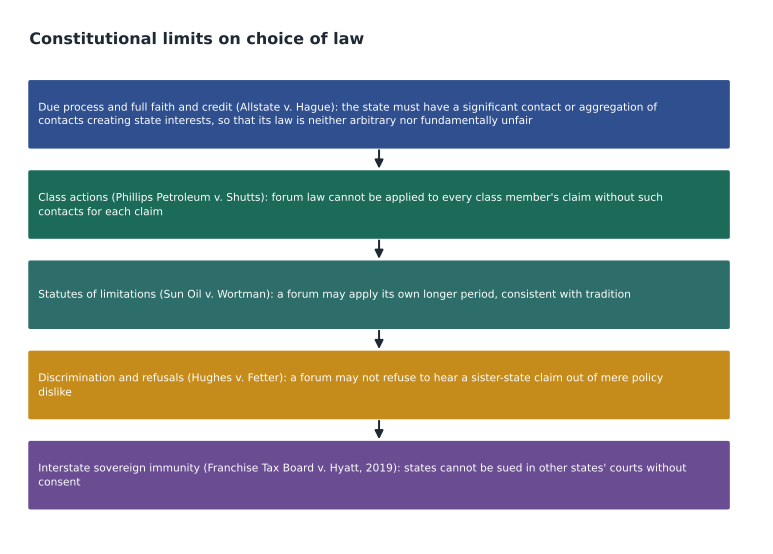
Hague sets a low bar. Most cases in which a forum applies its own law involve some contact between the forum and the parties or the transaction, and the Court has rarely found a violation. But the test is not empty: it requires that the contacts relate to the dispute in a way that creates a state interest, and it treats unfair surprise to the parties as a relevant concern. Contacts that arise only after the events, such as a plaintiff's move to the forum, cannot alone justify applying forum law, because otherwise a plaintiff could choose the law by choosing a new home.
Phillips Petroleum v. Shutts: class actions
The Hague test has its sharpest application in nationwide class actions. In Phillips Petroleum Co. v. Shutts, 472 U.S. 797 (1985), royalty owners sued Phillips in Kansas state court for interest on royalty payments that Phillips had delayed while awaiting regulatory approval of price increases. The class included about 28,000 owners of interests in leases in eleven states, most of whom had no connection to Kansas, and over 99 percent of the leases were outside Kansas. The Kansas courts applied Kansas law to every claim. The Supreme Court held that this violated due process: Kansas must have a significant contact or aggregation of contacts with the claims asserted by each member of the plaintiff class, contacts creating state interests, so that applying Kansas law is not arbitrary or unfair. Kansas's interest in regulating a defendant that did business there, and the fact that the plaintiffs had chosen Kansas by not opting out, were not enough as to leases and owners with no Kansas connection.
Shutts also held, on a separate issue, that a state court may bind absent class members in a damages class action even if they lack minimum contacts with the forum, provided they receive notice, an opportunity to be heard and participate, an opportunity to opt out, and adequate representation. The two holdings work together: a state may adjudicate nationwide classes, but it may not automatically apply its own law to every member's claim. In practice, Shutts has made nationwide class certification difficult whenever state laws differ materially, because the need to apply many states' laws undermines the predominance and manageability requirements of Rule 23(b)(3) and its state counterparts.
Applying Shutts to the Silverline surcharge class, Jordan Kimura distinguishes among class members. Westmarch residents who bought tickets in Westmarch for trips from Westmarch have obvious Westmarch contacts. A Harrowmere resident who bought a ticket online in Harrowmere for a trip between two Harrowmere towns has no Westmarch contact except that Silverline also does business in Westmarch, which Shutts held insufficient. Unless the plaintiff can show that the surcharge policy was designed and administered from Westmarch, which it was not, since Silverline is run from Ashcombe, the Westmarch court cannot apply the Westmarch Consumer Fraud Act to the claims of non-Westmarch class members. The class would likely have to be limited to Westmarch transactions or divided into subclasses governed by different states' laws.
Sun Oil v. Wortman: limitations as procedure
Three years after Shutts, the same Kansas litigation returned. In Sun Oil Co. v. Wortman, 486 U.S. 717 (1988), Kansas applied its own five-year statute of limitations to claims governed by the laws of Texas, Oklahoma and Louisiana, which had shorter periods. The Supreme Court held that this was constitutional. Justice Scalia's opinion relied on history: when the Constitution was adopted, statutes of limitations were understood to be procedural, and a long tradition of forum states applying their own limitations periods to foreign claims established that doing so is neither arbitrary nor unfair. The Court also held that Kansas did not violate full faith and credit in its interpretation of the other states' laws on interest, because a misconstruction violates the Clause only if it contradicts law that is clearly established and has been brought to the court's attention. Sun Oil confirms that constitutional limits are driven partly by tradition rather than purely by modern interest analysis.
Franchise Tax Board v. Hyatt: hostility and immunity
The long dispute between Gilbert Hyatt, an inventor, and California's tax agency produced three Supreme Court decisions. Hyatt moved from California to Nevada and claimed that California's Franchise Tax Board committed torts against him during an audit of his residency. He sued in Nevada state court. In Franchise Tax Board of California v. Hyatt, 578 U.S. 171 (2016), the Court held that Nevada violated the Full Faith and Credit Clause by refusing to apply to California's agency the same cap on damages that Nevada would apply to its own agencies in similar circumstances; a state may not adopt a special rule of law hostile to another state's law. Then, in Franchise Tax Board of California v. Hyatt, 587 U.S. 230 (2019), the Court, five to four, in an opinion by Justice Thomas, overruled Nevada v. Hall, 440 U.S. 410 (1979), and held that states retain their sovereign immunity from private suits brought in the courts of other states. Hyatt's suit was dismissed. The 2019 decision removes a whole category of interstate cases from state courts, and it reflects a view that the Constitution embeds principles of interstate sovereign equality that go beyond the text of the Full Faith and Credit Clause.
The overlap with personal jurisdiction
Choice of law and personal jurisdiction are analytically separate. A court may have jurisdiction but be required to apply another state's law, as in many diversity cases, and a state may have sufficient contacts to apply its law in theory but lack jurisdiction over a particular defendant. Shutts said explicitly that a forum's jurisdiction does not license it to apply its own law. The two inquiries nonetheless use overlapping concepts, contacts, fairness and foreseeability, and decisions about jurisdiction often determine which choice-of-law rules apply.
Recent Supreme Court decisions on personal jurisdiction therefore matter to conflicts practice. In Bristol-Myers Squibb Co. v. Superior Court, 582 U.S. 255 (2017), the Court held that California courts lacked specific jurisdiction over claims by nonresident plaintiffs who did not buy, use or suffer injury from the drug in California, even though the claims were identical to those of California residents. That decision limits mass actions in a single state court and thus limits the reach of that state's choice-of-law rules. In Ford Motor Co. v. Montana Eighth Judicial District Court, 592 U.S. 351 (2021), the Court held that Montana and Minnesota courts had jurisdiction over Ford in product cases arising from accidents in those states involving Ford vehicles first sold elsewhere, because Ford systematically served markets in those states for the very models involved, and the claims related to those contacts.
In Mallory v. Norfolk Southern Railway Co., 600 U.S. 122 (2023), the Court, five to four in an opinion by Justice Gorsuch, held that the Due Process Clause did not forbid Pennsylvania from requiring out-of-state corporations registering to do business there to consent to general jurisdiction, so a Virginia worker could sue a Virginia railroad in Pennsylvania for injuries suffered in Ohio and Virginia. Justice Alito, who supplied the fifth vote, concurred but suggested that such a registration requirement might violate the dormant Commerce Clause, a question not before the Court. On remand, the Philadelphia Court of Common Pleas rejected Norfolk Southern's Commerce Clause challenge in April 2025 without explanation, the Pennsylvania Superior Court declined to review the ruling, and the Pennsylvania Supreme Court denied review in January 2026. On October 5, 2026, the Supreme Court denied Norfolk Southern's petition for certiorari, leaving the question open but leaving Pennsylvania's registration statute in force.
Mallory has a direct choice-of-law consequence. If a plaintiff can sue a registered corporation anywhere it is registered, the plaintiff can choose among many states' choice-of-law methods, which revives the forum shopping that Klaxon and Shutts tried to contain. Most states do not have consent-by-registration statutes, and some state courts have read their statutes not to confer general jurisdiction, but the possibility makes the choice of forum even more consequential.
Finally, in Fuld v. Palestine Liberation Organization, 606 U.S. ___ (2025), decided June 20, 2025, the Court unanimously upheld a federal statute subjecting the PLO and the Palestinian Authority to personal jurisdiction in federal courts for certain terrorism claims. Chief Justice Roberts's opinion held that the Fifth Amendment's Due Process Clause, which governs federal courts exercising federal jurisdiction, does not incorporate the Fourteenth Amendment's minimum contacts test, and that the statute reasonably tied jurisdiction to conduct closely related to the United States that implicates sensitive foreign policy concerns. Justice Thomas, joined in part by Justice Gorsuch, concurred in the judgment. Fuld leaves open how far Congress may extend federal jurisdiction over foreign defendants, a question relevant to international cases like the claims against Northvale.
Jurisdiction over Northvale
The Silverline plaintiffs must establish personal jurisdiction over Northvale in Westmarch. Northvale sold its tires to Garrison, a Harrowmere distributor, and Silverline bought them in Harrowmere. In J. McIntyre Machinery, Ltd. v. Nicastro, 564 U.S. 873 (2011), a plurality held that a British manufacturer that sold through an independent American distributor and targeted the United States as a whole was not subject to jurisdiction in New Jersey, where one of its machines injured a worker, because it had not purposefully availed itself of the New Jersey market specifically. If Northvale did not target Westmarch, a Westmarch court may lack jurisdiction over it, even though jurisdiction over Silverline is secure. Harrowmere, where the tires were sold and the injury occurred, is a much stronger forum for claims against Northvale under Ford. The jurisdictional answer may therefore push the claims against Northvale toward Harrowmere and its First Restatement rules, or toward Ontario, which Lesson 11 considers.
Worked problem
A constitutional check on the surcharge class
The Westmarch trial court certifies a nationwide class and rules that the Westmarch Consumer Fraud Act governs every class member's claim. Silverline seeks review. Which class members' claims can constitutionally be governed by Westmarch law?
Show solution
- State the test: under Hague and Shutts, Westmarch must have a significant contact or aggregation of contacts with each class member's claim, creating state interests, so that applying its law is neither arbitrary nor fundamentally unfair.
- Westmarch residents who bought tickets in Westmarch: Westmarch is the place of purchase and the consumer's home. Contacts are ample.
- Non-residents who bought tickets for trips departing from Westmarch: the place of departure and performance is in Westmarch, which likely suffices.
- Non-residents who bought tickets for trips that never touched Westmarch: the only Westmarch contact is that Silverline does business there and that the named plaintiff chose Westmarch, which Shutts held insufficient.
- Unfair surprise: Silverline could not have expected Westmarch law to govern tickets for Harrowmere-only trips.
Answer: Westmarch law may govern the first two groups but not the third. The class must be narrowed or subdivided, which may defeat predominance for a nationwide class.
Common mistakes
MistakeA court that has personal jurisdiction may apply its own law.
InsteadJurisdiction and choice of law are separate; Shutts held that Kansas could hear the nationwide class but could not apply Kansas law to claims with no Kansas connection.
MistakeAllstate v. Hague requires a forum to apply the law of the state with the greatest interest.
InsteadHague requires only a significant contact or aggregation of contacts creating state interests, so that applying forum law is neither arbitrary nor fundamentally unfair. It is a low bar.
MistakeUnder Sun Oil, a state may not apply its own longer statute of limitations to foreign claims.
InsteadSun Oil upheld applying the forum's longer period, relying on the tradition of treating limitations as procedural.
MistakeMallory resolved whether consent-by-registration statutes violate the dormant Commerce Clause.
InsteadMallory decided only the due process question; the Commerce Clause challenge was rejected by Pennsylvania courts without analysis, and the Supreme Court denied certiorari on October 5, 2026.
Summary and key terms
- Due process and full faith and credit limit a state's power to apply its own law, but the limits are modest.
- Home Insurance v. Dick (1930) forbade Texas from applying its law to a contract with no Texas connection; Pacific Employers (1939) ended interest weighing under full faith and credit.
- Hughes v. Fetter (1951) forbids a forum from refusing to hear sister-state claims without a sufficient policy reason.
- Allstate v. Hague (1981): the forum must have a significant contact or aggregation of contacts creating state interests, so its law is neither arbitrary nor fundamentally unfair.
- Phillips Petroleum v. Shutts (1985) applies the test to each class member's claim; Sun Oil v. Wortman (1988) allows a forum's longer limitations period.
- Franchise Tax Board v. Hyatt (2019) restored interstate sovereign immunity; Bristol-Myers (2017), Ford (2021), Mallory (2023) and Fuld (2025) shape where cases can be heard and thus whose choice-of-law rules apply.
- Full Faith and Credit Clause
- Article IV, section 1, requiring states to respect other states' public acts, records and judicial proceedings.
- Hague test
- A state may apply its law only if it has a significant contact or aggregation of contacts creating state interests, so that doing so is neither arbitrary nor unfair.
- Unfair surprise
- The concern that a party could not reasonably have expected a state's law to govern.
- Consent by registration
- A statute treating a corporation's registration to do business as consent to general jurisdiction, upheld against a due process challenge in Mallory.
- Interstate sovereign immunity
- A state's immunity from private suits in other states' courts, recognized in Franchise Tax Board v. Hyatt (2019).
Practice problems
Work each problem on paper first, then reveal the answer to check.
What were the three Minnesota contacts the Hague plurality relied on?
Show answer
Hague's fifteen years of employment in Minnesota, Allstate's business presence in Minnesota and the widow's post-accident Minnesota residence (relevant but not alone sufficient).
Why did Kansas violate due process in Shutts?
Show answer
It applied Kansas law to every class member's claim although most leases and owners had no connection to Kansas, so Kansas lacked significant contacts with those claims.
What did the 2016 Hyatt decision hold, and what did the 2019 decision hold?
Show answer
In 2016 the Court held that Nevada could not apply a special rule hostile to California's agency (denying it the damages cap applied to Nevada agencies). In 2019 it overruled Nevada v. Hall and held that states are immune from private suits in other states' courts.
Why might Mallory increase forum shopping for choice of law?
Show answer
If registration-based consent supports general jurisdiction, plaintiffs can sue registered corporations in many states and pick among those states' choice-of-law methods.
Lesson quiz · 5 questions
Score 60% or more to complete this lesson.
Create a free account to save your progress, take quizzes and earn a certificate.