
LAWU-302 · Lesson 2 of 12 · 23 min
Choice of law approaches
▶ Video coming soon A video version of this lesson is on the way.
Castellane opens the second class by writing five words across the board: territory, rights, interests, contacts, quality. "Those are the five ideas American courts have used to decide whose law applies. Every approach you will study is built from one or two of them. Learn the ideas and the labels will take care of themselves." This lesson is a map. It traces how American choice of law moved from fixed territorial rules to the flexible methods most states use today, explains what each method is trying to do, and shows how to find out which method a given state follows. Later lessons look at each method in detail.
Why choice of law needs a method
When a case touches two states whose laws differ, someone has to decide which law governs. The answer cannot simply be "the fairest law," because each state's legislature or courts already decided what was fair for that state. Nor can it be "the forum's law" in every case, because then the outcome would depend entirely on where the plaintiff filed, which would reward forum shopping and make it impossible for people to plan their affairs. A choice-of-law method is a set of rules or principles for allocating legal authority among states. A good method should be predictable, so people can plan; should respect the legitimate concerns of every state involved; should treat like cases alike regardless of the forum; and should be workable by busy trial judges.
Those goals pull against each other. Fixed rules are predictable but sometimes produce results that no state wants. Flexible methods can reach sensible results but make outcomes harder to predict and easier to manipulate. The history of American choice of law is a long argument about that trade-off, and the argument is not over.
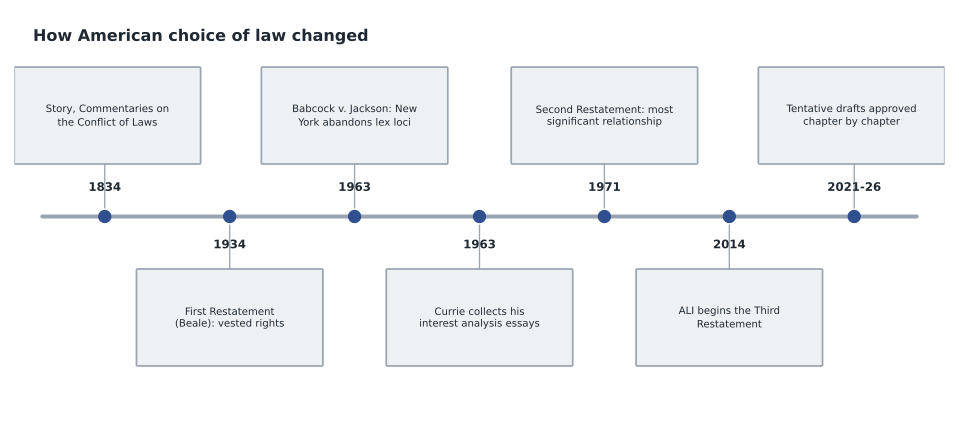
Territory and comity: Story
The American field begins with Joseph Story, a Justice of the Supreme Court and Harvard professor, whose Commentaries on the Conflict of Laws appeared in 1834. Story built on the Dutch writer Ulrich Huber. The starting point was territorial sovereignty: each nation's laws operate with full force within its own territory and bind all persons and property there, but have no force of their own beyond it. Foreign law could be applied in a forum only as a matter of comity, a courtesy extended because it served mutual convenience and justice. Comity remains an important word in the field. Courts still invoke it when they defer to foreign proceedings or recognize foreign judgments, as Lessons 10 and 11 show.
Vested rights: Beale and the First Restatement
By the early twentieth century the dominant theory was vested rights, associated with Joseph Beale of Harvard, who served as Reporter for the American Law Institute's Restatement of the Conflict of Laws, published in 1934. Beale argued that a legal right is created, or vests, at a particular place and time, by the law of that place, when the last event necessary to create it occurs. A tort right vests where the injury happens, because injury is the last element of a tort. A contract right vests where the contract is made. A forum that applies foreign law is not deferring to a foreign sovereign; it is simply recognizing a right that already exists, the way it would recognize a deed to land.
The theory produced a set of clear rules, which Lesson 3 examines: the law of the place of the wrong for torts, the law of the place of contracting for contract validity, the law of the situs for land, the law of the domicile at death for succession to movables. The rules asked only where a single event happened. They did not ask what the competing laws said or why. That was their strength, since a lawyer could predict the governing law from a map, and their weakness, since the map sometimes pointed to a state that had no reason to care.
The realist attack
Legal realists attacked vested rights from the 1920s onward. Walter Wheeler Cook argued that a court never really enforces a foreign right; it always applies its own law, which it chooses to model on the foreign rule. David Cavers, in a 1933 article, argued that choice of law should look at the content of the competing laws and the results they would produce, rather than choosing a jurisdiction blindly. Courts, meanwhile, were already escaping from the rules when they produced bad results, using the devices covered in Lesson 3: characterization, the substance and procedure line, renvoi and public policy. By the 1950s the rules were widely seen as arbitrary, and their escape devices as a form of disguised judicial discretion.
Interests: Currie and the revolution
The decisive attack came from Brainerd Currie, whose essays, written from the late 1950s and collected in 1963, proposed governmental interest analysis. Currie argued that choice of law should begin by asking what policy each state's law serves and whether that policy would be advanced by applying the law to the facts of the case. If only one state has an interest, the conflict is false and that state's law applies. If both have interests, the conflict is true, and Currie argued that a court should apply its own law, because courts are not equipped to weigh one state's interests against another's.
The same year, 1963, the New York Court of Appeals decided Babcock v. Jackson, 12 N.Y.2d 473 (1963). Georgia Babcock, a New York resident, was injured in Ontario when her host, a fellow New Yorker, lost control of his car on a weekend trip. Ontario had a guest statute that barred her claim; New York did not. The traditional rule pointed to Ontario as the place of injury. The court refused to follow it, holding that New York, as the state with the greatest concern with the specific issue, should supply the law. Ontario's statute was designed to protect Ontario insurers from collusive claims by guests, a concern not engaged by a New York host, a New York guest and a New York insurer. Babcock began what scholars call the choice-of-law revolution, in which most states abandoned the First Restatement over the next three decades.
Contacts: the Second Restatement
The American Law Institute's Restatement (Second) of Conflict of Laws, published in 1971 with Willis Reese as Reporter, tried to absorb the revolution without giving up on rules altogether. Its central idea is that an issue is governed by the law of the state with the most significant relationship to the occurrence and the parties with respect to that issue, determined by the principles in section 6 and by the contacts listed in sections like 145 (torts) and 188 (contracts). It also contains presumptive rules for particular issues, many of which echo the First Restatement: for personal injury, for example, section 146 presumes that the law of the place of injury applies unless another state has a more significant relationship. Lesson 5 covers the Second Restatement in detail.
The Second Restatement became the most widely followed method in the United States, in part because it gives a court a vocabulary for almost any result. Its critics say that is precisely the problem: a list of seven principles and four contacts, weighed case by case, can justify nearly anything. Its defenders say it guides judgment rather than replacing it, and that its presumptions give more predictability than its critics admit.
Quality: the better law approach
Robert Leflar of Arkansas proposed a different set of choice-influencing considerations: predictability of results, maintenance of interstate and international order, simplification of the judicial task, advancement of the forum's governmental interests, and application of the better rule of law. The last consideration was the controversial one, because it invites a court to prefer the law it thinks superior, which usually turns out to be its own. Courts in New Hampshire, in Clark v. Clark, 107 N.H. 351 (1966), and Minnesota, in Milkovich v. Saari, 295 Minn. 155 (1973), adopted Leflar's approach, and Wisconsin and a few other states use it. Lesson 4 returns to it.
Variations: comparative impairment and lex fori approaches
California refined interest analysis with comparative impairment, an approach proposed by William Baxter and adopted in Bernhard v. Harrah's Club, 16 Cal. 3d 313 (1976). In a true conflict, the court asks which state's interest would be more impaired if its law were not applied and applies the law of that state. Other states lean openly toward forum law. Kentucky courts apply Kentucky law whenever there are significant contacts with Kentucky, and Michigan's courts apply forum law unless a rational reason exists to displace it. Many states combine approaches, invoking the Second Restatement while reasoning in terms of interests.
Where the states stand
Each year since 1987 a survey of American choice-of-law decisions has classified the states by the method their courts follow. The survey was written for three decades by Symeon Symeonides and is now continued by other scholars; its thirty-eighth edition, covering 2024 decisions, appeared in early 2025. The classifications are approximate, because courts often recite one test and apply another, but the broad picture has been stable. About nine jurisdictions still follow the traditional lex loci delicti rule for torts, and about ten still follow lex loci contractus for contracts. The Second Restatement is the largest group in both categories. Smaller groups follow interest analysis or comparative impairment, the better law approach, forum-law approaches or combined methods.
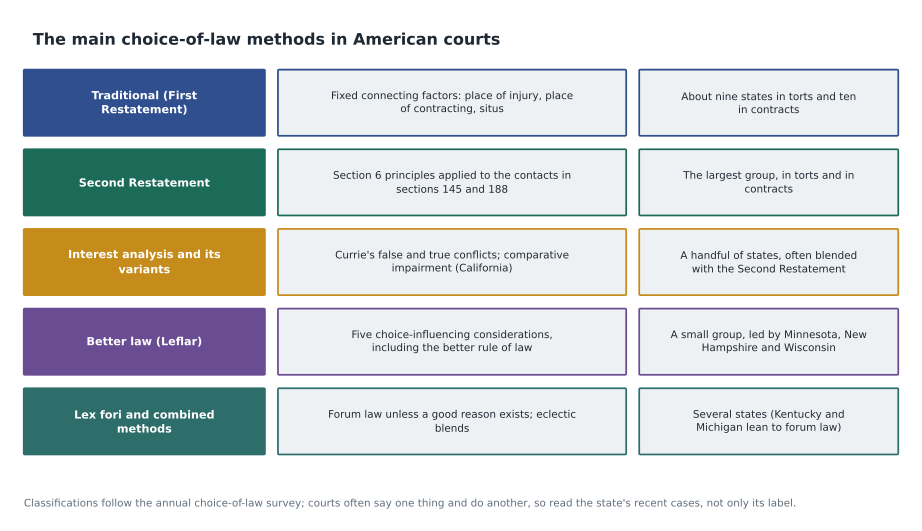
The traditional states are mostly in the Southeast and Mid-Atlantic. Alabama, Georgia, Maryland, North Carolina, South Carolina and Virginia are commonly listed, along with Kansas, New Mexico and Wyoming. Some of them apply the old rules with modern public policy exceptions, and Georgia has developed its own forum-favoring variant for statutory claims. States occasionally move. Rhode Island, for example, abandoned lex loci contractus for contract cases in Webster Bank, N.A. v. Rosenbaum (R.I. 2022), extending to contracts the interest-weighing approach it already used for torts. A lawyer should never rely on a list in a casebook. The right practice is to read the forum state's most recent supreme court decisions on the issue and on the category of case.
The Third Restatement project
In 2014 the American Law Institute began work on a Restatement (Third) of Conflict of Laws, with Kermit Roosevelt III of the University of Pennsylvania as Reporter and Laura Little, Christopher Whytock and later Ann Laquer Estin as Associate Reporters. The project has proceeded by tentative drafts approved by the Institute's membership chapter by chapter: chapters on the introduction, domicile and foreign law in 2021; the introductory topic of the chapter on choice of law in 2022; torts, property and contracts in 2023; substance and procedure and marriage in 2025; and trusts, contracts, agency and business organizations in 2026. Under the Institute's practice an approved tentative draft represents the Institute's position until the official text is published, which had not happened as of November 2026.
The Third Restatement's basic method is a two-step approach. A court first identifies which states' laws are relevant, meaning which states' laws, read in light of their purposes and their own scope limitations, actually claim to govern the issue. If only one state's law is relevant, it applies. If several are, the court resolves the conflict with rules of priority, many of them specific to torts, contracts and other areas. The drafts thus try to combine the insight of interest analysis, that laws have purposes and scope, with more concrete rules than the Second Restatement offers. No state has yet adopted the Third Restatement wholesale, and courts have only begun to cite its drafts.
Reading a choice-of-law opinion
Priya Natarajan asks how a practitioner should handle this variety. Castellane gives four habits. First, identify the forum and its method, because the method belongs to the forum. Second, read the method's leading case in the forum and the most recent decisions applying it to the same kind of issue, because states that use the same label often apply it differently. Third, frame the facts in the vocabulary of the forum's method: contacts for a Second Restatement state, interests for an interest analysis state, the place of the last event for a traditional state. Fourth, consider whether a different forum, with a different method, would produce a better result for the client, and whether the client can get there.
He then sketches how the Silverline case looks in the two invented states. In a Harrowmere court, which follows the First Restatement, the place of injury for every passenger is Harrowmere, so Harrowmere law, including its damages cap and guest statute, governs the tort claims unless an escape device intervenes. In a Westmarch court, which follows the Second Restatement, the presumption for personal injury also points to Harrowmere as the place of injury, but the court must ask whether Westmarch has a more significant relationship to particular issues, such as the cap as applied to Westmarch passengers or the guest statute as applied to two Westmarch friends in a Westmarch car. "Same accident, same people," Castellane says. "Different courthouse, different method, quite possibly different law."
Worked problem
Predicting the method
Philomena Hartwell asks her lawyer, Evander Pascale of a Brennan Falls firm, whether filing in Westmarch rather than Harrowmere could change the damages she can recover. Assume Westmarch follows the Second Restatement and Harrowmere the First Restatement. Outline the answer.
Show solution
- Identify the issue: whether Harrowmere's 350,000-dollar cap on noneconomic damages limits Hartwell's recovery.
- Harrowmere forum: the First Restatement applies the law of the place of the wrong to all tort issues, including damages. The injury occurred in Harrowmere, so the cap applies unless Hartwell can invoke an escape device.
- Westmarch forum: section 146 presumes the law of the place of injury, Harrowmere, but section 145 and section 6 require asking which state has the most significant relationship to the damages issue. Westmarch is Hartwell's domicile, the place where her losses will be felt and the place where the trip began; Harrowmere is the place of injury and Silverline's home.
- Interests behind the cap: a damages cap typically protects in-state defendants and their insurers from large awards. Harrowmere therefore has a real interest in protecting Silverline, a Harrowmere company. That makes this a true conflict, not a false one, and the outcome in Westmarch is uncertain.
- Practical advice: filing in Westmarch gives Hartwell a chance to avoid the cap that filing in Harrowmere almost certainly does not, subject to the forum selection clause and personal jurisdiction.
Answer: The choice of forum may well change the governing damages law, because the two forums use different methods. In Harrowmere the cap almost certainly applies; in Westmarch the question is open.
Common mistakes
MistakeMost states still follow the First Restatement.
InsteadOnly about nine states follow lex loci delicti for torts and about ten follow lex loci contractus for contracts. The Second Restatement is the largest group.
MistakeThe Third Restatement has replaced the Second Restatement.
InsteadAs of November 2026 the Third Restatement exists as approved tentative drafts; it has not been officially published or adopted wholesale by any state.
MistakeStates that follow the Second Restatement all apply it the same way.
InsteadCourts using the same label often reach different results. Read the forum's recent decisions on the same kind of issue.
MistakeInterest analysis always favors forum law.
InsteadCurrie's own approach applied forum law in true conflicts, but in false conflicts it applies the only interested state's law, which may be foreign. Later variants weigh interests or impairment.
Summary and key terms
- Choice-of-law methods try to balance predictability, respect for state interests, uniformity of results and workability.
- Story grounded the field in territorial sovereignty and comity; Beale's vested rights theory produced the First Restatement of 1934.
- Currie's interest analysis and the New York Court of Appeals' decision in Babcock v. Jackson (1963) began the choice-of-law revolution.
- The Second Restatement (1971) uses the most significant relationship test, guided by section 6 principles, contacts and presumptive rules; it is the most widely followed method.
- Other methods include comparative impairment (California), the better law approach (Minnesota, New Hampshire, Wisconsin) and forum-favoring approaches.
- The Third Restatement, with Kermit Roosevelt III as Reporter, has been approved in tentative drafts from 2021 to 2026 and uses a two-step approach: identify relevant laws, then resolve conflicts with priority rules.
- Comity
- The deference one sovereign extends to another's laws and judgments out of mutual respect and convenience.
- Vested rights
- Beale's theory that a right is created by the law of the place where the last event necessary to create it occurs.
- Interest analysis
- Currie's method of identifying the policies behind competing laws and whether each state's policy would be advanced on the facts.
- Most significant relationship
- The Second Restatement test for selecting the state whose law governs an issue.
- Better law approach
- Leflar's choice-influencing considerations, including application of the better rule of law.
- Comparative impairment
- California's method of resolving true conflicts by applying the law of the state whose interests would be more impaired if its law were not applied.
Practice problems
Work each problem on paper first, then reveal the answer to check.
Why did the New York Court of Appeals refuse to apply Ontario's guest statute in Babcock v. Jackson?
Show answer
Because the statute's purpose, protecting Ontario insurers from collusive claims by guests, was not engaged where the host, the guest and the insurer were all from New York. New York had the greatest concern with the issue.
A court cites section 6 of the Second Restatement but decides the case by asking which state's policy would be advanced. Which method is it really using?
Show answer
A combined approach that uses Second Restatement language with interest analysis reasoning, which is common. The survey classifies such courts as Second Restatement or combined, depending on how they reason.
What two steps does the Third Restatement draft use?
Show answer
First, identify which states' laws are relevant, in light of their purposes and scope. Second, if more than one is relevant, resolve the conflict with priority rules.
Name two criticisms of the Second Restatement.
Show answer
It is indeterminate, because a long list of principles and contacts can justify almost any result, and it is hard to predict, which makes planning and settlement harder.
Lesson quiz · 5 questions
Score 60% or more to complete this lesson.
Create a free account to save your progress, take quizzes and earn a certificate.