
LAWU-302 · Lesson 7 of 12 · 23 min
Choice of law in federal court: Erie and Klaxon
▶ Video coming soon A video version of this lesson is on the way.
On October 14, 2026, Evander Pascale filed Hartwell and Bergstrom's complaint in the Merrin County Superior Court in Westmarch against Silverline and Northvale. Within a month, Silverline's lawyers removed the case to the United States District Court for the District of Westmarch on the basis of diversity of citizenship: the plaintiffs are Westmarch citizens, Silverline is a Harrowmere citizen and Northvale is a citizen of a foreign state, and the amount in controversy far exceeds 75,000 dollars. Silverline then moved to transfer the case to the federal district court in Harrowmere under 28 U.S.C. section 1404(a), relying on the forum selection clause. "Two questions follow," Castellane tells the class. "Which state's choice-of-law rules does a federal judge use? And do those rules change if the case is transferred?" The answers come from a line of Supreme Court cases that every litigator must know.
Erie's foundation
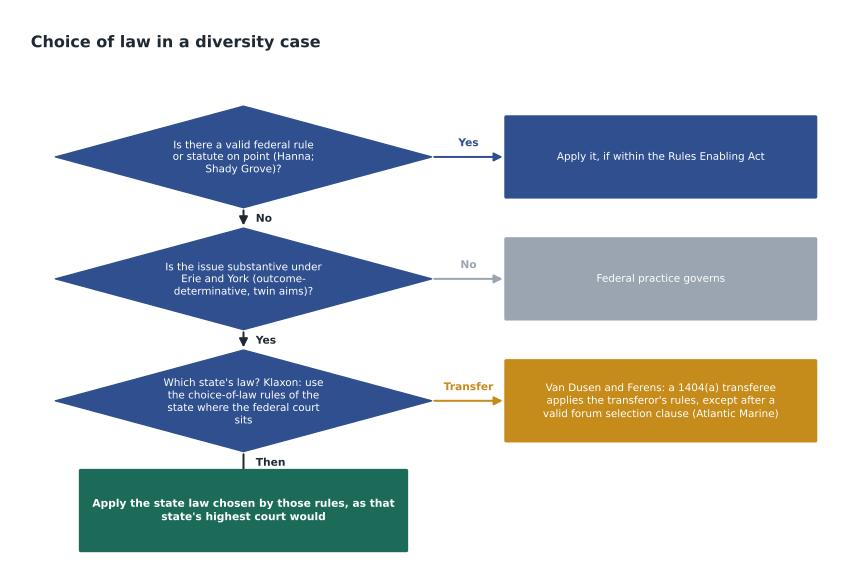
In Erie Railroad Co. v. Tompkins, 304 U.S. 64 (1938), the Supreme Court held that federal courts sitting in diversity must apply state substantive law, including state common law, overruling Swift v. Tyson's regime of federal general common law. Erie rested on the Rules of Decision Act, 28 U.S.C. section 1652, on constitutional concerns about federal lawmaking power, and on two policies later called the twin aims: discouraging forum shopping between state and federal courts and avoiding inequitable administration of the laws. Guaranty Trust Co. v. York, 326 U.S. 99 (1945), applied Erie to a state statute of limitations, asking whether the rule would significantly affect the outcome. Hanna v. Plumer, 380 U.S. 460 (1965), held that a valid Federal Rule of Civil Procedure governs in federal court even if state law differs, as long as the Rule is within the Rules Enabling Act and the Constitution. Shady Grove Orthopedic Associates, P.A. v. Allstate Insurance Co., 559 U.S. 393 (2010), applied Rule 23 to allow a class action that New York law would have barred.
Erie answered whether state law applies. It did not answer which state's law. A federal court in Westmarch hearing a case with contacts in Westmarch, Harrowmere and Ontario needs a choice-of-law rule before it can apply any state's substantive law. That gap was filled three years later.
Klaxon: the forum state's choice-of-law rules
In Klaxon Co. v. Stentor Electric Manufacturing Co., 313 U.S. 487 (1941), a contract made in New York was to be performed partly in Pennsylvania, and a suit on it was brought in federal court in Delaware. The question was whether a New York statute allowing prejudgment interest applied. The Third Circuit had decided the choice-of-law question as a matter of general law. The Supreme Court reversed, holding that a federal court in diversity must apply the choice-of-law rules of the state in which it sits. Otherwise, the Court reasoned, the accident of diversity of citizenship would disturb equal administration of justice in coordinate state and federal courts sitting side by side, which is exactly what Erie aimed to prevent. A companion case, Griffin v. McCoach, 313 U.S. 498 (1941), applied the same rule to an insurance dispute.
Klaxon has been criticized. Scholars have argued that federal courts could develop a uniform federal choice-of-law rule for interstate cases, which would reduce forum shopping among states and give federal courts a role suited to their national perspective. The Supreme Court has never accepted that argument and has applied Klaxon strictly. In Day & Zimmermann, Inc. v. Challoner, 423 U.S. 3 (1975), a soldier was killed in Cambodia by a defective artillery round made by a company with operations in Texas, and his estate sued in federal court in Texas. The Fifth Circuit applied Texas substantive law on the theory that Cambodia had no interest in the case. The Supreme Court summarily reversed: a federal court in Texas must apply Texas choice-of-law rules, which at the time pointed to the place of injury, even if the result seemed odd. A federal court is not free to engraft its own choice-of-law rules onto a state's.
Applying a state's choice-of-law method in federal court
Under Klaxon, the District of Westmarch must apply Westmarch's choice-of-law rules, which in Castellane's hypothetical are those of the Second Restatement. The federal court must predict how the Westmarch Supreme Court would apply the method to the issues in the case, using decisions of the Westmarch Supreme Court, the decisions of intermediate appellate courts as evidence, and, where permitted, certification of unsettled questions to the state's highest court. Most states allow federal courts to certify unsettled questions of state law to the state's highest court, and federal courts sometimes use that procedure when a state's choice-of-law method has not been applied to a particular kind of issue.
Klaxon also requires the federal court to follow the state's characterization of issues as substantive or procedural for choice-of-law purposes, at least where the state's characterization reflects its choice-of-law policy rather than federal procedure. Statutes of limitations show the layering. Under Guaranty Trust v. York, a federal court in diversity applies state limitations law. Under Klaxon, it applies the forum state's choice-of-law rules for limitations, including any borrowing statute. If Westmarch's rules treat limitations as procedural and apply Westmarch's three-year period, the federal court does the same.
Transfer under section 1404(a): Van Dusen and Ferens
When a federal case is transferred from one district to another, Klaxon raises a question: whose choice-of-law rules apply after transfer, those of the state where the case was filed or those of the state where it ends up? In Van Dusen v. Barrack, 376 U.S. 612 (1964), the Court addressed that question in litigation arising from an airplane crash in Boston. Pennsylvania plaintiffs sued in federal court in Pennsylvania, and the defendants sought transfer to Massachusetts. The Court held that when a defendant obtains a transfer under section 1404(a), the transferee court must apply the law, including the choice-of-law rules, that the transferor court would have applied. Section 1404(a) was meant to be a judicial housekeeping measure, a change of courtrooms, not a change of law, and a defendant should not be able to use it to deprive a plaintiff of the state law advantages that came with the plaintiff's choice of a proper forum.
In Ferens v. John Deere Co., 494 U.S. 516 (1990), the Court extended Van Dusen to transfers requested by the plaintiff. Albert Ferens, a Pennsylvania farmer, lost his hand in Pennsylvania to a Deere combine. He missed Pennsylvania's two-year limitations period for tort claims. He filed his tort claims in federal court in Mississippi, whose choice-of-law rules at the time treated limitations as procedural and applied Mississippi's six-year period, and then moved to transfer the case to Pennsylvania, the convenient forum. The Supreme Court held, five to four, that the transferee court in Pennsylvania had to apply the Mississippi choice-of-law rules and therefore the Mississippi limitations period. Justice Scalia's dissent argued that the decision rewarded blatant forum shopping. Ferens remains good law, though states have narrowed its practical effect by adopting borrowing statutes and modern limitations rules.
Transfer under a forum selection clause: Atlantic Marine
Atlantic Marine Construction Co. v. U.S. District Court, 571 U.S. 49 (2013), arose from a construction subcontract that required suit in Virginia. The subcontractor sued in Texas. The Supreme Court held that a valid forum selection clause should be enforced through section 1404(a) transfer (or forum non conveniens dismissal for a nonfederal forum) and should be given controlling weight in all but the most exceptional cases. The plaintiff's choice of forum merits no weight, the court should not consider the parties' private interests, and only public interest factors can defeat the clause. Most important for conflicts, the Court held that when a case is transferred to enforce a forum selection clause, the transferee court does not carry over the original venue's choice-of-law rules. A plaintiff who files in violation of a forum clause should not gain the choice-of-law advantages of the forum he chose in breach of the contract.
Atlantic Marine matters directly to the Silverline case. If the District of Westmarch decides that Silverline's forum selection clause is valid and covers the passengers' claims, it will transfer the case to the District of Harrowmere, and that court will apply Harrowmere's choice-of-law rules, the First Restatement, which select Harrowmere law, cap and all. If instead the court holds that the clause does not bind the passengers or does not cover personal injury claims, or the court denies transfer on public interest grounds, the case stays in Westmarch, or is transferred for convenience under the Van Dusen rule, carrying Westmarch's Second Restatement rules with it.
Priya Natarajan points out that most of the passengers never accepted the terms; only Hartwell clicked "I agree." Castellane agrees that this is the passengers' best argument. Courts have sometimes enforced forum clauses against nonsignatories who are closely related to the contract, but personal injury claims by passengers who were not parties to a charter arranged by a nonprofit are a long way from the commercial setting of Atlantic Marine. The enforceability and scope of the clause are themselves governed by contract law, and courts disagree on whether federal law or state law determines whether a forum clause is valid in the first place. The federal court will likely apply federal law to the enforceability of the clause and state law, selected by Westmarch choice-of-law rules, to its interpretation and to whether it binds nonsignatories.
Federal law and federal common law
Not every claim in federal court is a diversity claim. When a federal statute supplies the rule of decision, there is no choice-of-law question about the merits, though federal statutes sometimes incorporate state law. The Federal Tort Claims Act, for example, makes the United States liable in accordance with the law of the place where the act or omission occurred, which the Court in Richards v. United States, 369 U.S. 1 (1962), interpreted to mean the whole law of that place, including its choice-of-law rules. In maritime cases, federal courts apply federal maritime choice-of-law principles developed in Lauritzen v. Larsen, 345 U.S. 571 (1953), which lists factors such as the place of the wrongful act, the law of the flag and the domicile of the injured seaman.
Federal courts hearing claims against foreign sovereigns under the Foreign Sovereign Immunities Act face a related question. In Cassirer v. Thyssen-Bornemisza Collection Foundation, 596 U.S. 107 (2022), heirs sought to recover a Pissarro painting taken by the Nazis that was held by a Spanish foundation controlled by Spain. The Ninth Circuit had applied federal common law choice-of-law rules. The Supreme Court unanimously held that, because the FSIA provides that a foreign state shall be liable in the same manner and to the same extent as a private individual under like circumstances, a federal court must apply the same choice-of-law rule that would apply in a suit against a private party, which in a non-federal-question case means the forum state's rule. Cassirer thus extended Klaxon's logic to FSIA cases. On remand the Ninth Circuit applied California's governmental interest test and held that Spanish law governed, and the dispute then continued in light of later California legislation on stolen art, which students should check for its current status.
Preclusion and state law in federal court
Federal courts also sometimes look to state law to determine the preclusive effect of their own judgments. In Semtek International Inc. v. Lockheed Martin Corp., 531 U.S. 497 (2001), a federal court in California dismissed a diversity case as time-barred under California's statute of limitations. The plaintiff then sued in Maryland state court, where the limitations period had not run. The Supreme Court held that the preclusive effect of a federal diversity judgment is governed by federal common law, which adopts as its rule the law that would be applied by state courts in the state in which the federal diversity court sits, unless that rule is incompatible with federal interests. California law would not have given the dismissal claim-preclusive effect in other states, so the Maryland action could proceed. Lesson 9 returns to preclusion between states.
Strategy: removal, transfer and the choice of law
Because Klaxon makes federal and state courts in the same state apply the same choice-of-law rules, removal from Westmarch state court to the District of Westmarch should not change the governing law. What removal can change is procedure and pace: federal pleading standards, federal discovery, the availability of federal transfer under section 1404(a), and the possibility of consolidation in multidistrict litigation under 28 U.S.C. section 1407 if many similar cases are filed around the country. In multidistrict litigation the transferee judge applies the choice-of-law rules of each transferor court, following Van Dusen, which can mean applying several states' methods to cases that are being managed together.
Defendants therefore look for routes that change the forum state rather than merely the court system. A forum selection clause enforced under Atlantic Marine changes the forum state and its choice-of-law rules. A forum non conveniens dismissal sends the case to a foreign country with its own law, as Lesson 11 shows. Plaintiffs, for their part, try to file in a state with favorable choice-of-law rules and to keep the case there, sometimes by joining a nondiverse defendant to prevent removal. In the Silverline case, Pascale could have added Ferrand Fleet Service, the Brennan Falls garage, as a defendant on a negligent maintenance theory. As a Westmarch citizen, Ferrand would have destroyed complete diversity and kept the case in Westmarch state court, provided the claim against Ferrand was not fraudulently joined.
Worked problem
Predicting the governing law after transfer
Consider three scenarios for the Hartwell case in federal court: (1) it stays in the District of Westmarch; (2) the court transfers it to the District of Harrowmere for convenience under section 1404(a), at Silverline's request, without relying on the forum clause; (3) the court transfers it to the District of Harrowmere to enforce the forum clause. Which state's choice-of-law rules govern in each?
Show solution
- Scenario 1: Klaxon requires the District of Westmarch to apply Westmarch's choice-of-law rules, the Second Restatement.
- Scenario 2: Van Dusen requires the transferee court in Harrowmere to apply the law the transferor court would have applied, including Westmarch's choice-of-law rules.
- Scenario 3: Atlantic Marine holds that a transfer enforcing a valid forum selection clause does not carry the transferor's choice-of-law rules. The District of Harrowmere applies Harrowmere's choice-of-law rules, the First Restatement.
- Consequence: in scenarios 1 and 2, the Westmarch Second Restatement analysis of the damages cap from Lesson 5 governs; in scenario 3, the place-of-the-wrong rule selects Harrowmere law and the cap almost certainly applies.
Answer: The fight over the forum clause is really a fight over choice-of-law rules, and therefore over the damages cap.
Common mistakes
MistakeA federal court in diversity develops its own choice-of-law rules.
InsteadKlaxon requires it to apply the choice-of-law rules of the state in which it sits, even when the result seems odd (Day & Zimmermann v. Challoner).
MistakeAfter a section 1404(a) transfer, the transferee court applies its own state's choice-of-law rules.
InsteadVan Dusen and Ferens require it to apply the transferor court's rules, unless the transfer enforced a valid forum selection clause (Atlantic Marine).
MistakeRemoval from state to federal court changes the governing law.
InsteadBecause of Klaxon, removal within the same state should not change the choice-of-law rules; it changes procedure.
MistakeFederal courts hearing FSIA claims apply federal common law choice-of-law rules.
InsteadCassirer (2022) held they apply the same rule as in a suit against a private party, usually the forum state's rule.
Summary and key terms
- Erie requires federal courts in diversity to apply state substantive law; Klaxon (1941) requires them to apply the forum state's choice-of-law rules.
- Day & Zimmermann v. Challoner (1975) confirmed that federal courts may not modify a state's choice-of-law rules, even when the result seems anomalous.
- Van Dusen (1964) and Ferens (1990) hold that after a section 1404(a) transfer the transferee applies the transferor's choice-of-law rules, whoever sought the transfer.
- Atlantic Marine (2013) holds that a transfer enforcing a valid forum selection clause does not carry the original venue's choice-of-law rules.
- Cassirer (2022) applied the forum state's choice-of-law rule in FSIA cases; Richards (1962) read the FTCA to incorporate the whole law of the place of the act.
- Semtek (2001) adopts the forum state's preclusion law as federal common law for diversity judgments.
- Klaxon rule
- A federal court in diversity applies the choice-of-law rules of the state in which it sits.
- Section 1404(a)
- The federal statute authorizing transfer to another district for convenience or to enforce a forum clause.
- Van Dusen rule
- After a 1404(a) transfer, the transferee applies the law the transferor would have applied.
- Certification
- A procedure allowing a federal court to ask a state's highest court to decide an unsettled question of state law.
- Fraudulent joinder
- Joinder of a nondiverse defendant with no real claim, which a federal court disregards in assessing diversity.
Practice problems
Work each problem on paper first, then reveal the answer to check.
Why did the Supreme Court decide in Klaxon that federal courts must use the forum state's choice-of-law rules?
Show answer
To prevent diversity jurisdiction from producing different results in state and federal courts sitting side by side in the same state, in keeping with Erie's aim of equal administration of justice.
In Ferens v. John Deere, why did the plaintiff file in Mississippi and then seek transfer to Pennsylvania?
Show answer
Mississippi's choice-of-law rules applied its six-year limitations period; under Van Dusen, extended in Ferens, the Pennsylvania transferee court had to apply Mississippi's rules, saving the claim from Pennsylvania's two-year period.
What did Atlantic Marine hold about choice of law after a transfer to enforce a forum clause?
Show answer
The transferee court does not apply the transferor's choice-of-law rules; it applies its own state's rules.
How might the Silverline plaintiffs have prevented removal to federal court?
Show answer
By joining a Westmarch defendant with a real claim against it, such as Ferrand Fleet Service, which would defeat complete diversity.
Lesson quiz · 5 questions
Score 60% or more to complete this lesson.
Create a free account to save your progress, take quizzes and earn a certificate.