
LAWU-302 · Lesson 3 of 12 · 25 min
The First Restatement and its escape devices
▶ Video coming soon A video version of this lesson is on the way.
Castellane asks the class to imagine that the Silverline passengers file in Harrowmere. Silverline's Ashcombe lawyer, Linnea Torvald, would welcome that, because Harrowmere's courts still follow the First Restatement. "In Harrowmere," Castellane says, "the choice-of-law analysis for the tort claims takes about one sentence. The injuries happened on Route 41 in Harrowmere, so Harrowmere law governs. Everything interesting in this lesson is about how lawyers for the passengers would try to get out of that sentence." This lesson covers the traditional rules, the reasons courts found them unsatisfactory, and the escape devices that traditional courts used, and still use, to avoid results they consider wrong.
The structure of the traditional rules
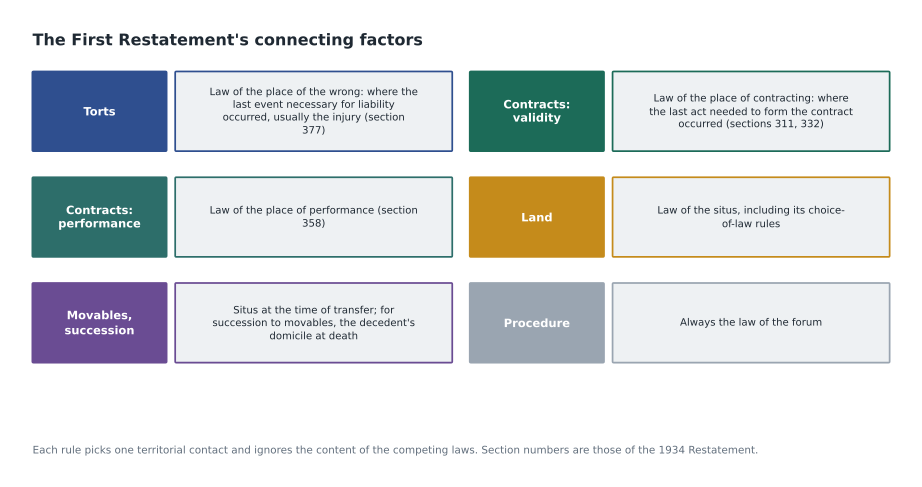
The 1934 Restatement of the Conflict of Laws organized the field into categories, each with a single connecting factor. The categories were defined by the forum's own understanding of legal concepts, and the connecting factors were almost all territorial: the place where an event happened or a thing was located. The rules did not ask what the competing laws provided, what policies they served or whether the states involved cared about the outcome. In Beale's theory those questions were beside the point, because the forum was only recognizing a right that had already vested somewhere.
Torts: the place of the wrong
For torts, the First Restatement applied the law of the place of the wrong, defined in section 377 as the state where the last event necessary to make an actor liable for an alleged tort takes place. Because injury is usually the last element of a tort, the place of the wrong is usually the place of injury, even if the negligent conduct happened elsewhere. The law of that place determined whether a tort was committed, what defenses were available and what damages could be recovered.
The leading illustration is Alabama Great Southern Railroad Co. v. Carroll, 97 Ala. 126, 11 So. 803 (1892). Carroll, an Alabama resident, worked as a brakeman for an Alabama railroad. Employees in Alabama negligently failed to inspect a coupling link before the train left Alabama, and the link broke in Mississippi, injuring Carroll there. Alabama's Employers' Liability Act had abolished the fellow servant rule, which barred an employee from suing the employer for a coworker's negligence; Mississippi still followed that rule. The Alabama Supreme Court held that Mississippi law governed because the injury, the last event necessary for a cause of action, occurred there. Carroll lost, even though the employer, the employee, the employment relationship and the negligent conduct were all in Alabama. To critics, Carroll became the emblem of a rule that ignored every reason a state might care.
The place of the wrong rule produced special puzzles for torts that do not happen in one place. In defamation, the injury occurs wherever the statement is read, which could be every state. In fraud, the loss may be suffered in one state and the reliance in another. In products cases, the defect, the sale and the injury may be spread across three states. The First Restatement had subsidiary rules for some of these cases, but the more a tort's elements were spread across states, the more arbitrary a single-place rule looked.
Contracts: the place of contracting
For contracts, the First Restatement looked mainly to the place of contracting, defined as the place where the last act necessary to form the contract occurred, usually where the acceptance was given or, for contracts by mail, where the acceptance was dispatched. The law of that place governed the contract's validity, capacity, formalities and the effect of misrepresentation, duress and illegality (section 332). Matters of performance, such as the manner and time of performance, the sufficiency of performance and excuse for nonperformance, were governed by the law of the place of performance (section 358). The line between validity and performance was itself a source of litigation.
Milliken v. Pratt, 125 Mass. 374 (1878), decided before the Restatement but under the same theory, shows the rule at work. Sarah Pratt, a married woman living in Massachusetts, signed a guaranty in Massachusetts for her husband's purchases from a Maine merchant and had it delivered to the merchant in Maine, where the guaranty was accepted. Massachusetts law at the time did not allow a married woman to bind herself as a surety for her husband; Maine law did. The Massachusetts court held the guaranty valid because the contract was made in Maine. The rule protected the merchant's expectations, but it also meant that a married woman's capacity, which Massachusetts law protected, could be changed by where a letter was accepted.
Property, succession and family
The First Restatement applied the law of the situs to almost every question about land, including the validity of a conveyance, the effect of a will on land and the creation of interests. It also applied the situs state's whole law, including its choice-of-law rules, so a forum would decide a question about land as the situs court would. For movables, the law of the place where the thing was located at the time of a transaction governed transfers, while succession to movables on death was governed by the law of the decedent's domicile at death. A marriage valid where it was celebrated was valid everywhere, subject to exceptions for marriages contrary to the strong public policy of the domicile. These situs and domicile rules have proven far more durable than the tort and contract rules. Many modern courts still apply situs law to land almost automatically, because land titles need certainty and the situs state controls the land records.
Why the rules lost support
Critics made four main objections. First, the rules were arbitrary: they selected the law of a state that might have no interest in the outcome, as in Carroll. Second, the rules depended on characterization, which was manipulable. Third, the rules were not as certain as they claimed, because the location of the last event was often debatable and the escape devices made results unpredictable anyway. Fourth, the vested rights theory was intellectually confused: a forum applying foreign law is making a choice, not discovering a pre-existing fact. By the 1960s most scholars had abandoned the theory, and courts began to follow.
Defenders of the traditional rules, including some courts that still apply them, answer that predictability matters, that judges are poorly placed to weigh the policies of other states, and that the modern methods have produced more litigation and less consistency than the rules ever did. The Maryland and Virginia appellate courts, among others, have expressly declined invitations to abandon lex loci delicti, reasoning that the alternatives are no better and that any change should come from the legislature. That debate is worth taking seriously, because it continues in the drafting of the Third Restatement.
Escape device one: characterization
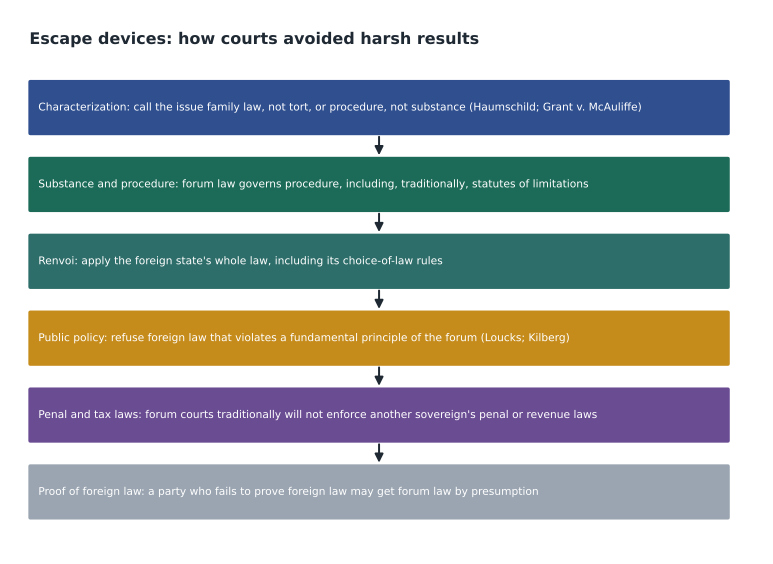
Because each rule applied only to a category, a court could change the result by changing the category. Haumschild v. Continental Casualty Co., 7 Wis. 2d 130 (1959), is the classic example. A wife sued her husband for injuries suffered in a car accident in California. Both spouses were domiciled in Wisconsin. California recognized interspousal immunity, which barred suits between spouses; Wisconsin did not. If the immunity was a question of tort, California law as the place of the wrong would apply and the wife would lose. The Wisconsin Supreme Court characterized interspousal immunity as a question of family law, governed by the law of the domicile, and applied Wisconsin law. The result made sense, since California had no reason to protect the marital harmony of Wisconsin spouses, but the court reached it by relabeling the issue.
Escape device two: substance and procedure
Forum law always governs procedure, so classifying an issue as procedural lets the forum apply its own rule. In Grant v. McAuliffe, 41 Cal. 2d 859 (1953), two cars driven by California residents collided in Arizona. The driver alleged to be at fault died, and the injured Californians sued his estate in California. Arizona law provided that a tort claim did not survive the death of the tortfeasor; California's survival statute allowed it. Justice Roger Traynor, writing for the California Supreme Court, characterized survival as a matter of procedure, akin to the question of who may be sued, and applied California's statute. The decision reached a sensible result, since Arizona had no interest in shielding a California estate from California plaintiffs, but few believed that survival of actions is really procedural.
Statutes of limitations were the most important use of the procedural label. A forum with a long limitations period could hear claims already barred where they arose. That made forum shopping attractive and prompted borrowing statutes, discussed in Lesson 1. The burden of proof, presumptions and the measure of damages were also contested. A rule that looks procedural but determines the outcome, such as a presumption that a driver who rear-ends another car was negligent, may well be treated as substantive by a modern court.
Escape device three: renvoi
Renvoi, from the French word for sending back, asks whether a reference to another state's law means that state's internal law only or its whole law, including its choice-of-law rules. Suppose a Harrowmere court, applying lex loci delicti, refers a question to the law of a state where an injury occurred, and that state's choice-of-law rules would refer the question back to Harrowmere law. If the Harrowmere court applies the other state's whole law, it ends up applying its own law. The First Restatement generally rejected renvoi, directing courts to apply only the internal law of the selected state, with exceptions for questions of title to land and the validity of divorces, where the forum should decide as the situs or domicile court would.
Renvoi has a famous English pedigree in In re Annesley, [1926] Ch. 692, where an English court asked to apply French law to the estate of an Englishwoman domiciled in France decided the case as a French court would have, accepting a reference back. In American practice renvoi is rarely used today, but it reappears in two settings. Under the Federal Tort Claims Act, the Supreme Court held in Richards v. United States, 369 U.S. 1 (1962), that the reference to the law of the place where the act or omission occurred means that place's whole law, including its choice-of-law rules. And modern courts sometimes look at another state's choice-of-law rules to decide whether that state actually wants its law applied, which is a kind of renvoi in interest analysis clothing.
Escape device four: public policy
A forum may refuse to apply foreign law that violates its fundamental public policy. The classic statement comes from Judge Benjamin Cardozo in Loucks v. Standard Oil Co. of New York, 224 N.Y. 99 (1918). A New York resident was killed in Massachusetts by the negligence of the defendant's employees, and his administrators sued in New York under Massachusetts's wrongful death statute, which measured damages by the defendant's culpability rather than by the survivors' loss. The defendant argued that the statute was penal and contrary to New York policy. Cardozo rejected both arguments. New York courts, he wrote, "are not so provincial as to say that every solution of a problem is wrong because we deal with it otherwise at home." Foreign law should be refused only if enforcing it would violate some fundamental principle of justice, some prevalent conception of good morals, some deep-rooted tradition of the common weal.
Loucks set a high bar, but courts sometimes cleared it. In Kilberg v. Northeast Airlines, Inc., 9 N.Y.2d 34 (1961), a New York resident bought a ticket in New York for a flight to Nantucket and was killed when the plane crashed in Massachusetts. Massachusetts capped wrongful death damages at 15,000 dollars. The New York Court of Appeals refused to apply the cap, pointing to New York's strong policy, embodied in its constitution, against limits on wrongful death recoveries, and called the cap absurd and unjust. Kilberg is often read as a precursor of Babcock, because the court was really reasoning about New York's interest in compensating its own residents.
The public policy device differs from the others in an important way. Traditionally it was a shield, not a sword: it allowed the forum to refuse to enforce a foreign claim, which often led to dismissal, rather than to substitute forum law. Courts that used it to apply forum law instead were stretching it. Modern courts using interest analysis or the Second Restatement fold public policy into the main analysis, but traditional states still rely on it, and it remains the main escape device in states like Maryland and Virginia.
Penal and revenue laws, and proof of foreign law
Two related doctrines limited what foreign law a forum would apply. Courts traditionally refused to enforce the penal laws of another sovereign, meaning laws that punish an offense against the public rather than compensate a private party. The Supreme Court drew that line in Huntington v. Attrill, 146 U.S. 657 (1892), holding that a New York statute making corporate officers liable for corporate debts if they signed false certificates was remedial, not penal, and therefore enforceable in Maryland. Courts also refused to enforce another sovereign's tax claims, a revenue rule that still has force in international cases.
Foreign law must also be proved. Traditionally it was treated as a fact that a party had to plead and prove, and a party who failed to do so might find the court presuming that the foreign law was the same as forum law, or might lose. In Walton v. Arabian American Oil Co., 233 F.2d 541 (2d Cir. 1956), an American injured in Saudi Arabia lost because he failed to prove Saudi law and the court refused to presume it matched New York law on the facts. Modern rules, such as Federal Rule of Civil Procedure 44.1, treat the determination of foreign law as a question of law that the court may research itself. Within the United States, courts take judicial notice of sister-state law. Lesson 11 returns to proof of foreign-country law.
The Silverline claims in a Harrowmere court
Jordan Kimura works through the claims as a Harrowmere judge would. Hartwell's and Bergstrom's personal injury claims against Silverline: the last event necessary for liability, the injury, occurred in Harrowmere, so Harrowmere law governs liability, comparative fault and the damages cap. Tremaine's claim against her friend Montclair: also injury in Harrowmere, so Harrowmere's guest statute applies and bars the claim unless Montclair was grossly negligent. Bergstrom's claim for his crushed cello under the charter contract: the place of contracting depends on where the last act of formation occurred. Hartwell clicked to accept Silverline's terms in Brennan Falls, which suggests Westmarch, but the contract also chooses Harrowmere law, and the First Restatement gave party choice little weight, a point Lesson 6 revisits.
Then Kimura looks for exits. Tremaine might argue, following Haumschild, that the guest statute concerns the host-guest relationship rather than the conduct of driving and should be characterized as governed by the law of the parties' common domicile, Westmarch. The argument has had little success in traditional states, which apply guest statutes as tort rules, but a sympathetic court might accept it. Hartwell might argue that the cap is procedural, which is weak, or that applying it would violate Harrowmere's own public policy, which makes no sense in Harrowmere's own court. In a Harrowmere forum, the passengers' realistic options are limited. That is the reason their lawyers will try to stay in Westmarch.
Worked problem
Applying the traditional rules
A Harrowmere resident buys a used car from a dealer in Westmarch, signing the contract in Brennan Falls. The contract requires delivery in Ashcombe, Harrowmere. The buyer later claims (1) that the contract is void because the dealer failed to give a disclosure required by Harrowmere law, and (2) that the dealer delivered late. Under the First Restatement, which law governs each issue?
Show solution
- Classify the issues. The first concerns validity (formalities and illegality); the second concerns performance (time of delivery).
- Validity is governed by the law of the place of contracting (section 332). The last act of formation, the signing, occurred in Westmarch, so Westmarch law decides whether the missing disclosure voids the contract.
- Performance is governed by the law of the place of performance (section 358). Delivery was due in Harrowmere, so Harrowmere law decides whether delivery was late and what follows.
- Note the escape routes: the buyer might argue that Harrowmere's disclosure rule reflects a fundamental public policy that a Harrowmere forum will enforce regardless of the place of contracting.
Answer: Westmarch law governs validity, Harrowmere law governs performance, and a Harrowmere forum might invoke public policy to protect its resident.
Common mistakes
MistakeUnder the First Restatement, the place of the wrong is where the negligent act occurred.
InsteadIt is where the last event necessary for liability occurred, usually the injury, as in Carroll, where the negligence was in Alabama but the injury in Mississippi.
MistakePublic policy lets a traditional court apply forum law whenever it prefers forum law.
InsteadLoucks sets a high bar: the foreign law must violate a fundamental principle of justice or deep-rooted tradition. Traditionally the device led to refusal to enforce, not substitution of forum law.
MistakeThe First Restatement accepted renvoi generally.
InsteadIt generally rejected renvoi, with exceptions for title to land and validity of divorce.
MistakeCharacterization is a neutral, mechanical step.
InsteadCharacterization determines which rule applies and was often used as an escape device, as in Haumschild and Grant v. McAuliffe.
Summary and key terms
- The First Restatement (1934) assigned each category of issue to a single territorial connecting factor, without regard to the content of the competing laws.
- Torts were governed by the place of the wrong, the place of the last event necessary for liability, usually the injury (Carroll).
- Contract validity was governed by the place of contracting and performance by the place of performance (Milliken v. Pratt).
- Land was governed by situs law, including situs choice-of-law rules; succession to movables by the domicile at death.
- Courts escaped harsh results through characterization (Haumschild), the substance and procedure line (Grant v. McAuliffe), renvoi and public policy (Loucks; Kilberg).
- Courts traditionally refused to enforce foreign penal and revenue laws (Huntington v. Attrill) and required foreign law to be proved.
- Lex loci delicti
- The law of the place of the wrong.
- Lex loci contractus
- The law of the place where the contract was made.
- Lex situs
- The law of the place where property is located.
- Escape device
- A technique (characterization, procedure, renvoi, public policy) used to avoid the result of a fixed choice-of-law rule.
- Renvoi
- Applying another state's whole law, including its choice-of-law rules, which may refer back to the forum or on to a third state.
- Penal law
- A law punishing an offense against the public, which other sovereigns traditionally will not enforce.
Practice problems
Work each problem on paper first, then reveal the answer to check.
In Carroll, why did the Alabama court apply Mississippi law although almost everything connected with the case was in Alabama?
Show answer
Because under the place of the wrong rule the right vested where the last event necessary for liability, the injury, occurred, and the injury occurred in Mississippi.
How did the Wisconsin court in Haumschild avoid California's interspousal immunity?
Show answer
It characterized interspousal immunity as a question of family law governed by the law of the spouses' domicile, Wisconsin, rather than as a tort question governed by the place of the wrong.
What test did Cardozo state in Loucks for refusing foreign law on public policy grounds?
Show answer
Foreign law should be refused only if enforcement would violate some fundamental principle of justice, some prevalent conception of good morals, some deep-rooted tradition of the common weal.
Under Richards v. United States, what law does the Federal Tort Claims Act direct a court to apply?
Show answer
The whole law, including choice-of-law rules, of the place where the act or omission occurred.
Lesson quiz · 5 questions
Score 60% or more to complete this lesson.
Create a free account to save your progress, take quizzes and earn a certificate.