
LAWU-302 · Lesson 4 of 12 · 24 min
Governmental interest analysis and its successors
▶ Video coming soon A video version of this lesson is on the way.
Castellane starts with the passenger in Clemency Montclair's car. Honora Tremaine and Montclair both live in Brennan Falls. Montclair's car is registered and insured in Westmarch. They were following the chorale's coach to a concert. When the coach rolled, Montclair swerved, hit a guardrail and Tremaine broke her collarbone. Harrowmere's guest statute bars a passenger's claim against a host driver absent gross negligence; Westmarch has no guest statute. "Under the First Restatement, Tremaine loses because the guardrail was in Harrowmere," Castellane says. "Ask yourselves a different question. Why does Harrowmere have a guest statute, and does that reason have anything to do with these two women?" That question is the heart of governmental interest analysis, the method that overturned the traditional rules.
Currie's method
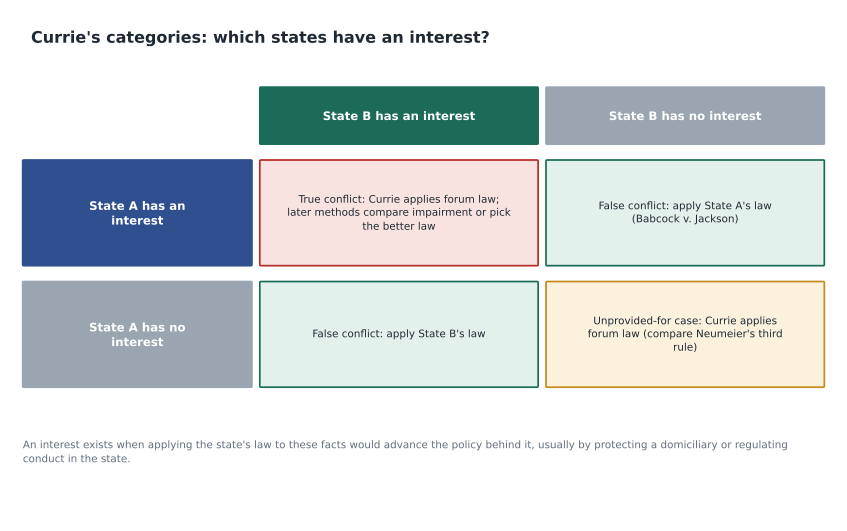
Brainerd Currie argued that a choice-of-law problem is a problem of statutory or common law interpretation. Every law has a purpose. When a case touches more than one state, the court should ask whether applying each state's law to the facts would advance that law's purpose. Currie's method has four steps. First, the court presumptively applies forum law. Second, if a party asks for foreign law, the court identifies the policies behind the competing laws and asks whether each state has an interest in applying its policy to these facts, usually because the state's own residents or territory are affected. Third, if only one state is interested, there is a false conflict and that state's law applies. Fourth, if both states are interested, there is a true conflict, and the forum should apply its own law, because a court has no legitimate way to rank its own state's policy below another's.
Currie later added a refinement: before declaring a true conflict, the court should take a moderate and restrained view of its own state's interest, in case a narrower reading of the forum's policy makes the conflict disappear. He also identified a third category, the unprovided-for case, where neither state has an interest in applying its law, and suggested applying forum law there too.
False conflicts: Babcock and Hurtado
Babcock v. Jackson, 12 N.Y.2d 473 (1963), introduced in Lesson 2, is the model false conflict. Ontario's guest statute aimed to prevent collusion between Ontario guests and Ontario hosts against Ontario insurers. Applying it to a New York host, a New York guest and a New York insurer would advance no Ontario policy. New York's policy of compensating injured guests, by contrast, was fully engaged, since the guest was a New Yorker. The court applied New York law. Ontario's only connection was the place of the accident, and the court noted that the rules of the road, such as speed limits and right of way, would still be governed by the law of the place of the conduct.
False conflicts also run the other way, protecting defendants or plaintiffs depending on whose policies are involved. In Hurtado v. Superior Court, 11 Cal. 3d 574 (1974), a Mexican resident was killed in California in an accident caused by California defendants. His widow and children, also Mexican residents, sued in California. Mexican law limited wrongful death damages; California law did not. The California Supreme Court held that Mexico's limit aimed to protect Mexican defendants from excessive financial burdens, an interest not engaged when the defendants were Californian. California's interests in deterring negligent conduct on its highways were engaged. The conflict was false, and California law applied, giving the Mexican plaintiffs more than their own country would have.
Applying the same reasoning to Tremaine's claim, Hannah Lindqvist concludes that Harrowmere's guest statute, whatever its purpose, protects Harrowmere hosts and their insurers. Montclair and her insurer are from Westmarch. Westmarch's policy of compensating injured passengers is engaged because Tremaine is a Westmarch resident. Only Westmarch has an interest in the issue, so the conflict is false and Westmarch law applies. Castellane agrees and adds that almost every modern method, including the Second Restatement, would reach the same result on these facts.
Neumeier and rules for guest cases
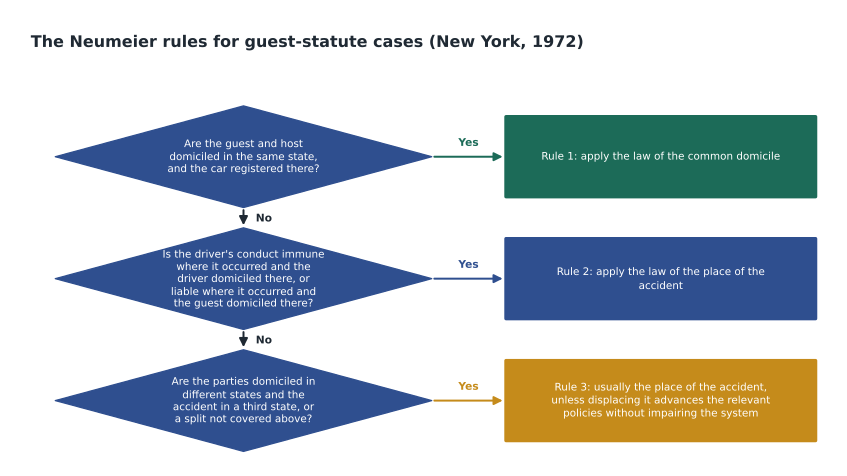
Interest analysis was criticized for unpredictability, and the New York Court of Appeals, after a decade of inconsistent guest-statute decisions, tried to restore order. In Neumeier v. Kuehner, 31 N.Y.2d 121 (1972), a New York host, Kuehner, drove an Ontario guest, Neumeier, in Ontario, and both were killed. The guest's estate sued in New York. Adopting rules proposed by Chief Judge Stanley Fuld in an earlier concurrence, the court announced three rules for guest-statute cases. First, when guest and host share a domicile and the car is registered there, the law of that state governs. Second, when the driver's conduct occurs in the driver's home state and that state would not impose liability, the driver should not be held liable because the guest's state would; conversely, when the guest is injured in the guest's home state and its law allows recovery, the driver who came into that state should not be able to invoke the law of the driver's home state as a defense. Third, in other split-domicile cases, the law of the place of the accident normally applies, unless displacing it would advance the relevant substantive law purposes without impairing the smooth working of the multistate system or producing great uncertainty for litigants.
Neumeier itself fell under the third rule: the guest was from Ontario, the host from New York, and the accident occurred in Ontario, the guest's home. The court applied Ontario's guest statute, reasoning that an Ontario resident injured in Ontario should not get a better result by suing a New Yorker than by suing an Ontario host.
Conduct-regulating and loss-allocating rules
New York later extended the Neumeier rules beyond guest statutes. In Schultz v. Boy Scouts of America, Inc., 65 N.Y.2d 189 (1985), two New Jersey boys were sexually abused by a scout leader, a member of a Franciscan religious order, at a camp in New York. The family sued the Boy Scouts and the Franciscan Brothers in New York. New Jersey's charitable immunity statute would bar the claims; New York had no such immunity. The court drew a distinction that has become central in American conflicts law. Conduct-regulating rules, such as standards of care and rules of the road, are governed by the law of the place of the tort, because that state has the dominant interest in regulating conduct within its borders. Loss-allocating rules, such as immunities, damages caps, guest statutes and contribution rules, which decide who bears a loss after it occurs, are governed by Neumeier's rules, which emphasize the parties' domiciles. Charitable immunity is loss-allocating, so the court applied New Jersey law, barring the claims.
The distinction can be hard to apply. In Padula v. Lilarn Properties Corp., 84 N.Y.2d 519 (1994), a New York worker employed by a New York company was injured in a fall from a scaffold in Florida. New York's Labor Law imposes absolute liability on owners and contractors for failure to provide proper scaffolding; Florida did not. The court held the New York rule conduct-regulating, because it aims to induce safe practices at the work site, and applied Florida law as the place of the conduct. In Cooney v. Osgood Machinery, Inc., 81 N.Y.2d 66 (1993), by contrast, a contribution claim against a Missouri employer, which Missouri's workers' compensation law shielded from contribution, was treated as loss-allocating and governed by Missouri law under Neumeier's third rule.
The most useful modern illustration for the Silverline file is Edwards v. Erie Coach Lines Co., 17 N.Y.3d 306 (2011). In January 2005 a charter bus carrying an Ontario women's hockey team struck a tractor-trailer parked on the shoulder of a New York highway near Geneseo. The passengers were Ontario domiciliaries, as were the bus company, its affiliate and the driver. The trailer's owner and the companies that hired it were Pennsylvania domiciliaries. Ontario caps noneconomic damages in catastrophic injury cases; New York does not. The New York Court of Appeals held the cap loss-allocating. As to the Ontario bus defendants, the first Neumeier rule applied because plaintiffs and defendants shared an Ontario domicile, so the Ontario cap governed. As to the Pennsylvania trailer defendants, the third rule applied, pointing to New York as the place of the accident; the trailer defendants had no meaningful Ontario contacts, so the proviso did not displace New York law, and the cap did not protect them. Two judges dissented, arguing that a single law should govern all defendants who were jointly and severally liable.
Applying the Neumeier pattern to Silverline
Priya Natarajan maps the Silverline plaintiffs onto the Neumeier rules, treating Harrowmere's 350,000-dollar damages cap as a loss-allocating rule. Winslow Fairlie, if he was domiciled in Harrowmere on September 19, shares a domicile with Silverline, a Harrowmere corporation, and the accident occurred in Harrowmere, so every factor points to Harrowmere and the cap applies to him. Hartwell and Bergstrom are Westmarch domiciliaries suing a Harrowmere company for an injury in Harrowmere. That is a split-domicile case in which the defendant acted in its home state and its home state's law protects it, which resembles the second Neumeier rule: Silverline should not lose the protection of its home state's cap because the passengers came from Westmarch. Under a New York-style analysis, the cap would likely apply to them as well.
Daniel Reyes is unhappy with the result. He points out that Silverline came to Westmarch to pick up the chorale, sold the trip to a Westmarch customer and had the coach serviced in Brennan Falls. Castellane says that is exactly the argument the passengers will make in a Westmarch court, which uses the Second Restatement rather than Neumeier. Lesson 5 shows how those contacts would be weighed. He also notes the significance of Fairlie's domicile: if Fairlie had completed his move to Brennan Falls before the trip, he would stand where Hartwell and Bergstrom stand, which shows how a fact as ordinary as a closing date can change the governing law.
True conflicts: Currie's answer and its critics
When both states have real interests, Currie's answer was to apply forum law. Lilienthal v. Kaufman, 239 Or. 1 (1964), is the standard example. An Oregon resident who had been declared a spendthrift under an Oregon statute borrowed money from a California lender in San Francisco and later refused to repay. Oregon law allowed the spendthrift's guardian to void such contracts; California law did not. Oregon had an interest in protecting the spendthrift's family from destitution, and California had an interest in protecting its lenders and the security of transactions. The Oregon Supreme Court, facing a true conflict, applied Oregon law, while acknowledging that a California court would probably have applied California law.
Lilienthal shows the main weakness of Currie's approach: in a true conflict the result depends on the forum, which encourages forum shopping and makes outcomes unpredictable. Critics also attacked the way interest analysis identifies interests. Currie assumed that states care mainly about their own residents, which can seem parochial and, applied to nonresidents, discriminatory. Interests were often attributed to states by judges and scholars rather than found in legislative history. And the method gave little weight to the multistate system as a whole or to the parties' expectations.
Comparative impairment
California tried to answer the forum-bias objection. In Bernhard v. Harrah's Club, 16 Cal. 3d 313 (1976), a Nevada casino that advertised heavily in California served alcohol to California residents who were visibly intoxicated. They drove back into California and injured Bernhard, a Californian. California law imposed liability on tavern keepers who served obviously intoxicated customers; Nevada law did not. Both states had interests: Nevada in protecting its tavern keepers from liability, California in protecting its residents on its highways. The court resolved the true conflict by asking which state's interest would be more impaired if its law were not applied. It concluded that California's interest would be more seriously impaired, especially because the club had actively solicited California customers and could foresee California injuries, and applied California law.
Comparative impairment does not always favor forum law. In Offshore Rental Co. v. Continental Oil Co., 22 Cal. 3d 157 (1978), a California company sued for the loss of a key employee's services after he was injured in Louisiana on the defendant's premises. An old California statute allowed such an action; Louisiana did not. The court held that California's interest in the archaic and isolated statute was weaker than Louisiana's interest in protecting businesses operating in Louisiana, and applied Louisiana law. Later, in Kearney v. Salomon Smith Barney, Inc., 39 Cal. 4th 95 (2006), the court applied California's law requiring the consent of all parties before a telephone call is recorded to calls made by a Georgia brokerage office to California clients, though only prospectively, because the brokerage may have relied on Georgia's one-party consent law in the past.
The better law approach
Robert Leflar's five choice-influencing considerations, introduced in Lesson 2, gave courts an openly evaluative tool. In Clark v. Clark, 107 N.H. 351 (1966), a New Hampshire wife was injured while riding as a guest in a car driven by her New Hampshire husband in Vermont, which had a guest statute. The New Hampshire Supreme Court, applying Leflar's considerations, applied New Hampshire law, observing that New Hampshire's rule of ordinary care was the better rule and that predictability and interstate order were not seriously affected. In Milkovich v. Saari, 295 Minn. 155 (1973), the Minnesota Supreme Court went further, applying Minnesota law to Ontario residents injured in Minnesota in an Ontario car, and declining to apply Ontario's guest statute partly because it considered that statute an outdated rule.
The better law approach is candid, but it is open to the charge that a court will almost always find its own law better. In practice, courts in Minnesota and Wisconsin tend to use it as one factor and rarely rest a decision on the better law consideration alone when the other considerations point elsewhere.
The unprovided-for case
Sometimes neither state seems to have an interest. In Erwin v. Thomas, 264 Or. 454 (1973), a Washington man was injured in Washington by an Oregon driver, and his wife sued in Oregon for loss of consortium. Washington did not allow a wife's consortium claim; Oregon did. Washington's rule protected defendants, but the defendant was from Oregon; Oregon's rule protected wives, but the wife was from Washington. Neither state's policy seemed engaged. The Oregon court applied Oregon law, as Currie had suggested. The case is a reminder that interest analysis depends on assumptions about whose benefit a law is meant to serve, and that those assumptions are open to debate.
Worked problem
Interest analysis in a Silverline variation
Suppose Montclair's passenger had been Winslow Fairlie, domiciled in Harrowmere, instead of Tremaine. Fairlie sues Montclair, a Westmarch driver, for injuries in the Harrowmere accident. Analyze the guest statute issue under Currie's method and under Neumeier.
Show solution
- Identify the competing laws: Harrowmere's guest statute bars the claim absent gross negligence; Westmarch imposes ordinary liability.
- Policies: Harrowmere's statute protects Harrowmere hosts and insurers from collusive suits, and arguably encourages hospitality on Harrowmere roads. Westmarch's rule protects injured guests and deters careless driving by Westmarch drivers.
- Interests: Harrowmere's protective policy is not engaged, because the host and insurer are from Westmarch. Westmarch's compensation policy is not obviously engaged, because the guest is from Harrowmere, though its deterrence policy may be. Under Currie this looks like an unprovided-for case, or at most a weak Westmarch interest, and Currie would apply forum law.
- Neumeier: the guest was injured in his home state, Harrowmere, whose law bars recovery; the host came into that state. The second rule addresses the converse situation (home-state law allowing recovery), so the case falls under the third rule, which points to the place of the accident, Harrowmere, unless displacing it would advance relevant policies without impairing the system.
- Likely result in a New York-style court: Harrowmere law, so Fairlie must prove gross negligence.
Answer: The same accident produces different answers for different passengers, depending on their domiciles. That is the strength and the burden of interest-based methods.
Common mistakes
MistakeA false conflict is a case where the laws of the two states are the same.
InsteadA false conflict exists when the laws differ but only one state has an interest in applying its law to the facts. When the laws are the same, there is no conflict at all.
MistakeInterest analysis always protects the plaintiff.
InsteadIt applies the law of the interested state, which may protect the defendant, as in Neumeier (Ontario guest statute) or Schultz (New Jersey charitable immunity).
MistakeDamages caps are conduct-regulating rules governed by the place of the tort.
InsteadNew York treats caps, immunities and guest statutes as loss-allocating rules governed by the Neumeier rules, as in Edwards v. Erie Coach Lines.
MistakeComparative impairment always favors the forum.
InsteadIn Offshore Rental the California court applied Louisiana law because California's interest in its archaic statute was weaker.
Summary and key terms
- Currie's interest analysis identifies the policies behind competing laws and asks whether each state's policy would be advanced on the facts.
- False conflicts (only one interested state) are resolved by applying that state's law: Babcock; Hurtado.
- Currie applied forum law in true conflicts (Lilienthal v. Kaufman) and in unprovided-for cases (Erwin v. Thomas).
- Neumeier v. Kuehner announced three rules for guest-statute cases; Schultz extended them to loss-allocating rules, while conduct-regulating rules follow the place of the tort (Padula).
- Edwards v. Erie Coach Lines applied an Ontario damages cap to Ontario plaintiffs suing Ontario bus defendants, but not to Pennsylvania trailer defendants.
- California resolves true conflicts by comparative impairment (Bernhard; Offshore Rental; Kearney); New Hampshire and Minnesota use Leflar's better law considerations (Clark; Milkovich).
- False conflict
- A case in which the laws differ but only one state has an interest in applying its law.
- True conflict
- A case in which two or more states have legitimate interests in applying their differing laws.
- Unprovided-for case
- A case in which no state appears to have an interest in applying its law.
- Conduct-regulating rule
- A rule meant to govern behavior, such as a standard of care, usually governed by the place of the conduct.
- Loss-allocating rule
- A rule deciding who bears a loss after it occurs, such as an immunity, cap or guest statute.
- Neumeier rules
- New York's three rules for guest-statute and other loss-allocation conflicts, emphasizing common domicile and the place of the accident.
Practice problems
Work each problem on paper first, then reveal the answer to check.
In Hurtado, why did the California court refuse to apply Mexico's limit on wrongful death damages to Mexican plaintiffs?
Show answer
The limit protected Mexican defendants from large awards; the defendants were Californian, so Mexico had no interest in applying it. California's interests in deterring negligent conduct on its roads were engaged. The conflict was false.
Under Schultz, is a charitable immunity statute conduct-regulating or loss-allocating?
Show answer
Loss-allocating, so the Neumeier rules apply. Because the plaintiffs and the Boy Scouts shared a New Jersey domicile, New Jersey's immunity applied.
In Bernhard v. Harrah's Club, what facts made California's interest more impaired?
Show answer
The injured plaintiff was a Californian injured in California, and the Nevada club had actively solicited California customers, making California injuries foreseeable.
Why did the Edwards court apply New York law, rather than the Ontario cap, to the Pennsylvania trailer defendants?
Show answer
Under the third Neumeier rule, the place of the accident (New York) normally governs, and the trailer defendants had no meaningful contacts with Ontario that would justify displacing it.
Lesson quiz · 5 questions
Score 60% or more to complete this lesson.
Create a free account to save your progress, take quizzes and earn a certificate.