
LAWU-301 · Lesson 9 of 12 · 25 min
Abstention
▶ Video coming soon A video version of this lesson is on the way.
On October 15, 2026, two weeks after Vashti Marchbank filed her federal suit, County Attorney Felicity Crane filed a civil action in the Merrin County District Court seeking forfeiture of Vashti's drone and a civil penalty of 2,500 dollars under the Critical Infrastructure Airspace Act's enforcement provisions. Judge Bramwell had not yet ruled on anything in the federal case; the State's motion to dismiss was not fully briefed. Director Thorsby's lawyers immediately filed a notice of the state proceeding and asked the federal court to dismiss Vashti's claims for declaratory and injunctive relief under Younger v. Harris. "Today," Sefton tells Section B, "we study the doctrines under which a federal court that has jurisdiction may nonetheless decline to use it. They are judge-made, they rest on comity and equity, and they are where most federal-state friction actually happens."
The starting point is a strong presumption in favor of exercising jurisdiction. Chief Justice Marshall wrote in Cohens v. Virginia (1821) that federal courts "have no more right to decline the exercise of jurisdiction which is given, than to usurp that which is not given." The modern Court repeats that federal courts have a virtually unflagging obligation to exercise the jurisdiction Congress has given them, a phrase from Colorado River Water Conservation District v. United States (1976). Abstention doctrines are exceptions to that obligation. They apply in carefully defined circumstances, and the Court has repeatedly reversed lower courts for abstaining too readily. Sprint Communications v. Jacobs (2013) is the clearest recent statement: in a unanimous opinion by Justice Ginsburg, the Court reversed a court of appeals that had abstained in deference to a pending state administrative proceeding, and confined the most important abstention doctrine, Younger, to three exceptional categories.
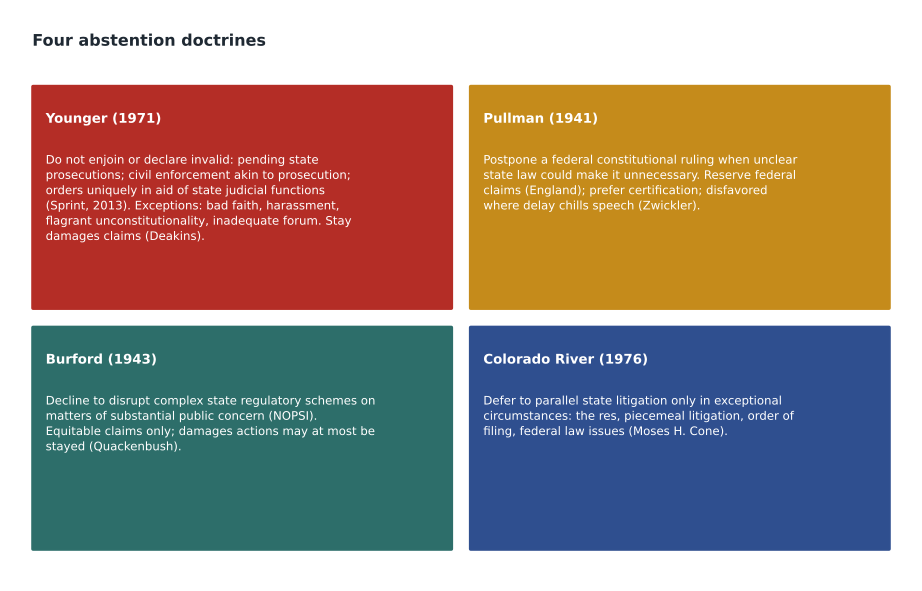
Younger v. Harris (1971) is the most important doctrine. John Harris was indicted in California under the state's Criminal Syndicalism Act for distributing leaflets advocating socialism. He sued in federal court to enjoin the prosecution, arguing that the Act violated the First Amendment on its face, and a three-judge court agreed. The Supreme Court reversed. Justice Black's opinion rested on two foundations. First, the traditional equitable rule that courts of equity should not restrain criminal prosecutions when the moving party has an adequate remedy at law and will not suffer irreparable injury: the cost, anxiety and inconvenience of defending against a single prosecution are not irreparable injury. Second, and more important, "Our Federalism," a sensitivity to the legitimate interests of both state and federal governments, in which the federal government, anxious though it may be to vindicate and protect federal rights, does so in ways that will not unduly interfere with the legitimate activities of the states. Harris could raise his First Amendment defense in the state prosecution, with Supreme Court review available.
Younger has narrow exceptions. A federal court may intervene where the state prosecution is brought in bad faith or for purposes of harassment, with no hope of obtaining a valid conviction, as in Dombrowski v. Pfister (1965), where Louisiana officials repeatedly arrested civil rights workers and seized their records under subversive activities laws. It may intervene where the statute is flagrantly and patently violative of express constitutional prohibitions in every clause, sentence and paragraph, a dictum in Younger that has almost never been satisfied. And it may intervene where the state forum is incapable of fairly adjudicating the federal claim, as in Gibson v. Berryhill (1973), where an Alabama optometry board composed of private practitioners had a financial interest in excluding the corporate-employed optometrists it was trying to discipline. Samuels v. Mackell (1971), decided the same day as Younger, extended the doctrine to declaratory judgments that would have the same practical effect as an injunction against a pending prosecution.
Timing is everything under Younger. Steffel v. Thompson (1974) held that when no state prosecution is pending, a federal court may grant declaratory relief against a threatened prosecution, because there is no state proceeding with which to interfere and the plaintiff otherwise faces the choice between intentionally violating the law and forgoing protected activity. Doran v. Salem Inn (1975) allowed preliminary injunctions in that setting, and Wooley v. Maynard (1977) allowed a permanent injunction protecting a New Hampshire man from future prosecutions for covering the state motto "Live Free or Die" on his license plate, even though he had been prosecuted before. But Hicks v. Miranda (1975) held that Younger applies with full force where state criminal proceedings are begun against the federal plaintiffs after the federal complaint is filed but before any proceedings of substance on the merits have taken place in the federal court. A plaintiff who files first therefore does not automatically win the race to the courthouse.
Younger soon spread beyond criminal prosecutions. Huffman v. Pursue, Ltd. (1975) applied it to a state civil nuisance proceeding to close an adult theater, which the Court described as in aid of and closely related to criminal statutes. Trainor v. Hernandez (1977) applied it to a state's civil action to recover welfare benefits obtained by fraud, Moore v. Sims (1979) to a state child abuse proceeding, Middlesex County Ethics Committee v. Garden State Bar Association (1982) to attorney disciplinary proceedings, and Ohio Civil Rights Commission v. Dayton Christian Schools (1986) to a state agency's sex discrimination proceeding against a religious school. The Court also applied Younger to private civil litigation involving the state courts' core functions: Juidice v. Vail (1977) involved contempt proceedings, and Pennzoil Co. v. Texaco Inc. (1987) involved Texas's requirement that a losing defendant post an appeal bond, there more than ten billion dollars, before enforcement of a judgment could be stayed.
Sprint pulled the doctrine back. Lower courts had read Middlesex as creating a three-part test: an ongoing state judicial proceeding, implicating important state interests, with an adequate opportunity to raise federal challenges. They abstained whenever those conditions were met. Sprint held that the Middlesex conditions are not dispositive; they are additional factors appropriately considered only after a case falls into one of three exceptional categories. Those categories are ongoing state criminal prosecutions, certain civil enforcement proceedings, and pending civil proceedings involving certain orders uniquely in furtherance of the state courts' ability to perform their judicial functions. The civil enforcement category, the Court explained, covers proceedings akin to criminal prosecutions: typically initiated by the state in its sovereign capacity, often after an investigation culminating in a formal complaint, to sanction the federal plaintiff for some wrongful act. The Iowa utilities board proceeding in Sprint, a dispute between private companies over intercarrier fees, was not of that kind.
Hannah Lindqvist applies Sprint to the forfeiture action. It was initiated by the State, through the County Attorney, in its sovereign capacity, to sanction Vashti for a wrongful act through forfeiture of property and a civil penalty, after an investigation by the State Patrol. That is a civil enforcement proceeding akin to a criminal prosecution, the second Sprint category. Under Hicks, it was filed after Vashti's federal complaint but before any proceedings of substance on the merits in federal court, so it counts as pending for Younger purposes. The Middlesex factors are satisfied too: the proceeding is judicial, the state has an important interest in enforcing its laws, and Vashti can raise her First Amendment and preemption defenses in the Merrin County court with review in the Westmarch Supreme Court and the Supreme Court. Unless she can prove bad faith or harassment, the federal court should abstain from granting declaratory or injunctive relief that would interfere with the forfeiture action.
Abstention does not necessarily end the federal case. Deakins v. Monaghan (1988) held that when Younger applies, a federal court should stay rather than dismiss claims for damages that cannot be obtained in the state proceeding, so that the plaintiff can return after the state case concludes. Vashti's damages claims against Trooper Garrity and the City therefore stay in federal court, on hold. And Younger binds only parties to the state proceeding or those whose interests are so intertwined with theirs that they are effectively parties. In Doran, the Court allowed two bar owners who were not being prosecuted to obtain a preliminary injunction against enforcement of a topless dancing ordinance, even though a third owner was being prosecuted and had to defend in state court. Friends of Harlan Creek, which is not a party to the forfeiture action, may be able to continue seeking prospective relief, although Hicks warns that closely related plaintiffs, such as employees and their employer, may be treated together.
Pullman abstention addresses a different problem. Railroad Commission of Texas v. Pullman Co. (1941) involved a commission order requiring that sleeping cars be in the charge of a conductor, who at the time was always white, rather than a porter, who was always Black. The railroad and the porters challenged the order under the Fourteenth Amendment. Justice Frankfurter's opinion held that the federal court should postpone decision because Texas law was unclear about whether the commission had authority to issue the order at all; a state court ruling that it lacked authority would end the case without any need for a federal constitutional decision. Pullman abstention applies when an unclear question of state law, if resolved one way, would make it unnecessary to decide a federal constitutional question. The federal court retains jurisdiction while the parties seek a state ruling, and under England v. Louisiana State Board of Medical Examiners (1964) the plaintiff may reserve the federal claims for decision in federal court after the state court rules on state law.
Pullman's costs are notorious. Sending parties to state court and back can take years, and in England itself the litigation lasted most of a decade. The Court has therefore encouraged certification, which allows a federal court to send an unclear state law question directly to the state's highest court for an authoritative answer, as most states permit. Arizonans for Official English v. Arizona (1997) praised certification as a way to reduce delay and cost and to build a cooperative judicial federalism. The Court has also said that Pullman is especially inappropriate where delay would chill First Amendment rights. Zwickler v. Koota (1967) refused to abstain in a challenge to a statute banning anonymous election literature, because the statute's alleged overbreadth was itself the constitutional problem and abstention would require the plaintiff to suffer the chill while state courts construed it.
Marcus Webb raises Pullman in the Marchbank file. The Act defines "critical infrastructure" to include prisons, substations, water treatment plants "and any other facility designated by order of the Director." Vashti's flights were over a public road outside the prison fence, and it is unclear whether the Act's 500-foot zone is measured from the facility's buildings or its property line. If a Westmarch court read the Act narrowly, it might not reach her flights at all, avoiding the First Amendment question. Sefton thinks Pullman abstention is unlikely here: the First Amendment context counsels against delay under Zwickler, the Younger analysis has already sent the central dispute to state court, and the better tool for the definitional question, if the federal court ever reaches it, is certification to the Westmarch Supreme Court. "Pullman is a scalpel," she says. "Use it only when one state law answer would make the federal question disappear."
Burford v. Sun Oil Co. (1943) protects complex state regulatory systems. Sun Oil sued in federal court to challenge the Texas Railroad Commission's grant of a permit to drill oil wells in the East Texas field. The Court held that the federal court should decline jurisdiction because Texas had concentrated review of the commission's orders in particular state courts, which had developed expertise in a complex regulatory program of vital importance to the state, and federal intervention would produce conflicting interpretations and disrupt the state's efforts to establish a coherent policy. New Orleans Public Service, Inc. v. Council of City of New Orleans (1989) narrowed Burford: it applies when there are difficult questions of state law bearing on policy problems of substantial public import, or when federal review would be disruptive of state efforts to establish a coherent policy on a matter of substantial public concern. Quackenbush v. Allstate Insurance Co. (1996) held that Burford permits a federal court to dismiss or remand only in cases seeking equitable or otherwise discretionary relief, not damages actions, which can at most be stayed.
Colorado River abstention addresses duplicative litigation. The United States sued in federal court to adjudicate its water rights in a Colorado river system, while a comprehensive state proceeding under a federal statute consenting to state adjudication of federal water rights was available. The Court held that the federal court properly dismissed in favor of the state proceeding, but only because of exceptional circumstances: the federal policy, expressed in the McCarran Amendment, against piecemeal adjudication of water rights in a river system, the absence of proceedings in the federal court beyond the complaint, the extensive involvement of state water rights, the distance of the federal court from the river and the government's participation in state proceedings elsewhere. Moses H. Cone Memorial Hospital v. Mercury Construction Corp. (1983) added that the presence of federal law issues weighs heavily against surrender of jurisdiction, and that the balance is heavily weighted in favor of its exercise. Wilton v. Seven Falls Co. (1995) recognized broader discretion to stay declaratory judgment actions in favor of parallel state litigation.
Congress has also limited federal intervention in state proceedings by statute. The Anti-Injunction Act, 28 U.S.C. section 2283, provides that a federal court may not grant an injunction to stay proceedings in a state court except as expressly authorized by Act of Congress, where necessary in aid of its jurisdiction, or to protect or effectuate its judgments. Mitchum v. Foster (1972) held that section 1983 is an expressly authorized exception, so the Act does not bar an injunction in a civil rights suit, though Younger still may. Smith v. Bayer Corp. (2011) read the relitigation exception narrowly, requiring that the issue in the state case be the same issue actually decided by the federal court. The Tax Injunction Act, 28 U.S.C. section 1341, bars federal courts from enjoining the assessment or collection of state taxes where a plain, speedy and efficient state remedy exists, and the Johnson Act, section 1342, does the same for state utility rate orders. Fair Assessment in Real Estate Association v. McNary (1981) added that comity bars section 1983 damages suits challenging state tax administration.
Two jurisdictional exceptions complete the picture. Ankenbrandt v. Richards (1992) confirmed a domestic relations exception that divests federal courts of power to issue divorce, alimony and child custody decrees, while allowing diversity tort suits between family members. Marshall v. Marshall (2006), the case involving the estate of a Texas oil magnate and his much younger widow, confined the probate exception to the probate or annulment of a will, the administration of an estate and the disposal of property in the custody of a state probate court. Both exceptions, the Court emphasized, are narrow, and neither bars federal jurisdiction over claims that merely relate to family or estate matters. Jordan Kimura observes that all these doctrines share a theme with Rooker-Feldman: the federal system tolerates parallel state and federal litigation, but it is hostile to federal courts directly disrupting a state proceeding that is already underway.
Sefton returns to strategy. For plaintiffs who want a federal forum, the lesson of Steffel and Hicks is speed and substance: file before the state does and get a federal court to hold proceedings of substance on the merits, such as a ruling on a preliminary injunction, before any state proceeding begins. For state lawyers, the lesson is the reverse, though a state proceeding filed purely to defeat federal jurisdiction invites a bad faith argument. For everyone, the lesson of Sprint is that Younger is limited to its categories, and a court that abstains outside them will be reversed. "Vashti filed first," Sefton says, "but she did not move for a preliminary injunction, so nothing of substance happened before the County Attorney filed. Had her lawyer asked for a preliminary injunction on day one and obtained a hearing, the outcome might have been different. Procedure is strategy."
Worked problem
Must the federal court abstain?
Vashti's federal suit (filed October 1, 2026) seeks a declaration that the Act is unconstitutional, an injunction against enforcement, return of the drone and damages. On October 15 the County Attorney files a state civil forfeiture and penalty action against her. No federal hearing has been held. Friends of Harlan Creek, a co-plaintiff in federal court, is not a party to the state action. Thorsby moves to dismiss under Younger.
Show solution
- Category: the forfeiture and penalty action is a civil enforcement proceeding akin to a criminal prosecution, initiated by the State in its sovereign capacity to sanction Vashti for a wrongful act, the second Sprint category.
- Timing: under Hicks v. Miranda, a state proceeding begun after the federal complaint but before proceedings of substance on the merits counts as pending.
- Middlesex factors: an ongoing judicial proceeding, an important state interest in enforcement and an adequate opportunity to raise federal defenses in state court. No exception applies absent proof of bad faith or harassment.
- Relief: abstain from declaratory and injunctive relief and the request for return of the drone as to Vashti; stay, not dismiss, her damages claims under Deakins v. Monaghan.
- Friends of Harlan Creek: not a party to the state action, so under Doran it may continue to seek prospective relief, unless its interests are so intertwined with Vashti's that Hicks treats them together.
Practice problems
Work each problem on paper first, then reveal the answer to check.
What are the three Sprint categories for Younger abstention?
Show answer
Ongoing state criminal prosecutions; civil enforcement proceedings akin to criminal prosecutions; and civil proceedings involving orders uniquely in furtherance of the state courts' ability to perform their judicial functions.
Under Hicks v. Miranda, when does a state prosecution filed after the federal complaint trigger Younger?
Show answer
When it is begun before any proceedings of substance on the merits have taken place in the federal court.
Why is Pullman abstention disfavored in First Amendment overbreadth challenges?
Show answer
Because delay while state courts construe the statute would itself chill protected speech, as Zwickler v. Koota (1967) explained.
Does the Anti-Injunction Act bar a federal injunction against a state prosecution in a section 1983 suit?
Show answer
No. Mitchum v. Foster (1972) held section 1983 is an expressly authorized exception, though Younger may still require abstention.
Summary and key terms
- Federal courts have a virtually unflagging obligation to exercise their jurisdiction; abstention is the exception (Colorado River; Sprint).
- Younger bars federal interference with pending state prosecutions and, under Sprint, two other narrow categories, absent bad faith, harassment, flagrant unconstitutionality or an inadequate forum.
- Without a pending prosecution, declaratory and injunctive relief are available (Steffel; Doran; Wooley), but state proceedings filed before proceedings of substance in federal court still trigger Younger (Hicks).
- Damages claims are stayed rather than dismissed under Younger (Deakins).
- Pullman postpones constitutional rulings when unclear state law may moot them; certification is preferred and delay is disfavored in First Amendment cases.
- Burford protects complex state regulatory schemes but does not allow dismissal of damages actions (Quackenbush).
- Colorado River permits deference to parallel state litigation only in exceptional circumstances.
- The Anti-Injunction Act, Tax Injunction Act and Johnson Act add statutory limits; section 1983 is an express exception to the Anti-Injunction Act.
Lesson quiz · 5 questions
Score 60% or more to complete this lesson.
Create a free account to save your progress, take quizzes and earn a certificate.