
LAWU-301 · Lesson 6 of 12 · 23 min
The Erie doctrine and federal common law
▶ Video coming soon A video version of this lesson is on the way.
Section B met Erie Railroad v. Tompkins (1938) as 1Ls in Professor Okafor-Bell's Civil Procedure course, using the Delgado e-bike case. Sefton tells them that in Federal Courts the question changes. "In Civil Procedure you asked which law a federal court applies in a diversity case. Here you ask why. Erie is a decision about the allocation of lawmaking power between the federal government and the states, and between courts and legislatures. Once you see that, you will understand the other half of today's class: the small but important body of federal common law that survived Erie." She puts the Marchbank file on the screen. Vashti's lawyer has added a Westmarch-law conversion claim against Trooper Garrity under supplemental jurisdiction, and the State says the claim must be dismissed under three Westmarch statutes. The federal court must decide which of them apply.
Swift v. Tyson (1842) is where the story starts. Section 34 of the Judiciary Act of 1789, the Rules of Decision Act now codified at 28 U.S.C. section 1652, provides that the laws of the several states, except where federal law otherwise requires, shall be regarded as rules of decision in civil actions in the federal courts. Justice Story read "laws" to mean state statutes and local usages, not state judicial decisions on matters of general law such as commercial transactions. Federal courts could therefore decide general commercial questions according to their own understanding of the general common law, even if a state's courts disagreed. The hope was that a uniform national commercial law would emerge. Instead, federal and state courts in the same state applied different rules to the same transactions, and litigants with diverse citizenship could choose between them.
The abuses became notorious. In Black and White Taxicab Co. v. Brown and Yellow Taxicab Co. (1928), a Kentucky company reincorporated in Tennessee solely to create diversity of citizenship and obtain a federal court that would enforce an exclusive railroad station contract that Kentucky courts treated as void. The Supreme Court upheld the federal judgment, with Justice Holmes dissenting. Ten years later, Erie overruled Swift. Harry Tompkins, a Pennsylvania citizen, was struck by something protruding from a passing freight train while walking along a footpath beside the tracks in Hughestown, Pennsylvania. Under Pennsylvania decisions, he was a trespasser to whom the railroad owed a duty only to avoid wanton negligence; under the federal general common law, the railroad owed ordinary care. He sued the New York railroad in federal court in New York and won under the general law. The Supreme Court reversed.
Justice Brandeis gave three reasons. First, new historical research by Charles Warren suggested that the Rules of Decision Act was meant to include state judicial decisions. Second, Swift had produced discrimination by noncitizens against citizens and defeated the uniformity it promised. Third, and most important, Swift was unconstitutional. "There is no federal general common law," Brandeis wrote. Congress has no power to declare substantive rules of common law applicable in a state, whether local or general, and no clause in the Constitution purports to give such a power to the federal courts. Federal courts, in other words, cannot make law in areas where Congress itself could not legislate, and even where Congress could legislate, the courts generally should not displace state law without legislative authorization. Erie is about federalism and separation of powers at once.
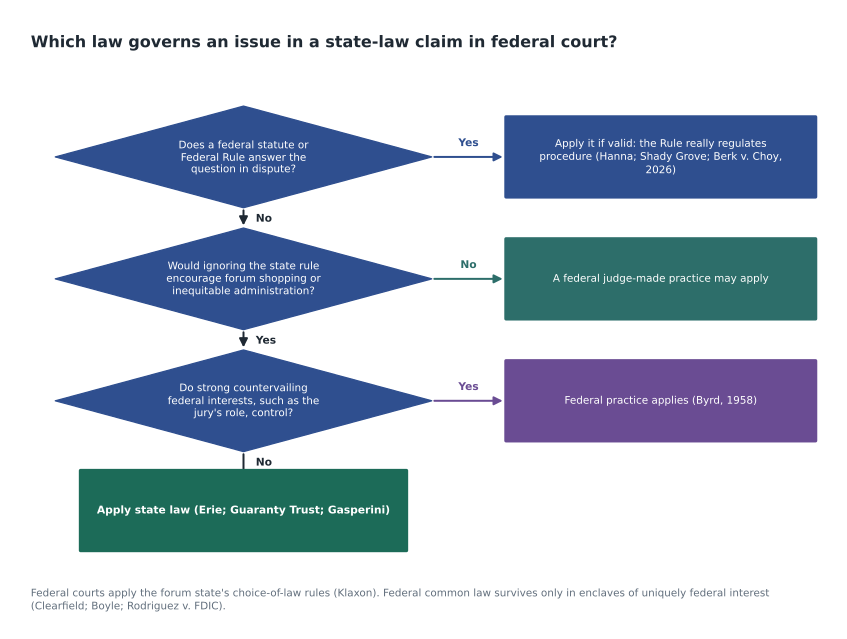
The post-Erie cases worked out the line between substance and procedure. Guaranty Trust Co. v. York (1945) asked whether a state statute of limitations applied in a federal equity suit, and answered with the outcome-determinative test: the outcome of litigation in federal court should be substantially the same, so far as legal rules determine it, as it would be in state court. Because nearly every rule can affect outcomes, the test proved too broad. Byrd v. Blue Ridge Rural Electric Cooperative (1958) held that a federal court should send a question to the jury even though state practice gave it to the judge, because the federal system's allocation of functions between judge and jury, informed by the Seventh Amendment, was a countervailing consideration. Hanna v. Plumer (1965) then reframed the test in light of Erie's twin aims: discouragement of forum shopping and avoidance of inequitable administration of the laws.
Hanna also separated two tracks. When a Federal Rule of Civil Procedure is on point, the question is not Erie at all but whether the Rule is valid under the Rules Enabling Act, 28 U.S.C. section 2072, which authorizes the Supreme Court to prescribe rules of practice and procedure that do not abridge, enlarge or modify any substantive right, and under the Constitution. In Hanna, Rule 4's method of service displaced a Massachusetts rule requiring in-hand service on an executor. No Federal Rule has ever been held invalid under that test. Shady Grove Orthopedic Associates v. Allstate Insurance Co. (2010) held that Rule 23 governed whether a class action could be brought for statutory interest that a New York statute barred from class treatment. Justice Scalia's plurality asked only whether the Rule really regulates procedure; Justice Stevens, providing the fifth vote, would also ask whether a state procedural rule was so intertwined with a state right or remedy that it functions to define the scope of the state-created right.
Berk v. Choy (2026) is the newest application. Harold Berk sued a Delaware hospital and doctor in federal court in a diversity case for medical malpractice. Delaware law required that a malpractice complaint be accompanied by an affidavit of merit from a qualified expert, and the district court dismissed when Berk did not file one. The Third Circuit affirmed. In January 2026, the Supreme Court reversed. Justice Barrett, writing for eight Justices, held that the Federal Rules, and Rule 8 in particular, answer the question whether a plaintiff must submit expert evidence with the complaint: they require only a short and plain statement of the claim, and they do not demand evidence at the pleading stage. Because the Rules answer the question, the Rules Enabling Act, not Erie's unguided analysis, controls, and Rule 8 is valid because it really regulates procedure. Justice Jackson concurred in the judgment. Commentators immediately asked what Berk means for state anti-SLAPP statutes and certificate-of-merit laws in other fields.
Sefton turns to the State's three statutes in the Marchbank file, all fictional. The first is the Westmarch Public Employee Claims Act's requirement that a person suing a state employee for a tort committed within the scope of employment serve a written notice of claim on the Attorney General within 180 days. The second requires that any such complaint be accompanied by a certificate, signed by the plaintiff's lawyer, attesting that the claim has merit after reasonable inquiry. The third caps damages against state employees for property loss at 25,000 dollars. Hannah Lindqvist takes the first: no Federal Rule addresses pre-suit notice, so the question is on the unguided Erie track, and ignoring the notice requirement would create obvious incentives to file state claims in federal court. Most federal courts treat such notice requirements as substantive conditions on the state-law claim, so the notice rule applies to Vashti's conversion claim.
Priya Natarajan takes the second. A lawyer's certificate of merit filed with the complaint looks very much like the Delaware affidavit in Berk, and Rule 11 already requires a lawyer signing a pleading to certify that its factual contentions have evidentiary support after reasonable inquiry. Under Berk, if the Federal Rules answer the question of what must accompany a complaint, the state requirement does not apply in federal court. The third statute, the damages cap, is easy: it defines the remedy for a state-law claim, no Federal Rule speaks to it, and refusing to apply it would produce different outcomes in federal and state court on the same claim. Gasperini v. Center for Humanities (1996) applied a New York standard for reviewing the size of jury verdicts as substantive state law in a diversity case, while preserving the federal appellate standard of review. A cap on recovery is more clearly substantive still.
Erie applies whenever a federal court decides a state-law claim, whether under diversity jurisdiction, supplemental jurisdiction or in bankruptcy. The federal court must also apply the choice-of-law rules of the state in which it sits, as Klaxon Co. v. Stentor Electric Manufacturing Co. (1941) held, so that a federal court in Westmarch decides which state's law governs exactly as a Westmarch court would. When a case is transferred under 28 U.S.C. section 1404(a) at a defendant's request, Van Dusen v. Barrack (1964) holds that the transferee court applies the law the transferor court would have applied. When state law is unclear, a federal court must predict how the state's highest court would rule, giving weight to intermediate appellate decisions. Many states, Westmarch among them in Sefton's hypotheticals, allow federal courts to certify unsettled questions to the state supreme court, a practice the Supreme Court has praised in Lehman Brothers v. Schein (1974) and Arizonans for Official English v. Arizona (1997).
Erie said there is no federal general common law. It did not say there is no federal common law. On the same day Erie was decided, Hinderlider v. La Plata River and Cherry Creek Ditch Co. (1938) held that the apportionment of an interstate stream between two states is a question of federal common law binding on state courts. The modern cases identify enclaves where federal courts may make law: where a uniquely federal interest is at stake and a significant conflict exists between that interest and the operation of state law, or where Congress has delegated lawmaking authority to the courts, as it did for collective bargaining agreements in section 301 of the Labor Management Relations Act, interpreted in Textile Workers Union v. Lincoln Mills (1957). Admiralty is another enclave, grounded in Article III's grant of admiralty jurisdiction. Federal common law, once made, is federal law: it binds state courts under the Supremacy Clause and claims under it arise under federal law for section 1331.
Clearfield Trust Co. v. United States (1943) is the leading case on the rights and duties of the United States. A forger endorsed a federal relief check and cashed it; the United States sued the bank that guaranteed the endorsement. The Court held that federal law governs the rights and duties of the United States on its commercial paper, because the government's issuance of millions of checks across the country called for a uniform rule, and the Court fashioned one. United States v. Kimbell Foods (1979) qualified Clearfield: even when federal law governs, courts may adopt state law as the federal rule of decision unless a uniform national rule is necessary or state law would frustrate specific federal objectives. Kamen v. Kemper Financial Services (1991) applied that borrowing approach to shareholder derivative suits under a federal statute.
Boyle v. United Technologies Corp. (1988) is the most aggressive modern example. The family of a Marine helicopter pilot killed when he could not escape his aircraft after a crash at sea sued the manufacturer for defective design of the escape hatch under Virginia tort law. In a five-to-four opinion by Justice Scalia, the Court held that the uniquely federal interest in procurement of military equipment, together with the discretionary function exception in the Federal Tort Claims Act, displaced state tort law under a government contractor defense. A contractor is not liable for design defects in military equipment when the United States approved reasonably precise specifications, the equipment conformed to them, and the contractor warned the government about dangers known to it but not to the government. Justice Brennan's dissent called the defense judicial legislation that Congress had repeatedly declined to enact.
The modern Court is far more cautious. Texas Industries v. Radcliff Materials (1981) refused to create a right of contribution among antitrust violators, leaving the matter to Congress. O'Melveny and Myers v. FDIC (1994) refused to create a federal rule governing the imputation of corporate officers' knowledge when the FDIC sues as receiver, explaining that cases in which judicial creation of a special federal rule would be justified are few and restricted. Rodriguez v. FDIC (2020), a unanimous opinion by Justice Gorsuch, held that federal courts should not develop federal common law to decide how a consolidated corporate tax refund is distributed between a bankrupt holding company and its subsidiary bank, because no uniquely federal interest required it. The same caution governs implied private rights of action under federal statutes: Alexander v. Sandoval (2001) held that only Congress can create a private right of action, and courts look solely to statutory intent, a principle Lesson 8 applies to section 1983 and Bivens.
Congress can also displace federal common law. Illinois v. Milwaukee (1972) recognized a federal common law of interstate water pollution nuisance, but City of Milwaukee v. Illinois (1981) held that the 1972 Clean Water Act amendments displaced it. American Electric Power Co. v. Connecticut (2011) held that the Clean Air Act and EPA's authority under it displaced any federal common law right to seek abatement of carbon dioxide emissions from power plants. Displacement of federal common law requires less than preemption of state law, because federal courts should not make law where Congress has spoken to the question at all. Jordan Kimura notes the connection to the rest of the course: whether climate change suits against energy companies belong in federal court has turned in part on whether they are governed by federal common law, an issue that has produced years of litigation over removal and remand.
Sefton closes with reverse Erie. When state courts hear federal claims, federal law governs not only the substance but also procedures that would burden the federal right. Dice v. Akron, Canton and Youngstown Railroad (1952) held that a state court hearing a Federal Employers' Liability Act claim must follow the federal rule giving fraud issues to the jury. Felder v. Casey (1988) held that Wisconsin's notice-of-claim statute could not be applied to a section 1983 suit in state court, because it burdened the federal remedy. So the same Westmarch notice requirement that applies to Vashti's state conversion claim in federal court does not apply to her federal section 1983 claim in any court. "The question is never just state or federal," Sefton says. "It is which sovereign's law governs which issue in which claim. Keep the claims separate in your head and you will get the answer right."
Worked problem
Which Westmarch rules apply to the conversion claim in federal court?
Vashti's federal complaint includes a section 1983 Fourth Amendment claim and a Westmarch-law conversion claim against Trooper Garrity. Westmarch law (fictional) requires (1) a notice of claim to the Attorney General within 180 days for tort claims against state employees, (2) a lawyer's certificate of merit attached to the complaint and (3) a 25,000 dollar cap on property damages against state employees. Vashti served notice on day 150 but filed no certificate. Which rules apply to which claims?
Show solution
- Conversion claim, notice: no Federal Rule addresses pre-suit notice to the state. On the Erie track, ignoring it would encourage forum shopping and inequitable administration, so it applies. She complied, so the claim survives.
- Conversion claim, certificate: under Berk v. Choy (2026), the Federal Rules, including Rule 8 and Rule 11, answer what must accompany a complaint in federal court. The certificate requirement does not apply in federal court, so its absence is not a ground for dismissal.
- Conversion claim, cap: the cap defines the state-law remedy, so it applies (compare Gasperini). Recovery on that claim is limited to 25,000 dollars.
- Section 1983 claim: none of the state rules applies. Federal law governs the federal claim, and under Felder v. Casey even a state court could not impose the notice requirement on it.
Practice problems
Work each problem on paper first, then reveal the answer to check.
What were Justice Brandeis's three reasons for overruling Swift v. Tyson?
Show answer
Historical research suggested the Rules of Decision Act included state judicial decisions; Swift produced discrimination and defeated uniformity; and federal courts had no constitutional power to declare general common law in areas reserved to the states.
Why did the Court in Berk v. Choy (2026) refuse to apply Delaware's affidavit of merit requirement in federal court?
Show answer
Because the Federal Rules, particularly Rule 8, answer whether evidence must accompany a complaint, and Rule 8 is valid under the Rules Enabling Act because it really regulates procedure.
What test did Boyle v. United Technologies adopt for the government contractor defense?
Show answer
No state tort liability for design defects in military equipment when the United States approved reasonably precise specifications, the equipment conformed to them, and the contractor warned of known dangers unknown to the government.
What did Rodriguez v. FDIC (2020) say about federal common law?
Show answer
That federal courts should create federal common law only where necessary to protect uniquely federal interests, and none required a federal rule for distributing a consolidated tax refund.
Summary and key terms
- Erie overruled Swift v. Tyson: there is no federal general common law, and federal courts apply state substantive law to state claims.
- Guaranty Trust's outcome-determinative test was refined by Byrd's federal interests and Hanna's twin aims.
- When a Federal Rule answers the question, it controls if valid under the Rules Enabling Act (Hanna; Shady Grove; Berk v. Choy, 2026).
- Federal courts apply the forum state's choice-of-law rules (Klaxon) and predict or certify unsettled state law.
- Federal common law survives in enclaves of uniquely federal interest or delegated authority (Clearfield; Lincoln Mills; Boyle), but the modern Court is reluctant to create it (Texas Industries; O'Melveny; Rodriguez).
- Congress can displace federal common law more easily than it preempts state law (City of Milwaukee; AEP v. Connecticut).
- Reverse Erie bars state procedures that burden federal claims in state court (Dice; Felder).
Lesson quiz · 5 questions
Score 60% or more to complete this lesson.
Create a free account to save your progress, take quizzes and earn a certificate.