
LAWU-301 · Lesson 12 of 12 · 25 min
Capstone: a federal courts litigation problem
▶ Video coming soon A video version of this lesson is on the way.
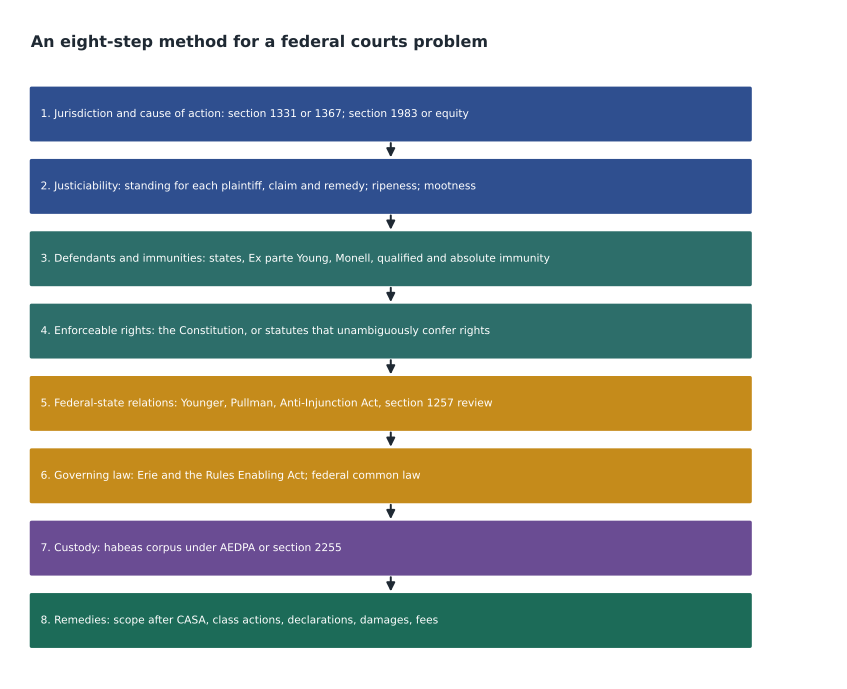
For the final class Sefton distributes a new file and tells Section B to put the Marchbank materials away. "On the exam, and in practice, nobody hands you a case labeled 'standing' or 'abstention.' They hand you a client with a problem and a deadline. Your job is to see every federal courts issue in the facts, put them in the right order and tell the client what a federal court can and cannot do for her." She reviews the method the class has used all semester, now formalized as eight questions: jurisdiction and cause of action; justiciability; the proper defendants and immunities; enforceable rights; the federal-state relationship, including abstention and review of state courts; the governing law for each claim; post-conviction remedies for anyone in custody; and remedies. The rest of the class is a worked memo. All persons, entities, statutes and events in the problem are fictional.
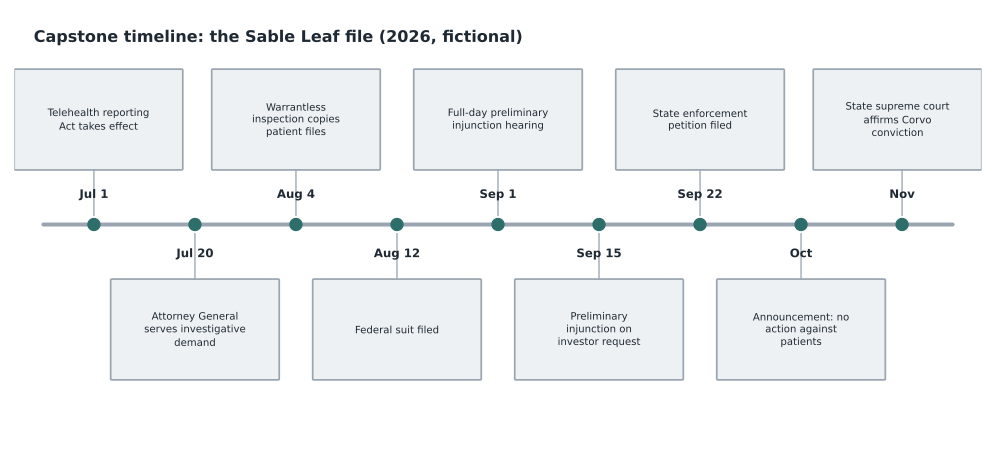
The facts. Westmarch's Telehealth Prescription Integrity Act took effect on July 1, 2026. Section 3 requires every telehealth provider that prescribes medication to a Westmarch resident to report the patient's name, address, diagnosis code and prescription to a new state database within 24 hours. Section 5 authorizes the Attorney General to issue civil investigative demands for any records relating to compliance, enforceable by petition in state court, and section 6 imposes civil penalties of 5,000 dollars per unreported prescription. Section 8 makes willful falsification of a report a misdemeanor. Sable Leaf Telehealth, Inc., a company that treats Westmarch patients for chronic conditions by video, refused to report, arguing that the reporting requirement violates its patients' privacy and conflicts with federal law. On July 20, Attorney General Thea Wynn served a civil investigative demand on Sable Leaf seeking all patient files for Westmarch residents and the names of its investors. On August 4, an investigator from the Attorney General's office, Colm Rourke, entered Sable Leaf's Brennan Falls office without a warrant during an unannounced compliance inspection and copied several patient files from an employee's computer.
On August 12, 2026, Sable Leaf and Westmarch Patients for Privacy, an association of patients, sued in the District of Westmarch. They named the State of Westmarch, the Westmarch Board of Pharmacy, Attorney General Wynn in her official capacity and Investigator Rourke individually. The complaint alleges that the Act and the demand violate the First and Fourth Amendments and the Fourteenth Amendment right to informational privacy; that the Act is preempted by federal law; that Rourke's inspection was an unreasonable search; that the reporting requirement violates patients' rights under HIPAA, the federal health privacy statute, enforceable under section 1983; and that the inspection was a trespass under Westmarch law. It seeks an injunction barring enforcement of the Act against all telehealth providers in the United States who treat Westmarch residents, a declaration, damages and fees. On September 1, Judge Bramwell held a full-day preliminary injunction hearing with live testimony and, on September 15, preliminarily enjoined enforcement of the demand's investor request against Sable Leaf. On September 22, the Attorney General filed a petition in Merrin County District Court to enforce the rest of the demand and to collect civil penalties.
Two more facts complete the file. In October 2026, the Attorney General announced that her office would not seek patient identities from patients themselves or penalize patients in any way, and that patient data in the database would be encrypted. And Elsbeth Corvo, a former Sable Leaf pharmacist who submitted false reports to the database in July 2026 to avoid the penalties, was convicted of the section 8 misdemeanor, sentenced to two years of probation, and lost her appeal in the Westmarch Supreme Court in November 2026, which rejected her argument that the Act violates the Fourth Amendment and held, alternatively, that she had waived the argument by pleading guilty under a Westmarch rule requiring constitutional objections before plea. Corvo wants to know whether she can get federal review. Sefton divides the class into groups, each taking one of the eight questions, and then assembles the answers into a single memo, which follows.
Question One: jurisdiction and cause of action. Issue: whether the district court has subject matter jurisdiction over each claim. Rule: section 1331 reaches claims created by federal law, under the Holmes test; suits to enjoin state officers on preemption grounds rest on equity (Shaw v. Delta; Armstrong); and section 1367 reaches state claims sharing a common nucleus of operative fact. Application: the constitutional claims are brought under section 1983, a federal cause of action, and arise under federal law. The preemption claim against the Attorney General arises under federal law as a suit in equity, subject to Armstrong's caution that a federal statute may impliedly foreclose equitable enforcement. The trespass claim against Rourke arises from the same inspection as the Fourth Amendment claim and falls within section 1367(a). Conclusion: the court has jurisdiction over all claims. If every federal claim were later dismissed, the court could decline to keep the trespass claim under section 1367(c).
Question Two: justiciability. Sable Leaf has standing to challenge the demand and the reporting requirement: it is the object of both, faces penalties and must either comply or risk sanctions. Under First Choice Women's Resource Centers v. Davenport (2026), a demand for sensitive information backed by the threat of enforcement inflicts a present injury, so the challenge to the investor request was ripe when filed even though no state court had ordered compliance. Westmarch Patients for Privacy has associational standing under Hunt if it identifies at least one member whose data has been or will be reported, as Summers requires; disclosure of private medical information to the government is a concrete harm with a close common law analog in privacy torts, satisfying TransUnion. But members who merely fear future misuse of the database face the Clapper problem unless they show a substantial risk. The Attorney General's October announcement about patients is voluntary cessation by a government officer, not binding and silent about the database itself, so under Laidlaw and Fikre it does not moot the patients' claims. The damages claim against Rourke rests on a completed injury and presents no justiciability problem.
Question Three: defendants and immunities. The State and the Board of Pharmacy, an arm of the state that is part of the state government rather than a separately incorporated entity responsible for its own judgments under Galette, are immune from suit in federal court under Hans, and neither is a person under section 1983 (Will). They should be dismissed. The Attorney General in her official capacity is a proper Ex parte Young defendant for prospective relief, because she enforces sections 5 and 6, but the federal court may not enjoin her on the basis of state law (Pennhurst), and any order to pay money from the treasury for past harms would be barred (Edelman). Investigator Rourke, sued individually for damages, cannot invoke the state's immunity (Hafer). He will assert qualified immunity. Warrantless administrative inspections of closely regulated businesses are permitted under New York v. Burger (1987) if the scheme provides a constitutionally adequate substitute for a warrant, while City of Los Angeles v. Patel (2015) held that hotels are not closely regulated and that inspection schemes must allow precompliance review. Whether a telehealth company is closely regulated, and whether copying patient files exceeded any lawful inspection, are questions on which the law may not be clearly established, so Rourke has a substantial qualified immunity argument, and the court may decide it on the clearly established prong alone under Pearson.
Question Four: enforceable rights. The constitutional claims are enforceable under section 1983. The HIPAA claim is not. Under Gonzaga and Medina v. Planned Parenthood South Atlantic (2025), a statute is enforceable under section 1983 only if it clearly and unambiguously confers individual rights in terms focused on the persons protected. HIPAA's privacy provisions are framed as directions to the Department of Health and Human Services and regulated entities and are enforced by the agency and by civil and criminal penalties; the federal courts of appeals that have addressed the question have held that HIPAA creates no private right of action, and the same features defeat enforcement through section 1983. Talevski does not help, because the nursing home statute there used rights-creating language that HIPAA lacks. The patients' informational privacy claim under the Fourteenth Amendment is weaker on the merits than it may appear, because the Supreme Court in Whalen v. Roe (1977) upheld a state prescription database against a privacy challenge and in NASA v. Nelson (2011) assumed without deciding that such a right exists. Conclusion: dismiss the HIPAA claim; the constitutional privacy claim survives a motion to dismiss but faces Whalen on the merits.
Question Five: federal-state relations. The Attorney General's September 22 state petition is a civil enforcement proceeding initiated by the State in its sovereign capacity to sanction Sable Leaf, the second Sprint category, so Younger would ordinarily require abstention from relief that would interfere with it. But under Hicks v. Miranda, a state proceeding filed after the federal complaint triggers Younger only if filed before proceedings of substance on the merits in federal court. Here the federal court had already held a full-day evidentiary hearing and granted a preliminary injunction on the merits of the investor request before the state petition was filed. Most courts treat a contested preliminary injunction ruling as a proceeding of substance, so Younger likely does not apply, and the federal case continues. Even if it did, the damages claims would be stayed rather than dismissed (Deakins). Pullman abstention is unnecessary because the Act's reporting duty is clear, and the Anti-Injunction Act does not bar an injunction because section 1983 is an express exception (Mitchum). If the federal court wished to restrain the later state proceeding to protect its own preliminary injunction, the in-aid-of-jurisdiction and relitigation exceptions would be read narrowly (Smith v. Bayer).
Question Six: governing law. The trespass claim is governed by Westmarch law under Erie and Klaxon, including Westmarch's substantive rules on the scope of an investigator's privilege to enter and any statutory damages limits. Any Westmarch requirement that the complaint be accompanied by a certificate or affidavit of merit would not apply in federal court after Berk v. Choy (2026), because the Federal Rules answer what a complaint must contain. A state notice-of-claim requirement for suits against state employees likely applies to the trespass claim as a substantive condition, but under Felder v. Casey it cannot apply to the section 1983 claims in any court. No federal common law is needed: the questions are governed by the Constitution, section 1983 and Westmarch law, and the modern Court disfavors creating federal common law absent a uniquely federal interest (Rodriguez v. FDIC).
Question Seven: Corvo's post-conviction options. Her direct route is a petition for certiorari to the Supreme Court within ninety days of the Westmarch Supreme Court's judgment, under section 1257. But the state court rested its decision alternatively on waiver by guilty plea under a state rule. If that rule is firmly established and regularly followed, it is an adequate and independent state ground and the Supreme Court cannot review the Fourth Amendment question (Fox Film; James v. Kentucky), so certiorari is unlikely. Her collateral route is federal habeas under section 2254. She is in custody for habeas purposes while on probation, under Jones v. Cunningham (1963). She must exhaust state post-conviction remedies, and the same waiver rule would create a procedural default, which she could overcome only by showing cause and prejudice or actual innocence. Her Fourth Amendment claim would also face Stone v. Powell if she had a full and fair opportunity to litigate it. Any federal petition must be filed within one year of finality, with tolling for properly filed state post-conviction applications. Conclusion: Corvo's prospects for federal review are poor; her best argument would be ineffective assistance of plea counsel for failing to preserve the objection, raised first in state post-conviction proceedings.
Question Eight: remedies. The request for an injunction protecting all telehealth providers in the United States fails under Trump v. CASA (2025): an injunction may be no broader than necessary to give complete relief to each plaintiff with standing. The court may enjoin enforcement against Sable Leaf and may protect identified association members whose data would be reported. For broader relief, the plaintiffs should move to certify a Rule 23(b)(2) class, perhaps of Westmarch-licensed telehealth providers or of Westmarch patients whose data must be reported, satisfying commonality under Wal-Mart through the uniform statutory requirement. A declaratory judgment against the Attorney General is available and would have precedential force. Damages against Rourke are available if he lacks qualified immunity, with punitive damages only on a showing of reckless or callous indifference (Smith v. Wade); damages against the State are barred. Fees under section 1988 require prevailing on the merits: the September preliminary injunction alone would not suffice if the case later became moot, under Lackey v. Stinnie (2025).
Sefton then asks Section B to step back and identify the decisions that most shaped the analysis. Priya Natarajan picks First Choice, because it made the investor-request challenge justiciable without waiting for state enforcement. Daniel Reyes picks Hicks, because the timing of the preliminary injunction hearing kept the case in federal court, and he notes the contrast with Vashti's case, where nothing of substance had happened before the state filed. Hannah Lindqvist picks Medina and Gonzaga, because they removed the HIPAA claim and showed how statutory rights claims turn on text. Marcus Webb picks CASA, because it reshaped the relief request. Jordan Kimura picks sovereign immunity, because getting the caption right at the start avoids a year of interlocutory appeals. Sefton agrees with all of them and adds her own: Pearson, because qualified immunity will likely decide whether Sable Leaf ever recovers damages for the inspection.
She also models the client letter that would accompany the memo. Sable Leaf can proceed in federal court on its constitutional and preemption claims against the Attorney General, and the court can protect it from the investor request and possibly from other parts of the demand if it prevails. Its patients' association can proceed if it identifies members whose data is at stake. The State and the Board must be dropped. The HIPAA claim should be withdrawn. Damages against the investigator are uncertain because of qualified immunity. The state enforcement petition will probably not displace the federal case, because the federal court acted first on the merits. Nationwide relief is not available, but class certification could extend protection. And the former pharmacist's conviction will be very hard to challenge in federal court. "Notice," Sefton says, "that half of that letter is about which court, which defendant and which remedy. That is federal courts law. The merits are the other half, and they matter less than clients expect until the forum questions are answered."
Sefton ends the semester the way she began it, with the sentence still on the board from the first class: "Before you ask whether you win, ask whether this court may hear you." She adds a second line beneath it: "And then ask what it can give you." Federal courts doctrine, she tells Section B, is often described as technical, but every technical rule reflects a judgment about the proper role of federal judges in a system of separated powers and dual sovereignty: Article III's case or controversy requirement, Congress's control over jurisdiction, the states' immunity and their courts' role as co-equal enforcers of federal law, the deference owed to state criminal judgments and the limits of equitable power. Lawyers who understand those judgments can predict how courts will apply the rules to new facts. "You will all practice in a world where these doctrines keep changing," she says. "The 2025 and 2026 Terms alone gave us CASA, Medina, Bost, Berk, Olivier, Galette, First Choice, Enbridge and Bowe. Read the new cases as they come. The questions will stay the same."
Worked problem
Short answer exercise: the three most dispositive issues
In a one-paragraph answer for each, state the conclusion on (1) whether Younger requires the federal court to abstain in Sable Leaf's case; (2) whether the patients' HIPAA claim may proceed under section 1983; and (3) whether the court may enjoin enforcement of the Act against every telehealth provider in the United States.
Show solution
- (1) Probably not. The state enforcement petition falls in the second Sprint category, but it was filed after the federal court held a full evidentiary hearing and granted a preliminary injunction, which most courts treat as proceedings of substance on the merits under Hicks v. Miranda. The federal case continues; damages claims would be stayed, not dismissed, if the court disagreed.
- (2) No. Under Gonzaga and Medina (2025), only statutes that clearly and unambiguously confer individual rights are enforceable under section 1983. HIPAA's privacy provisions are directed to the agency and regulated entities and enforced administratively; Talevski is distinguishable.
- (3) No. Under Trump v. CASA (2025), injunctions may be no broader than necessary to provide complete relief to each plaintiff with standing. The court may protect Sable Leaf and identified members of the association, and broader protection requires class certification under Rule 23(b)(2).
Practice problems
Work each problem on paper first, then reveal the answer to check.
Why are the State of Westmarch and the Board of Pharmacy improper defendants in Sable Leaf's federal suit?
Show answer
They are immune from suit in federal court under Hans v. Louisiana absent waiver or valid abrogation, and neither is a person under section 1983 (Will). The Attorney General in her official capacity is the proper defendant for prospective relief under Ex parte Young.
Why does First Choice v. Davenport matter to Sable Leaf's challenge to the investor request?
Show answer
It held that a state demand for sensitive information backed by the threat of enforcement inflicts a present First Amendment injury, so the challenge was justiciable without waiting for a state court to order compliance.
Can Corvo obtain Supreme Court review of the Fourth Amendment question?
Show answer
Probably not, because the Westmarch Supreme Court rested alternatively on waiver under a state procedural rule; if firmly established and regularly followed, that is an adequate and independent state ground.
What must Sable Leaf do to obtain protection for other telehealth providers?
Show answer
Seek certification of a Rule 23(b)(2) class, because under Trump v. CASA an injunction cannot protect nonparties beyond what complete relief to the plaintiffs requires.
Summary and key terms
- A federal courts problem is worked in order: jurisdiction and cause of action, justiciability, defendants and immunities, enforceable rights, federal-state relations, governing law, habeas and remedies.
- Present injuries from investigative demands are justiciable (First Choice, 2026); associational standing requires an identified member (Hunt; Summers).
- States and arms of the state are dismissed; officers are sued under Ex parte Young for prospective relief and individually for damages, subject to qualified immunity.
- Statutory claims under section 1983 require unambiguous rights-creating language (Gonzaga; Medina, 2025).
- Younger does not apply to state proceedings filed after proceedings of substance on the merits in federal court (Hicks).
- Erie governs state claims; Berk v. Choy (2026) displaces state affidavit and certificate requirements in federal court.
- Adequate and independent state grounds and procedural default limit review of state convictions.
- Relief after Trump v. CASA (2025) is party-specific unless a class is certified; fees require prevailing on the merits (Lackey, 2025).
Lesson quiz · 5 questions
Score 60% or more to complete this lesson.
Create a free account to save your progress, take quizzes and earn a certificate.