
LAWU-301 · Lesson 2 of 12 · 24 min
Article III and standing
▶ Video coming soon A video version of this lesson is on the way.
Sefton opens the second class by listing the people who have called her office about the Critical Infrastructure Airspace Act. Vashti Marchbank, whose drone Trooper Garrity seized in August 2026 and who wants to fly again over the Harlan Creek prison. A reader of Merrin Skywatch who says she relies on the photographs to understand prison conditions. Friends of Harlan Creek, a nonprofit whose members include relatives of prisoners. A state senator who voted against the Act and says it was passed in violation of the legislature's rules. A Brennan Falls taxpayer who objects to the money spent enforcing it. And a hobbyist in a different county who has never been near a prison but finds the law offensive. "All of them are sincere," Sefton says. "Some of them have standing. Most of them do not. Today we learn how to tell the difference, and why the Court insists on telling it."
Standing is the part of the case or controversy requirement that asks whether this plaintiff is the right party to bring this claim. The modern test comes from Lujan v. Defenders of Wildlife (1992). A plaintiff must show three things: an injury in fact, meaning an invasion of a legally protected interest that is concrete and particularized and actual or imminent, not conjectural or hypothetical; causation, meaning the injury is fairly traceable to the challenged conduct of the defendant and not the result of the independent action of a third party not before the court; and redressability, meaning it is likely, not merely speculative, that a favorable decision will redress the injury. In Lujan, environmental groups challenged a rule limiting the Endangered Species Act's consultation duty to actions in the United States. Members who said they hoped to return some day to see endangered species abroad lacked an imminent injury, because "some day" intentions without concrete plans are not enough.
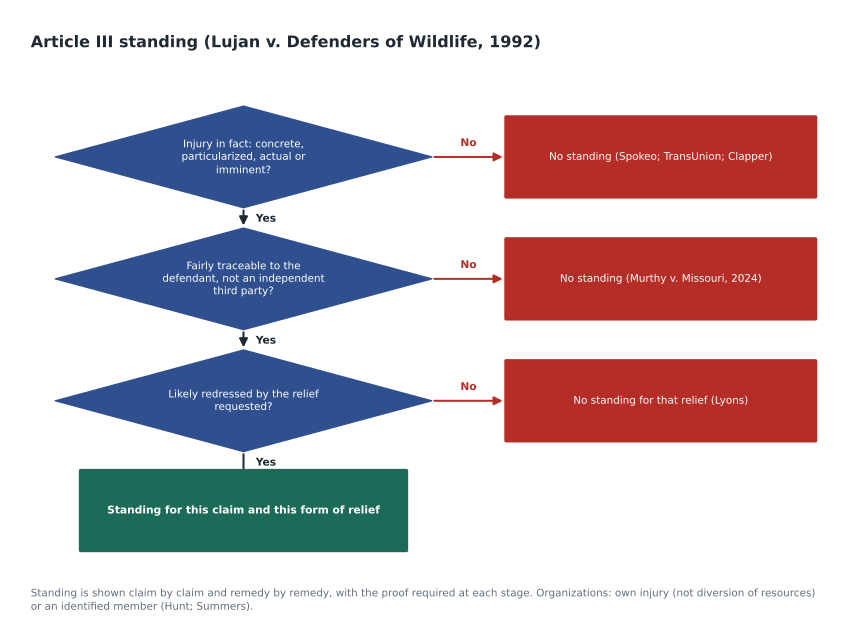
Why should a court care who brings a claim, if the claim is good? The Court's answers are structural. Standing keeps courts within the traditional role of deciding concrete disputes rather than issuing opinions about the general legality of government action, which belongs to the political branches. It ensures adverse parties with a real stake who will present the issues sharply. And it protects separation of powers by preventing every citizen from enlisting a judge to supervise how the executive enforces the law. Critics answer that the doctrine is malleable, that it was largely invented in the twentieth century, and that it can be used to avoid hard merits questions. Justice Thomas has argued, in separate opinions, that the history supports a distinction between suits asserting private rights, where injury is presumed, and suits asserting public rights, where a particular injury must be shown. Sefton asks the class to hold both views in mind.
Concreteness is the element the Court has developed most in the last decade. Spokeo v. Robins (2016) involved a website that published inaccurate information about Thomas Robins, allegedly in violation of the Fair Credit Reporting Act. The Court held that a plaintiff does not automatically have standing whenever a statute grants a right and a cause of action; a bare procedural violation, divorced from any concrete harm, is not enough. Concrete harms need not be tangible, but courts look to history and to Congress's judgment. TransUnion LLC v. Ramirez (2021) applied Spokeo to a class of 8,185 people whom TransUnion had flagged as potential matches on a government terrorism and drug trafficking list. The Court held, five to four in an opinion by Justice Kavanaugh, that the 1,853 class members whose misleading reports had been disseminated to third parties had standing, because their harm bore a close relationship to defamation. The rest, whose reports sat in TransUnion's files, did not. "No concrete harm, no standing," the majority wrote.
Imminence controls claims about the future. Clapper v. Amnesty International USA (2013) rejected the standing of lawyers, journalists and human rights groups who challenged a 2008 amendment to the Foreign Intelligence Surveillance Act. They feared their communications with overseas contacts would be intercepted, but the Court held, five to four, that a threatened injury must be certainly impending, and their theory rested on a speculative chain of possibilities about government targeting, court approval and actual interception. Nor could they manufacture standing by spending money to avoid a feared harm that was not itself imminent. The Court noted in a footnote that a substantial risk of harm can sometimes suffice, and later cases, including Susan B. Anthony List v. Driehaus (2014), use that formulation. Pre-enforcement challenges like Vashti's are the standard example, and Lesson 3 takes them up in detail.
Traceability and redressability often turn on third parties. In Murthy v. Missouri (2024), two states and five social media users sued federal officials who had pressed platforms to remove misinformation about COVID-19 and elections. The Court held, six to three in an opinion by Justice Barrett, that no plaintiff had standing to seek an injunction. The platforms had their own moderation policies before the government contacts began, so past restrictions could not be traced to the officials with any confidence, and the plaintiffs had not shown a substantial risk that the officials would cause future restrictions that an injunction would prevent. Justice Alito, joined by Justices Thomas and Gorsuch, dissented, arguing that at least one plaintiff had shown injury traceable to sustained pressure from the government. By contrast, Diamond Alternative Energy v. EPA (2025) held, seven to two, that fuel producers could challenge EPA's approval of California's vehicle emissions standards, because it was predictable that invalidating the standards would lead automakers to sell more gasoline vehicles and so increase fuel sales.
Organizational plaintiffs can sue in two ways. An organization may sue on its own behalf if the defendant's conduct injures the organization itself. Havens Realty Corp. v. Coleman (1982) found standing where racial steering impaired a housing counseling group's core services. But FDA v. Alliance for Hippocratic Medicine (2024) cut back sharply on that idea. Doctors and medical associations who oppose abortion challenged FDA's relaxation of restrictions on mifepristone. In a unanimous opinion by Justice Kavanaugh, the Court held that the individual doctors, who did not prescribe the drug, could not show that FDA's actions would likely cause them to treat patients or violate their consciences, and that the associations could not spend their way into standing by diverting resources to oppose a policy. Havens was described as an unusual case involving direct interference with an organization's core business activities. An organization may also sue on behalf of its members under Hunt v. Washington State Apple Advertising Commission (1977) if at least one member would have standing, the interests are germane to its purpose, and the claim does not require members' individual participation.
States are frequent plaintiffs and get special attention. Massachusetts v. EPA (2007) described states as entitled to "special solicitude" in the standing analysis when challenging EPA's refusal to regulate greenhouse gases, relying on Massachusetts's loss of coastal land. Later cases have been less generous. United States v. Texas (2023) held, eight to one in an opinion by Justice Kavanaugh, that Texas and Louisiana lacked standing to challenge federal guidelines setting priorities for immigration arrests, because a party generally has no judicially cognizable interest in forcing the executive to arrest or prosecute someone else, a principle from Linda R.S. v. Richard D. (1973). The same Term, Biden v. Nebraska (2023) held that Missouri had standing to challenge the student loan forgiveness plan because the plan would cost MOHELA, a state-created loan servicer that the Court treated as an instrumentality of Missouri, millions of dollars in fees. State standing, Sefton notes, is strongest when the state asserts a direct financial or sovereign injury of its own.
Some injuries are too widely shared. A generalized grievance, an interest in proper application of the law shared equally by all citizens, does not support standing. Lance v. Coffman (2007) rejected Colorado voters' challenge to a state court redistricting decision under the Elections Clause. Taxpayer standing is ordinarily barred too: Frothingham v. Mellon (1923) held that a federal taxpayer's interest in the Treasury is too remote. Flast v. Cohen (1968) carved out an exception for Establishment Clause challenges to congressional spending, but Hein v. Freedom From Religion Foundation (2007) refused to extend it to executive spending, and Arizona Christian School Tuition Organization v. Winn (2011) refused to extend it to tax credits. Municipal taxpayers stand on somewhat different footing under older precedent, but the Brennan Falls taxpayer who objects to the cost of drone enforcement has, at most, a weak claim, and only if the city itself spends identifiable money on the challenged program.
Bost v. Illinois State Board of Elections (2026) shows the generalized grievance line in action. Representative Mike Bost and two other candidates challenged an Illinois law counting mail ballots received up to two weeks after Election Day if postmarked by then, arguing it conflicted with federal statutes setting the day of the election. The lower courts held that the candidates lacked standing because the rule applied to everyone and they could not show it would cost them the election. In January 2026, the Supreme Court reversed. Chief Justice Roberts, writing for five Justices, held that candidates have a personal stake in the rules under which their own elections are conducted, whether or not the rules are likely to change the outcome. Justice Barrett, joined by Justice Kagan, concurred in the judgment on a narrower theory based on the costs the candidates incurred, and Justice Jackson, joined by Justice Sotomayor, dissented. A voter making the same argument would still face the Lance problem.
Government officials and legislators have their own rules. Raines v. Byrd (1997) held that individual members of Congress lacked standing to challenge the Line Item Veto Act, because their claimed injury, the dilution of their votes, was an institutional injury shared by all members. Arizona State Legislature v. Arizona Independent Redistricting Commission (2015) allowed a state legislature, authorized as an institution, to sue over a ballot initiative that removed its redistricting power. Virginia House of Delegates v. Bethune-Hill (2019) held that one chamber of a bicameral legislature could not appeal on its own to defend a redistricting plan. Hollingsworth v. Perry (2013) held that the official proponents of California's Proposition 8 lacked standing to defend it on appeal after state officials declined, because they had no personal stake beyond that of any citizen. The state senator who voted against the drone Act has the Raines problem: whatever injury she suffered belongs to the Westmarch Senate as an institution.
Standing is not dispensed in gross. A plaintiff must show standing for each claim and for each form of relief sought, as DaimlerChrysler Corp. v. Cuno (2006) and Town of Chester v. Laroe Estates (2017) put it. City of Los Angeles v. Lyons (1983) is the classic illustration. Adolph Lyons, choked by police during a traffic stop, could sue for damages for the past injury, but he lacked standing to seek an injunction against the department's chokehold policy because he could not show a real and immediate threat that he would again be stopped and choked. The distinction matters greatly in the Marchbank file. Vashti's claim for damages against Trooper Garrity for the seizure of her drone rests on a completed, concrete injury. Her request for an injunction against future enforcement of the Act depends instead on a credible threat of future enforcement against her. And the burden rises with the stage: allegations suffice at the pleading stage, evidence at summary judgment and proof at trial.
Two smaller doctrines round out the picture. First, a plaintiff generally must assert her own rights, not those of third parties. The Court allows third-party standing when the plaintiff has a close relationship with the right holder and there is a hindrance to the right holder's ability to sue, as Kowalski v. Tesmer (2004) explained, and vendors have long been allowed to assert the rights of their customers. Second, the Court once treated the zone of interests test, which asks whether a plaintiff's interests fall within those protected by the statute, as a prudential standing rule. Lexmark International v. Static Control Components (2014) recast it as a question of statutory interpretation: whether this plaintiff has a cause of action under this statute. That reframing matters because courts must decide Article III standing first and cannot skip it, while the cause of action question goes to the merits.
Daniel Reyes, who worked at a plaintiffs' firm before law school, asks what lawyers do with all this at the intake stage. Sefton's answer is to choose plaintiffs carefully and plead facts, not conclusions. For Vashti, the complaint should describe the seizure, the trooper's warning, her past flights near Harlan Creek, her specific plans to fly there again on identified dates once a court rules, her published reporting and the prosecution of her neighbor Bram Kessling under the Act in September 2026. For Friends of Harlan Creek, it should identify at least one member, perhaps a mother who flies her own drone to photograph the prison yard where her son exercises, who would have standing in her own right. For the reader of the newsletter, the honest answer is that a listener's interest in receiving information is recognized in First Amendment law, but her injury depends entirely on Vashti's decisions, and she adds little except a traceability problem. A good complaint includes the plaintiffs with the strongest standing and leaves out the rest.
Hannah Lindqvist asks how standing relates to the merits. Sefton draws a line on the board. Standing asks whether this plaintiff has suffered the kind of injury that federal courts may redress; it assumes, for purposes of the inquiry, that the plaintiff's legal theory is correct. The Court has warned against conflating the two, as when a lower court says a plaintiff lacks standing because the statute does not actually protect her. But there are real overlaps. Whether an injury is concrete may depend on whether it resembles a harm traditionally actionable at common law, and whether relief would redress it depends on what relief the law allows. Uzuegbunam v. Preczewski (2021) held that a claim for nominal damages, by itself, can redress a completed violation of a legal right, so a student whose speech was restricted on a college campus still had standing after the college changed its policy. That holding gives Vashti a fallback if her drone is returned and her request for an injunction becomes harder to sustain.
Jordan Kimura, who keeps the study group's outlines, summarizes the roster on the board at the end of class. Vashti: standing for damages and, with good pleading, for prospective relief. Friends of Harlan Creek: associational standing if a member flies drones near a covered facility and faces a credible threat. The reader: weak, because her injury depends on a third party's choices. The state senator: no standing under Raines, because the injury belongs to the institution. The taxpayer: no standing under Frothingham, absent unusual facts. The hobbyist who finds the law offensive: a generalized grievance, no standing. "You will notice," Sefton says, "that the people with standing are the people the law actually touches. That is not an accident. It is the theory."
Worked problem
Who has standing to challenge the drone Act?
Friends of Harlan Creek sues the Westmarch Director of Public Safety, Rupert Thorsby, seeking a declaration that the Critical Infrastructure Airspace Act violates the First Amendment and an injunction against its enforcement. The complaint alleges that the organization spent 12,000 dollars on a public education campaign about the Act and that its members "include persons who use drones." It names no member. Does the organization have standing?
Show solution
- Organizational standing on its own behalf: under FDA v. Alliance for Hippocratic Medicine (2024), spending money to oppose a policy or educate the public is not an injury that the policy causes to the organization. Havens Realty is limited to direct interference with core activities, such as counseling services. The 12,000 dollar campaign does not establish standing.
- Associational standing on behalf of members: Hunt requires that at least one member would have standing in her own right. Summers v. Earth Island Institute (2009) held that an organization must identify such a member; a statistical probability that some member is affected is not enough. The complaint's vague allegation fails.
- The fix: amend to identify a member, describe her drone use near a covered facility, her plans to continue and any warnings or enforcement against her or similarly situated people, so that her own injury is actual or imminent and the threat of enforcement is credible.
- Germaneness and individual participation: a prisoners' family group's purpose plausibly includes documenting prison conditions, and declaratory and injunctive relief does not require each member's participation.
Practice problems
Work each problem on paper first, then reveal the answer to check.
In TransUnion v. Ramirez, why did some class members have standing and others not?
Show answer
Those whose misleading reports were disseminated to third parties suffered a harm closely related to defamation, which is concrete. Those whose reports were never disseminated suffered no concrete harm, and a bare statutory violation was not enough.
Why did the plaintiffs in Murthy v. Missouri lack standing to seek an injunction?
Show answer
They could not trace past moderation to the federal officials rather than the platforms' own policies, and they did not show a substantial risk of future injury traceable to the officials that an injunction would redress.
Adolph Lyons sued for damages and an injunction over a police chokehold. Which claim survived?
Show answer
Only the damages claim. He lacked standing for the injunction because he could not show a real and immediate threat of being choked again (City of Los Angeles v. Lyons, 1983).
What did Bost v. Illinois State Board of Elections (2026) hold?
Show answer
Candidates have Article III standing to challenge the rules for counting votes in their own elections, without showing that the rules are likely to change the outcome.
Summary and key terms
- Standing requires injury in fact, causation and redressability (Lujan).
- Injuries must be concrete; a bare statutory violation is not enough (Spokeo; TransUnion).
- Future injuries must be certainly impending or present a substantial risk (Clapper; SBA List).
- Traceability and redressability fail when the harm depends on independent third parties (Murthy), but predictable effects on third parties can suffice (Diamond Alternative Energy).
- Organizations cannot spend their way into standing (Alliance for Hippocratic Medicine); associational standing requires an identified member with standing (Hunt; Summers).
- States have standing for direct financial or sovereign injuries (Biden v. Nebraska) but not to force enforcement against others (United States v. Texas).
- Generalized grievances, most taxpayer claims and individual legislators' institutional injuries do not support standing.
- Standing must be shown for each claim and each form of relief (Lyons); nominal damages can redress a completed violation (Uzuegbunam).
Lesson quiz · 5 questions
Score 60% or more to complete this lesson.
Create a free account to save your progress, take quizzes and earn a certificate.