
LAWU-301 · Lesson 8 of 12 · 24 min
Section 1983, Bivens and official immunity
▶ Video coming soon A video version of this lesson is on the way.
Sefton reads the statute aloud before saying anything else. Section 1983 of Title 42 provides that every person who, under color of any statute, ordinance, regulation, custom or usage of any state, subjects or causes to be subjected any citizen of the United States or other person within its jurisdiction to the deprivation of any rights, privileges or immunities secured by the Constitution and laws shall be liable to the party injured in an action at law, suit in equity or other proper proceeding for redress. "Congress passed this in 1871, in the Ku Klux Klan Act, because Southern state governments were not protecting Black citizens and white Republicans from violence," she says. "For ninety years it was almost a dead letter. Today it is the most important civil rights statute in American law, and nearly every suit against a state or local officer for violating the Constitution runs through it."
Monroe v. Pape (1961) revived the statute. Chicago police officers broke into the Monroe family's home without a warrant, forced the family to stand naked in the living room and ransacked the house. The city argued that the officers had not acted "under color of" state law because Illinois law forbade what they did. The Court rejected the argument: misuse of power, possessed by virtue of state law and made possible only because the wrongdoer is clothed with the authority of state law, is action taken under color of state law. The Court also held that the federal remedy is supplementary to state remedies, so a plaintiff need not first seek relief in state court. Patsy v. Board of Regents (1982) added that plaintiffs need not exhaust state administrative remedies either, a rule later modified for prisoners by the Prison Litigation Reform Act. Monroe also held that municipalities were not "persons" under the statute, a holding the Court reversed seventeen years later.
Monell v. Department of Social Services (1978) held that cities, counties and other local governments are persons who may be sued under section 1983. But it also held that they are liable only for their own policies or customs, not vicariously for the torts of their employees. A municipality is liable when execution of its official policy, or a custom so widespread as to have the force of law, causes the constitutional violation. Later cases filled in the details. Pembaur v. City of Cincinnati (1986) held that a single decision by an official with final policymaking authority can be policy. City of Canton v. Harris (1989) held that a failure to train can support liability only where it amounts to deliberate indifference to the rights of those with whom employees come into contact. Connick v. Thompson (2011) held that a single violation of the duty to disclose exculpatory evidence did not show deliberate indifference by a district attorney's office absent a pattern of similar violations.
Municipal liability has distinctive features. Owen v. City of Independence (1980) held that municipalities cannot assert qualified immunity, because the policies of the statute favor compensation by the entity best able to spread losses. City of Newport v. Fact Concerts (1981) held that municipalities are not liable for punitive damages. Los Angeles County v. Humphries (2010) held that Monell's policy-or-custom requirement applies to claims for prospective relief as well as damages. In the Marchbank file, the City of Brennan Falls is liable only if its own policy caused Vashti's injury. Here the facts help: in September 2026, two city police officers ordered Vashti to land her drone near the city's water treatment plant, citing a written directive from the chief of police instructing officers to seize any drone flying within 500 feet of the plant. A written directive from the final policymaker on police enforcement is official policy, so any constitutional violation it causes is the city's own.
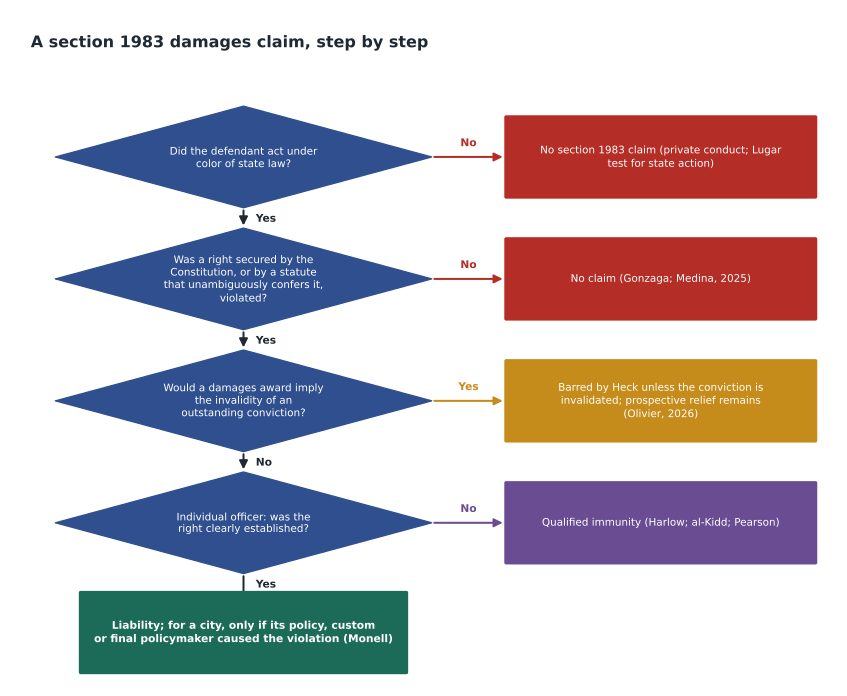
Section 1983 also reaches rights secured by federal "laws," not just the Constitution. Maine v. Thiboutot (1980) held that the statute allows suits to enforce federal statutory rights, such as rights under the Social Security Act. But Gonzaga University v. Doe (2002) held that only statutes that unambiguously confer individual rights, phrased in terms of the persons benefited rather than the obligations of the regulated party, are enforceable. Health and Hospital Corp. of Marion County v. Talevski (2023) held, seven to two in an opinion by Justice Jackson, that provisions of the Federal Nursing Home Reform Act protecting residents against unnecessary chemical restraints and improper transfers met that standard, rejecting the argument that statutes enacted under the Spending Clause can never be enforced through section 1983. Medina v. Planned Parenthood South Atlantic (2025) went the other way. In a six-to-three opinion by Justice Gorsuch, the Court held that the Medicaid Act's any-qualified-provider provision does not clearly and unambiguously confer an individual right enforceable under section 1983, and described Talevski as the atypical case. Justice Jackson, joined by Justices Sotomayor and Kagan, dissented.
Section 1983 has a boundary with habeas corpus. Preiser v. Rodriguez (1973) held that a prisoner challenging the fact or duration of his confinement must use habeas, with its exhaustion requirement, not section 1983. Heck v. Humphrey (1994) extended the idea to damages: a plaintiff may not recover damages under section 1983 for harm caused by actions whose unlawfulness would render a conviction or sentence invalid, unless the conviction has been reversed, expunged or otherwise invalidated. Olivier v. City of Brandon (2026) clarified the limits of Heck. Gabriel Olivier, a street preacher, was convicted in 2021 of violating a Mississippi city's ordinance confining demonstrators near an amphitheater to a protest area, and then sued to enjoin future enforcement. In March 2026 a unanimous Court, in an opinion by Justice Kagan, held that Heck does not bar suits seeking only prospective relief, even when the plaintiff was previously convicted under the challenged law. That holding matters for Bram Kessling, Vashti's neighbor, who pleaded guilty under the drone Act: Heck bars his damages claim while the conviction stands, but not a suit to stop future enforcement against him.
The most litigated defense in section 1983 cases is qualified immunity. The statute's text says nothing about immunity, but the Court has held that Congress legislated against a background of common law immunities it did not mean to abolish. Pierson v. Ray (1967) recognized a good faith defense for police officers. Harlow v. Fitzgerald (1982) reformulated it in purely objective terms: government officials performing discretionary functions are shielded from liability for civil damages insofar as their conduct does not violate clearly established statutory or constitutional rights of which a reasonable person would have known. Anderson v. Creighton (1987) required that the right be clearly established in a particularized sense, so that the contours of the right are sufficiently clear that a reasonable official would understand that what he is doing violates it. Ashcroft v. al-Kidd (2011) said that existing precedent must have placed the question beyond debate, so that every reasonable official would have understood the conduct was unlawful.
The Court has also managed the order of decision. Saucier v. Katz (2001) required courts to decide first whether the facts showed a constitutional violation and only then whether the right was clearly established, so that constitutional law would continue to develop. Pearson v. Callahan (2009) made that sequence optional, allowing courts to skip directly to the clearly established question. Critics argue that the combination produces constitutional stagnation: courts can grant immunity without ever deciding whether the conduct was unconstitutional, so the law never becomes clearly established for the next case. Defenders respond that qualified immunity protects officials from the burdens of litigation and from liability for split-second judgments in unsettled areas. The denial of qualified immunity on a question of law is immediately appealable under Mitchell v. Forsyth (1985), which gives individual defendants the same kind of interlocutory appeal that states have for sovereign immunity.
Clearly established law does not require a case directly on point. Hope v. Pelzer (2002) held that officials can be on notice that their conduct violates established law even in novel factual circumstances, where prison guards had handcuffed an inmate to a hitching post in the sun for hours. Taylor v. Riojas (2020) summarily reversed a grant of qualified immunity to prison officials who held an inmate for days in cells covered in human waste, because any reasonable officer should have realized the conditions were unconstitutional. But in Fourth Amendment excessive force cases, the Court has repeatedly emphasized specificity, as in Kisela v. Hughes (2018), where Justice Sotomayor's dissent called qualified immunity an absolute shield in practice. Justice Thomas has questioned the doctrine's historical basis in separate writings, and scholars such as William Baude have argued it is unlawful. Some states have responded by creating state-law causes of action against officers without qualified immunity, Colorado in 2020 and New Mexico in 2021 among them.
Priya Natarajan applies the doctrine to Trooper Garrity. Vashti alleges that the seizure of her drone violated the Fourth Amendment and that Garrity seized it in retaliation for her reporting, in violation of the First Amendment. On the Fourth Amendment claim, Garrity had probable cause to believe she had violated the Act, which no court had yet held unconstitutional. Michigan v. DeFillippo (1979) held that officers may generally rely on a presumptively valid statute; only a law so grossly and flagrantly unconstitutional that any reasonable person would see its flaws gives no protection. A new state drone law with a plausible safety rationale is not in that category, so Garrity likely receives qualified immunity on the Fourth Amendment claim. On retaliation, Nieves v. Bartlett (2019) held that probable cause generally defeats a retaliatory arrest claim, with a narrow exception where the plaintiff presents objective evidence that similarly situated people not engaged in protected speech were not arrested, and Gonzalez v. Trevino (2024) held that such evidence need not consist of comparisons to virtually identical people. Vashti would need evidence that Garrity ignored hobbyists flying in the same area.
Some officials receive absolute immunity based on the function they perform. Legislators acting in their legislative capacity are absolutely immune, as Tenney v. Brandhove (1951) and Bogan v. Scott-Harris (1998) held, so the Westmarch legislators who passed the Act cannot be sued for passing it. Judges are absolutely immune for judicial acts, even malicious ones, under Stump v. Sparkman (1978). Prosecutors are absolutely immune for conduct intimately associated with the judicial phase of the criminal process, such as deciding to charge and presenting the case, under Imbler v. Pachtman (1976), but only qualifiedly immune for investigative and administrative work, under Buckley v. Fitzsimmons (1993). Witnesses, including police officers, are absolutely immune for their testimony, under Briscoe v. LaHue (1983) and Rehberg v. Paulk (2012). Forrester v. White (1988) emphasized that immunity follows the function, not the office: a judge who fires a court employee acts administratively and gets only qualified immunity. County Attorney Crane is absolutely immune from damages for charging Kessling, though not from suits for prospective relief.
Private parties raise their own questions. A private party acts under color of state law only when the conduct is fairly attributable to the state, as when the private party acts jointly with state officials, performs a function traditionally and exclusively reserved to the state, or invokes state procedures with the aid of state officials, as Lugar v. Edmondson Oil Co. (1982) held for prejudgment attachment. Private parties who act under color of law do not always get qualified immunity. Richardson v. McKnight (1997) denied it to guards employed by a private prison company operating for profit, while Filarsky v. Delia (2012) granted it to a private lawyer retained by a city to assist an internal investigation alongside government employees. The question in each case is whether the common law in 1871 extended immunity to people in that role and whether the purposes of immunity apply.
For federal officers, there is no section 1983. Bivens v. Six Unknown Named Agents of Federal Bureau of Narcotics (1971) recognized an implied damages action directly under the Fourth Amendment against federal narcotics agents who searched Webster Bivens's apartment and arrested him without a warrant. Davis v. Passman (1979) extended Bivens to a congressional staffer's claim of sex discrimination under the Fifth Amendment, and Carlson v. Green (1980) to a federal prisoner's claim of inadequate medical care under the Eighth Amendment. Those three cases are the only contexts in which the Court has recognized a Bivens remedy. Since 1980 it has refused every request to extend Bivens to a new context, and Ziglar v. Abbasi (2017) called expanding it a disfavored judicial activity, setting out a two-step inquiry: whether the case presents a new context meaningfully different from the three, and if so, whether special factors counsel hesitation in the absence of congressional action.
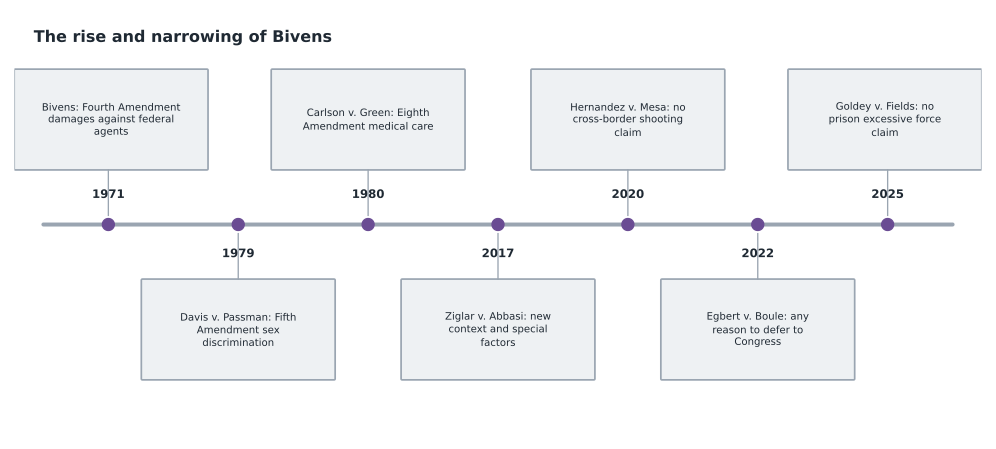
Egbert v. Boule (2022) all but closed the door. Robert Boule, who ran a bed and breakfast near the Canadian border in Washington State, alleged that a Border Patrol agent used excessive force against him on his property and then retaliated against him for complaining by reporting him to the IRS and other agencies. In a six-to-three opinion by Justice Thomas, the Court held that both claims failed. The two steps of Abbasi, it said, often resolve to a single question: whether there is any reason to think that Congress might be better equipped to create a damages remedy. If there is even one rational reason to defer to Congress, a court may not recognize a Bivens action. The existence of alternative remedial structures, such as an internal grievance process, independently forecloses a remedy even if the plaintiff considers them inadequate. The Court also held that there is no Bivens action for First Amendment retaliation. In Goldey v. Fields (2025), the Court summarily reversed a court of appeals that had recognized a Bivens claim for excessive force by federal prison officials.
Jordan Kimura notes the asymmetry. A person whose rights are violated by a state trooper has a statutory damages remedy under section 1983, subject to qualified immunity. A person whose rights are violated by a federal agent in the same way, outside the three Bivens contexts, generally has no damages remedy against the agent at all, and the Westfall Act makes the Federal Tort Claims Act the exclusive remedy for state-law torts by federal employees acting within the scope of their employment. The FTCA can provide a remedy against the United States for some torts, including law enforcement torts such as assault and false arrest under its law enforcement proviso, but it has its own exceptions and does not allow claims based directly on the Constitution. Sefton says that whether Congress should enact a statutory counterpart to section 1983 for federal officers is a recurring policy debate, and that bills to do so have been introduced but not enacted.
Sefton ends with remedies and procedure. Section 1983 borrows the forum state's statute of limitations for personal injury actions, as Owens v. Okure (1989) held, but federal law determines when the claim accrues, as Wallace v. Kato (2007) explained. Section 1988 allows prevailing plaintiffs to recover reasonable attorney's fees, which makes many civil rights suits economically possible. State courts have concurrent jurisdiction over section 1983 claims and may not refuse to hear them or burden them with state procedural rules, as Lesson 6 showed. "For Vashti," Sefton says, "the section 1983 analysis comes down to three claims. Prospective relief against Director Thorsby, which faces no immunity. Damages against Trooper Garrity, which face qualified immunity and probably lose on the Fourth Amendment theory. And claims against the City for its chief's directive, which face no qualified immunity but require proof that the policy itself was unconstitutional."
Worked problem
Who is liable under section 1983, and what defenses apply?
Vashti sues (1) Trooper Garrity for damages for seizing her drone; (2) the City of Brennan Falls for damages and an injunction based on the police chief's directive to seize drones near the water treatment plant; (3) County Attorney Crane for damages for threatening to charge her; and (4) the legislators who sponsored the Act. Bram Kessling, who pleaded guilty, sues the County Attorney for damages and an injunction against future prosecution. Analyze each claim.
Show solution
- Garrity: individual capacity damages are available under section 1983 (Hafer), but qualified immunity likely bars the Fourth Amendment claim because he relied on a presumptively valid statute (DeFillippo). The retaliation claim requires evidence of selective enforcement under Nieves and Gonzalez v. Trevino.
- City: the chief's written directive is official policy under Monell and Pembaur, so the City answers for any violation it causes. The City has no qualified immunity (Owen) and cannot be liable for punitive damages (Fact Concerts). Monell applies to the injunction claim too (Humphries).
- County Attorney: a threat to charge is closely tied to the decision to prosecute, a core advocacy function, so absolute prosecutorial immunity likely bars damages (Imbler), though investigative acts would get only qualified immunity (Buckley).
- Legislators: absolute legislative immunity bars any claim based on enacting the Act (Bogan).
- Kessling: Heck bars damages that would imply the invalidity of his standing conviction, but under Olivier v. City of Brandon (2026) he may seek purely prospective relief against future enforcement.
Practice problems
Work each problem on paper first, then reveal the answer to check.
What did Monell hold about municipal liability under section 1983?
Show answer
Municipalities are persons who may be sued, but only for violations caused by their own official policy or custom, not vicariously for employees' torts.
How did Medina v. Planned Parenthood South Atlantic (2025) differ from Talevski (2023)?
Show answer
Talevski found nursing home residents' rights under the Federal Nursing Home Reform Act enforceable under section 1983; Medina held the Medicaid any-qualified-provider provision does not clearly and unambiguously confer an enforceable individual right, calling Talevski atypical.
What did Olivier v. City of Brandon (2026) hold about Heck v. Humphrey?
Show answer
That Heck does not bar a section 1983 suit seeking only prospective relief against future enforcement of a law, even if the plaintiff was previously convicted under it.
What single question did Egbert v. Boule say often resolves a Bivens claim?
Show answer
Whether there is any reason to think Congress might be better equipped than the courts to create a damages remedy.
Summary and key terms
- Section 1983 provides a cause of action against persons acting under color of state law for violations of federal rights; it requires no exhaustion of state remedies (Monroe; Patsy).
- Municipalities are liable only for their own policies, customs, final policymaker decisions or deliberately indifferent failures to train (Monell; Pembaur; Canton; Connick), without qualified immunity (Owen).
- Statutory rights are enforceable only if unambiguously conferred (Gonzaga; Talevski, 2023; Medina, 2025).
- Heck bars damages that would imply an invalid conviction, but not purely prospective relief (Olivier, 2026).
- Qualified immunity protects officials unless they violated clearly established law (Harlow; al-Kidd); courts may decide the prongs in either order (Pearson).
- Legislators, judges, prosecutors acting as advocates and witnesses have absolute immunity based on function.
- Bivens remedies exist only in three contexts, and the Court refuses to extend them (Abbasi; Hernandez; Egbert; Goldey).
Lesson quiz · 5 questions
Score 60% or more to complete this lesson.
Create a free account to save your progress, take quizzes and earn a certificate.