
LAWU-301 · Lesson 10 of 12 · 26 min
Habeas corpus
▶ Video coming soon A video version of this lesson is on the way.
For this class Sefton sets the Marchbank file aside and opens a second one, drawn, she says, from the kind of case she litigated for seven years in a federal defender's capital habeas unit, although this one is not capital and all its people are fictional. In 2019 a jury in Merrin County convicted Lowell Tremont of arson for setting fire to an electrical substation, a fire that cut power to four thousand homes during a February cold snap. The State's case rested largely on footage from a drone flown by a state utility contractor, which an analyst testified showed a man of Tremont's build and gait leaving the scene, and on testimony from a cellmate. Tremont was sentenced to eighteen years. The Westmarch Supreme Court affirmed in March 2021, he did not seek certiorari, state post-conviction proceedings ended in September 2025, and he filed a federal habeas petition in the District of Westmarch in December 2025. "Today," she says, "we learn why most federal habeas petitions fail, and how the few that succeed get through."
The writ of habeas corpus is older than the Constitution. It commands a custodian to produce a prisoner and justify the detention, and it was the principal protection against unlawful executive imprisonment in English law. The Suspension Clause, Article I, section 9, provides that the privilege of the writ shall not be suspended unless when in cases of rebellion or invasion the public safety may require it. Section 14 of the Judiciary Act of 1789 gave federal courts power to issue the writ to federal prisoners. The great expansion came with the Habeas Corpus Act of 1867, passed during Reconstruction, which authorized federal courts to grant the writ to anyone, including state prisoners, held in custody in violation of the Constitution or laws of the United States. That statute, now 28 U.S.C. sections 2241 and 2254, is the basis of federal collateral review of state criminal convictions, one of the most contentious subjects in federal courts law.
For most of the nineteenth century, habeas review of state convictions was limited to whether the convicting court had jurisdiction. In the twentieth century the Court gradually expanded it. Moore v. Dempsey (1923) allowed federal inquiry into whether a mob-dominated trial of Black defendants in Arkansas had denied due process. Brown v. Allen (1953) held that state prisoners could relitigate in federal habeas federal constitutional claims that state courts had rejected on the merits. Fay v. Noia (1963) held that a prisoner who failed to raise a claim in state court could still raise it in federal court unless he had deliberately bypassed the state procedure. The Warren Court's expansion of criminal procedure rights, combined with broad habeas review, made federal district courts a second forum for reviewing state convictions, which state officials and many judges regarded as a serious affront to state courts and to the finality of criminal judgments.
The Burger and Rehnquist Courts pulled back. Stone v. Powell (1976) held that where the state has provided an opportunity for full and fair litigation of a Fourth Amendment claim, a state prisoner may not be granted federal habeas relief on the ground that evidence from an unconstitutional search was admitted at trial. Wainwright v. Sykes (1977) replaced Fay's deliberate bypass standard with a requirement that a prisoner who defaulted a claim under a state procedural rule show cause for the default and prejudice from it. Teague v. Lane (1989) held that new constitutional rules of criminal procedure generally do not apply retroactively on federal habeas to convictions already final when the rule was announced. Teague's exception for watershed rules of criminal procedure was abolished in Edwards v. Vannoy (2021), which held that the unanimous jury rule of Ramos v. Louisiana (2020) does not apply retroactively on federal collateral review and that no new procedural rule will qualify in the future.
Congress then enacted the Antiterrorism and Effective Death Penalty Act of 1996, known as AEDPA, which governs every petition filed since. Its central provision, 28 U.S.C. section 2254(d), provides that a federal court may not grant habeas relief on any claim that was adjudicated on the merits in state court unless the state decision was contrary to, or involved an unreasonable application of, clearly established federal law as determined by the Supreme Court, or was based on an unreasonable determination of the facts in light of the evidence presented in the state proceeding. AEDPA also imposed a one-year statute of limitations, strengthened the exhaustion requirement, limited evidentiary hearings and sharply restricted second or successive petitions. Felker v. Turpin (1996) upheld the successive petition limits against a Suspension Clause challenge, and the statute's structure has shaped every habeas decision since.
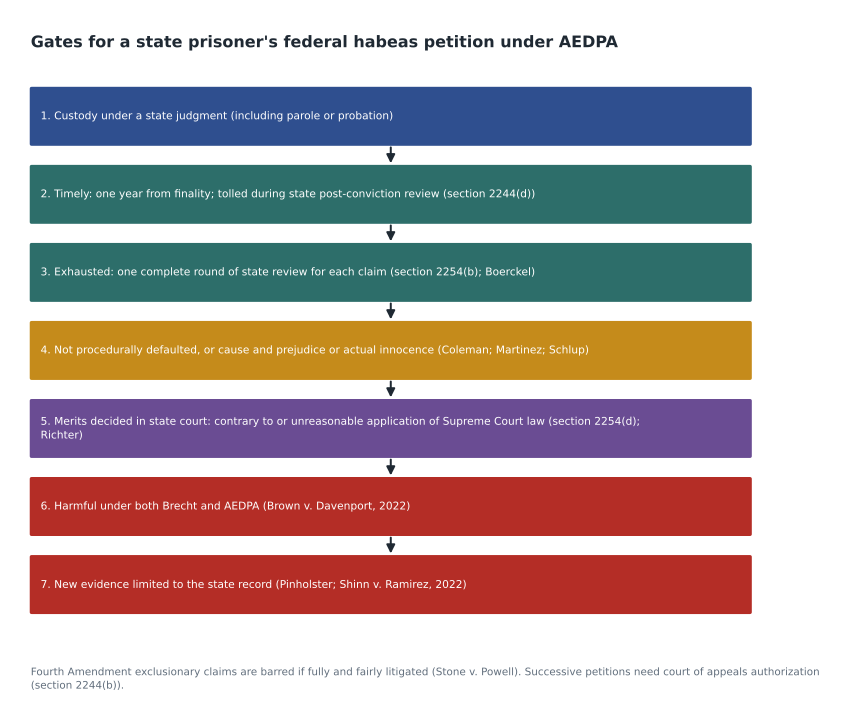
The limitations period comes first. Under section 2244(d)(1), the one-year clock usually runs from the date the state judgment became final by the conclusion of direct review or the expiration of time to seek it. Tremont's conviction became final in June 2021, ninety days after the Westmarch Supreme Court's March decision, when his time to petition for certiorari expired. Section 2244(d)(2) tolls the clock while a properly filed application for state post-conviction review is pending. Tremont filed his state petition in February 2022, about eight months into his year, and the clock stopped until the Westmarch Supreme Court denied review in September 2025. He then had roughly four months left, and his December 2025 filing was timely. Holland v. Florida (2010) recognized equitable tolling where a prisoner shows diligence and extraordinary circumstances, and McQuiggin v. Perkins (2013) held that a convincing showing of actual innocence can overcome the time bar, though the standard is demanding.
Exhaustion comes next. Section 2254(b) requires that a state prisoner first give the state courts a full opportunity to resolve each federal claim. O'Sullivan v. Boerckel (1999) held that this means one complete round of the state's established appellate review process, including a petition for discretionary review to the state supreme court when that is part of the ordinary process. Rose v. Lundy (1982) required dismissal of mixed petitions containing exhausted and unexhausted claims, and Rhines v. Weber (2005) allowed district courts, in limited circumstances where there is good cause and the unexhausted claims are potentially meritorious, to stay a mixed petition while the prisoner returns to state court. Tremont's lawyer learned in 2026 that the drone contractor's internal emails questioned whether the footage could identify anyone. A claim that the prosecution suppressed those emails, in violation of Brady v. Maryland, has never been presented to the Westmarch courts, so it is unexhausted, and a Rhines stay may be needed while he presents it there.
Procedural default is the related doctrine with harsher consequences. When a state court refuses to hear a federal claim because the prisoner failed to comply with an adequate and independent state procedural rule, the federal court may not hear it either, unless the prisoner shows cause for the default and actual prejudice, or that failure to hear the claim would result in a fundamental miscarriage of justice. Coleman v. Thompson (1991) opened with the sentence "This is a case about federalism" and held that a prisoner whose state post-conviction appeal was filed three days late had defaulted all his claims. Murray v. Carrier (1986) held that ineffective assistance of counsel can be cause, but only if it rises to a constitutional violation, and because there is no constitutional right to counsel in state post-conviction proceedings, a post-conviction lawyer's errors generally cannot be cause. The miscarriage of justice exception requires a showing, under Schlup v. Delo (1995), that it is more likely than not that no reasonable juror would have convicted in light of new reliable evidence. House v. Bell (2006) is a rare case where that standard was met.
Martinez v. Ryan (2012) created a narrow exception. Where state law requires that claims of ineffective assistance of trial counsel be raised for the first time in state post-conviction proceedings, a prisoner may show cause for defaulting such a claim if his post-conviction counsel was ineffective or he had no counsel, and the underlying claim is substantial. Trevino v. Thaler (2013) extended the exception to states whose procedures make it virtually impossible to raise the claim on direct appeal. Westmarch, in Sefton's hypothetical, requires trial ineffectiveness claims to be raised in post-conviction proceedings. Tremont's post-conviction lawyer never argued that trial counsel was ineffective for failing to consult a video expert who could have challenged the drone footage. Under Martinez, Tremont can try to establish cause for that default by showing his post-conviction lawyer's omission was itself ineffective and the trial claim is substantial.
Shinn v. Ramirez (2022) sharply limited what Martinez can accomplish. Two Arizona prisoners on death row, David Ramirez and Barry Jones, obtained federal evidentiary hearings to develop the factual basis for their defaulted trial ineffectiveness claims, and Jones won relief. The Supreme Court reversed, six to three, in an opinion by Justice Thomas. Section 2254(e)(2) bars a federal evidentiary hearing on a claim whose factual basis the prisoner "failed to develop" in state court, unless narrow exceptions apply, and under Coleman a prisoner bears the responsibility for his post-conviction counsel's failures. Martinez can excuse the procedural default, the Court held, but it cannot excuse the failure to develop the facts, so a federal court may not consider evidence beyond the state record to decide the merits of the claim. Justice Sotomayor's dissent said the decision made Martinez's promise illusory. For Tremont, whose claim depends entirely on a video expert who never testified in state court, Shinn is a serious obstacle: he may be able to show cause, but he may be unable to prove the claim.
Claims the state court decided on the merits face section 2254(d). Williams v. Taylor (2000) explained that a decision is contrary to clearly established law if it applies a rule that contradicts Supreme Court precedent or reaches a different result on materially indistinguishable facts, and it involves an unreasonable application if it identifies the correct rule but applies it unreasonably to the facts. Unreasonable means more than incorrect. Harrington v. Richter (2011) held that a state court's ruling must be so lacking in justification that there was an error well understood and comprehended in existing law beyond any possibility for fairminded disagreement, and that section 2254(d) applies even when the state court denied relief without explanation. Clearly established federal law means the holdings, not dicta, of the Supreme Court as of the time of the state decision. Cullen v. Pinholster (2011) held that review under section 2254(d)(1) is limited to the record before the state court, and Wilson v. Sellers (2018) told federal courts to look through an unexplained higher court decision to the last reasoned state decision.
Tremont's strongest preserved claim is that admitting the drone analyst's report without allowing him to cross-examine its author violated the Confrontation Clause. The Westmarch Supreme Court rejected the claim on the merits, reasoning that the report was not testimonial. Priya Natarajan points to Smith v. Arizona (2024), which held that when an expert conveys an absent analyst's statements in support of the expert's opinion, and the statements provide that support only if true, the statements are offered for their truth. But Smith was decided in 2024, after the Westmarch Supreme Court's 2021 decision, so it was not clearly established law at the relevant time, and under Teague it is unclear whether it announced a new rule. Tremont must show that the state court unreasonably applied the law as it stood in 2021, under Crawford v. Washington, Melendez-Diaz v. Massachusetts and Bullcoming v. New Mexico, beyond any possibility of fairminded disagreement. That is a hard showing, and the class concludes it probably fails.
Even a constitutional error requires relief only if it was harmful. Brecht v. Abrahamson (1993) held that on collateral review, an error is harmless unless it had a substantial and injurious effect or influence in determining the jury's verdict. Brown v. Davenport (2022) held, six to three in an opinion by Justice Gorsuch, that when a state court has found an error harmless under the Chapman standard on direct review, a federal habeas court must find both that the error was harmful under Brecht and that the state court's harmlessness ruling was unreasonable under AEDPA; satisfying Brecht alone is not enough. Ervine Davenport had been shackled at trial without justification, and the state courts had found the error harmless. The Sixth Circuit's grant of relief was reversed. Tremont's Fourth Amendment claim, finally, that the contractor's drone surveillance was an unreasonable search, is barred outright by Stone v. Powell, because he had a full and fair opportunity to litigate it in a pretrial suppression motion.
AEDPA's limits on second or successive petitions are strict. Under section 2244(b)(1), a claim presented in a prior petition must be dismissed. Under section 2244(b)(2), a new claim must be dismissed unless it relies on a new rule of constitutional law made retroactive by the Supreme Court, or on facts that could not have been discovered earlier through due diligence and that would establish by clear and convincing evidence that no reasonable factfinder would have found the prisoner guilty. A prisoner must obtain authorization from a court of appeals before filing, and under section 2244(b)(3)(E) the grant or denial of authorization is not appealable and cannot be the subject of a petition for certiorari. Banister v. Davis (2020) held that a timely Rule 59(e) motion to alter the judgment is part of the first habeas proceeding, not a successive petition. Rivers v. Guerrero (2025) held, unanimously in an opinion by Justice Jackson, that a second filing made after the district court's judgment, while an appeal is pending, is a successive petition subject to section 2244(b).
Federal prisoners proceed differently. Instead of habeas under section 2254, they file a motion to vacate the sentence in the sentencing court under 28 U.S.C. section 2255, which has its own one-year limit and its own restrictions on second or successive motions incorporated by reference to section 2244. Jones v. Hendrix (2023) held, six to three, that the saving clause in section 2255(e), which allows resort to traditional habeas under section 2241 when the section 2255 remedy is inadequate or ineffective, does not permit a federal prisoner to bring a claim based on a later statutory interpretation decision that the successive motion limits bar. Bowe v. United States (2026), decided five to four in January 2026 in an opinion by Justice Sotomayor, held that section 2244(b)(3)(E)'s bar on certiorari review of authorization decisions does not apply to federal prisoners seeking to file successive section 2255 motions, and that section 2244(b)(1)'s bar on repeating claims applies only to state prisoners' section 2254 petitions. Justice Gorsuch dissented, joined by Justices Thomas and Alito and in part by Justice Barrett.
Habeas also remains the core remedy against executive detention without trial, the use that the Suspension Clause most clearly protects. Rasul v. Bush (2004) held that the habeas statute reached detainees at Guantanamo Bay, and Boumediene v. Bush (2008) held that the Suspension Clause itself does. INS v. St. Cyr (2001) held that immigration statutes did not clearly strip habeas jurisdiction over questions of law. DHS v. Thuraissigiam (2020) held that the Suspension Clause did not entitle an asylum seeker in expedited removal to use habeas to obtain additional administrative review, because the historic writ sought release from custody, not permission to remain. In Trump v. J.G.G. (2025), the Court held, five to four in a per curiam order, that detainees challenging their removal under the Alien Enemies Act must proceed by habeas in the district of confinement, while emphasizing that they are entitled to notice and an opportunity to seek habeas relief before removal. Jordan Kimura notes that the oldest function of the writ, testing executive detention, has been more prominent in the last few years than at any time since Guantanamo.
Sefton closes with the outlook for Tremont. His Fourth Amendment claim is barred by Stone. His Confrontation Clause claim faces section 2254(d) and probably fails because Smith postdates the state decision. His ineffective assistance claim may get past procedural default under Martinez, but Shinn likely confines the federal court to a state record that contains no expert evidence. His Brady claim, based on the newly discovered emails, is the most promising: it must first be exhausted in state court, and Westmarch's post-conviction rules will determine whether a new petition is allowed. If the state court rejects it on the merits, section 2254(d) will apply; if on procedural grounds, the cause for the default may be the suppression itself, as in Banks v. Dretke (2004). "Habeas is not a second appeal," Sefton says. "It is a narrow gate built to protect state judgments. Your job is to find the claim that fits through it."
Worked problem
Working Tremont's petition
Tremont's federal petition (filed December 2025) raises four claims: (1) Confrontation Clause, rejected on the merits by the Westmarch Supreme Court in 2021; (2) ineffective assistance of trial counsel for failing to consult a video expert, never raised in state post-conviction proceedings; (3) a Fourth Amendment challenge to the drone surveillance, litigated in a pretrial suppression hearing; (4) a Brady claim based on contractor emails discovered in 2026, never presented to the state courts. Evaluate each.
Show solution
- Timeliness: conviction final June 2021; about eight months ran before the February 2022 state filing; tolled until September 2025; about four months remained, so December 2025 is timely.
- Claim 1: adjudicated on the merits, so section 2254(d) applies. Smith v. Arizona (2024) postdates the state decision and is not clearly established law for it; Tremont must show an unreasonable application of earlier precedent beyond fairminded disagreement (Richter). Likely denied.
- Claim 2: procedurally defaulted. Martinez may supply cause if post-conviction counsel was ineffective and the claim is substantial, but Shinn v. Ramirez bars a federal evidentiary hearing to develop the expert evidence, so the claim may fail on the state record.
- Claim 3: barred by Stone v. Powell, because he had a full and fair opportunity to litigate it in state court.
- Claim 4: unexhausted. The petition is mixed; the court should consider a Rhines stay (good cause: the emails were suppressed; potentially meritorious; no dilatory tactics) while he presents the claim in state court. If the claim is added later, timeliness may run from discovery of the facts under section 2244(d)(1)(D).
Practice problems
Work each problem on paper first, then reveal the answer to check.
What did Shinn v. Ramirez (2022) hold?
Show answer
That section 2254(e)(2) bars a federal court from holding an evidentiary hearing or considering evidence beyond the state record on a defaulted ineffective assistance claim, even when Martinez excuses the default, because the prisoner bears responsibility for post-conviction counsel's failure to develop the facts.
What must a habeas petitioner show under Brown v. Davenport when the state court found an error harmless?
Show answer
Both that the error had a substantial and injurious effect under Brecht and that the state court's harmlessness determination was unreasonable under AEDPA.
Why is a Fourth Amendment exclusionary rule claim usually not cognizable on federal habeas?
Show answer
Stone v. Powell (1976) bars relief when the state provided an opportunity for full and fair litigation of the claim.
What did Bowe v. United States (2026) hold?
Show answer
That the certiorari bar in section 2244(b)(3)(E) and the same-claim bar in section 2244(b)(1) apply to state prisoners' section 2254 petitions, not to federal prisoners' section 2255 motions.
Summary and key terms
- The 1867 Act extended habeas to state prisoners in custody in violation of federal law; the Suspension Clause protects the writ.
- Stone v. Powell bars Fourth Amendment exclusionary claims; Teague limits retroactivity, and Edwards v. Vannoy abolished the watershed exception.
- AEDPA imposes a one-year limit with statutory tolling, exhaustion, deference under section 2254(d), limits on new evidence and successive petition restrictions.
- Procedural default requires cause and prejudice or actual innocence (Coleman; Schlup); Martinez can supply cause for defaulted trial ineffectiveness claims, but Shinn bars new evidence.
- Section 2254(d) requires error beyond fairminded disagreement (Richter), judged on the state record (Pinholster) and Supreme Court holdings at the time.
- Habeas relief requires harm under both Brecht and AEDPA (Brown v. Davenport).
- Successive petitions are tightly limited (Felker; Banister; Rivers, 2025); federal prisoners use section 2255 (Jones v. Hendrix; Bowe, 2026).
- Habeas remains the core remedy against executive detention (Boumediene; Thuraissigiam; Trump v. J.G.G., 2025).
Lesson quiz · 5 questions
Score 60% or more to complete this lesson.
Create a free account to save your progress, take quizzes and earn a certificate.