
LAWU-301 · Lesson 3 of 12 · 24 min
Ripeness, mootness and political questions
▶ Video coming soon A video version of this lesson is on the way.
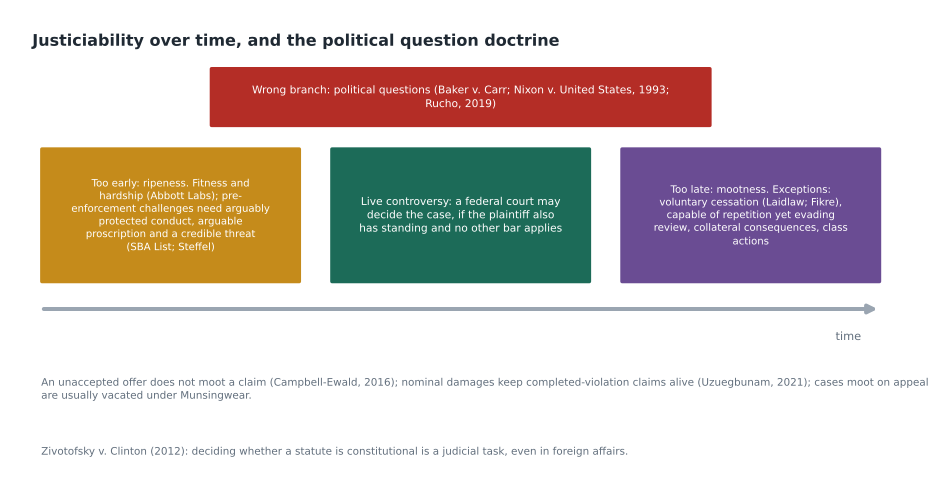
Sefton draws a horizontal line across the board and labels it "time." At the left end she writes "too early," at the right end "too late," and in the middle "live controversy." Above the line, floating free, she writes "wrong branch." "Standing asked whether this plaintiff is the right one," she says. "Today we ask whether this is the right moment, and whether this is a question for judges at all. Ripeness polices the left end of the line, mootness the right end, and the political question doctrine asks whether the Constitution has given the question to someone else." The Henry Monaghan formulation the class read for today describes mootness as "the doctrine of standing set in a time frame": the requisite personal interest that must exist at the start of the litigation must continue throughout its existence. Ripeness is the mirror image.
Federal courts do not give advisory opinions. In 1793, Secretary of State Thomas Jefferson, on behalf of President Washington, asked the Justices a series of questions about the treaties with France and Britain. The Justices declined, citing the separation of powers and their role as a court of last resort. Muskrat v. United States (1911) applied the principle to a statute that authorized certain Cherokee allottees to sue the United States to test the constitutionality of later legislation; the Court held there was no genuine adverse controversy, only a request for a ruling on a statute's validity. The same concern underlies the rule against collusive suits, as in United States v. Johnson (1943), where the nominal plaintiff in a rent control challenge was recruited and paid by the defendant landlord. Ripeness, mootness and the political question doctrine are all applications of the idea that federal courts decide disputes, not abstract legal questions.
Ripeness asks whether a dispute has matured enough for decision. Abbott Laboratories v. Gardner (1967), which Section B met in Administrative Law, set the two-part framework: the fitness of the issues for judicial decision, and the hardship to the parties of withholding court consideration. A purely legal challenge to a final regulation that forces regulated parties to choose between costly compliance and the risk of serious penalties is ripe. By contrast, Texas v. United States (1998) held unripe a challenge that rested on contingent future events that might not occur as anticipated, or at all. Poe v. Ullman (1961) refused to hear a challenge to Connecticut's contraceptive ban because the law had gone essentially unenforced for decades, so there was no realistic threat. The question for Vashti is which side of those lines she falls on.
The Court's modern approach to pre-enforcement challenges merges ripeness with standing. Susan B. Anthony List v. Driehaus (2014) involved an Ohio law criminalizing false statements about candidates. After the advocacy group was the subject of a complaint before the state elections commission for planning a billboard, it sued in federal court. A unanimous Court, in an opinion by Justice Thomas, held that a plaintiff may bring a pre-enforcement challenge when it alleges an intention to engage in a course of conduct arguably affected with a constitutional interest, the conduct is arguably proscribed by the statute, and there is a credible threat of prosecution. The formulation came from Babbitt v. United Farm Workers (1979). Past enforcement against the same conduct is good evidence of a credible threat, as is a law that allows anyone to file a complaint. The Court also noted that the so-called prudential ripeness factors sit in some tension with the principle that a federal court's obligation to hear cases within its jurisdiction is virtually unflagging.
Steffel v. Thompson (1974) supplies the reason the doctrine exists. Richard Steffel was twice warned by police to stop distributing handbills against the Vietnam War at a shopping center and was told he would be arrested if he returned; his companion was arrested and prosecuted. The Court held that he could seek a declaratory judgment in federal court without first exposing himself to arrest. "It is not necessary that petitioner first expose himself to actual arrest or prosecution to be entitled to challenge a statute that he claims deters the exercise of his constitutional rights," the Court explained. MedImmune v. Genentech (2007) applied the same idea outside criminal law: a patent licensee need not stop paying royalties and risk an infringement suit before challenging the patent's validity. The common thread is that the law does not force a person to break the law to test it.
Applied to the Marchbank file, the analysis is favorable. Vashti intends to fly her drone near Harlan Creek to gather news, conduct arguably affected with a First Amendment interest. The Act arguably proscribes the flights, since the prison is a covered facility and she has no permit. And the threat is credible: Trooper Garrity seized her drone and told her she would be charged, and the Merrin County Attorney, Felicity Crane, charged her neighbor Bram Kessling under the same provision in September 2026. Sefton contrasts a weaker plaintiff: a hobbyist two counties away who has no plans to fly near a covered facility and has never been warned. His challenge is unripe and his injury is not imminent. The Westmarch Attorney General's office, Sefton notes from experience, often answers such suits by disavowing enforcement against the plaintiff, which can defeat credibility of the threat if the disavowal is binding and specific.
The Court applied a similar present-injury approach to investigative demands in First Choice Women's Resource Centers v. Davenport (2026), a case filed as First Choice v. Platkin before New Jersey's attorney general changed. The state attorney general issued a subpoena demanding donor information from a faith-based pregnancy center network, and the network sued in federal court, claiming the demand chilled its supporters' freedom of association. The lower courts held the federal suit premature because no state court had yet ordered compliance. In April 2026, the Supreme Court unanimously reversed in an opinion by Justice Gorsuch. The Court held that a subpoena commanding production of sensitive donor information, backed by the threat of enforcement, inflicted a present injury on First Amendment association rights, enough for Article III, even though it was not self-executing. The decision addressed only justiciability; whether the subpoena was valid was left for further proceedings.
Mootness asks the opposite question. A case becomes moot when the issues are no longer live or the parties lack a legally cognizable interest in the outcome. DeFunis v. Odegaard (1974) dismissed as moot a challenge to a law school's admissions policy because the plaintiff, admitted under a court order, was about to graduate. New York State Rifle and Pistol Association v. City of New York (2020) dismissed a challenge to a city rule on transporting handguns after the city and state changed the law to give the plaintiffs the relief they sought. When a case becomes moot on appeal through no fault of the losing party, the usual practice under United States v. Munsingwear (1950) is to vacate the lower court judgment so that it has no preclusive effect. Acheson Hotels v. Laufer (2023), a case about whether a disability rights tester had standing, ended that way after the plaintiff voluntarily dismissed her underlying suits.
There are four principal exceptions to mootness. First, voluntary cessation: a defendant cannot automatically moot a case by stopping the challenged conduct, because it could resume once the case is dismissed. The defendant bears the formidable burden of showing that it is absolutely clear the conduct could not reasonably be expected to recur, as Friends of the Earth v. Laidlaw Environmental Services (2000) held. Already, LLC v. Nike (2013) found that burden met by an unconditional and irrevocable covenant not to sue. FBI v. Fikre (2024) held, unanimously, that the government's removal of a man from the No Fly List and its declaration that he would not be relisted on the current record did not moot his challenge, because it did not foreclose relisting for the same past conduct. West Virginia v. EPA (2022) applied the same principle to an agency that said it would write a new rule rather than revive the vacated one: the government's announced intention did not moot review.
Second, wrongs capable of repetition yet evading review. The doctrine, which traces to Southern Pacific Terminal Co. v. ICC (1911), applies when the challenged action is too short in duration to be fully litigated before it ends and there is a reasonable expectation that the same complaining party will be subjected to it again, as Weinstein v. Bradford (1975) framed the test. Roe v. Wade (1973) invoked it for pregnancy, and election cases invoke it regularly. Third, collateral consequences: a criminal defendant's challenge to a conviction survives completion of the sentence because convictions carry lasting legal consequences, as Sibron v. New York (1968) held. Fourth, class actions: when a class has been certified, the named plaintiff's claim may become moot without mooting the class's claims, as Sosna v. Iowa (1975) held, and United States Parole Commission v. Geraghty (1980) allowed a named plaintiff to appeal the denial of class certification after his own claim expired.
Defendants sometimes try to moot cases by paying the plaintiff. Campbell-Ewald Co. v. Gomez (2016) held that an unaccepted offer of complete relief under Rule 68 does not moot a plaintiff's claim, because an unaccepted offer is a legal nullity. The Court left open what happens if the defendant actually pays complete relief into an account for the plaintiff. Genesis HealthCare Corp. v. Symczyk (2013) had earlier held, on assumptions the parties conceded, that a collective action under the Fair Labor Standards Act became moot when the named plaintiff's individual claim did. Nominal damages also matter here. Uzuegbunam v. Preczewski (2021) held that a request for nominal damages for a completed constitutional violation keeps a case alive even after the challenged policy is repealed. Vashti's complaint should therefore ask for nominal damages as well as compensatory damages and an injunction.
Marcus Webb works through two mootness scenarios. Suppose that in early 2027 Westmarch amends the Act to exempt credentialed journalists. If the exemption clearly covers Vashti, her claims for prospective relief against the old law are likely moot, as in the New York rifle case, though her damages claims for the August 2026 seizure remain. Suppose instead that Director Thorsby issues a memorandum saying the State Patrol will not enforce the Act against journalists while the litigation is pending. That is voluntary cessation by a government official, revocable at will and tied to the litigation, and under Laidlaw and Fikre it almost certainly does not moot the case. Sefton adds that some lower courts give government defendants more benefit of the doubt than private ones when they change policy, but a litigation-driven memorandum is the weakest kind of change.
The political question doctrine is different in kind. It does not ask whether this plaintiff or this moment is right; it asks whether the question is one the Constitution assigns to the political branches or that courts lack the tools to resolve. Baker v. Carr (1962), which held legislative malapportionment claims justiciable under the Equal Protection Clause, listed six indicators, the most important being a textually demonstrable constitutional commitment of the issue to a coordinate political department and a lack of judicially discoverable and manageable standards for resolving it. Older cases, such as Luther v. Borden (1849), treated claims under the Guarantee Clause, which promises each state a republican form of government, as political questions. Nixon v. United States (1993) held that a federal judge's challenge to the Senate's use of a committee to take evidence in his impeachment trial was nonjusticiable, because the Constitution gives the Senate the "sole Power to try" impeachments.
The modern Court invokes the doctrine sparingly. Zivotofsky v. Clinton (2012) held that a challenge to the State Department's refusal to record "Israel" as the birthplace on passports of Americans born in Jerusalem, as a statute required, was justiciable: the courts were asked to decide whether the statute was constitutional, a familiar judicial task, not to decide the political status of Jerusalem. Powell v. McCormack (1969) held justiciable a challenge to the House's exclusion of a member who met the constitutional qualifications. The great modern example of nonjusticiability is Rucho v. Common Cause (2019). The Court held, five to four in an opinion by Chief Justice Roberts, that claims of excessive partisan gerrymandering present political questions beyond the reach of federal courts, because there is no judicially manageable standard for deciding how much partisanship is too much. Justice Kagan's dissent argued that lower courts had developed workable standards. Rucho left state courts and state constitutions free to address the issue, and several have.
Priya Natarajan asks whether anything in the Marchbank file raises a political question. Sefton thinks not. First Amendment and preemption claims are standard judicial fare, and the Act's text supplies standards. But she gives the class a variation. Friends of Harlan Creek amends its complaint to add a claim that the Act, rushed through the Westmarch legislature in a late night session without committee hearings in violation of the state's own procedural rules, denies Westmarch citizens a republican form of government under the Guarantee Clause. That claim, she says, is a near-certain loser in federal court: Guarantee Clause claims have been treated as nonjusticiable since Luther, the Court has never squarely revived them, and claims that a state legislature broke its own internal rules are matters of state law for state courts. "Do not plead the claim that invites the court to say no to everything," she says.
Sefton closes with the litigator's lesson. Justiciability defects are easy to raise and expensive to cure. Defendants raise them in a motion to dismiss under Rule 12(b)(1), and courts must consider them on their own even if no one raises them. Plaintiffs' lawyers anticipate them by building a record: dated plans, warnings, enforcement against others, evidence of chill, and requests for every form of relief that will keep the case alive. Government lawyers, she says from her years in the Attorney General's office, should think hard before trying to moot a case by a tactical policy change, because courts are suspicious and a binding change of law may give the plaintiff most of what she wanted anyway. The final word belongs to timing. A good case filed too soon or too late is no case at all.
Worked problem
Is Vashti's challenge ripe, and will it stay live?
Vashti files in the District of Westmarch on October 1, 2026, seeking a declaration that the Act violates the First Amendment, an injunction against its enforcement against her, compensatory damages of 1,800 dollars for the drone and nominal damages. On November 2, 2026, the State Patrol returns her drone. On November 10, Director Thorsby announces that the State Patrol will not enforce the Act against "bona fide journalists" pending further review. The State moves to dismiss for lack of jurisdiction. How should the court rule?
Show solution
- Ripeness on filing: under SBA List, she alleged a concrete intention to fly near Harlan Creek, conduct arguably protected by the First Amendment and arguably proscribed by the Act, and a credible threat shown by the seizure, the trooper's warning and the Kessling prosecution. Steffel confirms she need not violate the Act first. The challenge was ripe.
- Return of the drone: it eliminates the need for the property itself, but not the claim for compensatory damages for loss of use, if any, or the nominal damages claim, which under Uzuegbunam independently keeps the damages claim alive.
- The November 10 announcement: it is voluntary cessation by the defendant, revocable at will, limited to a pending review and silent about prosecutions by county attorneys, who are not bound by it. Under Laidlaw and Fikre, it is not absolutely clear that enforcement could not reasonably be expected to recur, so the prospective claims are not moot.
- The motion should be denied. If the legislature later amends the Act in a way that clearly protects her, the prospective claims may then become moot, and the court would address Munsingwear vacatur only if the case were on appeal.
Practice problems
Work each problem on paper first, then reveal the answer to check.
What three things must a plaintiff allege under Susan B. Anthony List v. Driehaus to bring a pre-enforcement challenge?
Show answer
An intention to engage in a course of conduct arguably affected with a constitutional interest, that the conduct is arguably proscribed by the statute, and a credible threat of prosecution.
Why did FBI v. Fikre (2024) hold that removing the plaintiff from the No Fly List did not moot his case?
Show answer
The government's declaration did not foreclose relisting him for the same past conduct, so it was not absolutely clear the challenged conduct could not reasonably be expected to recur.
Does an unaccepted offer of complete relief moot a plaintiff's claim?
Show answer
No. Campbell-Ewald v. Gomez (2016) held that an unaccepted settlement offer or Rule 68 offer is a legal nullity that leaves the controversy live.
Why did Rucho v. Common Cause treat partisan gerrymandering claims as political questions?
Show answer
Because there is no judicially discoverable and manageable standard for deciding when partisanship in districting becomes unconstitutional.
Summary and key terms
- Federal courts do not issue advisory opinions or decide collusive suits (Correspondence of the Justices, Muskrat, Johnson).
- Ripeness weighs fitness and hardship (Abbott Labs); pre-enforcement challenges require arguably protected conduct, arguable proscription and a credible threat (SBA List; Steffel).
- First Choice v. Davenport (2026) held that an outstanding subpoena for sensitive donor information inflicted a present First Amendment injury.
- Mootness asks whether a live controversy continues; Munsingwear vacatur clears lower court judgments when a case becomes moot on appeal.
- Exceptions: voluntary cessation (Laidlaw; Fikre), capable of repetition yet evading review, collateral consequences and certified class actions.
- Unaccepted offers do not moot claims (Campbell-Ewald), and nominal damages keep completed-violation claims alive (Uzuegbunam).
- The political question doctrine applies where the issue is textually committed elsewhere or lacks manageable standards (Nixon v. United States; Rucho), but is used sparingly (Zivotofsky).
Lesson quiz · 5 questions
Score 60% or more to complete this lesson.
Create a free account to save your progress, take quizzes and earn a certificate.